


Forter is one of the biggest names in fraud prevention.
Their platform processes transactions for major retailers using a proprietary "global graph" of over 1 billion user profiles. But here's the catch: Forter isn't for everyone.
The average Forter customer pays around $81,788 per year according to Vendr data.
That's enterprise pricing. Plus, their blackbox AI model means you get decisions without explanations. Some businesses need more transparency.
Others need more affordable options. Some just want different features.
This guide breaks down 7 Forter alternatives that might fit your business better.
We've researched each platform's pricing, features, and real customer results to help you make an informed choice.
Editor’s note: Want to hear some sample AI support calls made for your Shopify store?
- Just paste your store URL
- Get sample calls in under 20 seconds (no email required)
- Listen to demo calls for my store
What to look for in a Forter alternative
Before diving into the options, let's clarify what matters when evaluating fraud prevention tools.
Core capabilities to prioritize:
- Real-time transaction monitoring - Fraud decisions need to happen in milliseconds, not minutes
- Machine learning models - Rule-based systems alone can't catch sophisticated fraud
- Chargeback protection - Some platforms guarantee against chargebacks; others don't
- Integration ease - Shopify, WooCommerce, and payment processor connections should be straightforward
Model transparency matters:
Whitebox AI shows you exactly why a transaction was flagged. Blackbox AI gives you a score without explanation.
Forter uses blackbox. If you need to explain decisions to customers or regulators, whitebox might work better.
Pricing accessibility:
Forter targets enterprise. The alternatives on this list range from $699/month (SEON) to custom enterprise pricing.
Match your budget to your transaction volume.
Industry fit:
Some tools specialize in eCommerce. Others focus on travel, gaming, or financial services. Pick one that understands your specific fraud patterns.
Quick comparison: 7 Forter alternatives at a glance
| Product | Best For | Starting Price | Key Feature | Chargeback Guarantee |
|---|---|---|---|---|
| SEON | Transparency & customization | $699/mo | Whitebox ML with 900+ signals | No |
| Signifyd | High-volume merchants | Contact sales | 100% chargeback guarantee | Yes |
| Riskified | eCommerce revenue optimization | Contact sales | Order approval guarantee | Yes |
| Kount | Enterprise businesses | Contact sales | 32B transaction database | Optional |
| Sift | Multi-vertical digital | Contact sales | 1T+ annual events processed | No |
| SHIELD | Mobile apps & gaming | Contact sales | Device intelligence | No |
| Accertify | Travel & ticketing | Contact sales | AmEx backing | Yes |
Now let's look at each option in detail.
The 7 best Forter alternatives
1. SEON

Best for: Mid-market businesses wanting transparent, customizable fraud prevention
SEON takes a different approach than Forter. Instead of blackbox decisions, they give you whitebox machine learning.
You can see exactly why a transaction was flagged. For fraud teams that need to explain decisions to customers or regulators, this matters.
The platform connects 900+ first-party data signals. This includes device fingerprinting, email lookups, IP analysis, and digital footprinting across social media.
They own and control this data rather than reselling stale third-party information.
Key features:
- 240+ pre-built rules plus unlimited custom rule creation
- 14-day average implementation time (compared to 4-6 months for competitors)
- Case management and AML compliance tools
- Identity verification with liveness detection
- PSD2 compliance built-in
Pricing:
| Plan | Monthly Price | Key Inclusions |
|---|---|---|
| Starter | $699/mo | 2,500 fraud checks, 10 users, 50 custom rules |
| Premium | Custom | Unlimited API calls, users, rules, plus AML compliance |
Customer results:
Revolut improved fraud detection accuracy by 200 basis points using SEON.
Lottoland achieved 32x ROI by reducing bonus abuse. NOTYD dropped fraudulent transactions by 87% within days of implementation.
Pros:
- Full transparency in decision-making
- Fast implementation
- Public pricing for entry tier
- Strong AML compliance features
Cons:
- No chargeback guarantee
- Premium pricing requires sales contact
2. Signifyd

Best for: High-volume merchants wanting complete chargeback protection
Signifyd was founded in 2011 by former PayPal developers Rajesh Ramanand and Michael Liberty.
They pioneered the 100% chargeback guarantee model. If Signifyd approves a transaction that later turns out to be fraudulent, they cover the loss.
Their Commerce Protection Platform spans four areas: fraud protection, abuse prevention, account protection, and payments optimization.
They protect over $200 billion in annual transaction volume across thousands of merchants.
Key features:
- 100% financial guarantee on approved orders
- Machine learning combined with human analyst review
- Protection against promo abuse, return abuse, and reseller abuse
- Account takeover prevention
- 3DS optimization for payment authentication
Notable clients: Samsung, Rite-Aid, Lacoste, Hot Topic
Pros:
- Complete chargeback protection removes financial risk
- Former PayPal leadership brings deep payments expertise
- Ranked #1 in Digital Commerce 360 Leading Vendors for 5 consecutive years
- Extensive merchant network improves detection accuracy
Cons:
- Blackbox model lacks transparency
- Can be overly conservative, leading to false positives
- Incentive structure may favor declining borderline transactions
Signifyd works best for established eCommerce businesses with consistent transaction volumes.
The guarantee model works in your favor when fraud rates are predictable.
3. Riskified

Best for: eCommerce merchants focused on maximizing order approval rates
Riskified flips the traditional fraud prevention script. Instead of focusing on blocking bad orders, they optimize for approving good ones.
Their AI analyzes 480+ data attributes per transaction to distinguish legitimate customers from fraudsters.
An independent Forrester TEI study found Riskified delivers 594% ROI over three years.
The platform increases approval rates by 4-8 percentage points compared to in-house solutions.
Key features:
- Chargeback guarantee with liability shift
- Adaptive Checkout for dynamic customer journeys
- Policy Protect against refund and promo abuse
- Dispute Resolve for chargeback management
- Account Secure for ATO prevention
Customer results:
| Client | Result |
|---|---|
| Lorna Jane | 54% decrease in cost of fraud, virtually no chargebacks |
| Rue Gilt Groupe | 20% decrease in manually reviewed orders |
| Gametime | 1.5% increase in transaction success |
| Finish Line | 70% decrease in chargebacks |
Pros:
- Documented 594% ROI in independent study
- Focus on revenue optimization, not just fraud blocking
- Detects fraud 2-3X better than competitors in head-to-head pilots
- Strong eCommerce specialization
Cons:
- Limited to eCommerce (not suitable for other verticals)
- Pricing scales with volume
- No public pricing information
4. Kount
Best for: Enterprise businesses needing comprehensive trust and safety
Kount joined Equifax in 2021 in a $640 million acquisition.
They bring a massive data advantage: 32 billion interactions processed annually across their Identity Trust Global Network.
This scale means they've seen virtually every fraud pattern.
The platform offers three programs: Command (fraud detection), Central (identity verification), and Control (compliance).
You can customize your setup based on which threats matter most to your business.
Key features:
- AI/ML-powered fraud detection
- Synthetic ID detection
- Chargeback guarantee option
- AML and KYC compliance tools
- Customizable rulesets
Notable clients: AMC, Dunkin' Donuts, New Balance, PetSmart, Staples, GNC
Pros:
- Massive transaction database improves detection
- Equifax backing provides enterprise credibility
- Comprehensive coverage across fraud, identity, and compliance
- Strong in retail and restaurant verticals
Cons:
- Complex setup for enterprise implementations
- Some users report occasional loading time issues
- Requires sales contact for all pricing
Kount is transitioning to Equifax.com, so expect tighter integration with Equifax's identity and credit data over time.
5. Sift
Best for: Digital businesses across multiple verticals
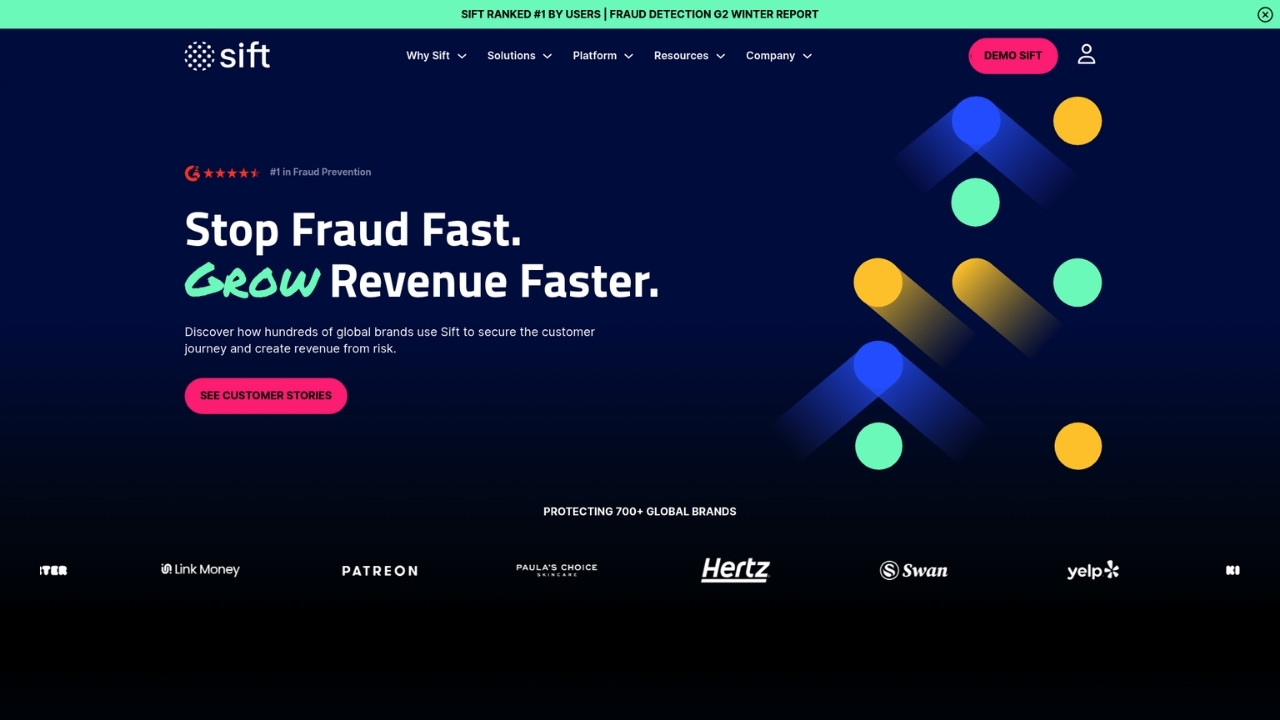
Sift processes over 1 trillion events annually across their global network of 1.6 billion digital citizens.
This scale puts them in the top tier of fraud prevention platforms by volume.
Their Digital Trust & Safety Suite covers the entire customer journey: signup, login, account activity, transactions, and post-transaction chargebacks.
They serve diverse verticals including marketplaces, fintech, and on-demand services.
Key features:
- Real-time risk decisioning
- Dynamic friction for customer experience
- Account takeover prevention
- Content integrity tools
- Machine learning with global data network
Notable clients: Poshmark, Harry's, Patreon, Turo, Yelp, Kickstarter, Hertz
Customer results:
Harry's reduced chargeback rates by 85% after implementing Sift. Turo built community trust without slowing growth. Skillshare streamlined fraud operations as a team of one.
Pros:
- Multi-vertical expertise (not just eCommerce)
- Massive event processing scale
- G2 Leader in Risk-Based Authentication
- Strong automation for lean teams
Cons:
- Enterprise-focused with no public pricing
- No chargeback guarantee option
- Feature breadth can mean less depth in specific verticals
6. SHIELD
Best for: Mobile apps, gaming platforms, and superapps
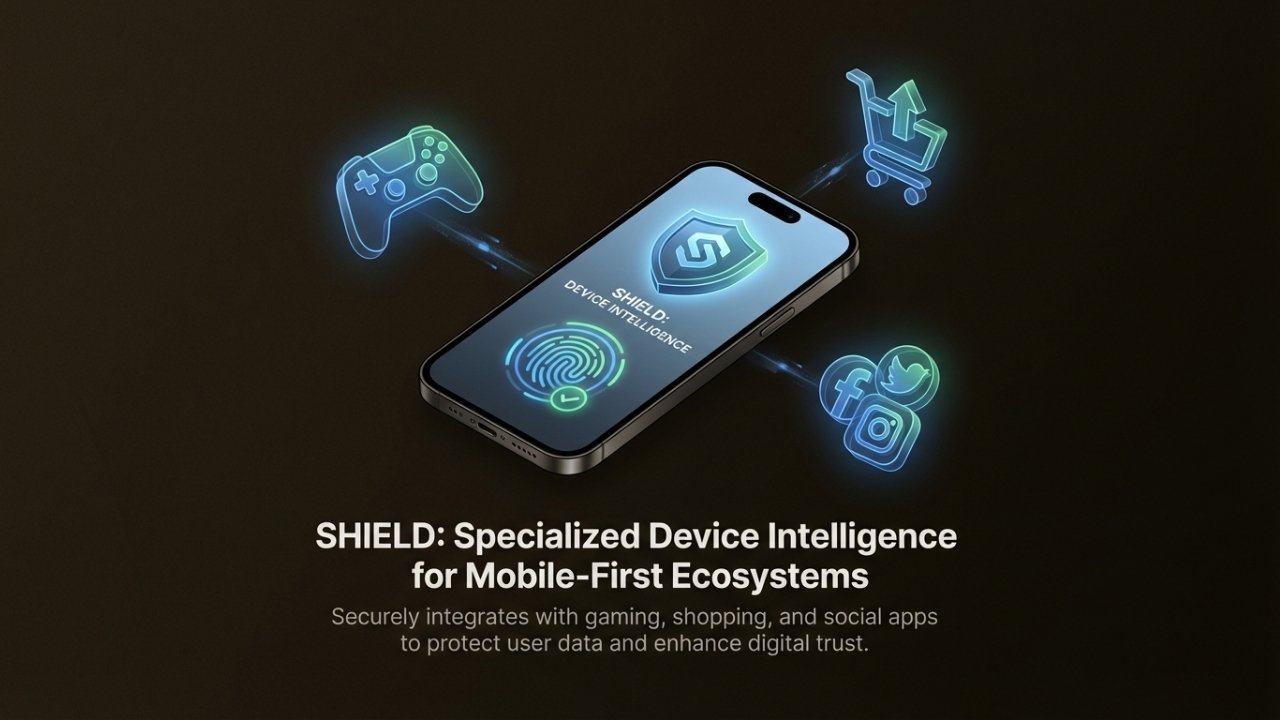
SHIELD (originally CashShield, founded 2008) specializes in device intelligence for mobile-first businesses.
They focus on persistent risk scoring that follows users across sessions and devices.
Their headquarters in Singapore with offices across Asia, Europe, and the US gives them strong coverage in Southeast Asian markets.
This regional focus differentiates them from US-centric competitors.
Key features:
- Device fingerprinting and intelligence
- Real-time profiling
- Persistent risk scoring across sessions
- Mobile-first architecture
- Bot attack detection
Notable clients: Razer, TrueMoney, MPL, OMNI, HappyFresh
Use cases:
- Payment fraud prevention
- Referral and promo abuse blocking
- Account sharing detection
- Ad fraud protection
- Spam and user abuse filtering
Pros:
- Excellent for mobile apps and superapps
- Strong presence in Southeast Asian markets
- Real-time session monitoring
- Specialized in gaming and digital goods
Cons:
- Less known in US and European markets
- Limited public information and pricing
- Narrower focus than full-suite competitors
7. Accertify

Best for: Travel, ticketing, and American Express merchants
Accertify has been part of American Express since 2010. They protect over 7.6 billion eCommerce transactions annually and have prevented more than $9 billion in risk. Their 24-hour multilingual support makes them popular with global brands.
The platform covers the full risk spectrum: account protection, fraud detection, abuse prevention, payment optimization, and chargeback management.
Their travel industry expertise is particularly deep.
Key features:
- AI and machine learning with community insights
- Account protection (addresses attacks 8x higher than checkout)
- Returns and abuse protection
- 3DS payment optimization
- Chargeback management with automated workflows
Customer results:
| Client | Result |
|---|---|
| United Airlines | 40%+ increase in win rate |
| Marks & Spencer | 99.98% frictionless customer journeys |
| Sportsbet | 80%+ decrease in fraud losses |
| Target Australia | 99% frictionless customer journeys |
Notable clients: Southwest Airlines, Ticketmaster, StubHub, Ryanair, Walmart, JetBlue
Pros:
- American Express backing provides stability
- Deep travel and ticketing expertise
- 24-hour multilingual support
- End-to-end protection from login to dispute
Cons:
- Harder to integrate outside AmEx ecosystem
- Best suited for businesses already using AmEx services
- Enterprise-focused with no public pricing
How to choose the right fraud prevention tool
Picking a Forter alternative depends on your specific situation. Here's a practical framework.
For small to mid-market businesses:
SEON offers the best balance of features and transparent pricing. At $699/month, their Starter plan is accessible without sacrificing capabilities.
The whitebox model helps if you need to explain decisions.
For high-volume eCommerce:
Signifyd and Riskified both offer chargeback guarantees. Signifyd brings PayPal heritage and extensive merchant networks.
Riskified focuses specifically on revenue optimization with documented ROI. Both require sales contact for pricing.
For mobile apps and gaming:
SHIELD specializes in device intelligence for mobile-first businesses. Their Southeast Asian presence is a bonus if that's your market.
For travel and ticketing:
Accertify's American Express backing and industry expertise make them the natural choice. Their client list includes most major airlines and ticketing platforms.
For enterprise across multiple verticals:
Kount and Sift both handle massive scale. Kount integrates with Equifax data. Sift processes the highest event volumes and serves diverse industries.
Key questions to ask vendors:
- What's your average implementation timeline?
- Do you offer a chargeback guarantee, and what are the terms?
- Can I see the reasoning behind fraud decisions?
- How do you handle false positives?
- What integrations do you offer for my eCommerce platform?
Protect your store with the right fraud solution
Forter set the standard for enterprise fraud prevention. But the alternatives on this list prove you have options.
Whether you need lower pricing, more transparency, or specialized features, there's a platform that fits.
The best approach? Start with free trials where available. Test how each platform handles your actual transaction patterns.
Measure false positive rates alongside fraud catch rates. And consider how fraud prevention fits into your broader customer experience strategy.
Speaking of customer experience: fraud prevention protects your revenue, but what about your customer support?
At Ringly.io, we help eCommerce businesses handle customer calls with AI. the AI, our AI phone agent, answers questions, looks up orders, and processes returns 24/7. It resolves about 73% of calls without human intervention.
If you're already investing in fraud prevention to protect transactions, consider complementing it with automated support to handle the customer conversations that follow.
Start your free trial and see how AI-powered phone support works for your store.
Frequently Asked Questions
What should you look for in Forter alternatives before making a decision?
Consider three factors: pricing transparency (can you see costs upfront or is everything 'contact sales'?), model transparency (whitebox vs blackbox AI), and chargeback protection (does the platform guarantee against losses?). Match these to your business size and risk tolerance.
Which Forter alternatives offer the best chargeback guarantee?
Signifyd pioneered the 100% chargeback guarantee model. Riskified and Accertify also offer guarantees with liability shifts. SEON, Sift, and SHIELD do not provide guarantees but typically offer lower pricing.
Are there affordable Forter alternatives for small eCommerce stores?
SEON is the most accessible with public pricing starting at $699/month. Most other alternatives require enterprise sales conversations. For very small stores, consider starting with built-in fraud tools from your payment processor before upgrading to dedicated platforms.
How do Forter alternatives compare for Shopify integration?
SEON, Riskified, and Signifyd all offer strong Shopify integrations. SEON's API-first approach enables fast implementation. Riskified specializes in eCommerce workflows. Signifyd provides comprehensive protection but may be overkill for smaller stores.
What makes SEON different from other Forter alternatives?
SEON's whitebox machine learning provides explainable decisions, unlike Forter's blackbox approach. They also publish pricing ($699/month starter) and average 14-day implementation versus months for competitors. Their 900+ first-party data signals provide deep fraud detection without relying on third-party data.