
This post in 30 seconds.
- Pet customer service isn't a volume problem. It's a stakes problem: weekend spikes, autoship LTV riding on every call, and a small slice of emotionally loaded calls you cannot get wrong.
- You'll get the real contact mix, a channel and response-time design you can copy, and the escalation rule that protects you on the sick-pet and grief calls the rest of the internet ignores.
- Built for founders, COOs, and Heads of CX at $10M-$100M Shopify pet brands with a visible phone number and a paid helpdesk.
Most advice about customer service for pet brands stops at "go 24/7 and be omnichannel." That's the baseline everyone already knows, not a plan. The harder question for a $10M-$100M Shopify pet brand is what to do with a phone line that rings hardest on Saturday morning, a subscription base where one bad support moment ends a 12-year customer relationship, and the occasional call from someone whose dog just died.
That last one is why pet support is different from every other vertical. Get it wrong and you don't lose a ticket, you get screenshotted.
If you run customer experience at a pet brand on Shopify doing $10M-$100M, you already know the weekend voicemails you never return and the same WISMO questions over and over. We've launched AI phone agents for Shopify brands trying to fix exactly that pattern, pet brands included. Book a 30-min call and we'll show you what your after-hours calls are actually worth.
In this post:
What pet brand customers actually contact you about
Before you design anything, you need to know what's actually coming in. So I went through the call logs across the pet brands we run on Ringly and counted what callers ask. Roughly 70% is routine: where's my order, subscription swaps and skips, and product questions tied to breed or life stage. The rest is a small but high-stakes slice. A sick pet. A recall scare. A customer who just lost a dog and wants to cancel the autoship.
That mix is the whole reason a generic support setup fails a pet brand. The routine 70% is automatable. The other 30% is the part that builds or breaks your brand, and it needs a human every time.
Here's the contact mix we see at a typical pet brand, with rough shares:
| Contact type | Share of contacts | Channel it lands on | Stakes |
|---|---|---|---|
| Where's my order (WISMO) | 30-45% | Phone, email, chat | Low per call, high if late |
| Subscription swap / skip / pause | 15-25% | Phone, chat | High (autoship LTV) |
| Product, breed, life-stage questions | 15-20% | Phone, chat, email | Medium |
| Returns and shipping issues | 8-12% | Email, chat | Medium |
| Emotional or health-adjacent (sick pet, grief, recall) | 5-10% | Phone | Highest |
WISMO alone is 30-50% of support contacts across DTC, according to Salesforce, and pet is no exception. In pet, a late order isn't an annoyance, it's a missed feeding, so the WISMO call carries more weight than it does for most categories. Pet parents buy on schedules tied to food running out, not impulse.
The subscription slice is where the money hides. Chewy's Autoship drives 82-84% of its net sales, per the company's FY2025 filings, and the same dynamic holds for smaller pet brands. TechCraft Studio, a brand we work with, handles 88% of its calls without a human, which frees its team to spend real time on the calls that need it.
A clean breakdown like this also tells you where to point automation first (the routine 70%) and where to never point it (the emotional 5-10%). More on that in the escalation section below. If you want the deeper view on the WISMO piece specifically, our breakdown of WISMO tickets covers what they cost and why they spike.
Why pet support is a stakes problem, not a volume problem
Pet brands rarely have the raw call volume of a supplement or beauty brand. You might see 20-60 calls a day, not 800. So the instinct is to under-invest, or to treat support as a cost to minimize.
That's the wrong frame. The value in pet support isn't volume, it's what each interaction is worth.
Start with retention. The average annual churn rate for online pet retailers is around 18%, and roughly 30% of that churn traces back to poor post-purchase support. Every subscription you save on a call is close to a full year of LTV, because pet relationships are long. The average pet lifespan is 12 to 15 years, so a customer you keep this weekend may stay with you for over a decade.
"My customers also feel like it's a normal person. They feel like they can communicate if they have questions."
— Claudia Droge, TechCraft Studio
Then there's the reputation math. Pet parents are emotional buyers, and 60% of them prefer brands that offer personalized service, according to Working Solutions. The flip side is unforgiving: one cold response to a grieving customer becomes a public review, and in a category this emotional that review travels. If you want the full retention playbook for this, we wrote one specifically for pet ecommerce customer retention.
So the goal isn't to handle the most calls cheaply. It's to never miss the call that matters and never sound robotic on the one that's heavy. That reframe changes every decision below, starting with channels.
Design your channels and response times
You don't need every channel. You need the right ones, with response-time targets your team can actually hit.
For a $10M-$100M pet brand, the practical channel set is phone, email, and chat, with social as a monitoring-and-deflect layer. If you're building this function from scratch, our broader guide to ecommerce customer retention pairs well with the channel design here. Phone is the one most pet advice underrates. Your older pet parents prefer it, and every emotional call comes in on it. If your phone rolls to voicemail after 6pm and all weekend, you're missing the highest-stakes contacts you get.
Here's a response-time design that works for the pet pattern:
| Channel | Target first response | Who it's for | Notes |
|---|---|---|---|
| Phone | Answer live, under 30 sec | Older pet parents, emotional calls, urgent WISMO | The highest-stakes channel. Voicemail loses the call. |
| Live chat | Under 2 min | Quick WISMO, subscription edits | Industry median FRT is under 2 min, so match it |
| Under 4 hrs business, under 12 overnight | Returns, detailed product questions | Median email FRT is 12+ hrs, so beating it is an easy edge | |
| Social DMs | Under 1 hr daytime | Public complaints, recall questions | Move sensitive threads to phone or DM fast |
The benchmarks here come from cross-industry ecommerce helpdesk data: live chat resolves in under 2 minutes, email drags to 12-plus hours at the median. The single cheapest win for most pet brands is closing the after-hours and weekend phone gap, because that's where the routine WISMO and the emotional calls both pile up.
One more design note: don't split the same customer across three tools with no shared context. A pet parent who chatted Friday and calls Saturday should not have to re-explain. Your helpdesk should carry the thread across channels.
The knowledge base and escalation rules that protect you
This is the section the rest of the internet skips, and it's the one that actually protects your brand.
Two pieces: the knowledge base that answers the routine calls, and the escalation rules that catch the calls no script should ever try to answer.
Start with the knowledge base. For a pet brand it has to cover:
- Breed and life-stage guidance: puppy vs senior formulas, size charts, feeding amounts pulled from your product data, never from generic advice.
- Ingredient and safety questions: "is this safe for a dog with a chicken allergy?" answered strictly from the product spec, with a clear line where it becomes a vet question.
- Subscription mechanics: how to pause, skip, swap, and change frequency. Make this frictionless. Pet diets shift as pets age, so swap velocity in pet runs higher than in supplements, and a customer who feels trapped cancels.
- Shipping, returns, and order status: the WISMO answers, wired to live tracking through a check-order-status integration so nobody is reading a tracking number off a screen.
Now the part that matters most. Build a hard-coded escalation rule that routes any call mentioning a sick, dying, injured, or lost pet straight to a human, with no automated attempt to resolve it. Trigger words like "sick," "emergency," "passed away," "put down," or "recall" should jump the queue to your most experienced person.
This is non-negotiable in pet. The grief calls are the ones operators remember, and the precedent everyone in the industry points to is Chewy sending flowers when a pet dies. You can't automate that warmth, and you shouldn't try. What you can do is make sure the routine 90% never clogs the line so your humans are free and present for the 10% that need them.
Recalls deserve their own sub-plan. DTC pet food sees several voluntary recalls a year, and when one hits, your phone lights up with worried customers at once. Have a recall playbook ready: a pinned knowledge entry with the affected lot numbers, a clear "is my batch affected" lookup, and an instant handoff to a human for anyone whose pet already ate the product. Never give veterinary advice. Route to a vet referral and a human rep.
Staffing and when to add the next rep
Pet support staffing is its own puzzle because the volume is lumpy. Weekdays are quiet, weekends spike, and you can't justify a full overnight team for 30 calls.
Here's the loaded math most pet brands run. A US customer service rep costs about $4,000 a month fully loaded (salary, benefits, training, the churn when they quit). A weekend-heavy pet brand often staffs like this:
| Line item | Today |
|---|---|
| 3 weekday reps at $4K loaded | $12,000/mo |
| 1 weekend rep at $4K loaded | $4,000/mo |
| Total | $16,000/mo, weekends still thin |
The trap is hiring rep #5 to cover the weekend gap, because that next hire takes months to train and the volume doesn't justify a full salary. The better move is to route the routine WISMO, subscription, and product calls to an AI phone agent, keep your humans for escalations, and stop the weekend voicemail leak entirely. In that model the AI absorbs the spike and your team handles the calls that actually need a person. The savings shape is roughly $11,000/mo, about $132K a year, and your weekend customers stop hitting voicemail.
The call makes sense if:
- You're a Shopify or Shopify Plus pet brand doing $10M-$100M
- You run a paid helpdesk (Gorgias, Zendesk, Gladly, Re:amaze, or Intercom)
- You have a visible phone number on your store
- Your CS team is 3-12 people
What happens on the call.
- We pull your last 7 days of after-hours and weekend calls live on the call. No homework for you.
- We show you the recovered revenue at the resolution rates we see for pet brands.
- You decide if it's worth a deeper conversation. No deck, no follow-up sequence.
If that's you, the math usually works. Book a 30-min call and we'll run your numbers live.
Plan for seasonal spikes and recall events
Pet support doesn't run flat. It runs in waves, and the brands that handle the waves well are the ones that planned for them.
The predictable spikes:
- Gifting season (Nov-Dec): holiday pet gifts, gift-order WISMO, delivery-timing anxiety. Volume can double.
- Summer travel: questions about boarding-friendly products, autoship timing around trips, address changes.
- New-product launches: a viral product means a flood of "is this right for my breed" calls the day it drops.
- Recall events: the least predictable and the most intense. Several a year in DTC pet food, each one a same-day surge.
The fix for all four is the same principle: proactive communication beats reactive support. Send tracking the moment an order ships. Notify subscribers of any delay before they call. Pin a recall FAQ the hour news breaks. Every question you answer before the customer asks is a call that never has to hit your queue. That's how you keep a small team sane through a spike without staffing for the peak year-round.
The metrics that actually matter
You can't manage what you don't measure, but pet brands often measure the wrong things. Ticket count tells you almost nothing in a low-volume, high-stakes category.
Track these instead:
| Metric | Why it matters for pet | Rough target |
|---|---|---|
| Resolution rate | Are calls actually getting solved, not just answered? | 65%+ autonomously |
| First response time by channel | Phone and chat are the urgent ones | Phone live, chat under 2 min |
| Autoship-save rate | Saved subscriptions = ~12-month LTV each | Track and trend up |
| CSAT on emotional/escalated calls | The brand-defining moments | As close to 100% as you can |
| Cost per resolved contact | Tells you the real efficiency, not raw volume | Compare to $7-$16/call BPO |
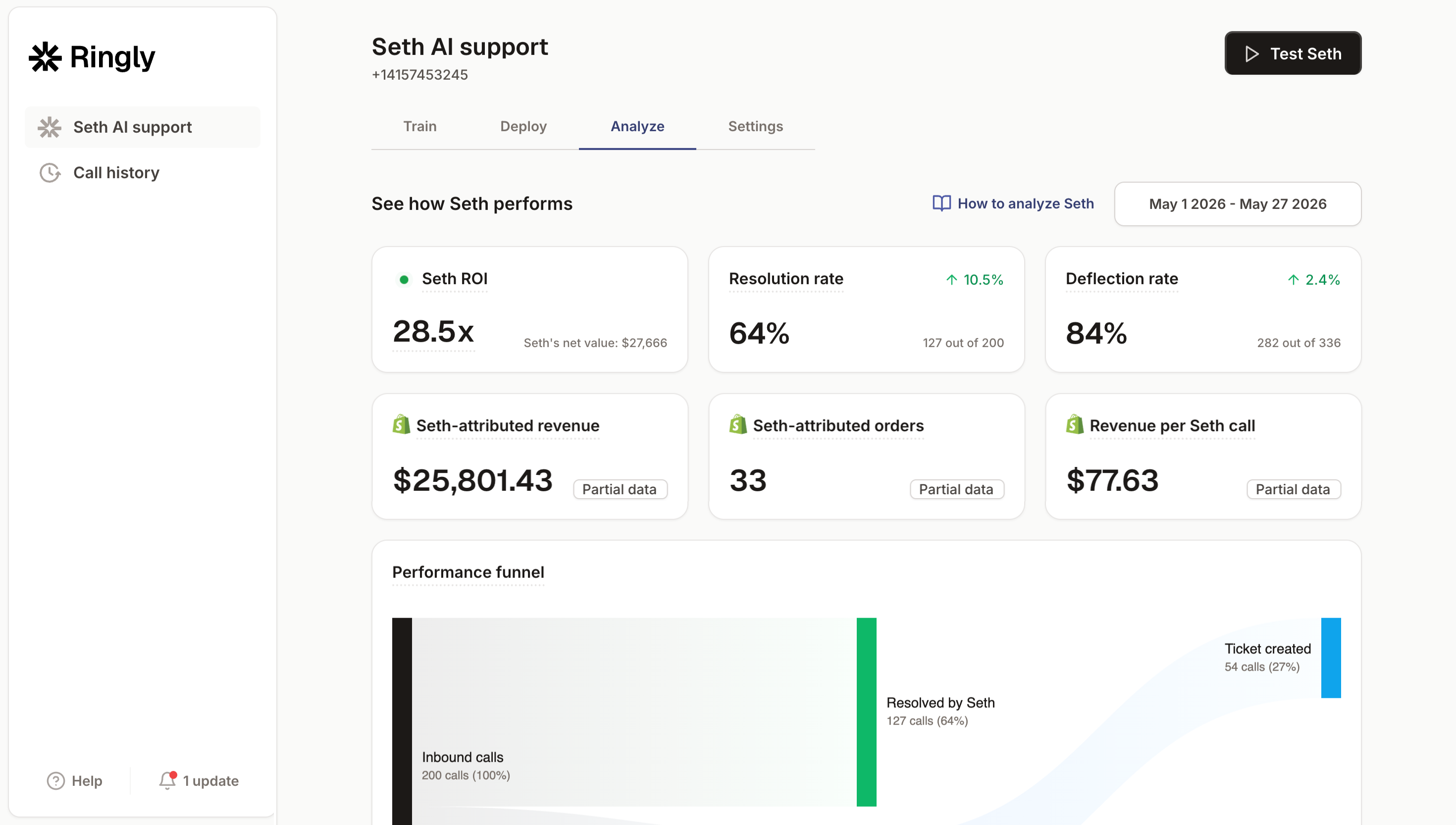
The number that surprises most operators is the revenue side. WashCo, a Shopify brand we launched recently, generated $22,664 in attributed revenue in the first 7 days post-launch, with 271 calls handled, an 85% deflection rate, a 66% resolution rate, and a cost of $0.91 per call versus $2.70 per human-handled call. That's the frame that matters: support isn't only a cost line, it's a revenue and retention line. Seth resolves up to 90% of calls autonomously.
Want to see your own numbers? Book a 30-min call and we'll do the math on your store live.
Where AI fits in the pet support stack
AI is one layer of this playbook, not the whole thing. Used right, it handles the routine 70-90% so your humans are free for the calls that need them. Used wrong, it tries to answer a grief call and you end up on Twitter.
Ringly.io is AI phone support for Shopify brands. Instead of hiring a new rep every time weekend volume creeps up, the AI takes the routine inbound calls: order status, subscription edits, breed and life-stage product questions, returns. It finds orders in your Shopify store, answers from your knowledge base, and cancels orders when a caller asks. It resolves up to 90% of calls autonomously.
The pet-specific part is the handoff. Any call that trips an emotional or health trigger word escalates cleanly to your team through a smart call transfer, so the AI never tries to handle the call it shouldn't. And it sits in front of your existing stack. You keep Gorgias or whatever helpdesk you already run, your phone number, and your workflows. The AI just stops the routine calls from clogging the line.
The most common thing customers say after talking to it: "you don't sound like AI." In an emotional category, that matters more than anywhere else. Plans start at $99 a month, with a 65% resolution guarantee, and you can be live in under an hour. For the deeper version of this, see our guides on pet brand phone support and pet ecommerce customer retention.
Frequently asked questions
How much should a pet brand spend on customer service? Most $10M-$100M pet brands run a 3-4 person team at roughly $4,000 loaded per rep, or $12,000-$16,000 a month. The smarter question is cost per resolved contact, not headcount. If routine calls are eating most of your payroll, routing them to automation can cut that figure to under $1 per call.
What's the best way to handle a grief or sick-pet call? Never automate it. Build a hard-coded rule that routes any mention of a sick, dying, or lost pet straight to your most experienced human, with no scripted attempt to resolve. The brands that win here, like Chewy with its pet-loss flowers, treat these moments as brand-defining, not as tickets.
How do I reduce WISMO calls for a pet brand? Get ahead of them. Send tracking the moment an order ships, notify subscribers of delays before they ask, and wire live order status into your phone and chat. WISMO is 30-50% of DTC support contacts, so even a partial deflection clears real load.
Should a pet brand offer 24/7 phone support? Yes, but you don't need a 24/7 human team to do it. Most after-hours and weekend calls are routine WISMO and subscription edits that 24/7 ecommerce phone support handles, with emotional calls escalating to a human. That closes the voicemail gap without a night shift.
How do I keep autoship customers from churning over a support issue? Make subscription changes frictionless and answer fast. Roughly 30% of pet retailer churn comes from poor post-purchase support, so every saved call is close to a year of LTV. Easy pauses, skips, and swaps prevent the "trapped" feeling that drives cancellations.
Can AI handle pet brand customer service calls? For the routine 70-90%, yes. Order status, subscription edits, and product questions are well within reach, and brands on Ringly resolve up to 90% of calls autonomously. The emotional and health-adjacent calls should always route to a human through a hard-coded handoff.
What channels does a pet brand actually need? Phone, email, and live chat, with social as a monitoring layer. Phone is the one most pet advice underrates, because older pet parents prefer it and every emotional call comes in on it. Skip the channels you can't staff well and go deep on the ones your customers actually use.
Talk to us

If you run a pet brand on Shopify and your phone rolls to voicemail every weekend, a 30-min call is the fastest way to see what those missed calls are actually worth. We'll pull your recent after-hours calls, show you the resolution rates we see for pet brands, and run the math on your store live.
Our 3 promises.
- Live in under 1 hour. Setup and test calls are free.
- 30-day money back on the $99 plan fee.
- 65% resolution guarantee: if Seth resolves under 65% of your support calls in a month, that month comes back as credit (after 90 days on Pay per call).
Ruben (Ringly co-founder) takes these calls personally.