
This guide in 30 seconds.
- There are five categories of cosmetics brand customer service software you actually need, and most beauty brands have bought four of them and skipped the one that handles the hardest calls.
- Watch the pricing model before the feature list. Per-ticket helpdesks can double-bill every AI reply, and a $360 plan turns into a $960 bill the week your launch lands.
- Built for $10M-$100M Shopify beauty and cosmetics brands running a paid helpdesk with a visible phone number and a 3-12 person support team.
You already run a helpdesk. You probably run a chat widget on top of it, plus a returns app and a loyalty program. So why does the call about whether a foundation matches a customer's undertone still ring out to voicemail at 9 p.m.?
That gap is the whole reason this guide exists. I set up a real Shopify beauty store and called every category leader's phone line at 11 p.m. with a shade-match question to see what happened. Most of them did nothing, because phone isn't a category most beauty brands think to buy. This is the full stack of cosmetics brand customer service software, what each piece does, and how to choose the parts you're missing.
I'm Ruben, co-founder of Ringly.io. We build AI phone support for beauty brands on Shopify, so the stuff below comes from setting these tools up against real call volume, not from reading their pricing pages. If you run customer experience at a Shopify beauty brand and you already know the launch-week phone backlog, book a 30-min call and we'll show you what your store is leaving in voicemail after-hours.
What makes cosmetics customer service software different
Beauty support isn't generic ecommerce support. A customer doesn't call to ask where a t-shirt is. She calls to ask whether a serum is safe with her retinol, what shade matches her undertone, or the right order to layer four products she just bought.
The defining trait of cosmetics support is that the questions are consultative, visual, and emotionally loaded, which is exactly the kind of conversation most software is bad at. According to PowerReviews, 74% of beauty consumers are more likely to buy from brands that offer personalized recommendations. That preference doesn't stop at the product page. It follows the customer into every support channel.
A few things stack the deck against a beauty brand specifically:
- Returns run high and they're shade-driven. Makeup return rates sit at 12-15% (Eightx), and most of those are "wrong shade," "wrong undertone," or "didn't work for my skin." A good support conversation before the order ships prevents the return entirely.
- Launch weeks are violent. An influencer post or a viral TikTok can put 5-10x your normal volume on the phone and the inbox inside 48 hours. Wonderskin went from $0 to $125M in 24 months largely on virality (Glossy), and that curve breaks any support team staffed for the average week.
- The phone is the channel nobody covers. Only 34.8% of skincare Shopify stores even list a phone number, yet 76% of consumers prefer phone for complex issues. Beauty issues are complex by definition.
So when you evaluate cosmetics brand customer service software, the question isn't "which tool is best." It's "which combination covers all five jobs, including the phone call most of my competitors are ignoring."
The 5 categories of CS software a cosmetics brand needs
Here's the part that gets skipped. Most "best software" lists hand you a flat row of 15 tools with no map. What you actually need is a stack: five categories that each do a different job, that hand off to each other cleanly. Get the architecture right first, then pick a winner inside each category, because a great helpdesk with no phone layer still drops the call that drives the return.
The five categories:
- Helpdesk / ticketing. The system of record for every conversation.
- Live chat and the social inbox. Real-time text on your site plus Instagram and WhatsApp DMs.
- Phone and voice AI. The channel that handles the shade, ingredient, and "where's my order" calls. This is the one most stacks skip.
- Returns and exchanges. Self-serve portals that turn a return into an exchange.
- Loyalty and voice-of-customer. Reviews, loyalty tiers, and the feedback loop that tells you what's breaking.
Here's how they compare at a glance, including the pricing model, which matters more than the feature list when your volume swings.
| Category | Leading tools | What it solves | Pricing model | Who needs it |
|---|---|---|---|---|
| Helpdesk / ticketing | Gorgias, Zendesk, Gladly, Kustomer, Re:amaze | Central inbox, ticket history, escalation | Per-ticket OR per-seat | Every brand. Non-negotiable. |
| Live chat / social inbox | Intercom, Tidio, Re:amaze, Gorgias | Real-time text, Instagram/WhatsApp DMs | Per-seat + AI usage | Brands with heavy social traffic |
| Phone and voice AI | Ringly | Inbound calls: shade, ingredients, WISMO, after-hours | Flat monthly + minutes | Brands with a visible phone line and after-hours volume |
| Returns and exchanges | Loop, AfterShip Returns, Returnly-style | Self-serve returns, exchange-first flows | Per-return or flat | Brands with 10%+ return rates (all makeup) |
| Loyalty and VoC | Yotpo, Okendo, Smile.io | Reviews, loyalty tiers, feedback analytics | Tiered SaaS | Brands building repeat-purchase rate |
Most beauty brands I talk to have categories 1, 2, 4, and 5 covered and category 3 wide open. That's the gap this guide keeps coming back to.
How I tested these tools
I'm Ruben, co-founder of Ringly. Over the last few weeks I set up a production Shopify beauty store and ran every category leader through the same five-part workflow, so the verdicts below come from using the tools, not from their marketing.
Here's what I scored against:
- Shopify integration depth. I connected each tool to the test store, pushed a real order through, and watched whether it could see the customer, find the order, and write back without custom dev work.
- The shade-match conversation. I sent a "which shade matches my undertone" question through every channel each tool offered, then judged whether the answer was useful or a canned deflection.
- The pricing-model stress test. I modeled each tool's bill at a normal week and at a launch-week 5x spike, because the bill that matters is the one that arrives after a viral moment, not the sticker price.
- The female-voice and brand-tone check. Beauty buyers care about who their customers hear. I checked which phone tools offer a female voice and brand-matched vocabulary out of the box.
- The 11 p.m. failure mode. I called every tool's phone line, and every Ringly competitor's, at 11 p.m. on a Tuesday with a shade question to see what a real after-hours customer would hit.
That last test is the one nobody else in this space runs, and it's the most revealing. The number of "leading" support tools that simply have no phone answer after-hours is the entire reason category 3 is open at most beauty brands. I don't take affiliate commissions on anything below. Ringly is in here for the same reasons and against the same tests as everyone else.
Category 1: helpdesk and ticketing
The helpdesk is the system of record. Every email, ticket, and escalation lives here, and it's the one category no brand skips. The thing to scrutinize isn't the feature list, it's whether the pricing model punishes you for growing, because a beauty brand's volume is anything but steady.
The honest fork in this category is per-ticket versus per-seat.
Gorgias is the Shopify-native default, priced per ticket with unlimited agent seats. Plans run from $10/mo to $900/mo plus custom Enterprise. The catch worth knowing before you sign: each AI interaction gets billed as both an AI charge (around $0.90-$1.00) and a helpdesk ticket ($0.36-$0.40), so automated replies double-bill. Verified reviewers on Capterra and G2 report a $360 plan landing as a $960 bill at higher volume, and per-ticket pricing can spike 200% during a Black Friday rush. Auto-responded junk mail counts as billable too. Gorgias is still excellent at Shopify integration and ease of use. Just model your launch-week bill before you commit.
Zendesk flips the model: per agent seat, starting around $19/agent/mo on annual billing and climbing to $55+ with the AI add-ons. Copilot and the AI Agent suite are separate line items, and automated resolutions run $1.50-$2.00 each. Your cost scales with headcount, not volume, which is friendlier during a launch spike but heavier if your team is large.
Gladly is conversation-based rather than ticket-based, runs around $180-$210 per agent per month, and counts Ulta Beauty among its customers. It's built for B2C brands that treat support as a loyalty channel. Kustomer sits in the enterprise lane with a unified customer timeline and a custom quote. Re:amaze is the affordable, store-focused option at $29-$69 per seat.
What to evaluate: pricing model first (per-ticket vs per-seat against YOUR volume curve), Shopify integration depth, how cleanly it escalates, and whether the AI features are bundled or bolted on with usage fees.
Choose per-ticket (Gorgias) if your team is small relative to your volume. Choose per-seat (Zendesk, Gladly) if your volume is steady and your team is the cost driver.
Category 2: live chat and the social inbox
Beauty discovery happens on Instagram and TikTok, so a chunk of your support lands in DMs, not your inbox. Live chat plus a social inbox catches it.
For a beauty brand, the social inbox is where the pre-purchase shade question shows up, which means it's a revenue channel disguised as a support channel. Converge's data shows only 23% of beauty brands respond to social inquiries within four hours, so even decent speed here is an edge.
The main options:
- Intercom: strong chat plus Fin AI, priced per seat with AI usage on top. Best for brands that want chat and product-education flows in one place.
- Tidio: lower-cost live chat and chatbot, good for smaller teams getting started.
- Re:amaze: unifies chat plus Instagram, Facebook, and WhatsApp in one inbox, which is handy if social is most of your volume.
- Gorgias: has a native chat module, so if it's already your helpdesk you may not need a separate tool.
What to evaluate: which social channels it actually connects (Instagram and WhatsApp are the beauty ones), whether visual replies are easy (customers want to see swatches), and whether chat history syncs back to your helpdesk so you're not running two systems of record.
The limit of this whole category: chat and DMs are text. The customer who wants to talk through a routine, or who's older and reaches for the phone, isn't served here. That's category 3.
Category 3: phone and voice AI (the layer most stacks skip)
This is the category nobody in the top search results covers, and it's the one beauty brands need most. When I called the phone lines during testing, the pattern was stark: chat-first tools have no real phone answer, and after 6 p.m. the call goes to voicemail nobody returns.
That's a problem, because 76% of consumers prefer phone for complex issues and beauty's most valuable questions, the shade match and the ingredient-safety check, are the complex ones. Businesses answer only 37.8% of inbound calls overall (AmbsCallCenter), and 62% of callers who can't reach anyone switch to a competitor (PCN). For a beauty brand, that lost call is often a lost shade-match sale and a return that didn't have to happen.
Ringly.io: AI phone support for beauty brands
Best for: $10M-$100M Shopify beauty and cosmetics brands with a visible phone number and after-hours or launch-week call volume they can't staff.
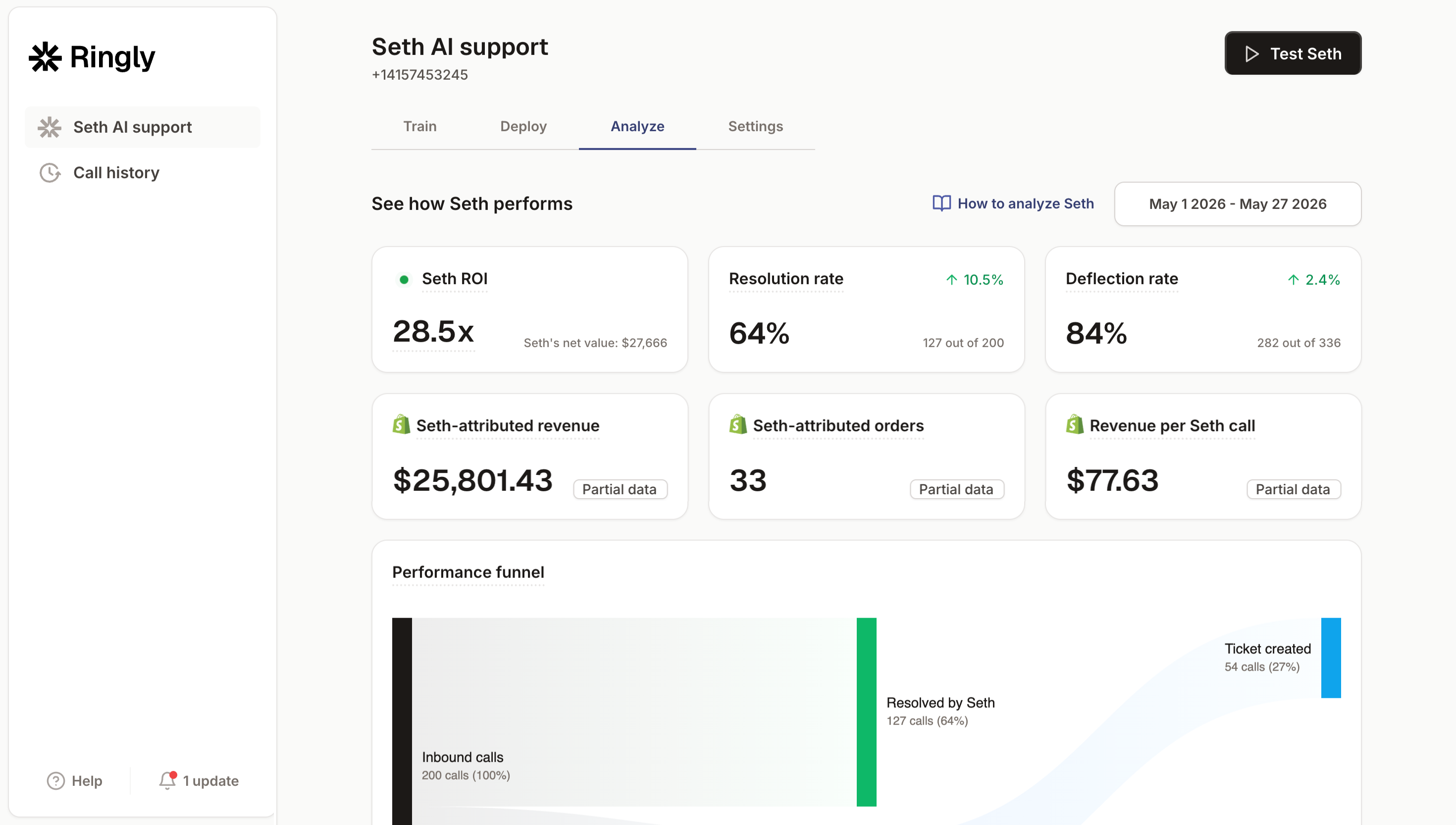
Ringly.io is AI phone support for Shopify brands. Instead of growing your support headcount every time a launch hits, the AI takes the routine inbound calls so your team can focus on the conversations that actually need a person. It answers calls 24/7, finds orders in your Shopify store, processes returns and exchanges, answers shade and ingredient questions from your knowledge base, and escalates cleanly to whatever helpdesk you already run.
Seth resolves up to 90% of calls autonomously for $1.99 a call after the first 50, versus the $7-$16 a human BPO call costs. It sits in front of your existing stack, so you keep Gorgias or Zendesk and your phone number. You're adding a layer, not ripping anything out.
On the beauty-specific objections: yes, you can run a female voice (the thing Nancy at Shop Priceless asked us for first), and the AI speaks your brand vocabulary because it's built from your knowledge base. The single most repeated thing customers say after a call is "you don't sound like AI," which matters more in beauty than anywhere else.
Real numbers from WashCo, a Shopify brand we launched recently:
- $22,664 in attributed revenue, first 7 days post-launch
- 271 calls handled
- 85% deflection rate
- 66% resolution rate
- $0.91 per call vs $2.70 per human-handled call
Source: Ringly dashboard, verified live data.
Pricing: $99 a month for the first 50 conversations, then $1.99 each. Free to try. Live in under an hour. 65% resolution guarantee: if Seth resolves under 65% of your calls in a month, that month comes back as credit (after 90 days on Pay per call).
What works:
- It picks up after-hours. The 9 p.m. shade call that used to hit voicemail gets answered, which is exactly where the recovered revenue comes from.
- It handles WISMO at volume. "Where's my order" calls route to your Shopify data automatically. See how WISMO calls work.
- It absorbs the launch spike. No hiring eight seasonal reps for a week of viral volume.
- It's a layer, not a replacement. Keep your helpdesk, your number, your workflows.
What doesn't:
- It's phone-first. If your support is 90% email with no phone line, you'll get less out of it than a brand with real call volume.
- It's not a chat or returns tool. It does one channel extremely well rather than ten channels at 60%.
Why it leads this category: it's the only tool in the stack built to answer the call, and for beauty the call is where the highest-friction, highest-value conversation happens. Compare it to your current setup on a beauty-store phone support breakdown or the skincare version.
"My customers also feel like it's a normal person. They feel like they can communicate if they have questions."
— Claudia Droge, TechCraft Studio
Categories 4 and 5: returns and loyalty
The last two categories round out the stack. They matter for beauty, but they're better-covered ground, so I'll keep this tight.
Returns and exchanges is where you turn a 12-15% makeup return rate into exchanges instead of refunds. Loop, AfterShip Returns, and similar portals let a customer swap a wrong shade for the right one without a support ticket, which protects both the margin and the relationship. For a beauty brand, an exchange-first flow is worth more than a fast refund, because the wrong-shade return is recoverable if you make the swap easy.
Loyalty and voice-of-customer is the repeat-purchase engine. Yotpo, Okendo, and Smile.io handle reviews and loyalty tiers, while VoC analytics tools surface what's actually breaking across channels. Beauty repeat-purchase benchmarks sit at 30-45%, so this category pays for itself on retention alone. Just don't confuse a VoC analytics tool with operational support software. They tell you what's wrong; they don't answer the call.
Neither of these replaces the helpdesk or the phone layer. They sit alongside, and they're worth getting right once categories 1 through 3 are solid.
What this stack costs vs the phone layer
Here's the math that usually reframes the decision. Beauty brands don't run on a steady support team. They run hot during a launch and crawl between them, then pay the full headcount year-round.
Take a typical $50M beauty brand staffing eight reps to survive launch month:
| Line item | Today | With Ringly on the phone layer |
|---|---|---|
| 8 reps × $4K loaded per rep | $32,000/mo | depends on team size |
| Ringly phone layer | not in stack | ~$8,000/mo |
| Idle cost between launches | high (team sized for the spike) | absorbed by the AI |
| Annual support payroll | ~$384,000/yr | materially lower |
That's $384K a year for a team sized to the launch and idle most of the other eleven months. Move the routine calls (shade, ingredients, WISMO, after-hours) to the AI and your team stops being staffed for a spike that comes a few times a year. The other 30%, the genuinely complex consults, still go to a person, who now has time to actually handle them.
Want to compare us to your current setup? Book a 30-min call and we'll do the math live on your store.
What happens on the call.
- We pull your last 7 days of missed calls live, on the call. No homework for you.
- We show you the recovered revenue at the resolution rates we typically see for beauty brands.
- You decide if it's worth a deeper conversation. No deck, no follow-up sequence.
The call makes sense if:
- You're a Shopify (or Shopify Plus) beauty brand doing $10M-$100M
- You run a paid helpdesk (Gorgias, Zendesk, Gladly, Re:amaze, or Intercom)
- You have a visible phone number on your store
- Your support team is 3-12 people
If that's you, the math usually works. Book a 30-min call and we'll run it live on your store.
How to choose your cosmetics CS software
You don't buy this stack all at once. You figure out what's missing and fill the gap. A quick decision framework:
- Choose a per-ticket helpdesk (Gorgias) if your support team is small relative to your call and ticket volume, and you want deep Shopify integration. Model the launch-week bill first.
- Choose a per-seat helpdesk (Zendesk, Gladly) if your volume is steady and predictable, or your team is the main cost driver and you want AI fees that don't scale with every reply.
- Add a social inbox (Re:amaze, Intercom) if Instagram and WhatsApp DMs are a real chunk of your pre-purchase questions.
- Add phone and voice AI (Ringly) if you have a visible phone number, after-hours volume, or launch spikes you can't staff. This is the gap at most beauty brands.
- Add returns and loyalty (Loop, Yotpo) if your return rate is in the normal makeup range and you're trying to lift repeat-purchase rate.
The honest summary: most $10M-$100M beauty brands already have four of the five categories. The one they're missing is phone, and it's the one handling the conversation that drives the return. Start there. For a broader look at the operational side, see our guide to beauty ecommerce customer support challenges and the general ecommerce customer service playbook. Pricing for the phone layer is on the pricing page.
Frequently asked questions
What software do cosmetics brands use for customer service? Most run a helpdesk like Gorgias or Zendesk as the system of record, a live chat or social inbox for Instagram and WhatsApp, a returns app, and a loyalty tool. The category most skip is phone and voice AI, which handles the shade, ingredient, and after-hours calls the other tools can't.
Do beauty brands really need phone support software? If you have a visible phone number, yes. 76% of consumers prefer phone for complex issues, and only 34.8% of skincare Shopify stores even list a number, so it's both expected and underserved. An AI phone agent answers the calls your team can't get to without adding headcount.
How much does customer service software cost for a beauty brand? It depends on the model. Helpdesks run from $10/mo per-ticket (Gorgias) to $19-$210 per agent per month (Zendesk, Gladly), and AI features often add per-resolution fees on top. A phone layer like Ringly starts at $99 a month for the first 50 conversations, then $1.99 each.
Is Gorgias good for cosmetics brands? It's a solid Shopify-native helpdesk, but watch the per-ticket billing. Each AI reply can count as both an AI charge and a ticket, so a $360 plan can land as $960 at higher volume, and costs can spike 200% during a launch. Model your peak-week bill before committing.
Can AI handle shade-matching or ingredient questions on the phone? Yes, when it's built from your knowledge base. Ringly's AI answers product, shade, and ingredient questions from your docs and escalates the genuinely subjective consults to a human. It won't invent a shade recommendation it isn't confident about.
Will a male AI voice work for a female-focused beauty brand? You don't have to use one. Ringly offers a female voice from the Retell voice library, and the AI speaks your brand vocabulary. The most common thing customers say after a call is that it doesn't sound like AI at all.
How does customer service software reduce returns? Answering the pre-purchase shade and fit question before the order ships, and making exchanges easy after, is where the savings come from. Makeup return rates run 12-15%, mostly wrong-shade, so a good shade conversation on the phone or in chat prevents the return outright.
Should a beauty brand use per-ticket or per-seat helpdesk pricing? Per-ticket (Gorgias) is cheaper if your team is small relative to volume, but punishing during a launch spike. Per-seat (Zendesk, Gladly) is steadier when your volume is predictable. Map both against your real launch-week volume, not your average week.
Talk to us

If you run a $10M-$100M Shopify beauty brand and your phone goes quiet after 6 p.m., a 30-min call is the fastest way to see the revenue sitting in your voicemail. We'll pull your missed calls live and show you what the phone layer would have caught.
Our 3 promises.
- Live in under 1 hour. Setup and test calls are free.
- 30-day money back on the $99 plan fee.
- 65% resolution guarantee: if Seth resolves under 65% of your support calls in a month, that month comes back as credit (after 90 days on Pay per call).
Ruben (Ringly co-founder) takes these calls personally.