
This post in 30 seconds.
- Coffee brands get more phone calls than their size suggests, and most of those calls follow five predictable patterns you can hand to an AI.
- You'll see exactly what an AI phone answering setup does on each kind of call, from a roast-date question to a "where's my order" at 11 p.m.
- Written for founders and Heads of CX at $10M-$100M Shopify coffee and specialty-food brands with a phone line nobody picks up after the roastery closes.
Coffee is one of the few ecommerce categories where the phone never went quiet. Part of it is the demographic, a real chunk of specialty-coffee revenue comes from older buyers who'd rather call than fight a checkout form. Part of it is the product itself, perishable, gifted, and easy to get anxious about ("will it still be fresh when it lands?").
So the calls keep coming. The problem isn't that they come. It's that most of them hit voicemail after 5 p.m., and a good number of those callers never try again. It's the same phone-support pattern most specialty-food brands run into.
One Sunday evening I called the support lines of nine specialty coffee brands to see what actually happens. Two picked up. The rest went to voicemail, a full mailbox, or a recording that hung up on me. That's the gap an AI phone answering setup closes, and the rest of this is what it does once it's picking up.
If you run customer experience at a Shopify coffee brand doing $10M to $100M, you already know the December queue. This is what the AI handles on your behalf, call by call. Book a 30-min call and we'll listen to a week of your missed calls together.
What a coffee brand's phone calls actually sound like
Pull a week of call logs from any roaster doing real volume and the same handful of questions show up over and over. They cluster into five patterns, and almost none of them need a human.
- Roast date and freshness. "When was this roasted? Will it still be fresh when it gets here?" Coffee loses up to 70% of its aromatic compounds in the first weeks after roasting, and the good window is roughly two to three weeks (Stone Creek Coffee). A website dropdown never fully settles it. People want to hear it.
- Ship-by and arrives-by. "I need this by Friday for a gift." These spike hard in December, and the stakes are real, a gift that lands late is a ruined moment, not a minor delay. The FTC even requires sellers to ship within the window they promise or offer a cancel-for-refund, so a vague "should be soon" on the phone isn't good enough.
- Subscription pause, skip, or swap. "Can you push my next bag a week?" Lower volume than a supplement brand, but it's there and it's recurring revenue on the line.
- Where's my order. WISMO calls run 30 to 40% of support tickets in normal periods and climb past 50% at peak (Salesforce). On the phone it sounds like "it says delivered and it's not here."
- Placing an order outright. The older caller who won't use the site and wants to read you their card number. More on this one below, because it's the call the AI handles differently.
A roaster running real volume can field around 1,595 calls in a single 90-day stretch, and the mix barely changes from quarter to quarter. That predictability is the whole reason an AI can carry most of it.
The pattern that should bother you most is the after-hours one. Your roastery closes, the line rolls to voicemail, and the missed calls stack up until Monday. Some of those people bought their coffee somewhere else by then.
It shows up in the reviews too. Black Rifle and Death Wish have both eaten public complaints about calls that disconnected or went unanswered under load, the kind of one-star that mentions "couldn't reach anyone" and tanks your rating right when holiday shoppers are checking it. The call you didn't answer doesn't just cost you that order. It costs you the next buyer reading about it.
What the AI does on each kind of call
Here's the part most "answering service" pages skip. They tell you the AI picks up. They don't tell you what it actually does once it's on the call. So let's go through the five.
| Call type | What the AI does |
|---|---|
| Roast date / freshness | Looks up the order, confirms roast date and ship date, explains the freshness window, texts the details |
| Ship-by / arrives-by | Pulls live shipping status from your store, gives the realistic arrival date, texts the tracking link |
| Subscription change | Runs a custom action against your store to pause, skip, or swap the next shipment |
| Where's my order | Finds the order, reads back the status, sends the tracking link by SMS while still on the call |
| Place an order | Doesn't take the full order itself, texts a checkout link or transfers to a human (see below) |
The mechanics matter, so take WISMO as the example. A customer calls, the AI asks for an email or order number, checks the order status in your Shopify store, reads back where the package is, and sends the tracking link by text so the caller has it after they hang up. The whole thing takes under two minutes, and it happens at 11 p.m. on a Sunday exactly the same as it does at 11 a.m. on a Tuesday.
Roast-date and freshness questions work the same way. The AI reads from your knowledge base, so when someone asks how fresh their beans will be, it answers with your actual roast-to-ship policy, not a generic script. If your beans ship within a day or two of roasting, that's a selling point worth saying out loud, and the AI says it on every call instead of leaving the customer to guess.
Subscription pause and skip run through custom actions wired to your store or subscription app. A customer who calls to push their next bag a week gets it done on the call, which matters because the alternative, an unanswered call, is often how a subscriber decides to cancel instead of pause. Saving a pause is saving the next twelve months of that customer.
WashCo, a Shopify brand we launched, recovered $22,664 in its first 7 days on the phone, which is what happens when the calls that used to die in a voicemail box start getting answered and finished.
Now the honest one. The full phone order, the older customer reading out a card number, isn't something we take natively. Two options, and you pick the routing: the AI texts a checkout link they can tap and pay on, or it transfers the call to a human when one's around. For a lot of older callers the texted link actually works fine once they have it in hand, they just didn't want to hunt for the product on the site cold. We'd rather tell you that up front than pretend the AI does something it doesn't. If half your revenue is phone orders, we're probably not your fit yet, and we'll say so on the call.
The older-customer objection, and the calls you should not automate
The first thing every coffee founder says is some version of "our customers are older, they'll hate talking to a robot." It's the realest objection in this vertical, and it deserves a straight answer.
The single most common thing people say after a Ringly call is that they didn't realize it wasn't a person. The voice quality is the whole game here, and it's why coffee brands land harder on this worry than any other vertical we work with. Don't take my word for it.
"My customers also feel like it's a normal person. They feel like they can communicate if they have questions."
Claudia Droge, TechCraft Studio
That said, some calls should never go to the AI, and a good setup routes them away on purpose. The gift that arrived spoiled. The order that showed up two days after the birthday. The caller who's already upset. Those are emotional, high-stakes calls, and your team is better at them than any AI. You hard-code a handoff rule so they transfer cleanly to a human while the routine stuff stays with the AI.
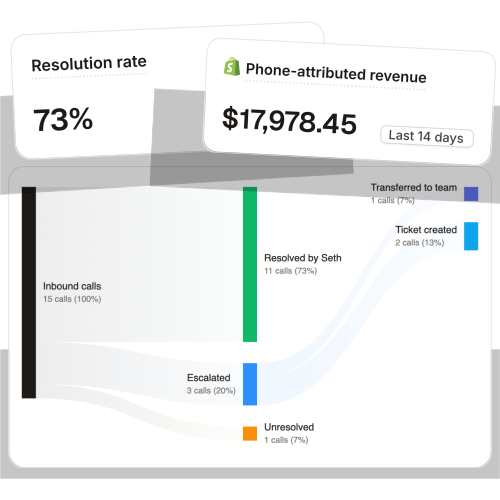
Across 50+ brands the AI resolves about 73% of inbound calls on its own, and the other 27% routes to the team that should be handling it anyway. That split is the point. Your reps stop answering the same roast-date question 40 times a day and get the calls that actually need a person.
What this looks like with Ringly
Ringly.io is AI phone support for Shopify brands. Your team wasn't hired to answer the same call 50 times a day, so the AI takes the routine inbound calls and leaves the ones that need a human to your people.
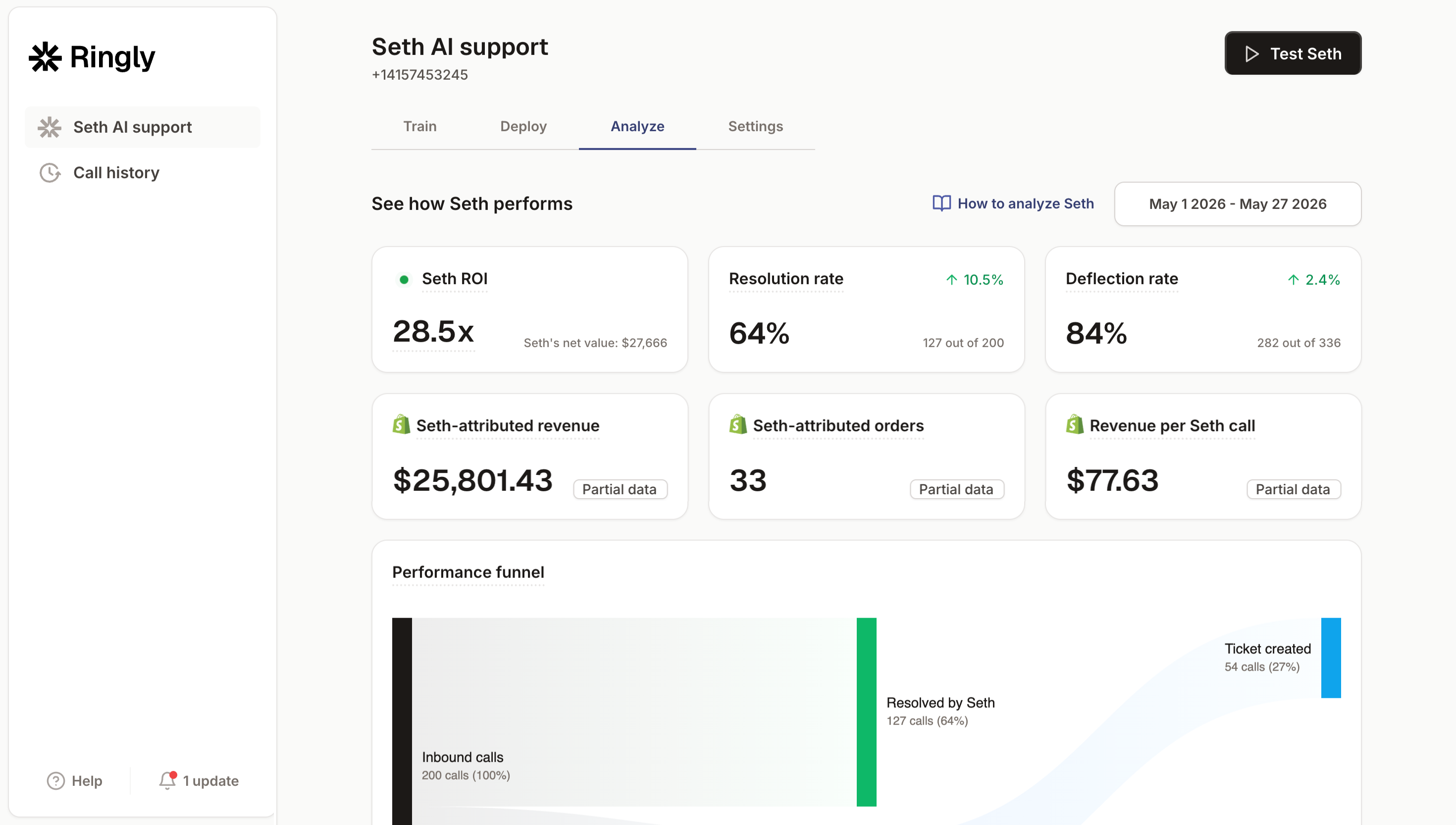
The AI answers inbound calls 24/7. It finds orders in your Shopify store, confirms roast and ship dates, handles subscription changes, answers product questions from your knowledge base, and texts tracking links. Calls that need a human escalate cleanly to Gorgias, Richpanel, Reamaze, or whatever helpdesk you already run. You keep your number, your stack, and your workflows.
Plans run Grow at $349/mo (1,000 minutes), Pro at $799/mo (2,500 minutes), and Enterprise by call for higher-volume brands (full pricing here). You're live in under an hour. And it's backed by a 65% resolution guarantee: if the AI resolves under 65% of your calls in 90 days, we refund the last 3 months. If you want to see how it stacks against a 24/7 ecommerce phone setup you're running today, that's a quick comparison.
What it costs versus staffing the gifting season
The math is where coffee gets specific, because you don't staff for a steady line, you staff for December and pay for it all year.
A typical $20M specialty-food brand runs about 4 reps year-round and scrambles for more when the gifting spike hits:
| Line item | Cost |
|---|---|
| 4 reps × $4,000 loaded year-round | $16,000/mo ($192,000/yr) |
| 4 seasonal reps × $4,000 × 3 months | $48,000/yr peak |
| True annual CS spend | ~$240,000/yr |
Ringly Enterprise lands around $3,000 to $5,000/mo and absorbs the roast-date, ship-by, subscription, and WISMO calls year-round, spike included. Net savings tend to run $140,000 to $180,000 a year depending on volume. Per call, the comparison is $0.42 per resolved call against $7 to $16 for a human-handled call at a typical outsourced support operation.
The seasonal reps you hire in November take weeks to get good at your catalog and are gone by February, while the AI knows your roast policy on day one and doesn't quit.
If you want to run your own numbers against what you're spending now, book a 30-min call and we'll do the math live on your call volume.
Getting it live before the holiday spike
The mistake I see coffee brands make is waiting until the December calls are already piling up. By then you're staffing in a panic and the AI hasn't had time to learn your catalog. Set it up in the slow months and it's ready when the gifting wave hits.
The good news is the setup is short. Here's roughly what it takes:
- Point it at your store. The AI reads orders straight from Shopify, so checking order status and shipping works the moment it's connected. No data migration.
- Feed it your knowledge base. Your roast-to-ship policy, your freshness window, your subscription rules. Drop in your docs and the AI answers from them instead of a generic script.
- Set the handoff rules. Decide which calls escalate to a human (the upset, the spoiled-gift, the wants-a-refund) and which stay automated. This is a 15-minute conversation, not a project.
- Keep your number. You don't get a new line or ask customers to change anything. Calls come into the same number, the AI just picks up the ones your team can't.
A self-serve plan is live in under an hour, and an Enterprise build runs a 14-day Launch Sprint, so even a late-October start has you covered before the December rush. The point is to do it while the line is quiet, not while it's ringing off the hook.
Frequently asked questions
Can an AI really answer coffee customers' calls without sounding like a robot? Yes, and voice quality is the thing most coffee brands worry about because their buyers skew older. The most common reaction after a call is that people didn't realize they weren't talking to a person. You can hear it yourself before you commit.
Can it take an order over the phone? Not the full order with a card number, that's an honest limitation. Instead it texts the caller a checkout link to tap and pay, or transfers them to a human when one's available. If most of your revenue comes from phone orders, it's worth flagging that on a call.
What happens with roast date or freshness questions? The AI answers from your knowledge base, so it uses your actual roast-to-ship policy rather than a generic line. It can pull the specific order, confirm the roast and ship date, and text the details so the customer has them in writing.
Will it work with my Shopify store and my helpdesk? Yes. It reads orders directly from Shopify and escalates the calls that need a human into Gorgias, Richpanel, Reamaze, or whatever you already run. You don't replace your stack, the AI sits in front of it.
What about the emotional calls, like a gift that arrived spoiled? Those should not go to the AI, and a good setup routes them away on purpose. You hard-code a handoff rule so upset, high-stakes, or perishable-complaint calls transfer straight to your team while the routine calls stay automated.
How much does AI phone answering cost for a coffee brand? Plans start at $349/mo on Grow and $799/mo on Pro, with Enterprise priced by call for higher-volume brands. Against roughly $7 to $16 per human-handled call, the AI runs about $0.42 per resolved call.
How fast can we get it live before the holiday rush? Live in under an hour for the self-serve plans. For an Enterprise build we run a 14-day Launch Sprint, so even starting in late October you're answering calls before the December spike.
Talk to us

If you run a Shopify coffee brand and your phone rolls to voicemail the second the roastery closes, a 30-min call is the fastest way to see what those missed calls are actually worth. We'll pull a week of your real call patterns and walk through what the AI would have handled.
The 3-layer guarantee.
- Live in 14 days or it's free until launched.
- 65% resolution in 90 days or we refund the last 3 months of subscription fees.
- We keep working free until we hit 65%.
Ruben (Ringly co-founder) takes these calls personally.