
Replacing one customer service rep runs $10,000 to $20,000, and that number climbs toward $46,000 once you count the months a new hire spends ramping (Insignia Resources, 2026). The average rep quits around month 14. So when a founder or Head of CX at a $10M-$100M Shopify brand asks me whether they should outsource, the honest answer is usually "outsourcing is the wrong frame." There are three lanes, not two, and most brands pick the wrong one because nobody laid them out cleanly. We pulled the call-and-cost data from 50+ Shopify brands on Ringly to write this, and the channel split is where the decision actually gets made. If you want to skip the reading and see the math on your own numbers, book a 30-min call and we'll run it live.
This guide is for the operator running a paid helpdesk (Gorgias, Zendesk, Gladly, Re:amaze) and a visible phone line, with 3 to 12 reps and a support backlog eating most of the payroll. If that's you, the question isn't "outsource or not." It's which work goes where. Book a 30-min call and we'll map your channels against your actual call volume, no deck.
This post in 30 seconds.
- Outsourcing is not one decision. It's three: keep it in-house, hand it to a BPO, or automate the routine. Pick the wrong lane and you either overpay or hurt the brand.
- Split the call by channel. Email and chat outsource cleanly. Phone is the channel that quietly breaks the math, and it's where automation beats both in-house and a BPO on cost per resolution.
- Built for $10M-$100M Shopify brands running a paid helpdesk and a visible phone number, where the same five questions eat 60-80% of CS payroll.
The real cost of keeping it all in-house
Before you decide whether to hand support off, get honest about what the in-house version actually costs. It's never just the salary line.
A US rep runs about $4,000/mo fully loaded once you add benefits, payroll tax, training, and the dead time between shifts. That's the easy number. The expensive number is churn. Customer service turnover sits at 40-45% a year in 2026, average tenure is 14 to 15 months, and 69-73% of new reps quit inside their first year (Insignia Resources). You hire, you spend six to eight months getting someone productive, and they're gone before the investment pays back.
Put plainly: keeping support fully in-house means you're not really buying coverage, you're renting a hiring problem that resets every 14 months. That's the churn tax, and it never appears on the salary line.
Then there's the work itself. Across the brands we've looked at, 60-80% of inbound CS is the same handful of questions: where's my order, can I return this, does this ship to Canada, the same five things over and over. You're paying experienced reps a loaded rate to read tracking numbers off a screen, and WISMO calls alone account for a big chunk of it. That's the part that makes the "should I outsource" question worth asking in the first place. If you want the full breakdown of where the money goes, our customer service cost statistics page has the numbers.
In-house isn't wrong. It's right for a specific kind of work, which we'll get to. But if your team is mostly answering repeatable tickets, you're spending senior-rep money on junior-rep work, and the churn tax never stops.
When outsourcing actually makes sense
Outsourcing earns its keep in a few clear situations. If you're in one of them, a good BPO is a real answer.
- Your volume is mostly process-driven. WISMO (where's my order) alone is 30-40% of tickets, and over half during peak (Salesforce). Order status, simple returns, address changes: these follow rules, so a trained outside team can run them without deep brand knowledge.
- You get violent seasonal spikes. If BFCM triples or quintuples your ticket count, a BPO lets you flex up for six weeks without hiring eight people you'll lay off in January.
- You need 24/7 or multilingual coverage you can't staff. An outside team in another timezone covers nights without asking your reps to work the graveyard shift.
The cost case is real too. Done right, outsourcing cuts support spend 40-60% (Shopify), because a US agent at $17-26/hour gets replaced by an offshore agent at $10-15/hour. We've broken down the providers worth a look in our Shopify customer support outsourcing guide, the best call center outsourcing companies, and the deeper BPO-for-Shopify breakdown walks through how the contracts actually price.
Read that list back and one thing stands out: the strongest signal you should outsource is that your tickets are repeatable, predictable, and rule-following, and your team is drowning in them instead of doing higher-value work. If that's your queue, a BPO is a defensible call.
One rule before you sign anything: get a 2 to 4-week paid trial first. Test response quality, accuracy, brand voice, and how they handle escalations on your real tickets. A BPO that won't pilot is a BPO to walk away from.
When outsourcing backfires
Here's the part the outsourcing companies don't write about, because they're the ones selling it. Outsourcing fails in predictable ways, and the failures cost more than the savings.
The first is brand voice. An outside team doesn't know your brand the way someone on payroll does. They follow scripts, miss the nuance, and customers feel it. For a lifestyle or premium brand where the support conversation IS the product experience, a scripted reply reads as a downgrade, and you find out about it in a 1-star review.
The second is complex or technical products. If your reps need real product knowledge to answer well, a rotating offshore team will follow the script too rigidly and get it wrong on the calls that matter most.
The third is the founder-relationship brand. Some of your customers feel like they have a personal line to you. They reference products by style number, they expect to be remembered, and they will not accept a stranger reading a script. Handing those calls off doesn't save money, it leaks loyalty.
"My customers also feel like it's a normal person. They feel like they can communicate if they have questions."
Claudia Droge, TechCraft Studio
And then there's data. Sharing customer information with a third party pulls GDPR, CCPA, and PCI into scope no matter where the agents sit. That's not a dealbreaker, but it's overhead nobody mentions in the sales call.
The line I give every founder who asks: don't outsource the work where the customer would notice the difference, outsource the work where they wouldn't. Everything in this section is a version of that one rule.
So if your support is mostly relationship-driven, technical, or central to a premium brand promise, keep that work close. The honest answer for those brands is: don't outsource it, and don't hire your way out of it either. Automate the routine layer so your in-house team has the hours to be excellent on the calls that count.
Split the decision by channel
This is the piece every other guide skips, and it's the one that changes the answer. "Customer service" isn't one thing. Email, chat, and phone have completely different economics, and the right lane is different for each.
Email and chat are text. They're asynchronous, easy to script, easy to QA, and easy to template. A BPO or a helpdesk AI handles them cleanly because the work is process-driven and you can review transcripts after the fact.
Phone is the hard one. It's live, it's synchronous, the caller hears tone and hesitation, and you can't review it after the fact, the moment already happened. Phone is also your most expensive channel to staff and the one most likely to embarrass the brand when it's outsourced to a script. It's also where after-hours hurts most: a missed call goes to voicemail, the voicemail never gets returned, and the customer buys from someone who picked up.
| Channel | Outsource to a BPO | Automate (AI) | Best lane |
|---|---|---|---|
| Cleanly, process-driven | Helpdesk AI, strong | Outsource or automate | |
| Chat | Cleanly, process-driven | Helpdesk AI, strong | Outsource or automate |
| Phone | Expensive, brand-risky, hard to QA | Resolves the routine 73% at low cost | Automate routine, escalate the hard calls |
Treat phone as its own decision. It's the channel where the in-house cost is highest, the outsourcing risk is highest, and automation has the biggest edge. If you've been lumping the phone line in with your email queue, that's where the money's been leaking. Our 24/7 ecommerce phone support guide goes deeper on the after-hours math.
The third option: automate the routine, keep humans on the hard 30%
The 2026 model that actually works on a Shopify brand isn't outsource-or-keep. It's three layers: automation handles the high-volume routine, humans (yours or a BPO's) handle the moderate stuff, and your best in-house people own the complex, high-stakes calls.
The routine 60-70% (order status, returns, product questions) is exactly the work that doesn't need a human and shouldn't be eating a senior rep's day. That's where an AI phone agent fits.
1. Ringly.io: AI phone support for Shopify brands
Ringly is AI phone support for Shopify brands. Your team wasn't hired to answer the same call 50 times a day. Instead of growing headcount every time call volume goes up, or shipping your phone line to a script offshore, the AI takes the routine inbound calls so your team can focus on the work that actually moves revenue.
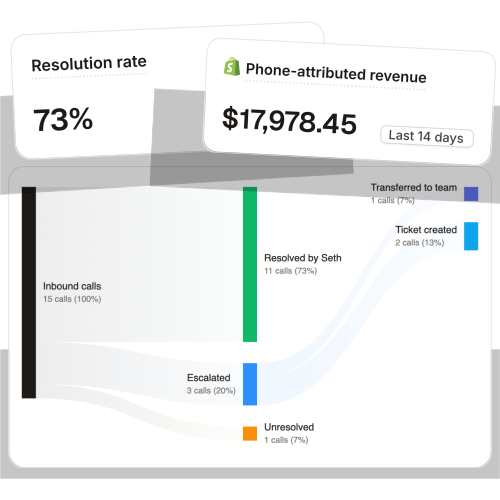
The AI answers inbound calls 24/7. It finds orders in your Shopify store, processes returns and exchanges, answers product questions from your knowledge base, and rescues abandoned carts via outbound follow-up. Across 50+ brands, the AI resolves 73% of calls autonomously at roughly $0.42 per resolved call, versus $7 to $16 per call for human BPO. Calls that need a human escalate cleanly to Gorgias, Richpanel, Re:amaze, or whatever helpdesk you already run, so you keep your stack and your control.
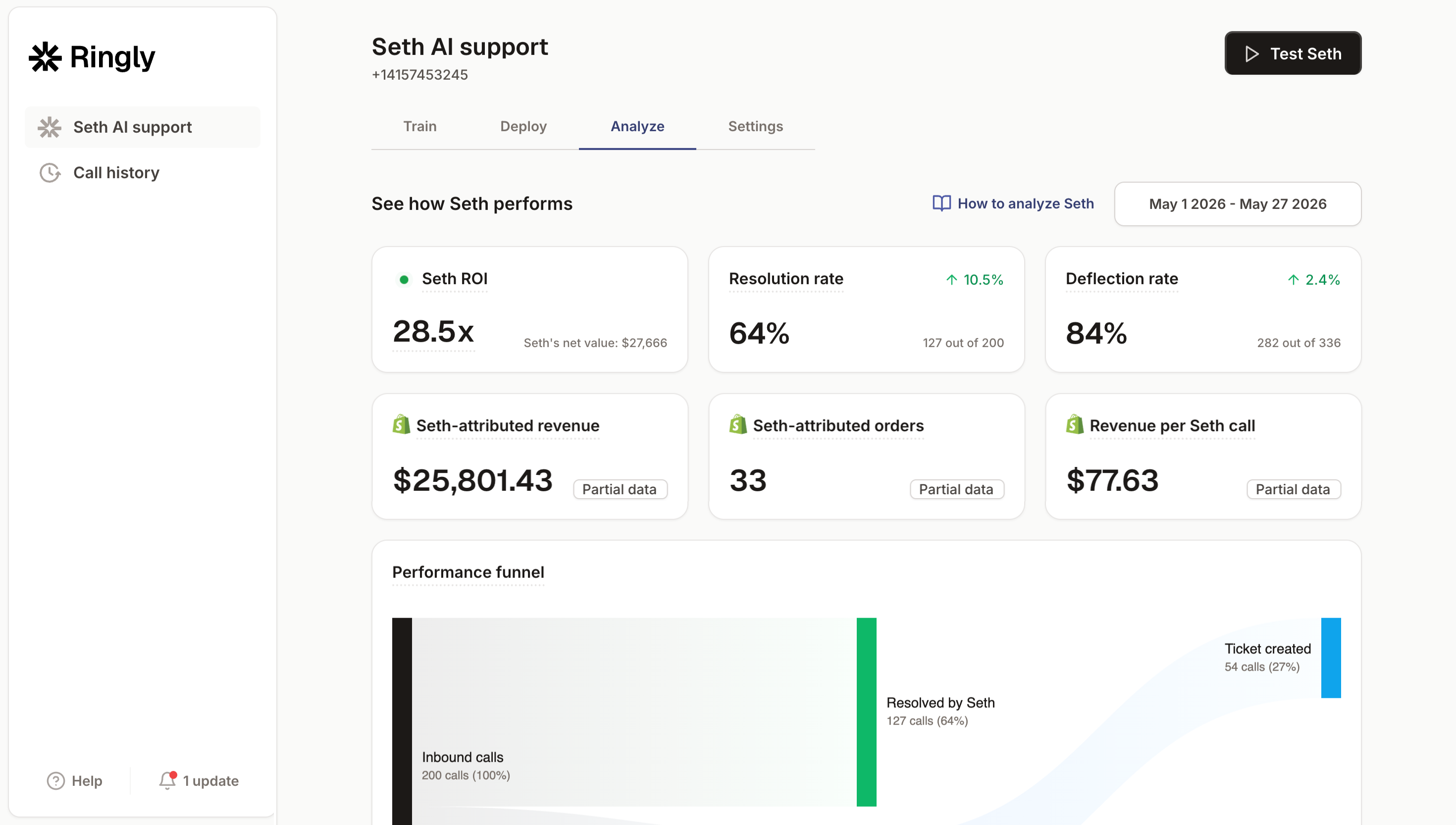
The proof is on the phone side specifically. WashCo, a Shopify brand we launched, recovered $22,664 in its first 7 days on the phone. BioLongevity Labs runs at 79% end-to-end resolution, and TechCraft Studio handles 88% of its calls without a human. That's the routine layer automated, with the hard calls still going to a person.
Pricing: Grow $349/mo (1,000 minutes), Pro $799/mo (2,500 minutes), Enterprise custom. 14-day free trial on Pro. Live in under an hour.
Where automation wins over outsourcing is the unit economics on the channel that's hardest to outsource. A BPO still costs $1.50 to $3.50 per call and still carries the brand-voice risk. The AI runs the repeatable calls at a fraction of that and never has a bad Monday. For the channel comparison in detail, see our in-house vs outsource support breakdown and the ecommerce customer service overview.
If your phone line is the channel quietly costing you the most, book a 30-min call and we'll show you what your missed calls are worth.
What it costs you today vs the alternatives
Run the math on a typical $50M Shopify brand with a 6-rep CS team.
| Line item | Today | With Ringly |
|---|---|---|
| 6 reps x $4K loaded per rep | $24,000/mo | n/a |
| Ringly Enterprise (~$5K/mo) | n/a | $5,000/mo |
| Net monthly CS spend | $24,000/mo | $5,000/mo |
| Monthly savings | n/a | $19,000/mo |
| Annual savings | n/a | $228,000/yr |
That's roughly 70% of repeatable calls (order status, returns, product questions) routed to the AI. The other 30%, the genuinely complex calls, still go to your CS team, who now have the hours to actually solve them. Compare that to outsourcing, where you cut maybe 40-60% of cost but inherit the brand-voice and quality-control risk on every call. The full pricing is public if you want to model your own volume, and Shopify Plus brands tend to see the spike pattern most.
Want to compare all three lanes against your real numbers? Book a 30-min call and we'll do the math live.
The decision in one table
Strip it down to your situation and the lane that fits.
| Your situation | Recommended lane |
|---|---|
| High volume of repeatable email/chat tickets, predictable rules | Outsource email/chat to a vetted BPO |
| 3x-5x seasonal spikes you can't staff | BPO for the spike, automate the steady-state routine |
| Phone line going to voicemail after hours | Automate the routine calls, escalate the hard ones |
| Premium brand where support IS the experience | Keep complex work in-house, automate the routine layer |
| Complex/technical product needing real expertise | Keep in-house, never script it offshore |
| Senior reps stuck reading tracking numbers all day | Automate the routine, redeploy the team |
Choose a BPO if your tickets are text-based, rule-following, and your main problem is volume. Choose to automate if phone is your pain and the routine is eating your team. Choose in-house for the calls where a customer would notice a stranger on the line. Most $10M+ brands end up running all three at once, which is the point: it was never one decision.
Frequently asked questions
At what revenue should I outsource Shopify customer service?
There's no clean revenue line, it's about ticket volume and channel mix. Below roughly $2.4M/yr you usually don't have the volume to justify a dedicated outside team. Above $10M, the better question is what to automate versus what to staff, not whether to outsource everything.
Is offshore outsourcing really cheaper?
On the sticker price, yes: $10-15/hour versus $17-26/hour in the US. But once you add management overhead, training cycles, and the churn a BPO carries too, the per-resolution cost narrows. On phone specifically, an AI agent at roughly $0.42 per resolved call beats both.
Can I outsource only phone support?
You can, but it's the channel where outsourcing carries the most risk: live, unscriptable, and brand-sensitive. Most Shopify brands get a better result automating the routine phone calls and escalating the complex ones, rather than shipping the whole line to a BPO script.
Will outsourced agents hurt my brand voice?
They can, especially for premium or founder-led brands where customers expect to be remembered. Outside teams follow scripts and miss nuance. Keep the relationship-heavy and technical work close, and only outsource the process-driven tickets where the customer wouldn't notice a difference.
Outsource vs AI: which is better for a Shopify store?
For the repeatable, high-volume work, AI wins on cost and consistency, especially on phone, where it resolves 73% of calls autonomously. For moderate-complexity overflow, a BPO still has a role. The 2026 answer is usually both, layered, not one or the other. Our AI receptionist for ecommerce guide covers how the phone layer works.
What should I keep in-house no matter what?
The calls where a customer would notice a stranger: high-value complaints, technical product questions, retention saves, and anything tied to your brand's personal relationship with its buyers. Automate the routine so your in-house team has the hours to be excellent on those.
Talk to us

If you run a $10M-$100M Shopify brand and your phone line is the channel quietly costing you the most, a 30-min call is the fastest way to see the math on your own numbers. We'll split your channels, show you what's cheap to outsource and what's expensive, and run the resolution math live.
The 3-layer guarantee.
- Live in 14 days or it's free until launched.
- 65% resolution in 90 days or we refund the last 3 months of subscription fees.
- We keep working free until we hit 65%.
Ruben (Ringly co-founder) takes these calls personally.