
This post in 30 seconds.
- Coffee brands get more phone calls than almost any other ecommerce, and they're nearly all the same handful of conversations: where's my order, will it still be fresh, change my gift's ship date, pause my subscription, place an order because the website feels fiddly.
- An AI phone agent answers those calls 24/7, sees the order in Shopify, and acts on it. It hands the genuinely complex calls to your team with the context already attached. The one thing it won't do is take a credit card over the phone.
- Built for $10M-$100M Shopify coffee brands running a paid helpdesk with a visible phone number on the site.
Coffee is one of the few ecommerce categories where customers still pick up the phone. A real chunk of specialty coffee revenue comes from people who'd rather call than tap through a checkout. Only about 12% of 55-to-64-year-olds like paying through an app, versus 45% of the under-25s (Attest, 2025), and a lot of those older buyers are loyal, high-frequency coffee drinkers. So they call. Then there's the freshness anxiety on a perishable bag, the gift order that has to land by a specific date, and the December gifting spike that triples your volume for six weeks. Stack those up and the phone is busy in a way it just isn't for most brands.
If you run a $10M-$100M Shopify coffee brand, you already know what happens to those calls after the roastery closes: they go to voicemail, and the voicemails sit. Around 80% of callers routed to voicemail hang up without leaving a message (Eden), and the average business answers only 37.8% of its inbound calls (AmbsCallCenter). That's the gap an AI phone agent for coffee brands is built to close. If your line is the leaky part of your support, book a 30-min call and we'll do the math on what those missed calls are worth.
What an AI phone agent actually is for a coffee brand
Strip away the category noise (a lot of "AI agent for coffee" results are about robot baristas and in-store POS, which is not this) and it's simple. An AI phone agent answers your inbound support line, talks to the caller like a person, and resolves the call. For a coffee brand, the useful version does three things in one breath: it picks up around the clock, it can see the caller's order in your Shopify store, and it can actually do something with that order.
That last part is the whole game. A voice agent that can talk but can't touch the order is just a more expensive answering machine. Plenty of tools will read a script and take a message. The one you want pulls up the order, sees that the dark roast subscription renews on the 14th, texts the customer a tracking link, and pauses the next shipment, all on the call. Ringly is an AI phone agent built for Shopify, and it does this for Shopify brands, resolving up to 90% of inbound calls on its own. The ones it can't finish, it escalates cleanly into your helpdesk with the order and the transcript attached, so your rep isn't starting from zero.
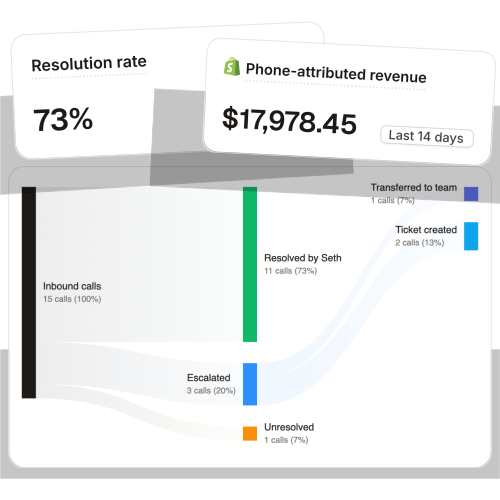
Here's the quick version of how it stacks up against the other ways coffee brands cover the phone:
| Option | Answers 24/7 | Sees and acts on the Shopify order | Cost when calls spike | Best for |
|---|---|---|---|---|
| AI phone agent (Ringly) | Yes | Yes | Flat monthly, doesn't move | Brands with steady + seasonal call volume |
| Human answering service | Yes | No (takes a message) | Per-minute, spikes in December | Pure overflow, no order actions |
| Voicemail + callback | No | No | "Free", but you lose the call | Brands fine with losing after-hours calls |
| Hiring another rep | No (shifts only) | Yes | $4K/mo loaded, plus training | Brands that want a human for everything |
The agent isn't trying to be your whole support team. It's there to take the volume that's eating your team's day so the humans can handle the calls that actually need a human. Think of it the way you'd think about a great front-of-house person at the roastery: it knows the menu cold, it handles the line, and it knows when to grab the owner. The difference is it never calls in sick during peak, never needs three months of training, and the cost doesn't climb when the orders do.
The five calls it takes, and the one it can't
I sat and listened to real inbound calls at coffee brands running Ringly, and sorted which ones the agent takes on its own versus which still need your team. Coffee is unusually repetitive on the phone. WISMO ("where's my order") alone is 20-40% of ecommerce support contacts and climbs past 50% at peak (Salesforce). Here are the five that come up over and over, and the agent handles all of them:
- Where's my order, and will it still be fresh. The agent looks up the order in Shopify, gives the ship and roast date, and texts a tracking link. Freshness anxiety on a perishable bag is half of these calls, and a straight answer ends them.
- Roast, grind, and product questions. "Is the house blend a medium or a dark?" "Which grind do I pick for a moka pot?" It answers from your knowledge base, in your words, using the product names your customers actually use.
- Gift orders and delivery-date changes. Coffee gifting is time-sensitive and emotional. The agent checks the arrives-by date, moves a ship date, and flags the order if a change can't be made.
- Pause, skip, or cancel a subscription. Every recurring-coffee cancel is a call. The agent can pause or skip on its own, or route a cancel to your team if you'd rather a human try the save.
- After-hours and weekend overflow. These are the calls currently hitting voicemail. Roasteries keep roastery hours; customers call on Sunday morning. The agent picks up.
The one it can't do: take a credit card over the phone. This matters in coffee specifically, because some of your older customers call precisely to place an order. We don't process card payments on a call. What the agent does instead is text the caller a secure payment link to finish the order themselves, or transfer them to a human with the cart already built. It's an honest limit, and I'd rather name it than sell you a feature that doesn't exist. WashCo, a Shopify brand we launched, recovered $22,664 in its first 7 days on the phone, and none of that came from the agent reading out card numbers.
How I sorted which coffee calls the agent can take
I'm Ruben, co-founder of Ringly. The list above isn't from a spec sheet. It's from sitting with the real call data across the Shopify brands on Ringly and pulling out what coffee brands actually get asked, then checking what the agent could finish without a human.
Here's what I scored each call type against:
- Could it see the order? I checked that the agent pulls the live Shopify order on the call, not a cached copy from last night.
- Could it act, not just talk? I tested whether it could send a tracking SMS and pause a real subscription mid-call, instead of promising to "pass it along".
- Could it answer a coffee-specific question? I asked it roast and grind questions from a real brand's knowledge base and listened for whether it sounded like the shop or like a generic bot.
- Did it escalate cleanly? For the calls it shouldn't finish, I watched whether it handed off with the order and the transcript attached, or dumped the customer into a cold queue.
- The failure mode. I stress-tested the hardest coffee call there is: an older, slightly skeptical caller who wants to pay by card over the phone. The right behavior is a graceful payment link or a warm transfer, not a dead end.
The five calls above are the ones that passed all five checks. The card-payment call is the one that didn't, which is why it's the honest exception rather than a buried asterisk.
How it connects to your Shopify store and helpdesk
The agent doesn't replace the tools you already pay for. It sits in front of them. You keep your phone number, you keep Gorgias or Zendesk or whatever helpdesk your team lives in, and the agent becomes the layer that picks up the phone before any of that gets involved.
On a call, it reads from your Shopify store and your knowledge base, then checks the order status, sends an SMS, or runs a custom action like pausing a subscription. When a call needs a person, it transfers or drops a ticket into your helpdesk with everything attached. Nothing about your existing stack has to change, which is the part most coffee operators don't expect.
Setup is fast. You point it at your website and knowledge base, connect Shopify, and it's live in under an hour for the self-serve plans. For brands that want it done for them, we build and tune the whole thing, so your team isn't the implementation crew. If you've read our guide to coffee brand phone support, this is the layer that does the picking-up. The agent also speaks 40 languages, which matters if you ship internationally or serve a mixed customer base.
What it costs vs an answering service
This is where coffee brands usually flinch, because the obvious comparison is a human answering service, and those bill by the minute. Per-minute pricing punishes you at exactly the worst moment: the December gifting spike, when call volume is highest and every minute is metered.
Run the math on a typical $20M coffee brand. You're probably carrying around 4 reps year-round at roughly $4,000/mo loaded each, so $16,000/mo. Then you staff up for Nov-Dec gifting, another 4 seasonal reps for three months, call it $48,000 on top. True annual support spend lands near $240,000. An AI phone agent handles the roast-date, grind, gift-order, WISMO, and subscription calls year-round, and it absorbs the gifting spike without the seasonal hiring scramble.
On a per-call basis it's not close. An in-house rep call runs about $2.70 loaded; the agent handles a call for $1.99 after the first 50, versus $7-$16 a call at a human BPO. And spam, hang-ups and wrong numbers are free. The cost of a missed call is the quiet one: 62% of people who can't reach you switch to a competitor, and 85% never call back (PCN, 2026). For a coffee brand with a loyal, phone-first base, that's churn you never see on a dashboard.
Want to see what the swap looks like against your actual numbers? Book a 30-min call and we'll do the math live.
Will your older coffee customers accept an AI on the phone?
This is the real objection, and it lands harder in coffee than anywhere else, because the phone-first customers skew older and more skeptical. Fair. Nobody wants their most loyal buyer to feel handed off to a robot.
Here's what actually happens. The single most repeated thing customers say after a call with our agent is "you don't sound like AI." It knows your roast names, your shipping windows, and your return policy, so it feels like calling the shop, not a call center menu. TechCraft Studio runs 88% of its calls without a human, and their founder put it plainly:
"My customers also feel like it's a normal person. They feel like they can communicate if they have questions."
Claudia Droge, TechCraft Studio
The test isn't whether the caller can tell it's AI in a lab. It's whether they hang up with their problem solved and their day better. You can hear it yourself before you decide anything, which is the point of a voice AI for coffee customer service demo. And for the calls where a human really is better, the after-hours coverage just routes them to your team instead of voicemail.
Gear Rider, on the volume side, closed 1,595 sales and support calls in 90 days without a single phone rep, which tells you how much routine volume a good agent absorbs before a human is needed at all. The brands that get this wrong treat the agent as an all-or-nothing switch. The ones that get it right set it loose on the repetitive 70% and keep their people for the calls that build the relationship: the regular who wants a recommendation, the gift gone wrong, the wholesale lead. You can read more on 24/7 ecommerce phone support if you want the broader picture, or check the pricing to see where you'd land.
Frequently asked questions
Can an AI phone agent take a card payment over the phone for a coffee order? No, and we won't pretend otherwise. The agent texts the caller a secure payment link to finish the order, or transfers them to a human with the cart already built. It handles everything around the order, just not the card itself.
Will it work with my Shopify subscription app for pause, skip, and cancel? Yes. Pausing and skipping a recurring coffee order is one of the calls it handles on its own. Cancels can be auto-handled or routed to your team if you'd rather a person attempt the save first.
Does it replace my helpdesk like Gorgias or Zendesk? No. It sits in front of your helpdesk and keeps your existing number. Calls that need a human escalate into Gorgias, Zendesk, Re:amaze, or whatever you already run, with the order and transcript attached.
Will older coffee customers know they're talking to AI? Most don't, and the most common feedback is "you don't sound like AI." Because it knows your roast names and shipping windows, it feels like calling the shop. For anyone who'd rather speak to a person, it transfers cleanly.
How fast can a coffee brand get an AI phone agent set up? Live in under an hour on the self-serve plans once you connect Shopify and point it at your knowledge base. We can build and tune it for you, so your team isn't the setup crew.
What does it cost vs a human answering service? You pay per call, not per minute: $99 a month for the first 50 conversations, then $1.99 each, against $7-$16 a call at a human BPO.
Is there a guarantee it'll actually resolve calls? Yes. If Seth resolves under 65% of your calls in a month, that month comes back as credit (after 90 days on Pay per call).
Talk to us

If you run a $10M-$100M Shopify coffee brand and your line goes to voicemail after the roastery closes, a 30-min call is the fastest way to see what those missed calls are costing you. We'll pull the kinds of calls your store gets and show you which ones the agent takes off your team's plate.
Our 3 promises.
- Live in under 1 hour. Setup and test calls are free.
- 30-day money back on the $99 plan fee.
- 65% resolution guarantee: if Seth resolves under 65% of your support calls in a month, that month comes back as credit (after 90 days on Pay per call).
Ruben (Ringly co-founder) takes these calls personally.