
Commerce is now a conversation
More and more shoppers prefer using AI assistants to find products in 2026.
You have spent years perfecting your site navigation, but the way your customers buy is shifting faster than ever.
You know that if your brand isn't where the "conversations" are happening, you are leaving six figures on the table every single month.
Shopify has just launched its agentic storefronts, agentic storefront to turn your product catalog into a living feature in ChatGPT.
First, we will look at how this tech puts your brand inside tools like ChatGPT and Gemini.
Then, we will show you how to automate your phone support to handle the new wave of sales this feature creates.
Editor’s note: Want to hear some sample AI support calls made for your Shopify store?
- Just paste your store URL
- Get sample calls in under 20 seconds (no email required)
- Listen to demo calls for my store

What does this mean for you? It means your store has a new sales channel that connects you directly to AI chat platforms like Google's AI Mode in Search, the Gemini app, and Microsoft Copilot.
The goal is to meet customers where they’re already asking questions and making decisions.
In this guide, we'll walk through everything you should know. We’ll cover what an agentic storefront is, how to get one set up, the tech behind it, what the customer journey feels like (including a pretty big catch), and the pricing models available.
What is an agentic storefront Shopify?
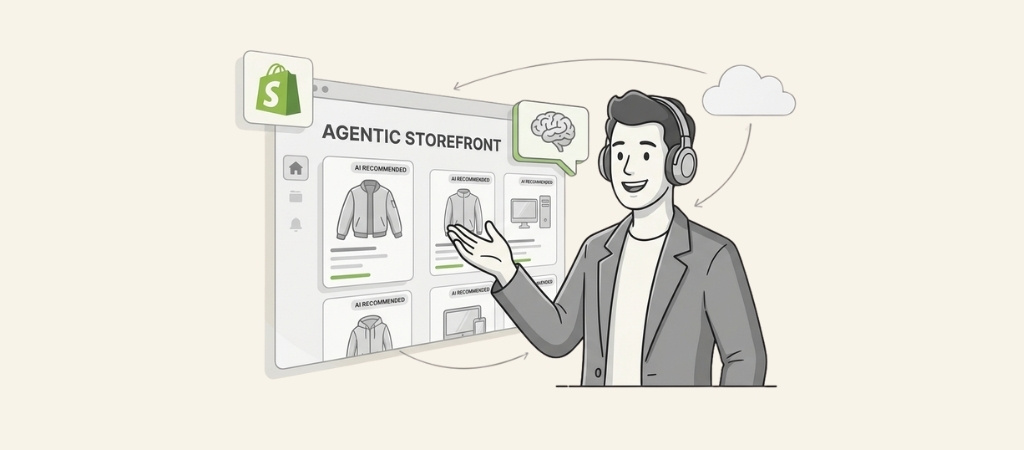
Think of an agentic storefront as a system that lets an AI assistant become a personal shopper for your customers. It can find your products, suggest them, and sell them, all inside a chat.
The AI stops being just a search engine and turns into a helper that actually accomplishes tasks for the user.
Shopify's version is a new sales channel that links your product catalog directly to the biggest AI platforms. The agentic storefront on Shopify is basically a bridge.
It gives AI like ChatGPT, Microsoft Copilot, and Perplexity real-time access to your product info, pricing, and inventory, so they can talk about your products intelligently.
This isn't just a simple link, though. A couple of key technologies are working behind the scenes:
- Shopify Catalog: This is Shopify's huge, central system for organizing product data from millions of merchants. It uses special Large Language Models (LLMs) to automatically categorize and enrich information. This makes sure that when an AI agent looks at your products, it understands what they are and how to present them correctly.
- Universal Commerce Protocol (UCP): Shopify co-developed this open standard with Google. UCP is like a universal language that helps different AI agents, your store, and payment systems communicate securely. It's what lets the AI handle things like applying discount codes or recognizing loyalty benefits right inside the chat.

How the agentic storefront Shopify works for merchants
Getting your store ready for this new channel might sound like a headache, but Shopify has tried to make it as simple as possible. Here’s what you can expect in terms of features and controls.
Centralized setup for your agentic storefront Shopify across AI platforms
Shopify's goal is to keep things simple. They're building this so you have a single, one-time setup inside your Shopify Admin.
You connect your store once, and your products can then show up across AI platforms without you needing to build a custom integration for each one.
This single setup makes your products discoverable through ChatGPT in agentic storefronts and on some of the biggest names in AI, including:
- ChatGPT
- Microsoft Copilot
- Perplexity
- And soon, in AI Mode in Google Search and the Gemini app.
Just remember, this is a brand-new feature being rolled out in stages. If you don't see it in your admin panel yet, don't worry. Many merchants are on a waitlist, so it’s just a matter of time before it's more widely available.
Maintaining brand control with your agentic storefront Shopify
Letting an AI handle sales conversations might sound a little scary, but Shopify has built-in tools to help you keep control of your brand.
You can use the Knowledge Base App to upload all your key info, like FAQs, return policies, and brand voice guidelines.
This is how you "teach" the AI agent to give accurate, on-brand answers to customer questions, making it sound less like a generic robot and more like one of your team members.
The tool also helps you structure your product data correctly. Making sure your schema, attributes, and metafields are clean and organized is really important.
When your data is well-structured, AI agents can present your products consistently and correctly, which makes for a much better customer experience.
Managing channels and measuring success for your agentic storefront Shopify
You always get the final say on where your products show up. From your Shopify admin dashboard, you can see all the available AI platforms and just toggle them on or off. If you decide ChatGPT isn't a fit for your brand, you can switch it off with a click.
You also won't be guessing about performance. Every order that comes through an agentic storefront goes directly into your Shopify Admin with full attribution.
You'll see exactly which AI channel brought in the sale, so you can track your ROI and make smart decisions about where to focus your energy.
The agentic storefront Shopify customer experience and its key limitation
While buying through an agentic storefront is incredibly smooth, the journey isn't perfect. There’s a big gap that appears right after the purchase is made.
The new path to purchase with an agentic storefront Shopify
Let's imagine how this works for a shopper. Someone is chatting with an AI assistant and asks, "Find me a waterproof jacket from a sustainable brand."
The AI can now check Shopify's catalog, show relevant products from stores like yours, and answer any follow-up questions about materials or sizing.
Once the customer makes a decision, they can check out right in the chat window using Shopify's fast and trusted checkout without ever leaving the conversation.
As the merchant, you get the sale and, just as importantly, you keep full ownership of the customer relationship and their data. It’s pretty seamless.
The post-purchase support gap with an agentic storefront Shopify
But here's the problem: that smooth, conversational vibe disappears the moment the payment is confirmed. Agentic storefronts are designed for pre-sale discovery and conversion, not for what comes after.
So when that same customer asks, "Where is my order?" or "How do I start a return for this jacket?", they can't ask the AI that just helped them.
The conversation just stops. This transition can create a disjointed experience, moving the customer from a smooth, conversational purchase to a traditional support channel like phone or email.
This is where a complete conversational strategy is so important. While Shopify’s agentic storefronts are handling the sales conversation, another tool is needed for the post-purchase side.
For example, platforms like Ringly.io provide a 24/7 AI phone agent named an AI agent that handles those exact post-purchase questions. the AI can look up orders, process returns, and answer FAQs over the phone, creating a more consistent conversational experience. This addresses the other half of the conversational commerce journey.

Pricing for your agentic storefront Shopify tools
Shopify is offering two ways to get started with agentic commerce, depending on whether you're already on their platform.
For existing Shopify merchants
If you already have a Shopify store, the Agentic Storefront will work like a new sales channel, much like the Facebook or TikTok channels. Based on Shopify's initial announcements, it seems to be an integrated feature for merchants.
However, Shopify hasn't yet said whether there will be any specific transaction fees for this channel. We'll have to wait for more details as the feature becomes more widely available.
For brands on other platforms (the Agentic plan)
For brands that do not use Shopify as their main e-commerce platform, there's a new option called the Agentic plan. This is for businesses that want their products to appear in AI-powered conversations without moving their entire online store.
It lets them upload their product catalog to Shopify Catalog and start selling through agentic storefronts.
Right now, specific pricing for the Agentic plan hasn't been released. If you're interested, you can sign up for the waitlist to be the first to get updates.
Here’s a quick comparison of the two options:
| Feature | For Existing Shopify Merchants | For Non-Shopify Merchants (Agentic Plan) |
|---|---|---|
| Primary Goal | Add AI chats as a new sales channel to an existing store. | Syndicate products to AI channels without migrating the core store. |
| How it Works | Enable via the Shopify Admin as a new sales channel. | Sign up for the Agentic plan and connect product data to Shopify Catalog. |
| Prerequisites | An active Shopify store. | A product catalog on another platform (e.g., Magento, BigCommerce). |
| Pricing | Included as a sales channel (fee structure TBC). | Standalone plan pricing (To be announced). |
| Status | Phased rollout to existing merchants. | Waitlist available for early access. |
Is your store ready for an agentic storefront Shopify?
The takeaway here is pretty simple: the agentic storefront on Shopify is more than just a cool new feature. It's a powerful new channel for getting your products found and sold by putting your brand right inside the AI conversations where your future customers are spending their time.
To see how Shopify thinks about this new channel, check out their official announcement video which breaks down the concept of Agentic Storefronts.
A video from Shopify explaining what an agentic storefront Shopify is and how it helps brands get discovered in AI chats.
But the bigger story is the shift toward conversational commerce. Winning in this new landscape won't just be about showing up in AI chats for the first sale.
Real success will come from offering a consistent, helpful, and smooth conversational experience across the entire customer journey, from discovery all the way to post-purchase support.
So, as you think about what's next, you can start taking action now. Get your product data cleaned up and organized. Document your brand voice and policies so they're ready for a knowledge base. And most importantly, start thinking about your post-purchase strategy, so you're ready to complete the conversational circle.
Ringly.io: AI phone support for Shopify brands
Ringly is AI phone support for Shopify brands. Phone support, without the payroll. Instead of growing your support headcount every time call volume goes up, the AI takes the routine inbound calls so your team can focus on the work that actually moves revenue.
The AI answers inbound calls 24/7. It finds orders in your Shopify store, processes returns and exchanges, answers product questions from your knowledge base, and rescues abandoned carts via outbound follow-up. Across 50+ brands, the AI resolves 73% of calls autonomously at roughly $0.42 per resolved call. Calls that need a human escalate cleanly to Gorgias, Richpanel, Reamaze, or whatever helpdesk you already run.
Ringly prices per phone conversation (see Ringly's pricing), with a custom plan for high volume. Try it for free. Most brands go live in under an hour. If Seth resolves under 65% of calls in a month, you don't pay for that month.
What exactly is an agentic storefront Shopify?
An agentic storefront Shopify is a sales channel that connects your product catalog to AI chat platforms like ChatGPT and Gemini. It allows these AI assistants to act as personal shoppers, recommending and selling your products within a conversation.
How do I set up an agentic storefront Shopify for my business?
Shopify is rolling out a centralized setup in the Shopify Admin. The idea is a one-time connection that syncs your products across multiple AI platforms. If you don't see the option yet, you may be on the waitlist as it's a phased rollout.
What are the main limitations of using an agentic storefront Shopify?
The biggest limitation is the post-purchase support gap. The agentic storefront Shopify is great for sales, but once a purchase is made, the AI can't help with questions like "Where is my order?" or return requests. Customers have to switch to traditional support channels like phone or email.
Is there a specific fee for using the agentic storefront Shopify channel?
For existing Shopify merchants, it will be a new sales channel. Shopify hasn't confirmed if there will be specific transaction fees yet. For businesses on other platforms, there will be a standalone "Agentic plan," but pricing for that has not been announced.
Can I use an agentic storefront Shopify if my e-commerce store isn't on Shopify?
Yes. Shopify is introducing a new "Agentic plan" specifically for this purpose. It allows brands on other platforms like Magento or BigCommerce to upload their product catalog and use the agentic storefront feature without migrating their entire store.
How does an agentic storefront Shopify help me maintain brand control?
Shopify provides a Knowledge Base App where you can upload your FAQs, return policies, and brand voice guidelines. This helps "train" the AI agent to provide answers that are accurate and consistent with your brand's tone.