
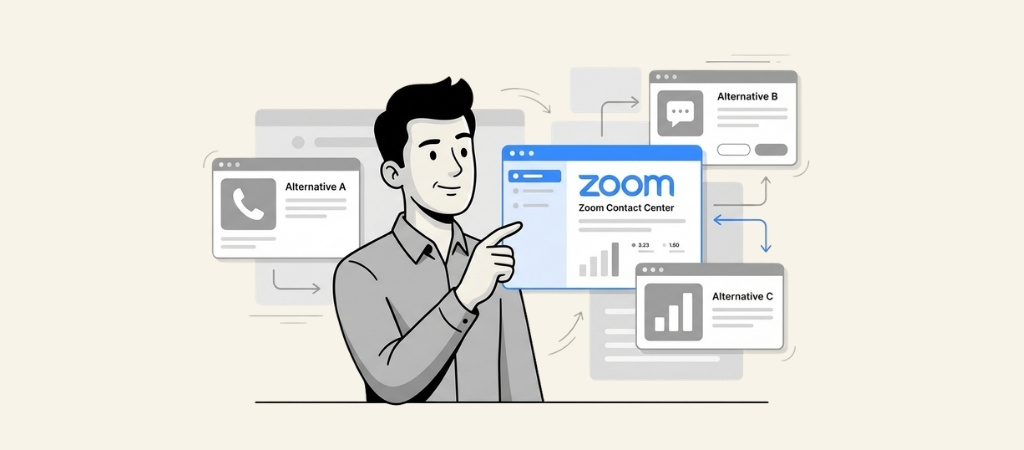
Zoom Contact Center starts at $69 per user per month, but that price tag doesn't always match what teams actually need.
Maybe you're looking for better AI features, simpler pricing, or a platform that doesn't require months of setup. Whatever your reason, you're not alone.
Plenty of teams are exploring alternatives that better fit their specific workflows and budgets.
This guide covers 7 Zoom contact center alternatives worth considering in 2026.
Each one brings something different to the table, from AI-powered transcription to enterprise-grade workforce management.
Editor’s note: Want to hear some sample AI support calls made for your Shopify store?
- Just paste your store URL
- Hear sample calls for your store (no email required)
- Listen to demo calls for my store
What is Zoom Contact Center?
Zoom Contact Center is Zoom's entry into the contact center as a service (CCaaS) market. It builds on their video conferencing success, adding omnichannel support, AI chatbots, and visual IVR to handle customer interactions across voice, video, and digital channels.
Pricing runs from $69 to $149 per user per month depending on features. The platform integrates naturally with Zoom Meetings, which is convenient if your team already lives there. But the pricing can jump quickly with add-ons, and some teams find the feature set limiting compared to dedicated contact center platforms. Setup also tends to take longer than advertised, especially for complex routing rules or custom integrations.
Top Zoom Contact Center Alternatives at a Glance
Here's a quick comparison before we dive into the details:
| Platform | Best For | Starting Price | Key Strength |
|---|---|---|---|
| RingCentral | Unified communications | $20/user/mo | UCaaS + CCaaS combined |
| Dialpad | AI-driven insights | $15/user/mo | Real-time transcription |
| Talkdesk | Fast-growing teams | $85/user/mo | Quick deployment |
| Five9 | Outbound sales | $119/user/mo | Predictive dialer |
| Nextiva | Small businesses | $18.95/user/mo | Simple, affordable |
| Genesys | Large enterprises | $75/user/mo | Workforce management |
| NICE CXone | Regulated industries | Custom | Compliance tools |
The 7 Best Zoom Contact Center Alternatives
1. RingCentral Contact Center

RingCentral works best for teams that want their business phone system and contact center in one place. If you're already using RingCentral for calls and messaging, adding their contact center features keeps everything unified.
The platform offers three main tiers:
| Plan | Price | Key Features |
|---|---|---|
| RingEX | $20/user/mo | Business phone, messaging, video, AI assistant |
| RingEX Pro | $35/user/mo | CRM integrations, advanced analytics, SSO |
| RingEX Ultra | $45/user/mo | Device analytics, unlimited storage, premium support |
Contact center features require a base plan plus an additional module. The upside is a true all-in-one experience. Your agents can switch between internal calls and customer interactions without jumping between apps. The 99.999% uptime SLA is also reassuring if reliability is a priority.
The downside? You'll need to commit to the full RingCentral stack to get the most value. If you only want contact center software without changing your phone system, this isn't the right fit.
Pros:
- Comprehensive unified communications
- Excellent uptime and reliability
- Strong mobile apps
- 100+ integrations
Cons:
- Best value requires full stack commitment
- Contact center pricing requires sales consultation
- Can be complex for smaller teams
2. Dialpad AI Contact Center

Dialpad stands out for teams that want AI features without enterprise complexity or pricing. Their real-time transcription and sentiment analysis work impressively well, even on the entry-level plan.
Pricing is straightforward:
| Plan | Price | Key Features |
|---|---|---|
| Standard | $15/user/mo | AI meetings, unlimited calling, basic telephony |
| Pro | $25/user/mo | CRM integrations, 24/7 support, API access |
| Enterprise | Custom | 100% uptime SLA, SSO, priority support |
The AI Recaps feature automatically summarizes calls and pulls out action items. Ai CSAT predicts customer satisfaction without sending surveys. For sales teams, live coaching gives agents real-time guidance during calls.
The interface is clean and modern. Setup takes hours, not weeks. Mobile apps are genuinely useful, not afterthoughts.
The trade-off is fewer advanced features for international calling and a smaller integration ecosystem than RingCentral or Genesys. But for most small to mid-sized teams, Dialpad covers the essentials exceptionally well.
Pros:
- Best-in-class AI transcription
- Transparent, affordable pricing
- Clean, intuitive interface
- Strong mobile experience
Cons:
- Limited international calling
- Smaller app ecosystem
- Advanced features require Enterprise plan
3. Talkdesk

Talkdesk targets fast-growing teams that need to deploy quickly without hiring consultants. Their low-code workflow builder lets non-technical users create automation rules and routing logic.
Here's the pricing breakdown:
| Plan | Price | Key Features |
|---|---|---|
| Digital Essentials | $85/user/mo | Digital engagement, routing, API access |
| Voice Essentials | $105/user/mo | Everything above plus voice, speech recognition |
| Elite | $165/user/mo | Workforce management, screen recording |
| Industry Clouds | $225/user/mo | Industry-specific solutions |
Talkdesk Copilot gives agents real-time suggestions during conversations. Autopilot handles routine inquiries without human intervention. Navigator uses AI to route customers to the right agent based on context, not just queue position.
Deployment typically takes days rather than months. The AppConnect marketplace offers 60+ pre-built integrations. Industry-specific clouds for financial services, healthcare, and retail include compliance features out of the box.
The higher price point is the main drawback. Support quality also varies significantly between tiers, with lower-tier customers reporting slower response times.
Pros:
- Fast deployment
- Low-code automation
- Strong AI agent assist
- Industry-specific solutions
Cons:
- Higher pricing than competitors
- Support quality varies by tier
- Some features locked to higher tiers
4. Five9

Five9 is built for outbound-heavy operations. If you run sales teams, collections, or appointment scheduling, their predictive dialer is among the best in the industry.
Pricing starts higher than most competitors:
| Plan | Price | Key Features |
|---|---|---|
| Digital | $119/user/mo | Omnichannel, workflow automation |
| Core | $159/user/mo | Voice, IVR, ACD, CRM integrations |
| Plus/Pro/Enterprise | Custom | Workforce management, AI insights |
The predictive dialer uses algorithms to minimize agent wait time while staying compliant with regulations. Intelligent Virtual Agent handles self-service for common requests. Workforce optimization tools help with scheduling, quality monitoring, and coaching.
Five9 integrates with major CRMs including Salesforce, Microsoft Dynamics, and ServiceNow. The platform scales reliably for large contact centers with hundreds of agents.
The complexity is real. You'll need technical expertise or professional services to get the most from Five9. The interface feels dated compared to newer competitors. And while AI features exist, they lag behind Dialpad or Talkdesk.
Pros:
- Industry-leading predictive dialer
- Strong outbound campaign tools
- Reliable at scale
- Comprehensive workforce optimization
Cons:
- Complex configuration
- Higher starting price
- Less AI-focused than alternatives
- Requires technical expertise
5. Nextiva

Nextiva appeals to small and mid-sized businesses that want simple, affordable communications without sacrificing essential features. Their all-in-one approach combines business phone, video, and basic contact center capabilities.
Pricing is competitive:
| Plan | Price | Key Features |
|---|---|---|
| Essential | $18.95/user/mo | Voice, video, messaging, mobile app |
| Professional | $22.95/user/mo | Auto attendant, SMS, CRM integrations |
| Enterprise | $32.95/user/mo | Call recording, voicemail transcription |
The NextivaONE app unifies all communication channels in one interface. Call Pop displays customer information before agents answer. The platform integrates with Salesforce, HubSpot, Zendesk, and Microsoft Teams.
Setup is straightforward. Most teams can get running in a day or two without consultants. Customer support gets consistently positive reviews.
The limitation is contact center depth. Nextiva handles basic queuing and routing well, but lacks advanced features like workforce management or sophisticated AI. It's best viewed as a business phone system with contact center capabilities, not a full CCaaS platform.
Pros:
- Affordable entry point
- Easy setup and use
- Good customer support
- All-in-one communications
Cons:
- Less robust contact center features
- Limited customization
- Fewer AI capabilities
6. Genesys Cloud CX

Genesys Cloud CX is designed for large enterprises with complex requirements. If you need global deployment, deep analytics, and comprehensive workforce management, Genesys delivers.
Pricing is more accessible than you might expect:
| Plan | Price | Key Features |
|---|---|---|
| CX 1 | $75/user/mo | Voice, IVR, basic routing |
| CX 2 | $115/user/mo | Digital channels, workforce engagement |
| CX 3 | $155/user/mo | AI routing, predictive engagement |
| CX 4 | $240/user/mo | Full workforce management, advanced AI |
The AI-powered experience orchestration connects every customer touchpoint into unified journeys. Predictive routing matches customers to agents based on skills, history, and predicted outcomes. Journey analytics visualize the complete customer experience across channels.
With 350+ pre-built integrations and open APIs, Genesys fits into virtually any enterprise tech stack. Global compliance and multi-region deployment support international operations.
The trade-off is complexity. Full implementation takes months, not weeks. Teams need training to use advanced features effectively. The platform can feel overwhelming for smaller operations that don't need enterprise-grade capabilities.
Pros:
- Deep analytics and reporting
- Global scale and compliance
- Comprehensive feature set
- Strong workforce management
Cons:
- Longer setup time
- Requires training
- Higher price at upper tiers
- Complex for smaller teams
7. NICE CXone

NICE CXone leads in workforce optimization and compliance. If you're in financial services, healthcare, or any regulated industry, their built-in compliance tools and quality management are hard to beat.
Pricing isn't published publicly. You'll need to contact sales for a quote, which typically indicates enterprise-focused pricing.
The platform combines CXone Mpower with Cognigy AI for advanced conversational capabilities. Workforce optimization includes industry-leading scheduling, quality management, and coaching tools. Speech analytics analyze 100% of interactions for compliance and quality.
NICE is trusted by over 25,000 brands globally including Toyota, Sony, and Lowe's. Real results include 75% increases in customer satisfaction and millions in cost savings.
This is heavyweight software for heavyweight requirements. Smaller teams will find it overkill. Implementation requires significant time and resources. But for regulated enterprises that need bulletproof compliance and workforce management, NICE CXone is worth the investment.
Pros:
- Best-in-class workforce management
- Strong compliance features
- Advanced AI with Cognigy
- Proven enterprise results
Cons:
- No transparent pricing
- Heavyweight for smaller teams
- Complex implementation
- Enterprise-focused
How to Choose the Right Zoom Contact Center Alternative
With seven solid options, how do you pick? Let's break it down.
Start with your team size and growth plans. Small teams should look at Dialpad, Nextiva, or RingCentral. Fast-growing mid-market teams fit well with Talkdesk. Large enterprises should evaluate Genesys or NICE CXone.
Next, consider your AI and automation needs. If real-time transcription and coaching matter most, Dialpad leads. For low-code automation and quick deployment, Talkdesk excels. If you need advanced conversational AI, look at NICE CXone.
Integration requirements matter too. RingCentral works best if you want unified communications. Genesys offers the deepest integration ecosystem. Five9 connects well with traditional enterprise CRMs.
Finally, factor in setup time and training. Dialpad and Nextiva can be running in hours. Talkdesk takes days. Genesys and NICE require months for full implementation. Be realistic about your internal resources and timeline.
Ringly: A Smarter Alternative for E-commerce
If you run a Shopify store, traditional contact center software might be overkill. You don't need complex routing rules or workforce management. You need to handle order questions, returns, and "where's my package" calls without hiring a team.
Ringly.io offers a different approach. We built the AI, an AI phone rep that handles customer calls 24/7. The AI resolves around 70% of calls without human intervention: checking order status, processing returns, answering FAQs, and escalating only when necessary.
Most stores go live within an hour, not weeks. Connect your Shopify store, choose a phone number, and the AI starts answering calls immediately. No technical team required. No months of implementation.
Pricing starts at $99 a month for the first 50 conversations, then $1.99 each. No per-user fees. No complex tiers. Just transparent pricing that scales with your call volume.
If you're spending too much time on repetitive phone calls, try Ringly.io for free and see what the AI can handle for your store.
Frequently Asked Questions
What are the most affordable Zoom contact center alternatives?
Dialpad starts at $15/user/mo and Nextiva at $18.95/user/mo, making them the most budget-friendly options. Both offer solid features for small teams without the complexity of enterprise platforms.
Which Zoom contact center alternative has the best AI features?
Dialpad leads in real-time AI with live transcription, sentiment analysis, and automatic call summaries. Talkdesk also offers strong AI agent assist features, while NICE CXone provides advanced conversational AI through Cognigy.
Are there Zoom contact center alternatives specifically for outbound sales teams?
Five9 is built for outbound operations with an industry-leading predictive dialer. RingCentral and Genesys also handle outbound campaigns well, but Five9 specializes in this use case.
What Zoom contact center alternatives work best for small businesses?
Nextiva and Dialpad are ideal for small businesses. Nextiva offers simple, affordable unified communications. Dialpad provides powerful AI features at a low price point. Both are easy to set up without technical expertise.
Which Zoom contact center alternatives are best for regulated industries?
NICE CXone leads in compliance and regulatory features, making it ideal for financial services and healthcare. Genesys Cloud CX also offers strong compliance tools and global certifications for regulated environments.
How long does it take to implement these Zoom contact center alternatives?
Dialpad and Nextiva can be set up in hours. Talkdesk typically takes days. RingCentral and Five9 require weeks for full deployment. Genesys and NICE CXone implementations usually span several months for enterprise configurations.
Can I keep my existing phone number when switching from Zoom Contact Center?
Most alternatives support number porting. RingCentral, Dialpad, Nextiva, and Talkdesk all offer number porting services. Genesys and NICE CXone also support this for enterprise migrations, though the process may take longer.