


The short version.
- Most subscription billing tools get judged on pricing flexibility. The number that actually moves your revenue is how much failed-card churn they claw back.
- 20-40% of subscription churn is involuntary: the card failed, nobody recovered it, and the subscriber lapsed without ever deciding to leave (Chargebee).
- Eight tools compared on where the recurring charge lives, the dunning engine, proration, and the support load each one creates. Built for $10M-$100M Shopify brands running recurring.
- The fork SaaS roundups skip: keep billing on Shopify (Recharge, Loop) or run a standalone engine (Stripe Billing, Chargebee, Recurly).
If you run recurring on a Shopify brand, your biggest revenue leak probably isn't a customer who got annoyed and hit cancel. It's a Visa that expired in March, a retry that ran once and gave up, and a subscriber who never knew anything went wrong. That bucket has a name. Involuntary churn, and it accounts for somewhere between 20% and 40% of all subscription losses (enComm). It's the quietest line item in ecommerce customer retention, and the most recoverable.
Most "best subscription billing software" lists are written for B2B SaaS teams picking a tool to bill seats and usage. This one is written for the person running a $10M-$100M Shopify DTC brand on recurring orders, where the same five billing questions hit your phone line every week and your CS team eats them one at a time. I set up trial accounts on each tool below and pushed a failed charge through to watch the retry engine actually work, then cross-checked against what we see across the Shopify brands on Ringly. If you want to skip the reading and have us map your recurring-billing call volume on a call, book a 30-min call and we'll do the math live.
The 8 tools at a glance
Here's the quick read before the deep dives. Pricing is current as of mid-2026 and pulled from each vendor's published rates.
| Tool | Pricing (from) | Where billing lives | Best for | Dunning strength |
|---|---|---|---|---|
| Stripe Billing | ~0.5% on recurring + Stripe fees | In Stripe | Teams already on Stripe | Solid (Smart Retries) |
| Chargebee | ~$299/mo + % of volume | Standalone | Complex pricing models | Best in the category |
| Recurly | ~$249/mo + ~0.9% | Standalone | Retry optimization | Best in the category |
| Recharge | $99/mo + 1.49% + 19¢ | On Shopify | Keeping recurring on Shopify | Strong |
| Loop Subscriptions | $99/mo + 1% GMV | On Shopify | High-volume Shopify brands | Strong |
| Maxio | Mid-hundreds/mo, custom | Standalone | B2B SaaS rev-rec | Solid |
| Zuora | $50,000+/yr | Standalone | Enterprise/global | Strong |
| Paddle | ~5% revenue share | Merchant of record | Digital products + tax | Solid |
One thing worth saying up front: Ringly isn't in that table. It isn't a billing tool and won't run your recurring charges. It picks up the phone calls your billing tool creates and can't answer. More on that near the end, after the tools that actually do the billing.
How I evaluated these subscription billing tools
I'm Ruben, co-founder of Ringly. We run AI phone support for Shopify brands, which means I sit one layer downstream of every billing tool on this list. When a charge fires, a card declines, or a renewal hits, a chunk of those customers pick up the phone. So I evaluate billing tools the way a Shopify operator does, not the way a SaaS finance team does.
Over the last few weeks I set up trial accounts on each tool, ran a recurring plan through, and forced a failed charge to watch what the retry engine did with it. Here's what I scored against:
- Where the recurring charge lives. I checked whether the subscription data stays inside the Shopify order (Recharge, Loop) or sits in a separate system you reconcile later (Stripe, Chargebee, Recurly). For a Shopify brand this is the first fork, and most roundups never mention it.
- The dunning and recovery engine. I forced a card decline and watched the retry schedule, the card-updater behavior, and the customer notifications. This is the number that moves revenue, so it got the most weight.
- Proration and plan changes. I ran a mid-cycle upgrade, a pause, and a partial refund through each tool to see whether the math came out right or needed a human to babysit it.
- Pricing transparency. I noted whether the cost was a clean monthly number or a percentage of billing volume that quietly scales with you.
- The support load it creates. Every billing event generates a customer contact. I scored how many "why was I charged" and "cancel my subscription" calls each tool's flow was likely to push onto a phone line, on top of the usual WISMO calls every store already fields.
I don't take affiliate commissions on anything below. Ringly appears at the end for what it actually is, the phone layer, not as a billing competitor it isn't.
The 8 best subscription billing tools
The tool you pick matters less than whether its dunning engine recovers the 20-40% of churn that's just a failed card. Read every section below through that lens.
1. Stripe Billing
Best for: teams already running Stripe payments who want recurring billing without adding a second vendor.

Stripe Billing is the recurring layer that sits on top of Stripe's payment stack. If your checkout is already Stripe, turning on Billing is the least disruptive path to subscriptions. It handles fixed, tiered, and usage-based pricing, prorates plan changes, and ships with Smart Retries plus an automatic card account updater.
Pricing
| Plan | Price |
|---|---|
| Starter | ~0.5% on recurring charge volume |
| Scale | ~0.7-0.8% on recurring volume |
| Plus | Standard Stripe processing (2.9% + 30¢) on top |
What works
- Cheapest serious entry point: 0.5% on recurring is well below the percentage-of-volume fees the standalone platforms charge.
- Smart Retries and card updater: the retry timing is data-driven, and expired-card updates happen automatically for major networks.
- Developer-grade API: if you have engineering, you can build almost any billing logic you want.
What doesn't
- Complex pricing needs custom code: tiered, hybrid, and unusual usage models are possible but you build the logic yourself.
- Off-Shopify: the subscription lives in Stripe, not the Shopify order, so reconciliation and the customer record sit in two places.
- Dunning is good, not best in the category: the multi-channel recovery in Recurly and Chargebee goes further than Stripe's retry logic.
Why it ranks 1st
For most Shopify brands already on Stripe, this is the highest-value starting point. Cheap, reliable, and the recovery engine is good enough to stop the obvious leaks. You graduate off it when your pricing or recovery needs outrun the custom-code budget.
2. Chargebee
Best for: mid-market brands with complex pricing that want the strongest dunning available.
Chargebee is a purpose-built subscription billing platform, not a payments layer with billing bolted on. It handles recurring, usage-based, tiered, and hybrid models, and its proration holds up on the messy mid-cycle scenarios that break naive setups. Reviewers on Gartner Peer Insights consistently rank it near the top of the recurring-billing category.
Pricing
| Plan | Price |
|---|---|
| Starter | Free (capped billing volume) |
| Performance | ~$299/mo + % of billing volume |
| Enterprise | Custom |
What works
- Best in the category dunning: smart retry timing plus multi-channel customer outreach, which is why it tends to recover more than retry-only systems.
- Real proration: mid-cycle upgrades, pauses, and partial refunds came out correct without manual cleanup.
- Revenue recognition: handles the accounting side if you need it.
What doesn't
- SaaS-shaped: built for software pricing, so it can feel like overkill for a brand selling a $40 monthly coffee resupply.
- Percentage of volume adds up: the variable fee scales with your billing, not your headcount.
- Off-Shopify: same reconciliation tradeoff as Stripe.
Why it ranks 2nd
If your pricing is genuinely complex and recovery is your top priority, Chargebee is the strongest pure-play billing engine on this list. The reason it's not first for a Shopify brand is that most DTC pricing isn't complex enough to need it.
3. Recurly
Best for: consumer and ecommerce subscriptions where squeezing the most out of retry logic is the whole game.
Recurly built its reputation on involuntary-churn reduction. Its retry logic is machine-learning driven, and its churn-prediction models flag at-risk accounts before they lapse. For a brand whose recurring revenue is the business, that recovery focus is the pitch.
Pricing
| Plan | Price |
|---|---|
| Core | ~$249/mo + ~0.9% of billing volume |
| Professional | $1,000+/mo |
| Elite | Custom |
What works
- Retry optimization is the headline: decline-specific retry timing that recovers meaningfully more than a fixed schedule.
- Churn prediction: the analytics flag accounts likely to fail before they do.
- Built for consumer subs: the whole product assumes high-volume recurring, which fits DTC.
What doesn't
- Percentage of volume: same scaling-fee story as Chargebee.
- Off-Shopify: the subscription record lives in Recurly.
- Priced above Stripe Billing for a comparable entry point.
Why it ranks 3rd
Recurly is the specialist's pick when recovery is the single most important axis. Recurly itself estimates failed subscription payments cost businesses around $129 billion in lost revenue across 2025, and its product is aimed squarely at clawing that back. For most Shopify brands, the on-Shopify apps below get you most of that benefit without leaving the platform.
4. Recharge
Best for: Shopify DTC brands that want the recurring charge to stay inside Shopify.
Recharge is the most-installed subscription app on Shopify, and its core advantage is simple: the recurring charge lives in the Shopify order, not a separate system. You get a customer portal, automated dunning sequences, cancel-prevention save flows, and a deep app ecosystem around it. For the full breakdown of its tiers, see our Recharge subscriptions pricing guide.
Pricing
| Plan | Price |
|---|---|
| Starter | $25/mo (first 50 subscribers, net-new merchants) |
| Standard | $99/mo + 1.49% + 19¢/transaction |
| Pro | $499/mo + 1.34% + 19¢/transaction |
What works
- Recurring stays on Shopify: one source of truth for the order, the customer, and the subscription.
- Mature failed-payment recovery: automated retry schedules plus update-your-card prompts.
- Cancel-prevention save flows: configurable discount, delay, swap, and frequency-change offers.
What doesn't
- Fees stack at volume: the percentage plus per-transaction fee adds up as you grow.
- Less pricing flexibility: standard subscription models only, not the exotic tiers Chargebee handles.
Why it ranks 4th
For most Shopify subscription brands, Recharge is the default for a reason. Keeping billing on-platform is worth a lot operationally. It ranks below the pure-play engines only because their recovery and pricing flexibility go further if you need it. For managing the cancel side specifically, pair it with a real plan for subscription cancellation calls.
5. Loop Subscriptions
Best for: high-volume Shopify brands that want retention tooling and dunning without leaving the platform.

Loop is the newer Shopify-native option, built retention-first for 7-to-9-figure brands. It keeps billing on Shopify like Recharge does, but leans harder into customizable retry logic, dunning, and save flows. At scale, its percentage fee can come out lower than Recharge's.
Pricing
| Plan | Price |
|---|---|
| Starter | $99/mo + 1% subscription GMV |
| Pro | $399/mo + 0.75% subscription GMV |
What works
- Customizable retry logic: you control the retry schedule and recovery sequence.
- Retention-first: the save flows and bundling tools are the core product, not an add-on.
- Lower percentage at scale: Pro's 0.75% beats Recharge's rate for high-volume brands.
What doesn't
- Smaller ecosystem: fewer third-party integrations than Recharge's older, larger app network.
- On-Shopify only: not a fit if you sell recurring off-platform too.
Why it ranks 5th
Loop is the strongest Recharge alternative for high-volume brands that care most about retention and recovery. If you're comparing the two, it usually comes down to ecosystem maturity (Recharge) versus retention depth and scale pricing (Loop). Worth a look alongside Skio and the other Shopify subscription apps.
6. Maxio
Best for: B2B SaaS businesses that need revenue recognition and SaaS metrics alongside billing.
Maxio (the merger of Chargify and SaaSOptics) is billing plus financial operations for B2B software. It handles recurring and usage billing, but its real draw is GAAP-compliant revenue recognition and the MRR/ARR/churn reporting a SaaS finance team needs.
Pricing
Maxio doesn't publish flat rates. Plans start in the mid-hundreds per month and scale with billing volume. You'll need to talk to sales for a real quote.
What works
- Revenue recognition: ASC 606 handling built in.
- SaaS metrics: MRR, ARR, and churn tracking native to the platform.
- Usage billing: solid for metered software pricing.
What doesn't
- Wrong shape for physical DTC: this is a B2B SaaS tool, full stop.
- Not Shopify-native: no on-platform option.
Why it ranks 6th
Maxio is excellent at what it does, which is B2B SaaS billing and finance. For a Shopify physical-product brand, it's the wrong category. It's on this list because it shows up in every roundup and you should know to skip it.
7. Zuora
Best for: enterprises with genuinely complex, global, high-volume billing.
Zuora is the enterprise end of the market. It handles the most complex billing scenarios, multi-currency global operations, and payment orchestration across gateways. It's powerful, and it's priced and implemented like enterprise software.
Pricing
Custom only, typically starting around $50,000 per year and climbing from there based on volume and modules.
What works
- Handles real complexity: if your billing genuinely needs this, nothing on this list does it better.
- Global and multi-gateway: built for international scale.
- Payment orchestration: routes across processors to improve approval rates.
What doesn't
- Enterprise price and weight: $50K+ and a real implementation project.
- Overkill for most DTC: the complexity you're paying for is complexity you probably don't have.
Why it ranks 7th
Zuora earns its place for the small set of brands operating at genuine enterprise billing complexity. For everyone else on this list's reader profile, it's more platform than the problem requires.
8. Paddle
Best for: digital-product and software sellers who want global tax handled for them.
Paddle is a merchant of record, which means Paddle becomes the legal seller and absorbs global tax, VAT, and chargeback handling for you. For a software or digital-goods business selling worldwide, that compliance offload is the entire value.
Pricing
Roughly 5% revenue share per transaction, with enterprise terms negotiable.
What works
- Tax and compliance handled: one fee covers payments plus global tax.
- Chargeback management: Paddle deals with disputes as the merchant of record.
- Simple for global digital sales: no separate tax-filing setup.
What doesn't
- 5% is steep: well above the percentage fees of the billing-only tools.
- Built for digital, not physical: the merchant-of-record model fits software, not DTC physical product.
Why it ranks 8th
Paddle solves a real problem for the right business, but that business sells digital products, not recurring physical orders. It rounds out the list so you know where it fits and, for a Shopify physical-product brand, where it doesn't.
The number nobody benchmarks: failed-payment recovery
Every roundup ranks these tools on pricing flexibility. The axis that actually shows up in your bank account is recovery.
Here's the math. Say your recurring base is $1M in MRR and your monthly failed-payment rate is 8%, which is normal for DTC subscriptions. That's $80,000 a month hitting a decline. If your dunning recovers 40% of it, you keep $32,000. If you push recovery to 60%, you keep $48,000. That 20-point swing is $16,000 a month, $192,000 a year, on the exact same customer base and the exact same product.
A 20-point lift in recovery rate is worth more than almost any pricing tweak you'll make this year. The industry-median recovery rate sits near 47.6%, while top layered programs reach 70-85% (ProsperStack). The gap between median and top is pure recoverable revenue.
This is also where Shopify's native dunning runs out of road. It can't customize the retry schedule, has no machine-learning retry optimization, and offers no SMS (Churn Buster). For a small brand that's fine. For a $10M-$100M brand, the difference between native retries and a real recovery engine is six figures a year. The same logic applies to the refund and cancellation side: the cleaner the flow, the less of it ends up on a human.
If you want us to look at your recurring-billing flow and the call volume it generates, book a 30-min call.
How to choose the right subscription billing software
The first decision isn't which tool, it's whether the recurring charge should live on Shopify or in a standalone engine. Everything else follows from that.
- Choose Recharge if you want recurring to stay on Shopify with the largest, most mature app ecosystem behind it.
- Choose Loop if you're a high-volume Shopify brand that wants retention and dunning depth on-platform, and the scale pricing pencils out better.
- Choose Stripe Billing if you're already on Stripe, have engineering, and want the cheapest reliable recurring layer.
- Choose Chargebee if your pricing is genuinely complex and recovery is your top priority.
- Choose Recurly if retry optimization and churn prediction are the single most important things to you.
- Choose Maxio if you're B2B SaaS and need revenue recognition plus SaaS metrics.
- Choose Zuora if you operate at enterprise billing complexity with global, multi-gateway needs.
- Choose Paddle if you sell digital products globally and want tax and compliance handled.
For most Shopify DTC brands in the $10M-$100M range, the real shortlist is Recharge, Loop, or Stripe Billing. The rest are either SaaS tools or enterprise platforms aimed at a different buyer.
Where the phone comes in (the part the billing tool can't do)
Every billing roundup leaves this part out. The tool runs the charge. It does not answer the customer who calls because of the charge.
Across the Shopify brands on Ringly, "why was I charged," "cancel my subscription," and "update my card" are one of the most common after-hours call clusters we see. The billing tool fires the renewal at 2 a.m. The decline email goes out. And then a real person calls your line the next morning, often confused, sometimes annoyed, and your CS team works through them one at a time. The better your billing tool is at generating recurring events, the more of these calls it generates.
Ringly.io is AI phone support for Shopify brands. It isn't a billing tool. It's the layer that picks up those billing-driven calls so your team isn't buried in them. The AI phone agent answers inbound calls 24/7, finds the order and the subscription in your Shopify store, explains the charge, processes the cancellation or the card update, and escalates the genuinely complex calls cleanly to whatever helpdesk you already run.
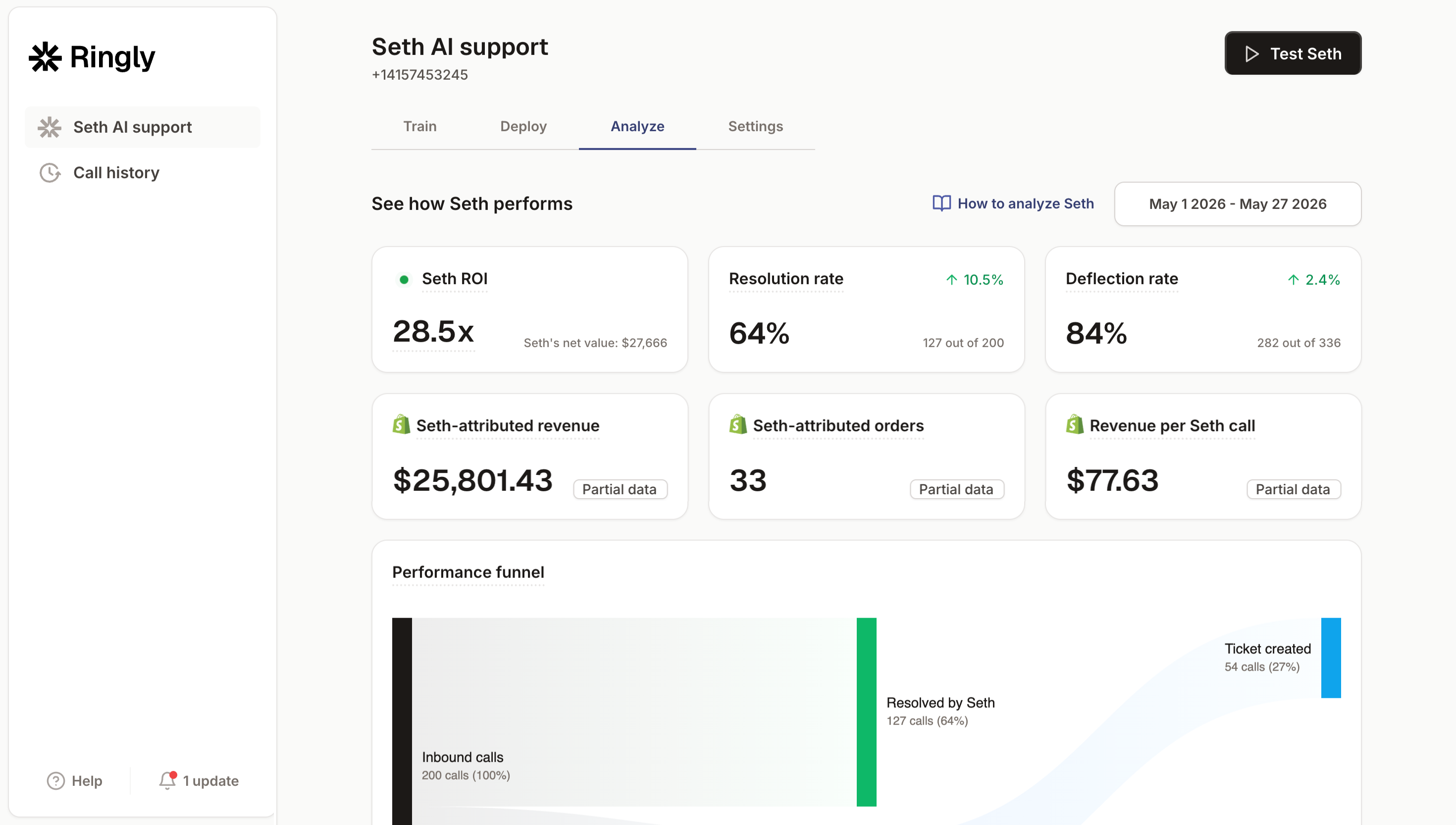
Seth resolves up to 90% of inbound calls autonomously. WashCo, a Shopify brand we launched, recovered $22,664 in attributed revenue in its first 7 days on the phone. Subscription-heavy categories see this most: a supplement brand's phone line is full of pause, skip, and "why was I charged" calls.
"My customers also feel like it's a normal person. They feel like they can communicate if they have questions."
Claudia Droge, TechCraft Studio
What this costs you today vs what it costs to answer it
Take a $50M Shopify brand running a 6-rep CS team, where a big slice of the queue is billing questions:
| Line item | Today | With Ringly |
|---|---|---|
| 6 reps x $4K loaded per rep | $24,000/mo | n/a |
| Ringly (~$5K/mo) | n/a | $5,000/mo |
| Net monthly CS spend | $24,000/mo | $5,000/mo |
| Monthly savings | n/a | $19,000/mo |
| Annual savings | n/a | $228,000/yr |
That's roughly 70% of the repeatable calls (where's my order, why was I charged, cancel, update card, the same five things over and over) handled by the AI. The genuinely complex calls still go to your CS team, who now have time to actually solve them. If your subscription line is one of those repeatable clusters, see how brands handle Shopify customer service without growing headcount.
Frequently asked questions
What is subscription billing software?
Subscription billing software automates recurring charges: it runs the renewal, prorates plan changes, retries failed payments, and manages cancellations. The category ranges from payment-layer add-ons like Stripe Billing to standalone platforms like Chargebee and on-Shopify apps like Recharge.
What is dunning and why does it matter?
Dunning is the automated process of recovering failed subscription payments through retries and customer notifications. It matters because 20-40% of subscription churn is involuntary, meaning the payment failed rather than the customer choosing to leave, and most of that is recoverable with a good dunning engine.
Should recurring billing live on Shopify or a standalone tool?
For most Shopify DTC brands, keeping recurring on-platform (Recharge or Loop) means one source of truth for the order, customer, and subscription. A standalone engine (Stripe Billing, Chargebee, Recurly) makes sense when you need pricing flexibility or recovery depth those apps can't match, and you're willing to reconcile two systems.
Is Stripe Billing enough for a Shopify subscription business?
For early-stage brands already on Stripe with engineering on hand, yes. As your pricing gets more complex or you want recovery beyond Stripe's retry logic, the on-Shopify apps or a pure-play engine like Recurly usually pay for themselves.
How much revenue do failed payments actually cost?
Recurly estimates failed subscription payments cost businesses around $129 billion in lost revenue across 2025. On your own books, a brand with $1M MRR and an 8% failure rate is putting $80,000 a month at risk, of which a good dunning system can recover well over half.
Does subscription billing software handle proration automatically?
The better platforms do. Chargebee and Recurly handle complex mid-cycle upgrades, pauses, and partial refunds cleanly. Stripe Billing prorates standard plan changes well but can need custom logic for unusual models, and on-Shopify apps handle the common DTC cases out of the box.
Talk to us

If you run recurring on a $10M-$100M Shopify brand and your phone lights up every time a card declines or a renewal fires, a 30-min call is the fastest way to see what that volume is costing you. We'll look at your real billing-driven call queue and do the math.
Our 3 promises.
- Live in under 1 hour. Setup and test calls are free.
- 30-day money back on the $99 plan fee.
- 65% resolution guarantee: if Seth resolves under 65% of your support calls in a month, that month comes back as credit (after 90 days on Pay per call).
Ruben (Ringly co-founder) takes these calls personally.