
The short version.
- A call queue is the virtual line your callers sit in when every rep is busy, waiting for the next one to free up.
- It's useful, but for most Shopify stores the queue is a symptom: it forms because routine calls (order status, returns, product questions) pile up faster than a small team can clear them.
- Built for founders, COOs, and heads of CX at $10M-$100M Shopify brands running a helpdesk plus a visible phone number.
A call queue is simple to define and easy to underrate. It's the holding line that catches inbound calls when your reps are already on other calls, then hands them out one at a time as people free up. Every business phone system has one.
The part nobody tells you on the vendor pages: for a Shopify store, a growing queue is rarely a phone-system problem. It's a volume problem wearing a phone-system costume. If you run customer experience at a $10M-$100M Shopify brand with a phone line on your site, the queue that builds every afternoon is mostly the same routine calls hitting a team that was never sized for the seasonal spike. We've launched AI phone agents for 50+ Shopify brands fighting exactly that, and the queue is almost always downstream of one thing: too many repeatable calls, too few reps. If your line backs up after 5 p.m. or every Monday, book a 30-min call and we'll look at what your queue is actually made of.
What a call queue actually is
Picture the queue at a deli counter. People take a number, wait their turn, and get served in order. A call queue does the same thing for your phone line. When a call comes in and all your reps are busy, the system holds that caller in a virtual line instead of dropping them, then routes them to the next rep who hangs up.
A call queue doesn't add capacity. It just organizes the wait for capacity you already have. That distinction matters, and it's where most stores get the wrong idea about what a queue can fix.
Here's the basic flow, the same across most business phone systems:
- A call arrives and every rep is already on a call.
- A greeting or menu picks up. This is the IVR (the "press 1 for orders, 2 for returns" menu). It collects intent and decides where to send the call.
- The caller joins the line. First in, first out, unless you've set priority rules.
- They wait with hold music, a position announcement ("you're third in line"), or an estimated wait time.
- The next free rep gets the next call. With skills-based routing, the call goes to the rep best matched to the reason for it.
People mix up the queue and the IVR all the time, so it's worth separating them. The IVR is the menu that greets and directs. The queue is the waiting room the call sits in afterward until a human is free. The menu feeds the queue. You can have a great menu and still have a brutal queue if there aren't enough people on the other end.
A rough rule from the floor: one ecommerce rep handles somewhere between 20 and 50 calls a day depending on how complex they get. So if your store takes 300 calls on a heavy Monday and you've staffed three reps, the math says some of those callers are going to wait. That waiting line is your queue, and how long it gets is a staffing decision, not a software one.
Why the queue forms (and what it's really costing you)
Most Shopify phone volume is bursty. It clusters after 6 p.m., on weekends, in the days after a launch, and through the whole BFCM stretch. A queue forms because you've sized your team for the average and the spikes blow past it. You can't justify hiring rep #5 for a Tuesday-night rush that lasts two hours, so the line builds and people wait.
The queue isn't free. Every minute a caller sits on hold is a minute they're deciding whether your brand is worth it. And the data on that decision is not kind.
Around 60% of callers hang up before they hit the one-minute mark, and more than 90% are gone by five minutes (call-abandonment research). A Nextiva study of customer patience found that 54% of callers hang up after up to eight minutes on hold (Nextiva 2025). Industry abandonment rates average around 6%, but plenty of busy centers run 12-20% during their peaks.
On a store with a $30-plus average order value, an abandoned call isn't a metric. It's an order walking to a competitor who picked up. The caller who gives up at 90 seconds was often ready to buy, place a reorder, or sort out a return that would have kept them a customer. That's the real cost of the queue, and it never shows up on the phone bill.
WashCo, a Shopify brand we launched, recovered $22,664 in its first 7 days on the phone once those calls stopped hitting a wall. The point isn't the exact figure. It's that the calls in your queue have revenue attached, and the ones that abandon take it with them.
This is also why voicemail isn't coverage. Around 80% of callers routed to voicemail hang up without leaving a message, and the messages that do land rarely get returned the same day. Sending your overflow queue to voicemail just moves the abandonment somewhere you can't see it.
The call queue features that actually move the needle
Phone systems sell a long list of queue features. Most of them are noise. A few genuinely change whether a caller stays or bails. Here are the ones worth setting up.
| Feature | What it does | Worth it? |
|---|---|---|
| Callback in queue | Holds the caller's place and calls them back instead of making them wait | Yes. Cuts abandonment by up to ~32% and 75% of people prefer it |
| Estimated wait time | Tells the caller how long they're likely to wait | Yes. Honest waits feel shorter than silent ones |
| Position announcement | "You're 3rd in line" | Useful, secondary to wait-time |
| Skills-based routing | Sends the call to the rep best matched to the reason | Yes, if you have specialized reps |
| After-hours routing | Decides what happens to calls outside business hours | Critical. This is where most stores leak |
The one that matters most is the callback. Instead of forcing people to sit on hold, the system keeps their spot and rings them back when a rep is free. A callback option reduces abandonment by up to 32% (CallTools), and 75% of US adults say they'd rather get a callback than listen to hold music, especially once the wait runs past five minutes (Nextiva).
A callback doesn't shorten the wait. It just stops the wait from costing you the call. That's a real win, and you should turn it on. But notice what it doesn't do: it doesn't reduce the number of calls, and it doesn't get the customer their answer any faster. It manages the symptom.
After-hours routing is the other one most stores get wrong. The queue empties at 6 p.m. because the reps go home, but the calls don't stop. Handling that after-hours volume is usually where the biggest revenue leak hides.
How to set up a call queue for a Shopify store
If you're standing up a queue (or fixing the one you have), here's the order that works for an ecommerce team.
- Map your real volume by hour and day. Pull a month of call data. You're looking for the spikes, not the average. Most stores find their queue pain is concentrated in a few windows, not spread evenly.
- Group calls by reason. Order status, returns and exchanges, product questions, everything else. This tells you how much of your queue is routine WISMO volume versus genuinely complex calls. If most of it is order-status lookups, that's a clue the queue is solving the wrong problem.
- Set a wait threshold and route by it. Decide the longest you'll let someone wait, then trigger a callback before they hit it. Don't let anyone sit past two or three minutes.
- Turn on callback and after-hours routing. These two cover the moments the queue does the most damage: the peak rush and the closed-for-the-day stretch.
- Measure abandonment, not just answer rate. Answer rate flatters you. Abandonment tells you how many people gave up. Watch it weekly during peak season.
Do all of that and you'll have a well-run queue. But a well-run queue is still a queue, and that brings up the question the phone vendors never ask: does this volume need to be in a line at all?
The better move: shrink the queue instead of managing it
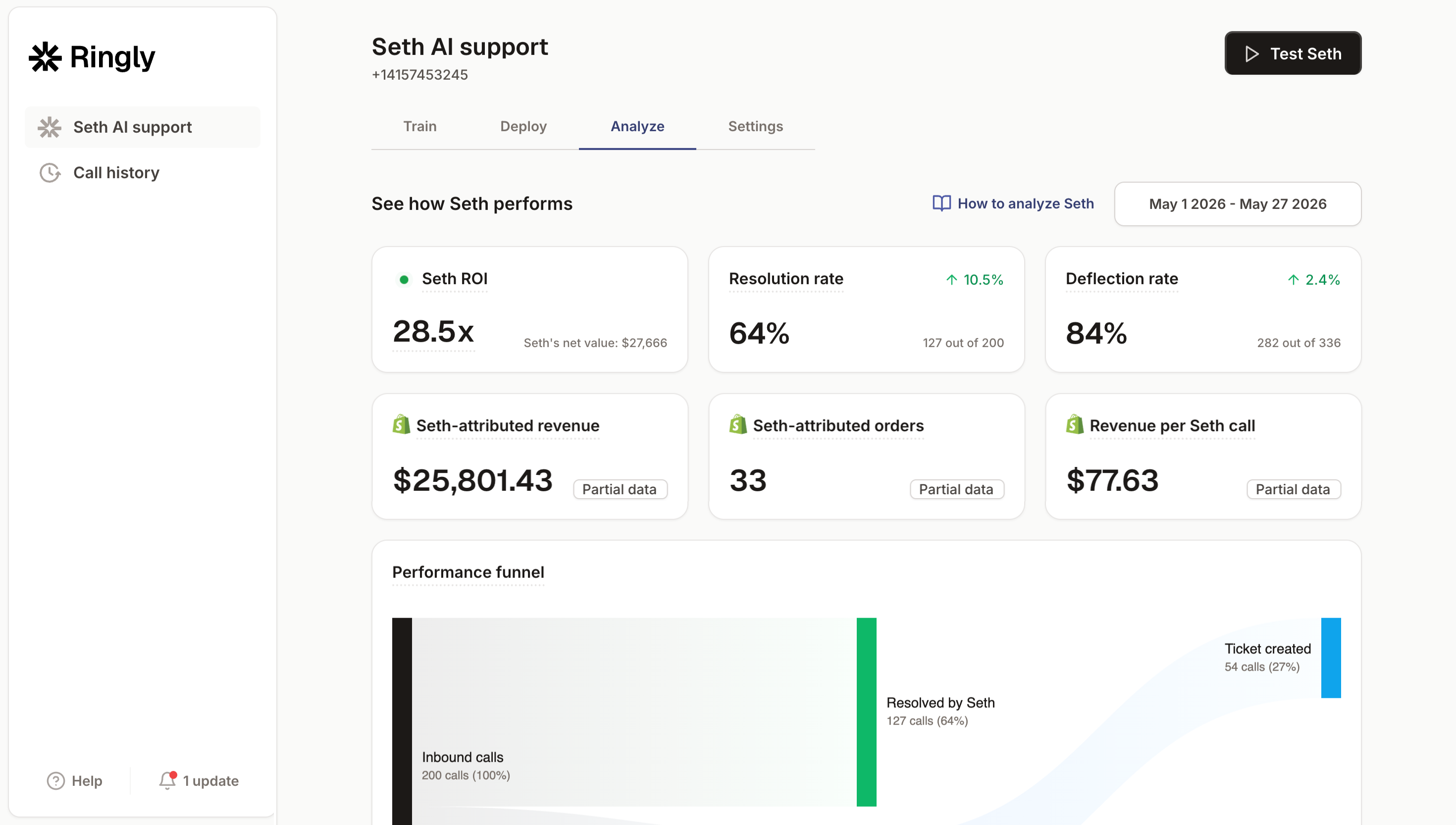
Here's the reframe. When we pull the call logs across the 50+ Shopify brands on Ringly, the same pattern shows up every time: 70-80% of inbound calls are routine. Order status, returns, a product question, the same handful of things over and over. Those calls don't need a queue. They need an answer.
The best call queue for a Shopify store is the one that mostly never forms, because the routine 70-80% gets resolved the second the phone is picked up. That's the part the deli-counter model misses. You don't have to make people wait for an answer your system already knows.
That's what Ringly.io does. Ringly is AI phone support for Shopify brands. Instead of growing your support headcount every time call volume goes up, the AI takes the routine inbound calls so your team can focus on the work that actually moves revenue. It answers 24/7, finds orders in your Shopify store, processes returns and exchanges, and answers product questions from your knowledge base. Across 50+ brands, it resolves 73% of calls autonomously at roughly $0.42 per resolved call. The calls that need a human, the genuinely hard 20-30%, escalate cleanly to Gorgias, Richpanel, Reamaze, or whatever helpdesk you already run. The queue still exists for those. It's just a lot shorter, because the routine calls never joined it.
The usual worry is that customers will hate talking to AI. The thing we hear back most often is the opposite.
"My customers also feel like it's a normal person. They feel like they can communicate if they have questions."
Claudia Droge, TechCraft Studio
The economics land harder than the queue features do. Take a typical $50M Shopify brand running a 6-rep CS team:
| Line item | Today | With Ringly |
|---|---|---|
| 6 reps × $4K loaded per rep | $24,000/mo | n/a |
| Ringly (~$5K/mo) | n/a | $5,000/mo |
| Net monthly CS spend | $24,000/mo | $5,000/mo |
| Monthly savings | n/a | $19,000/mo |
| Annual savings | n/a | $228,000/yr |
That's roughly 70% of repeatable calls routed to the AI on pickup, so they never queue. The other 30%, the calls that actually need a person, still go to your team, who now have the time to handle them well instead of scrambling to clear a backlog. If you want to see what your own queue looks like split into routine versus complex, book a 30-min call and we'll do the math live.
Frequently asked questions
What's the difference between a call queue and an IVR? The IVR (or auto attendant) is the menu that greets the caller and routes them: "press 1 for orders." The call queue is the waiting line the call sits in after routing, until a rep is free. The menu feeds the queue.
How do I reduce call queue wait time? Two levers work: cut the volume hitting the queue, and offer a callback so people don't have to wait on hold. Turning on a callback option alone reduces abandonment by up to 32%. Routing the routine calls (order status, returns) to something that resolves them on pickup does even more, because those calls never enter the queue.
Is a callback better than hold music? For most callers, yes. 75% of US adults say they'd rather get a callback than wait on hold, especially past five minutes. It holds their place and rings them when a rep is free, so you stop losing the ones who would have hung up.
How many calls can one rep handle in a day? Roughly 20 to 50, depending on how complex the calls are. Order-status and simple return calls run fast, while troubleshooting or escalations eat far more time. That spread is why a queue forms on busy days even with a full team.
How do I handle the holiday call spike without hiring a seasonal team? Group your calls by reason first, because 70-80% of the spike is usually routine WISMO and return questions. Route those to something that answers them automatically, keep your human reps for the complex 20-30%, and you absorb the spike without staffing for a peak that lasts a few weeks.
Does Ringly replace my phone system or call queue? No. Ringly sits in front of your existing setup. It answers the routine calls on pickup so they never queue, and escalates anything complex to your current helpdesk and reps. You keep your number, your queue, and your team. There's just a lot less in the line.
How much does this cost? Ringly plans are Grow at $349/mo, Pro at $799/mo, and Enterprise custom, with a 14-day free trial on Pro. Resolved calls run roughly $0.42 each versus $7-$16 per call for human BPO. There's a 65% resolution guarantee: if the AI resolves under 65% of your calls in 90 days, we refund the last 3 months. See pricing for the details.
Talk to us

If you run a $10M-$100M Shopify brand and your phone line builds a queue every afternoon, a 30-min call is the fastest way to see what that line is costing you. We'll pull your call volume, split it into routine versus complex, and show you how much of the queue could clear on pickup.
The 3-layer guarantee.
- Live in 14 days or it's free until launched.
- 65% resolution in 90 days or we refund the last 3 months of subscription fees.
- We keep working free until we hit 65%.
Ruben (Ringly co-founder) takes these calls personally.