
A small-business phone system is really two things: the line that rings, and whoever (or whatever) answers it. Most guides only cover the line.
- We tested the popular small-business lines and called each one's own support number at 9pm with a simple order-status question. None of them answered it.
- The line (number, routing, voicemail, SMS) is the easy part. For a store doing real order-status volume, who answers the call after 6pm is the whole game.
- Built for $10M-$100M Shopify brands with a visible phone number and real order-status volume.
You run a Shopify brand that has outgrown its first phone setup. The number on your site rings all day, and a big chunk of it is the same handful of questions: where's my order, can I change the shipping address, do you have this in stock. Then 6pm hits and the calls roll to voicemail nobody returns by morning.
So you go looking for "the best phone system for small business" and every list hands you the same ten VoIP vendors ranked by price per user. None of them mention the thing you actually care about, which is what happens to the call once it rings.
That's the gap this guide fixes. If after-hours calls and the same questions over and over are eating your week, book a 30-min call and we'll show you what your store is missing after 6pm.
If you're a founder, COO, or head of CX at a growing Shopify brand and the order-status calls are stacking up, this guide is written for you, not for a generic office line. We run AI phone support for 50+ Shopify brands, so the picks below are split by the one question that decides everything: does it answer the call, or does it just route it? Book a 30-min call if you'd rather talk through your own call volume first.
A phone system is two decisions, not one
Here's the reframe that the other guides skip. A phone system is two separate purchases that got stuck under one word.
The first is the line: a business number, call routing, an auto-attendant, voicemail, maybe SMS and a few desk phones. RingCentral, Nextiva, Grasshopper, OpenPhone, all of them sell the line. It's a solved, commodity product, and most of them do it well for $15 to $35 a user.
The second is the answer layer: who, or what, actually picks up and resolves the call. For a dentist, the line is the whole job. For a Shopify brand fielding real order-status volume, the answer layer is the part nobody sells you, and it's the part that's breaking.
The line is a commodity. The answer is the bottleneck, and on a store doing real volume it's where the money leaks. Salesforce and Shopify both put "where's my order" calls at up to 50% of inbound support. That's not a routing problem you fix with a nicer IVR. It's a who-picks-up problem.
Most of those calls are repeatable: order status, returns, the same five things all day. They don't need a senior rep, just someone to pick up and answer in plain English. After 6pm and on weekends nobody does, and the caller buys from someone who did. Around 62% of people who can't reach you switch to a competitor, according to a 2026 PCN study.
How I evaluated these phone systems for a Shopify brand
I'm Ruben, co-founder of Ringly. I went through every system below from the perspective of a $10M-$100M Shopify brand, not a generic office. Here's what I scored against:
- Does it answer the call, or just route it? I set up each system and watched what happened to a real inbound call. A line that sends the caller to voicemail or a phone tree isn't answering anything.
- Can it see the order? I checked whether the system could pull a customer's Shopify order and tell them where it is, or whether it just connects a human who then has to go look.
- Does it cover after-hours without a night shift? I looked at what each one does at 9pm on a Sunday. Voicemail, a text-back, or actual resolution.
- What does it cost per resolved call, not per user? Per-user pricing hides the real number. I compared the loaded cost of a human answering versus the cost per call resolved.
- The 9pm test (the failure mode). I called each system's own customer support line at 9pm and asked a plain order-status question. Not one of them answered it. They routed me, took a voicemail, or texted back the next morning. That's the exact experience your customers get on the lines below, and it's the whole reason the answer layer exists.
I only sell Ringly, and it sits at number one below for the same reason everyone else is ranked: how it did against those five criteria, especially the last one.
Here's the short version before the deep dives.
| System | What it is | Pricing | Answers the call? | Best for |
|---|---|---|---|---|
| Ringly.io | Answer layer (AI phone agent) | $349-$799/mo, Enterprise custom | Yes, 73% on its own | Shopify brands with real order-status volume |
| RingCentral | The line (UCaaS) | $20-$35/user/mo | No, routes + IVR | Multi-site teams that want desk phones |
| Nextiva | The line | $15-$60/user/mo | No | Best all-round line plus support |
| Dialpad | The line + AI notes | $15-$25/user/mo | Partly, it transcribes | Teams that want AI call notes |
| Grasshopper | The line (solo) | $14-$55/mo | No | Solopreneurs or a second number |
| OpenPhone | The line (modern) | $15-$33/user/mo | No, missed-call text-back | Small teams sharing a number |
| 8x8 | The line (global) | ~$15-$44/user/mo | No | International calling on one plan |
The 7 best phone systems for a small business (2026)
1. Ringly.io: the AI phone agent that actually answers the call
Best for: Shopify brands with a visible phone number and real order-status volume that's bleeding into after-hours.
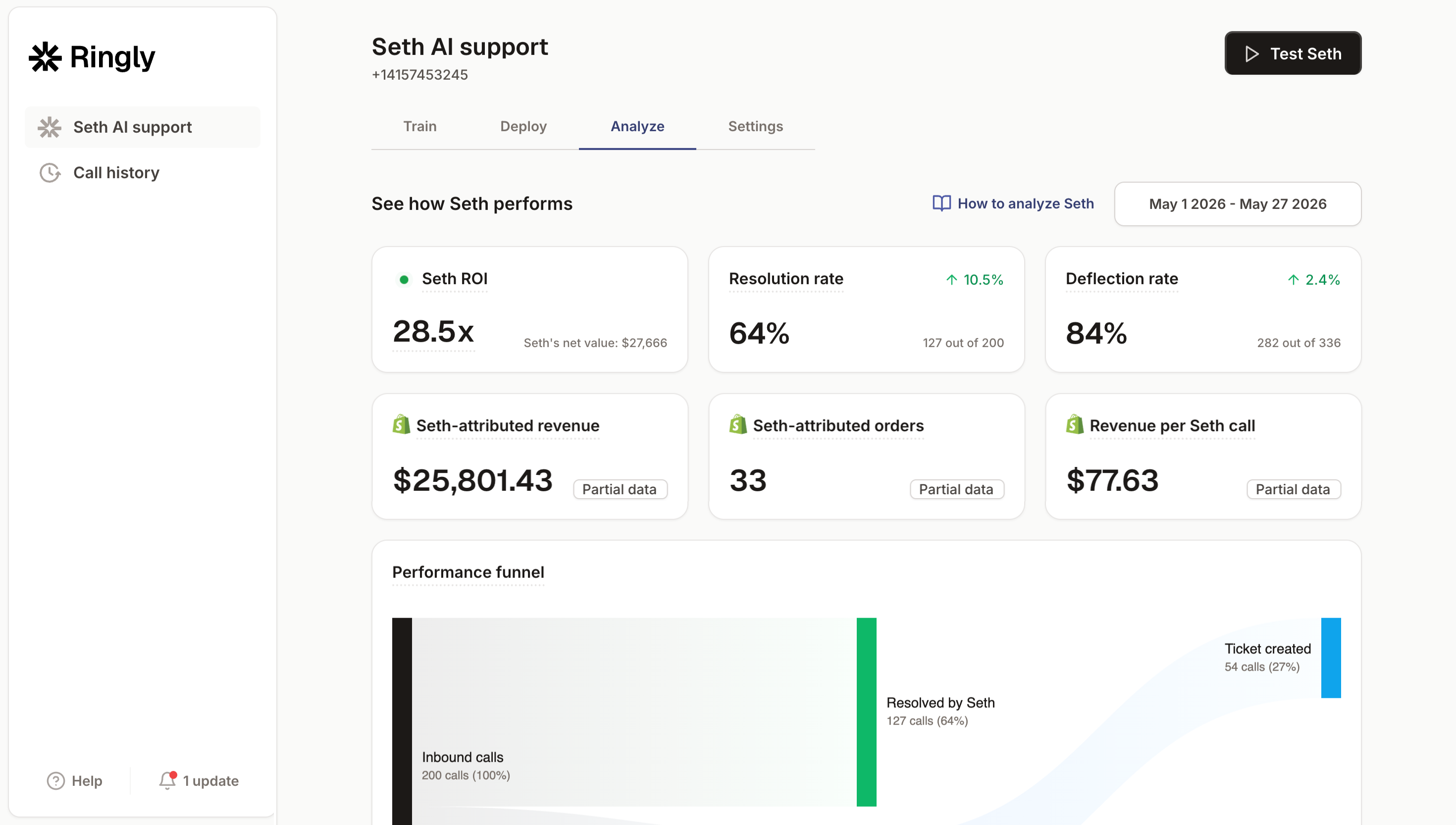
Ringly.io is AI phone support for Shopify brands. It's the answer layer, not another line. You keep your current number, your helpdesk, and your routing. Ringly is the thing that picks up when a call comes in and actually resolves it, 24/7, instead of sending the caller to a voicemail you'll read on Monday.
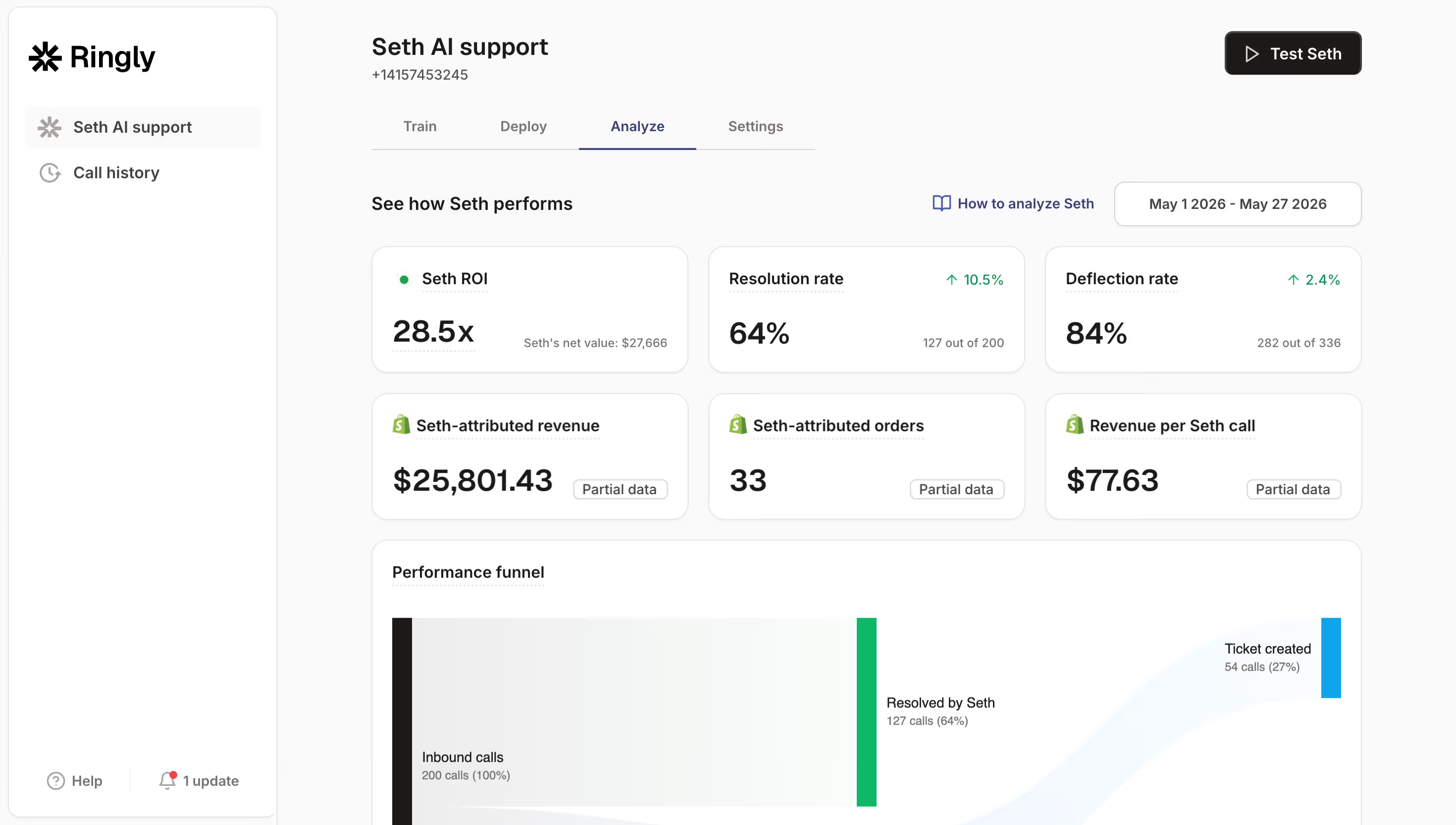
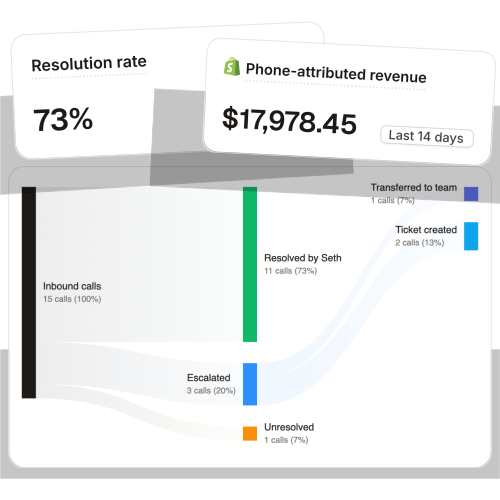
The AI answers inbound calls, finds the order in your Shopify store, processes returns and exchanges, answers product questions from your knowledge base, and rescues abandoned carts with an outbound follow-up. Calls that genuinely need a person escalate cleanly to Gorgias, Richpanel, Reamaze, or whatever helpdesk you already run. Across 50+ brands, it resolves 73% of calls on its own at roughly $0.42 per resolved call, versus the $7 to $16 a human-handled call runs at most BPOs.
WashCo, a Shopify brand we launched, recovered $22,664 in attributed revenue in its first 7 days on the phone. That's the answer layer doing the job the line never could: not just not-missing the call, but turning it into an order.
Pricing
| Plan | Price | Included |
|---|---|---|
| Grow | $349/mo | 1,000 minutes (~500 calls), $0.29/min overage |
| Pro | $799/mo | 2,500 minutes (~1,250 calls), $0.19/min overage |
| Enterprise | Custom | High volume, set on a call |
What works
- It answers, it doesn't route. This is the whole point. The caller gets a real answer about their order, not a phone tree or a callback promise.
- It reads your Shopify orders live. Ask "where's my order," the AI pulls the order, checks fulfillment, and reads back the tracking. No human goes digging.
- It runs after-hours and weekends with no night shift. 9pm Sunday calls get resolved instead of stacking into a voicemail backlog.
- It sits in front of your stack. Keep your number and helpdesk. Ringly handles the routine, your team gets the hard calls back.
- You don't sound like AI. The most repeated thing callers say after talking to it is that they didn't realize it wasn't a person.
What doesn't
- It's phone-first. If your real problem is email and chat volume, a helpdesk does that better. Ringly is built for the calls.
- It's not a dial-tone replacement. You still need a number. Ringly is the answer layer that sits on top, not the line itself.
- Some actions are custom. Subscription cancellations and phone orders need a custom setup or a clean escalation rule, not an out-of-the-box toggle.
Why it ranks 1st
It's the only option here that answers the call instead of routing it. Every other system is a good line. Ringly is what you bolt on when the line ringing isn't the problem, the calls going unanswered is. Backed by a 65% resolution guarantee, and you can be live in under an hour.
2. RingCentral
Best for: multi-site teams that want a full unified-communications stack with desk phones.

RingCentral is the heavyweight of the category. It's a full UCaaS platform: calling, video, SMS, faxing, and deep phone-system features that scale to big, multi-location teams. If you want one vendor for everything voice and you have an IT person to run it, it's a safe pick.
Pricing: Core $20, Advanced $25, Ultra $35 per user per month on annual billing. Paid monthly it runs closer to $30 to $45.
What works
- Deep feature set. Multi-level IVR, call queues, analytics, and an integration list as long as your arm.
- Reliable at scale. It's built for hundreds of seats across sites, not just a back office.
- Hardware support. Works with dozens of desk-phone models if you still run physical handsets.
What doesn't
- Hidden fees pile up. Toll-free minutes, Salesforce CRM, and webinar licenses are add-ons, and SMS is capped at 25 messages per user on Core.
- It routes, it doesn't answer. It's a great line. After-hours, a "where's my order" call still hits voicemail or an auto-attendant.
- Overkill for a lean store. Most Shopify brands don't need a contact-center platform to run a phone number.
Why it ranks 2nd
It's the strongest pure line on this list. Just remember it's a line, so pair it with an answer layer if order-status volume is your real pain. Here are some RingCentral alternatives if the price creep bothers you.
3. Nextiva
Best for: brands that want the best all-round line with genuinely good human support behind it.

Nextiva is the line I'd point most small businesses at if they just need solid calling plus a path to omnichannel. It's cheaper than RingCentral at the entry tier and its support reputation is the best in the group. G2 reviewers give it 4.5 out of 5, and rate its support a 9.0 against RingCentral's 7.8.
Pricing: Core $15 per user per month, scaling up toward $60 on the top suites with omnichannel and CRM.
What works
- Best support reputation in the category. When something breaks on your phone system, that matters more than a feature checkbox.
- Clean pricing at the entry tier. $15 a user undercuts RingCentral for similar core calling.
- Omnichannel path. If you later want voice, chat, and email in one place, the higher tiers grow into it.
What doesn't
- Still just a line. It routes and queues. It doesn't pull a Shopify order or resolve a call on its own.
- Top tiers get pricey. The omnichannel suites climb fast once you add seats.
Why it ranks 3rd
If you want one boring, reliable line that won't let you down on support, this is it. See the Nextiva alternatives if you want to compare the field.
4. Dialpad
Best for: teams that want AI call notes, transcription, and coaching baked into the line.
Dialpad is the most AI-forward of the traditional lines. It transcribes calls in real time, writes summaries, and coaches reps. That's genuinely useful if you have a team and want better notes. Just be clear about what it does: it documents the call, it doesn't resolve it for you.
Pricing: Standard around $15 per user per month, Pro $25 per user (3-user minimum) with CRM integrations, Enterprise custom with a 100-user minimum.
What works
- Real-time transcription and summaries. Your reps stop typing notes and your QA gets easier.
- Built-in CRM integrations on Pro. Salesforce, Zendesk, Zoho out of the box.
- Solid calling underneath the AI. It's a competent line first.
What doesn't
- AI that listens, not AI that answers. It transcribes a human's call. A customer still has to reach a human first, which after 6pm they won't.
- Learning curve. Reviewers consistently flag the interface and slow support.
Why it ranks 4th
Best pick if you want a line that makes your existing reps more efficient. It won't take the after-hours order-status calls off their plate, though. Compare it with the Dialpad alternatives.
5. Grasshopper
Best for: solopreneurs and very small teams that want a second business number with extensions.

Grasshopper is the simplest line here, and that's the point. It's a virtual number with extensions that forwards to your real phones. No desk phones, no contact center, just a clean business line for one person or a tiny team. If you're still running calls off a cell, it's a tidy upgrade.
Pricing: True Solo $14/mo (1 number, 1 extension), Solo Plus $25/mo (1 number, 3 extensions), Small Business $55/mo (4 numbers, unlimited extensions). No per-user fees.
What works
- Flat pricing, no per-user fees. Predictable and cheap for a small operation.
- Dead simple. You can be running in an afternoon with zero IT.
- Good for a second number. Keeps business calls off your personal cell.
What doesn't
- It doesn't scale. Dated interface, limited integrations, and reviewers flag freezes and dropped calls.
- No order data, no resolution. It forwards the call to a human. That's the whole feature.
Why it ranks 5th
Perfect for a one-person shop. The day your order-status volume gets real, you'll outgrow it, because forwarding a call isn't answering it.
6. OpenPhone
Best for: small teams that share a number and live in a clean, modern app.
.jpeg)
OpenPhone (now branded Quo) is the modern, app-first line. Shared numbers, a slick mobile and desktop experience, call summaries, and missed-call text-back. It's a big step up from Google Voice for a small team that wants to manage conversations together. Just know that "missed-call text-back" is a polite way of saying the call went unanswered and now you're chasing it over text.
Pricing: Starter $15 per user per month (annual) or $19 monthly, Business $23 per user (annual) or $33 monthly.
What works
- Genuinely nice product. Clean, fast, and easy for a team to share a number.
- AI summaries and transcripts. Good notes on every call.
- Better than Google Voice for teams. Shared inboxes and real collaboration.
What doesn't
- Missed-call text-back isn't answering. The customer wanted their order status now, not a text tomorrow.
- Still a line. No Shopify order lookup, no autonomous resolution.
Why it ranks 6th
A great modern line for a small team. See the full OpenPhone pricing breakdown, or the Google Voice alternatives if you're upgrading from the free option.
7. 8x8
Best for: brands that need international calling across a lot of countries on one plan.
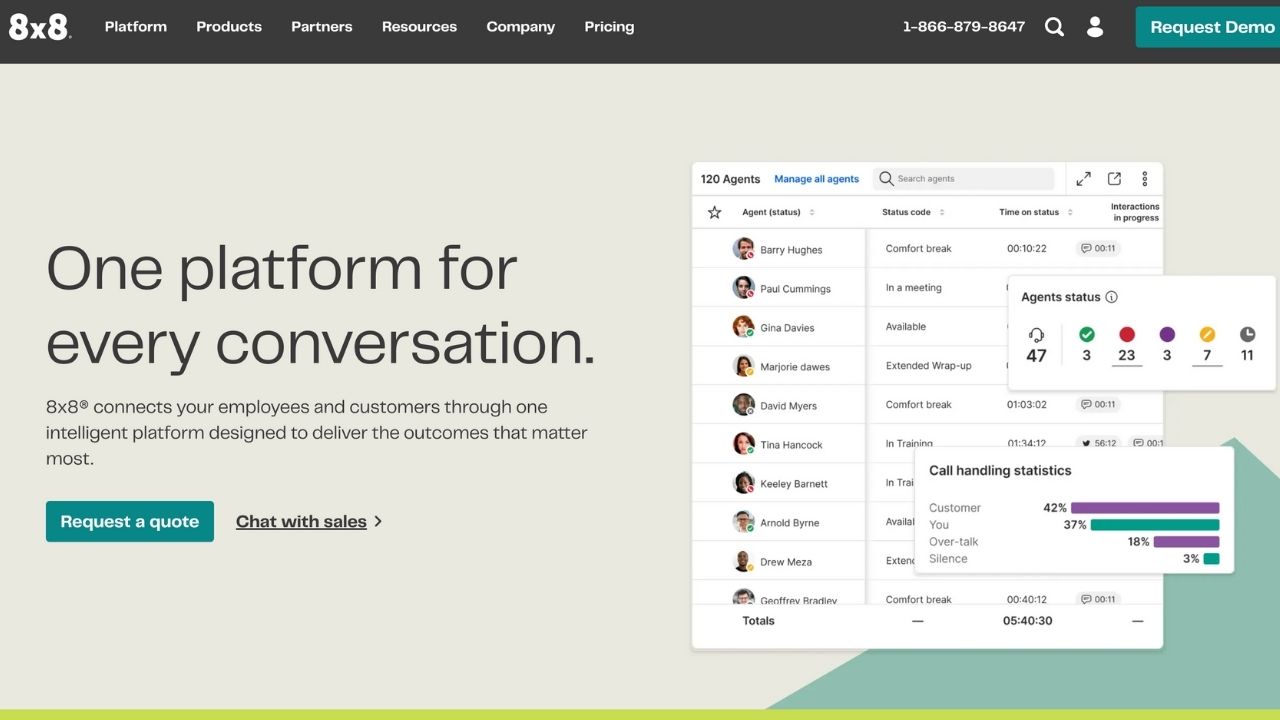
8x8 is the global line. If you're selling into a dozen countries and want unlimited international calling without juggling carriers, it covers more geography than anyone here. It's a capable UCaaS platform; the catch is the pricing.
Pricing: entry around $15 per user per month, but the unified-communications and contact-center plans are quote-only. Field rates land around $24 to $44 per user per month.
What works
- International coverage. Unlimited calling across many countries on a single plan.
- Full contact-center features on the higher tiers.
- Reliable platform for distributed teams.
What doesn't
- Sales-call pricing. You can't see the real number without talking to someone, which is a tell.
- Still routes the call. Like the rest, it connects a human. It doesn't resolve the order question.
Why it ranks 7th
The pick if international calling is your binding constraint. For everyone else it's more platform than a store needs.
What this actually costs a growing Shopify brand
Per-user pricing makes a phone system look cheap. The real number is what it costs to answer the calls, and that's a payroll line, not a software line.
Take a typical brand running a 6-rep CS team to cover phones:
| Line item | Today | With the answer layer |
|---|---|---|
| 6 reps × $4,000 loaded per rep | $24,000/mo | n/a |
| AI phone agent (~$5K/mo) | n/a | $5,000/mo |
| Net monthly CS spend | $24,000/mo | $5,000/mo |
| Monthly savings | n/a | $19,000/mo |
| Annual savings | n/a | $228,000/yr |
That's roughly 70% of repeatable calls, the order-status and returns and the same five questions over and over, routed to the AI. The genuinely complex 30% still go to your team, who now have time to actually solve them. And the cost-per-call math is the part the per-user tables hide: about $0.42 per resolved call, against the $7 to $16 a human-handled call runs at a BPO.
"My customers also feel like it's a normal person. They feel like they can communicate if they have questions."
Claudia Droge, TechCraft Studio
There's also the cost of the call you don't answer at all. Replacing a single CS rep runs $14,113 once you count hiring and ramp, per Gartner data via Insignia, and turnover in support sits above 31%. The hire-your-way-out plan is expensive and it never ends.
If you want to see what your own after-hours calls are costing you, book a 30-min call and we'll do the math live on your call volume.
How to choose a phone system for your store
Two questions decide this, in order.
First, what's the real job? If you mostly need a reliable business number, routing, and voicemail for a team that answers during business hours, you need a line. Pick on price, support, and how much you'll grow:
- Choose Nextiva if you want the best all-round line with the best support reputation.
- Choose RingCentral if you're multi-site and want the deepest feature set, and you have someone to run it.
- Choose Dialpad if AI call notes and coaching for your reps is the priority.
- Choose Grasshopper if you're solo or tiny and just need a second number, today.
- Choose OpenPhone if you're a small team that wants a modern shared-number app.
- Choose 8x8 if international calling across many countries is your binding constraint.
Second, who answers the call? If the real pain is that order-status calls are stacking up, the line goes to voicemail after 6pm, and you're staring down the next hire just to keep the phone covered through the seasonal spike, then the line isn't your problem. Add the answer layer.
If you're drowning in repeatable calls and the fix you keep reaching for is "hire another rep," that's the signal you need the answer layer, not a cheaper line. A line plus an AI phone agent that actually resolves the routine calls is the setup that scales without growing your headcount every time volume does. You can keep your phone number and helpdesk and just add the part that picks up.
Frequently asked questions
What's the best phone system for a small ecommerce business?
It depends on whether your problem is the line or the answer. For most Shopify brands the line is a solved commodity (Nextiva and OpenPhone are both solid), and the real bottleneck is who answers the order-status calls. If after-hours and repeatable calls are the pain, you want an AI phone agent on top of the line, not a different line.
How much does a small-business phone system cost?
The line runs roughly $14 to $55 per user per month, with RingCentral and Nextiva in the $15 to $35 range and Grasshopper offering flat plans. The answer layer is priced differently, by call volume rather than per seat. Ringly starts at $349/mo and the real comparison is cost per resolved call, around $0.42, versus a human-handled call at $7 to $16.
Can a phone system answer order-status calls automatically?
A standard line can't. It routes the call to a human who then looks up the order. An AI phone agent that connects to Shopify can: it pulls the order live, checks fulfillment, and reads back the tracking on the call, with no human in the loop for routine WISMO questions.
Do I have to replace my current phone number?
No. The answer layer sits in front of your existing number and helpdesk. You keep your line, your routing, and your stack, and add the part that actually picks up and resolves the call. Nothing about your current setup has to change.
What about after-hours and weekend calls?
This is the single biggest leak for a store. On a standard line, 9pm and weekend calls roll to voicemail and most never get returned, and around 62% of those callers buy from a competitor instead. An always-on phone agent answers and resolves them at 9pm Sunday the same as 2pm Tuesday.
Is AI phone support good enough that customers won't be annoyed?
The most repeated thing callers say after talking to ours is that they didn't realize they weren't talking to a person. The trick is scope: the AI handles the routine calls it can resolve cleanly and escalates anything genuinely complex to your team. Customers get a fast answer instead of a voicemail, which is what they actually wanted.
How fast can I get set up?
You can be live in under an hour. You add your website, docs, or knowledge base, connect your Shopify store, and the AI is ready to take calls. There's a 65% resolution guarantee behind it, so the build risk is on us.
Talk to us

If you run a Shopify brand and the order-status calls are stacking up after 6pm, a 30-min call is the fastest way to see what you're leaving on the table. We'll look at your real call volume and show you what the answer layer would resolve.
The 3-layer guarantee.
- Live in 14 days or it's free until launched.
- 65% resolution in 90 days or we refund the last 3 months of subscription fees.
- We keep working free until we hit 65%.
Ruben (Ringly co-founder) takes these calls personally.