
This post in 30 seconds.
- The fit problem: Posh AI is excellent voice AI, but it was built for banks and credit unions. On a Shopify store it can't find an order, start a return, or hand a hard call to your helpdesk.
- The benchmark to beat: an alternative is only worth switching to if it resolves the routine call on its own. Ringly does that for up to 90% of calls, at $1.99 a call after the first 50.
- Built for $10M-$100M Shopify brands running a paid helpdesk and a phone line nobody picks up after 6 p.m.
If you run a Shopify brand and someone pointed you at Posh AI, you already found the catch. Posh is real, well-funded voice AI. It just lives in a different building. It answers calls for banks and credit unions, where the job is checking a balance or moving money, not telling a customer where order #1042 is.
So the question isn't "is Posh good." It's "what's good at the call YOUR store actually gets." This piece is for the founder, COO, or head of CX at a $10M-$100M Shopify or Shopify Plus brand who's drowning in after-hours calls and tired of tools that answer the phone but don't resolve anything. I've launched AI phone agents for Shopify brands, and the line between "answers" and "resolves" is the whole game. Book a 30-min call and we'll pull your last week of missed calls and show you what's resolvable.
In this post:
Here's the short version before the detail. The one column that matters for a Shopify brand is whether the tool can resolve an order call, not just answer it.
| Tool | Best for | Pricing | Resolves Shopify orders? | Verdict |
|---|---|---|---|---|
| Ringly.io | Shopify phone support that resolves calls | From $99 a month (50 conversations included) | Yes, native | Best fit for DTC |
| Smith.ai | Booking and lead capture with human fallback | AI from ~$95/mo; human plans $292-$975/mo | No, takes messages | Good receptionist, not order resolution |
| Goodcall | Cheap, fast AI answering for service businesses | $79-$129/mo + $0.50/caller | No | Simple but not ecommerce |
| Synthflow | Teams who want to build their own agent | Usage-based, lower at low volume | Only if you build it | Flexible but DIY |
| Gorgias (with its AI) | Chat and email automation | Helpdesk + per-AI-resolution fees | Chat yes, phone weak | Keep for chat, add phone |
What Posh AI is, and why a Shopify brand looks elsewhere
Posh (posh.ai) spun out of MIT's AI lab in 2018 and has raised $72.5M to build conversational AI for one industry: banking. Voice assistant, chatbot, internal knowledge tool, the whole stack, all aimed at credit unions and banks. It's deployed at over 100 financial institutions.
And it works. Florida Credit Union's voice assistant fields more than 30,000 calls a month and resolves roughly 91% of phone conversations without a human, per Posh's own client story. That's a strong number. Nobody should pretend Posh is bad voice AI.
The gap for a Shopify store isn't quality, it's fit. Posh integrates with core banking systems and contact-center platforms. It does not connect to your Shopify store, so it can't check order status, process a return or exchange, answer a product question from your knowledge base, or escalate a messy call into Gorgias, Zendesk, Gladly, or Re:amaze. On a banking call that's fine. On a Shopify call, "where's my order" is 30-40% of your tickets and 50% at peak, per Salesforce, and a tool that can't read your orders can't touch it.
Here's why this matters more than it looks. When a Shopify customer calls and gets voicemail, you don't get a second chance. 85% of callers who can't reach a person never call back, and 62% switch to a competitor, per a 2026 PCN study. And most stores are already leaking: businesses answer only 37.8% of inbound calls, per AmbsCallCenter. So the alternative you pick has to do the Shopify-specific work, not just hold the line.
There's a second reason Posh comes up for Shopify brands at all. It's a serious product with serious results, so it gets recommended in "best voice AI" roundups that don't separate banking from ecommerce. A founder reads "91% resolution" and thinks that number will carry over to their store. It won't, because resolution is measured against the calls the tool can actually handle. Posh resolves 91% of banking requests. On a Shopify line full of order-status and return calls it has no Shopify data to read, so its resolution on YOUR calls would be close to zero. The headline number is real and the fit is still wrong.
Answering a call and resolving a call are not the same thing
This is the distinction that decides everything below, so it's worth a minute. Most "AI phone" tools answer. A smaller number resolve.
Answering means the call gets picked up, the customer is greeted, and a message gets taken or a transfer gets attempted. That's better than voicemail. It is not the same as fixing the customer's problem.
Resolving means the call ends with the thing the customer wanted done: they know where order #1042 is, the return is started, the product question is answered correctly. A tool that answers but can't resolve just moves your morning backlog from voicemail to a message queue. The reps still have to call everyone back.
For a $10M-$100M Shopify brand, the whole reason to add AI to the phone is to stop the routine call from ever reaching a human. If the tool can't read your Shopify orders, it can't resolve the routine call, and you've bought a more expensive answering machine. That's the lens for the five tools below: not "does it answer," but "does it resolve the Shopify call."
How I tested these 5 Posh AI alternatives
I'm Ruben, co-founder of Ringly.io. I evaluate voice and phone-support tools constantly, not as a critic, as a buyer, because I run AI phone support for Shopify brands and I need to know where everything actually breaks.
For this list I connected each tool to a real Shopify store (where it could connect at all) and ran the same after-hours workflow through every one:
- Shopify order resolution. I called in as a customer and asked for the status of order #1042 to see if the tool could read the order and answer, or only take a message.
- Returns and exchanges. I asked to start a return on a delivered item and watched whether the tool could actually begin it or just promised someone would call back.
- Helpdesk escalation. I forced a complex, off-script call and checked whether it handed off cleanly into a helpdesk like Gorgias, or dead-ended in voicemail.
- Setup and who owns it. I noted whether the tool is done-for-you or whether I'd be the one building the flows, tuning the prompts, and owning the failures.
- What a Shopify call costs. I priced each one against real DTC call volume, not a banking demo, since per-call pricing that looks cheap at 30 calls gets ugly at 2,000.
I don't take affiliate money on anything below. Ringly is mine, and it's listed first because it's built for exactly this, but it's scored against the same five tests as everyone else. Where a tool is great at its real job and just wrong for Shopify, I say so.
The 5 best Posh AI alternatives compared
1. Ringly.io: AI phone support built for Shopify
Best for: $10M-$100M Shopify and Shopify Plus brands that want the routine call resolved, not just answered.
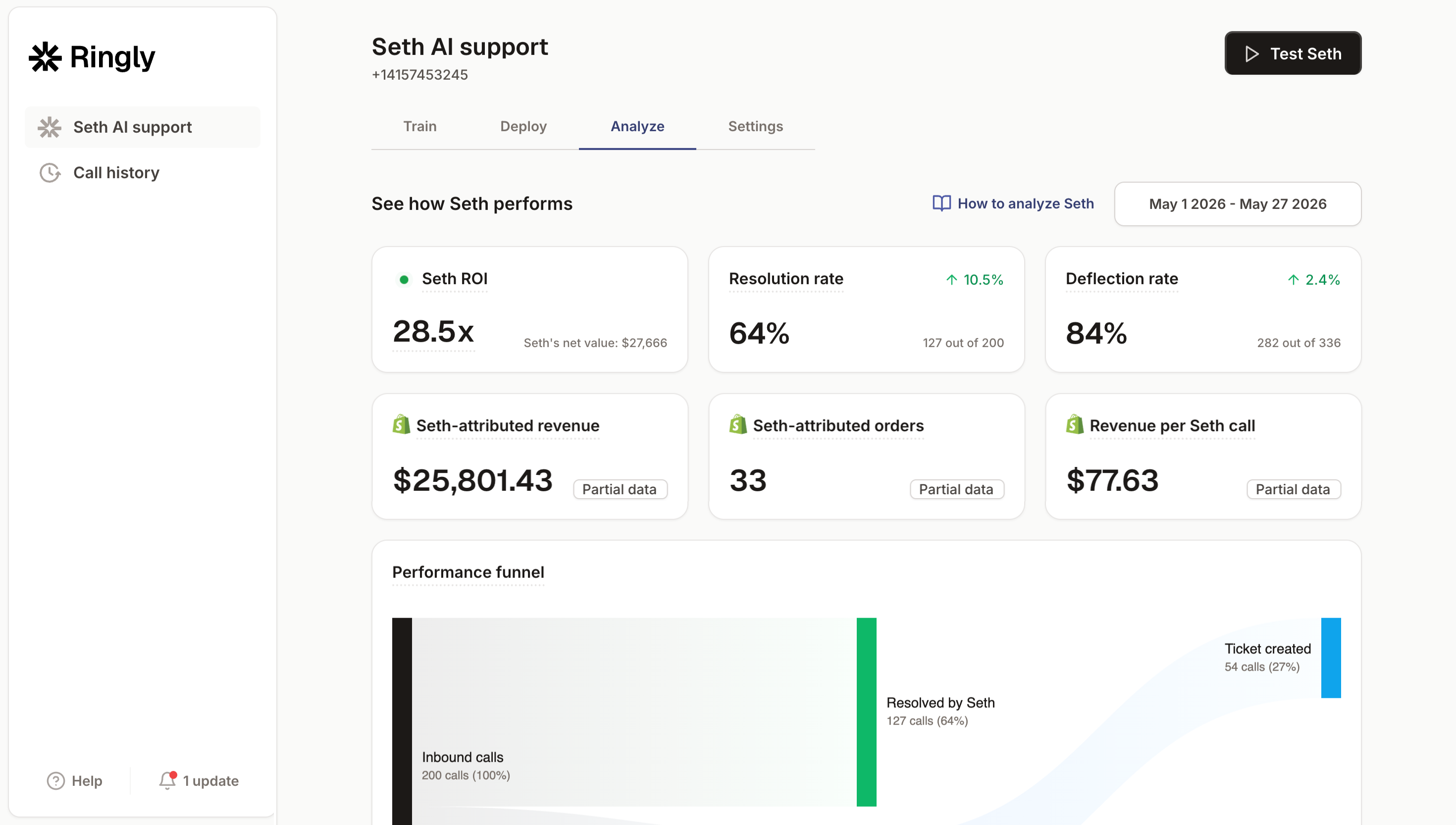
Ringly is AI phone support for Shopify brands. Where Posh handles a banking call, Ringly handles a Shopify call: it reads the order, starts the return, answers the product question from your knowledge base, and cancels the order when a caller asks. The phone shouldn't be a tax on your support team, and this is the tool built to take that tax off.
The AI answers inbound calls 24/7 in 40 languages. Calls that genuinely need a human escalate cleanly into Gorgias, Richpanel, or Re:amaze, so you keep your current number, your helpdesk, and your workflows. Seth resolves up to 90% of calls on its own for $1.99 a call after the first 50, versus $7 to $16 a call for human BPO. WashCo, a Shopify brand we launched, recovered $22,664 in its first 7 days on the phone.
In the test I ran for this list, this is the tool that actually closed the loop. It read order #1042 off the connected store and gave the customer a real status, it started the return without bouncing the call to a human, and when I forced an off-script complaint it handed the call into the helpdesk with the full context attached instead of dropping into voicemail. That's the whole job, and it's the job Posh can't do on a Shopify line because it was never built to see your store.
Pricing
| Plan | Price | Included | Best for |
|---|---|---|---|
| Pay per call | $99 a month | 50 conversations, then $1.99 each | Shopify brands taking support calls |
What works
- Native Shopify resolution. It finds orders, processes returns and exchanges, and answers product questions from your knowledge base, the calls Posh can't see.
- Escalates into your helpdesk. Hard calls hand off cleanly to Gorgias, Richpanel, or Re:amaze. You control what escalates.
- Done-for-you build. You don't design flows or tune prompts. Live in under 1 hour, and setup is free.
- 65% resolution guarantee. If Seth resolves under 65% of your calls in a month, that month comes back as credit (after 90 days on Pay per call).
- Customers say it doesn't sound like a bot. The most repeated compliment across our calls is "you don't sound like AI."
What doesn't
- Phone-first, not all channels. Ringly does phone. If you want one tool for chat, email, and voice in a single box, it's not that.
- No real-time inventory or phone-order payments. Inventory refreshes daily rather than live, and we don't take card payments over the phone.
Why it ranks first
It's the only tool here built for the Shopify call specifically. Posh resolves banking requests; Ringly resolves order, return, and product calls and escalates the rest into the helpdesk you already pay for.
2. Smith.ai
Best for: brands that mostly need calls answered, leads captured, and appointments booked, with a human as backup.
Smith.ai is a virtual receptionist service with an AI receptionist tier. It's popular with law firms and service businesses because it answers 24/7, captures leads, and routes to a human when needed. For a store that wants the phone covered and messages taken, it does that well.
Pricing
Smith.ai's AI receptionist plan starts around $95/mo. Its human-receptionist plans run $292.50/mo for 30 calls, $532.50 for 60, and $975 for 120, with overage around $9.75 to $11 per call, per Smith.ai's pricing page. It's well reviewed on G2.
What works
- Real human fallback. When the AI can't handle it, a trained receptionist picks up, which some brands want.
- Strong at booking and lead capture. Appointments and intake are its home turf.
- 24/7 coverage. The after-hours line gets answered.
What doesn't
- It takes messages, it doesn't resolve Shopify orders. No native order lookup or returns, so the WISMO call still lands on your team in the morning.
- Per-call pricing scales painfully. At DTC call volumes, $9.75 to $11 per overage call adds up fast.
Why it ranks second
A solid receptionist for services. But "answer and take a message" is the gap a Shopify brand is trying to close, not the fix.
3. Goodcall
Best for: small and local service businesses that want a cheap AI phone agent live the same day.
Goodcall is an AI phone agent and virtual receptionist aimed at service businesses, clinics, salons, home services. It's quick to set up and priced low, which is the appeal.
Pricing
Goodcall's Starter plan is $79/mo for 100 unique callers and Growth is $129/mo for 250, with $0.50 per caller over the limit, per Goodcall's pricing page. No per-call or per-minute charges.
What works
- Cheap entry point. $79/mo is low for an always-on AI answerer.
- Fast setup. You can have something answering quickly.
- Good for appointment and lead workflows. Its core use case is booking and routing.
What doesn't
- Built for service businesses, not ecommerce. No Shopify integration, so it can't resolve an order or a return.
- Unique-caller caps get expensive at scale. A brand with steady inbound volume blows past 250 callers fast.
Why it ranks third
Genuinely good and cheap for a salon's front desk. For a Shopify store's order calls, it's the wrong shape.
4. Synthflow
Best for: teams with a builder who want to design their own voice agent from scratch.
Synthflow is a no-code voice AI builder. It's flexible and can be cheaper at low volume, and you can wire it into almost anything, including Shopify, if you do the work.
Pricing
Usage-based, lower at small volumes and rising with minutes. Public pricing favors low-volume testing over a fully-built production agent.
What works
- Build anything. If you have a specific flow in mind, you can construct it.
- Lower cost at low volume. Good for experimenting before you commit.
- No-code editor. You don't need an engineer to start.
What doesn't
- You own the build, the QA, and the failures. The Shopify integration, the prompt tuning, the escalation rules, all of it is your job, not theirs.
- Not done-for-you. When a call goes wrong at 11 p.m., there's no team behind it but yours.
Why it ranks fourth
A capable toolkit, not a finished phone team. Great if you want to build; the wrong answer if you want the problem solved for you.
5. Gorgias (with its AI)
Best for: brands that want chat and email automation in the helpdesk they already run.
Most brands reading this already pay for Gorgias. Its AI is strong on chat and email, and that's where it should stay. Phone is the weak channel: its Sidekick AI is marketed at 60% automation but published case studies land at 26-56%, and per-resolution billing climbs with volume.
Pricing
Helpdesk subscription plus per-AI-resolution fees that stack on top. The phone side is not its strength, and the bill grows with ticket and AI volume.
What works
- Best-in-channel chat and email AI. For text support inside the helpdesk, it's strong.
- You already run it. No new vendor to onboard for chat.
- Native Shopify data in tickets. Order context shows up in the agent view.
What doesn't
- Phone is the weak spot. It's a helpdesk with chat AI, not a phone-resolution engine.
- Per-resolution billing creeps. AI tickets get billed on top of the base fee.
Why it ranks fifth
Keep Gorgias for chat and email. Put a phone-purpose tool in front of it for voice, and let the hard calls escalate back into it. That's the setup, not a swap.
What replacing Posh-style call handling costs vs Ringly
Posh's pricing is set in banking-procurement conversations, so there's no public number to anchor on. The honest comparison for a Shopify brand isn't Posh's invoice anyway. It's your CS payroll, since that's the cost the phone is actually loading.
Take a typical $50M Shopify brand running a 6-rep CS team:
| Line item | Today | With Ringly |
|---|---|---|
| 6 reps × $4K loaded per rep | $24,000/mo | n/a |
| Ringly Enterprise (~$5K/mo) | n/a | $5,000/mo |
| Net monthly CS spend | $24,000/mo | $5,000/mo |
| Monthly savings | n/a | $19,000/mo |
| Annual savings | n/a | $228,000/yr |
That's roughly 70% of repeatable calls, order status, returns, the same five questions over and over, routed to the AI, while the genuinely complex calls still go to your team, who now have time to actually solve them. Exact Enterprise pricing is set on a call. These are the savings shapes we see across 200,000+ calls.
"My customers also feel like it's a normal person. They feel like they can communicate if they have questions."
Claudia Droge, TechCraft Studio
TechCraft handles 88% of its calls without a human. That's the difference between a tool that answers and a tool that resolves, and it's the difference a Shopify brand is paying for. Want to compare this to your current setup? Book a 30-min call and we'll do the math live on your real call volume.
How to choose the right Posh AI alternative
The decision comes down to one question: does the tool resolve the Shopify call, or just answer it?
- Choose Ringly if you run a $10M-$100M Shopify brand and you want order, return, and product calls resolved 24/7 with hard calls escalated into your helpdesk.
- Choose Smith.ai if you mostly need calls answered, leads captured, and a human on standby, and you're fine resolving the order yourself later.
- Choose Goodcall if you're a small or service-style business that wants a cheap AI answerer live today and you don't need Shopify order resolution.
- Choose Synthflow if you have a builder on the team and you want to design and own a custom voice agent.
- Keep Gorgias for chat and email, and pair it with a phone-purpose tool for voice rather than asking it to be your phone agent. If you're weighing this against keeping a human team, our breakdown of in-house vs outsourced Shopify support lays out the real numbers.
If you've already tried an AI tool that disappointed you, that's usually a fit problem, not an AI problem. A chatbot or a banking agent pointed at a Shopify phone line was doing the wrong job in the wrong channel.
Frequently asked questions
Is Posh AI good? Yes, for banking. Posh is well-funded voice AI deployed at 100+ financial institutions, and customers like Florida Credit Union resolve about 91% of phone calls with it. It's just built for credit unions, not Shopify stores, so it can't read your orders or returns.
Why would a Shopify brand look for a Posh AI alternative? Because Posh doesn't connect to Shopify. It can't look up an order, process a return, answer a product question from your knowledge base, or escalate into Gorgias or Zendesk, which is most of what a DTC support call is.
What's the best Posh AI alternative for Shopify? For phone support, Ringly.io, because it's built for the Shopify call: it resolves up to 90% of calls on its own and escalates the rest into your existing helpdesk. The right pick depends on whether you need order resolution or just call answering.
How much does AI phone support for Shopify cost? Ringly is $99 a month for the first 50 conversations, then $1.99 each. Receptionist tools like Smith.ai run from about $95/mo to $975/mo, and Goodcall from $79/mo, but those answer and route rather than resolve orders.
Does an AI phone agent replace my helpdesk? No. A good one sits in front of Gorgias, Zendesk, Gladly, or Re:amaze and escalates the hard calls into it. You keep your helpdesk, your number, and your workflows.
Can these tools handle after-hours and weekend calls? Yes, all of them answer 24/7. The real difference is whether the after-hours call gets resolved on the spot or just lands back on your team Monday morning as a message.
What if we already tried AI phone support and it didn't work? That's common, and it's usually a fit issue. A chatbot or a banking-built agent pointed at a Shopify phone line fails because it's the wrong tool for that call, not because AI can't do it.
Talk to us

If you run a $10M-$100M Shopify brand and you're losing calls after-hours, a 30-min call is the fastest way to see what Posh-style tools leave on the table and what's actually resolvable on your line.
Our 3 promises.
- Live in under 1 hour. Setup and test calls are free.
- 30-day money back on the $99 plan fee.
- 65% resolution guarantee: if Seth resolves under 65% of your support calls in a month, that month comes back as credit (after 90 days on Pay per call).
Ruben (Ringly co-founder) takes these calls personally.