

At $10M in revenue, the phone stops being a side channel and starts being a line item.
- What an AI phone agent actually does at this scale, and why the economics flip once you cross $10M.
- The real number: a 6-rep team runs about $24,000/mo. The AI handles 70-80% of those calls for a fraction of it.
- Built for founders, COOs, and Heads of CX at $10M-$100M Shopify brands running a paid helpdesk with a visible phone number.
Most Shopify brands quietly pulled the phone number off their contact page in the last two years. The staffing math stopped working. But somewhere around $10M in revenue the math flips back, and the brands that figure that out first recover real money. WashCo, a Shopify brand we launched, pulled in $22,664 in its first 7 days on the phone. I pulled the call logs across 50+ Ringly brands to write this, and the $10M-plus ones all share one pattern: 70 to 80% of every call is the same five questions, and the after-hours slice is where the revenue quietly leaks.
If you run customer experience or operations at a $10M-$100M Shopify brand, you already know the Monday queue: WISMO, WISMO, a refund, three more WISMO, and a voicemail from a customer who called five times over the weekend. We build AI phone agents for 50+ Shopify brands trying to fix exactly that. Book a 30-min call and we'll show you what your store is leaving on the table after-hours.
What an AI phone agent actually is at this scale
An AI phone agent answers your inbound calls the way a trained rep would, except it picks up on the first ring, every ring, at 2 a.m. on a Sunday. It connects to your Shopify store, so when a customer asks where their order is, it looks up the real order and tells them. It pulls product answers from your knowledge base. It books returns, handles exchanges, and hands the genuinely hard calls to a human.
The point at $10M-plus isn't "a robot answers the phone." It's that the routine 70-80% of calls stop touching your payroll at all. That's the part that moves a P&L.
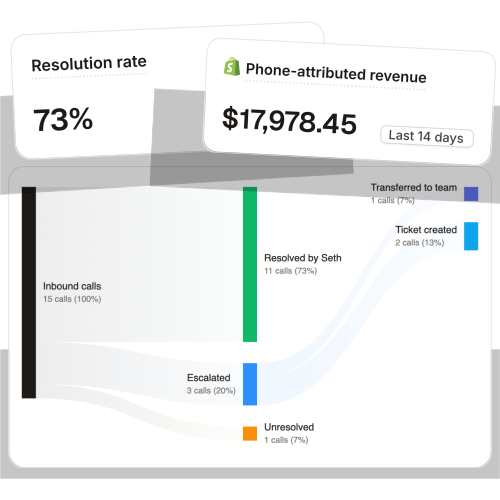
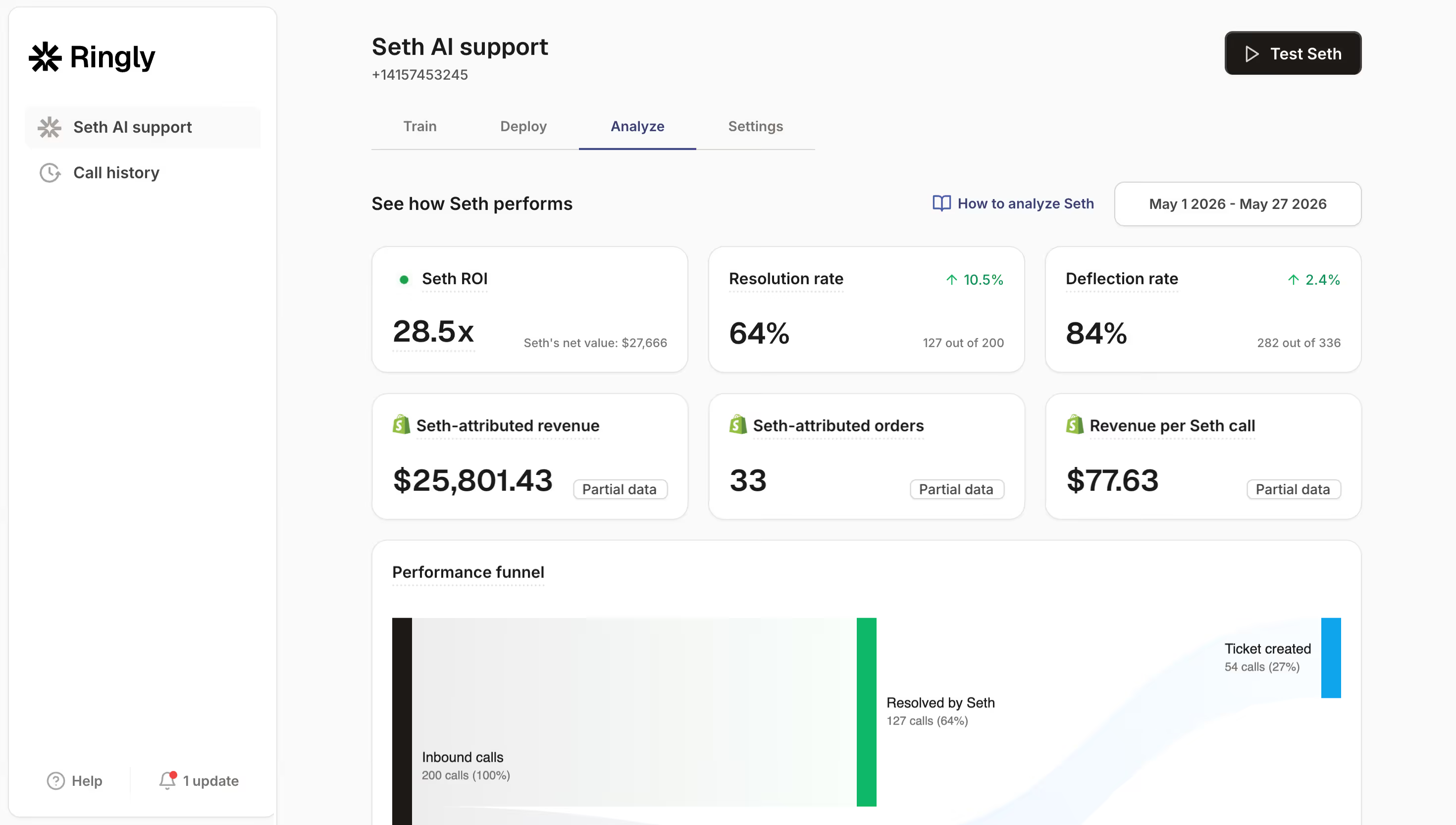
Across the 50+ brands on Ringly, the AI resolves 73% of inbound calls on its own at roughly $0.42 per resolved call. A human BPO runs $7 to $16 a call by comparison. This is a different thing from a chatbot or an AI voice agent for ecommerce bolted onto a website widget. It lives on the phone, where your highest-intent and most-frustrated customers go when chat didn't cut it.
What it handles out of the box:
- Order status (WISMO). The single biggest call type. It reads the live order from Shopify and gives a real answer, not "let me check." See how the order-status lookup works.
- Returns and exchanges. Starts the flow, sends the label, logs it to your helpdesk.
- Product questions. Answers from your knowledge base, refreshed daily from your site.
- Abandoned-cart rescue. Calls back the customer who almost bought.
Why $10M is the line where the phone math flips
Below $10M, the phone is a trickle. You get maybe a few calls a day, and neither a night-shift rep nor an AI build pays for itself. You let it roll to voicemail and mostly that's fine.
Above $10M, three things happen at once. Call volume crosses the threshold where the after-hours leak becomes real money. Hire #5 gets genuinely expensive. And your existing Shopify Plus customer service team is already buried in tickets, so the phone is the thing that breaks first.
A higher-AOV store sees 12-18% of orders generate a phone call, versus about 3% at a $40 AOV. As you scale, that ratio doesn't shrink, your order count just multiplies it. The volume is real, and most of it is repeatable.
Here's what makes the leak hurt. WISMO calls run 30-40% of tickets in a normal week and over 50% at peak (Salesforce). Those calls don't stop at 6 p.m. They keep coming, and they roll to voicemail, and 80% of voicemail-routed callers hang up without leaving a message (Eden). A caller who can't reach you doesn't sit patiently. They buy from someone else.
WashCo, a Shopify brand we launched, recovered $22,664 in its first 7 days on the phone. That's not a chat-deflection number. That's revenue from calls that used to die in a voicemail box.
What it handles vs what still goes to your team
The honest version: an AI phone agent is not your whole CS team. It's the routine 70-80%. The other 20-30%, the genuinely complex calls, still go to your reps, who now have time to actually solve them instead of reading tracking numbers all day.
Your team stops answering the same five questions 50 times a day and starts handling the calls that need a person. That's the trade. It's also why the brands that buy this frame it as "stop hiring rep #5," not "fire the team."
"My customers also feel like it's a normal person. They feel like they can communicate if they have questions."
Claudia Droge, TechCraft Studio
Be clear-eyed about the limits, because the SERP won't tell you them. An AI phone agent does not take orders or payments over the phone (regulation plus the risk of getting a card number wrong, so the workaround is an SMS payment link). Subscription pause-and-cancel is a custom action, not a default. Inventory answers come from a daily knowledge-base refresh, not real-time stock. If your call volume is mostly phone-orders or live subscription edits, walk in knowing that.
Everything else escalates cleanly. The AI does the first pass, and anything it can't close hands off to a human with the full context, logged into Gorgias or whatever helpdesk you already run.
After-hours is where the money actually leaks
Here's the part the SERP skips. The expensive calls aren't the ones during business hours, when a rep can grab them. They're the nights and weekends, when nobody's on the line.
A customer who placed a $200 order on Saturday morning wants to know where it is by Saturday night. They call. It rolls to voicemail. And 80% of voicemail-routed callers hang up without leaving a message (Eden). Worse, a missed call doesn't make someone patient. 85% of callers who can't reach a person never call back, and 62% switch to a competitor (PCN). At a $40 AOV that's annoying. At the order values a $10M-plus brand runs, it's a real number, every single weekend.
The 24/7 part is the whole reason AI phone pencils at this scale, because a night-shift rep never will. You can't justify paying someone $4,000/mo to sit idle from 10 p.m. to 6 a.m. waiting for the handful of calls that matter. The AI covers that window at no marginal cost. That's the gap our 24/7 ecommerce phone support breakdown gets into. It's also why WashCo's first 7 days produced recovered revenue, not just deflected tickets, the calls it caught were the ones that used to go nowhere.
What this costs vs what your team costs today
Take a typical brand at this scale running a 6-rep CS team. A US rep runs about $4,000/mo loaded, salary plus benefits, payroll tax, training, and the cost of the ones who quit. The 2026 replacement cost for a single CS rep is $14,113 (Insignia, citing Gartner), and contact-center turnover runs 30-45% a year. So the team isn't just expensive, it's a churning expense.
| Line item | Today | With an AI phone agent |
|---|---|---|
| 6 reps × $4K loaded | $24,000/mo | n/a |
| AI phone agent (illustrative) | n/a | ~$5,000/mo |
| Net monthly CS spend | $24,000/mo | $5,000/mo |
| Monthly savings | n/a | $19,000/mo |
| Annual savings | n/a | $228,000/yr |
That assumes roughly 70% of calls (the WISMO, returns, and product questions, the same five things over and over) route to the AI. The other 30% stay with your team. The exact price is set on a call, and it usually lands around 20% of your current CS spend:
| Team size | CS spend today | AI phone agent (illustrative) | Net monthly savings |
|---|---|---|---|
| 4 reps | $16,000/mo | ~$3,000/mo | ~$13,000/mo |
| 6 reps | $24,000/mo | ~$5,000/mo | ~$19,000/mo |
| 12 reps | $48,000/mo | ~$8,000/mo | ~$40,000/mo |
For more detail on the underlying numbers, our breakdown of Shopify customer service cost walks through the loaded-cost math line by line.
If you want to run your own numbers against your real call volume, book a 30-min call and we'll do the math live on your store.
How an AI phone agent sits in front of your Gorgias (not instead of it)
You don't rip out your stack. The AI phone agent sits in front of the phone line you already have, you keep your number, your helpdesk, and your workflows. It picks up first, resolves what it can, and pushes everything else into Gorgias, Zendesk, Reamaze, or Richpanel as a ticket with the call context attached.
The mistake brands make is treating this as a helpdesk replacement. It's a layer in front of the one you already pay for. Your reps still live in the same tool. They just get a lighter, higher-value queue.
This is also where the AI-voice category has burned people. If you tried Consio or another voice tool and it underdelivered, the honest read is usually that you got handed software and left to configure it. Our take on that is in Consio vs Ringly. The done-for-you model exists precisely because configuring a phone agent yourself is where most deployments stall. If you're earlier in the research, our overview of automated phone support for Shopify brands covers how the handoff works end to end.
How to evaluate one for a brand your size
I run phone support for 50+ Shopify brands, so I evaluate these tools as a buyer, not a critic. If I were shopping for an AI phone agent at $10M-plus, here's what I'd actually test:
- Call the line yourself. Voice quality is the whole game. The most repeated thing our customers' callers say is "you don't sound like AI." If a demo line sounds like a phone tree, walk.
- Who builds it, you or them. A DIY builder hands you an editor and wishes you luck. A done-for-you setup means an engineer tunes it against your real calls. At your scale, you do not have time to be the implementation team.
- Does it actually read your Shopify orders. Ask it a live WISMO question on a real order during the demo. If it can't pull the order, it's a script, not an agent.
- How it escalates. Confirm it logs to your helpdesk with full context, not a dead-end transfer.
- The guarantee. Anyone confident in the product will put resolution on the line. We guarantee 65% resolution in 90 days or we refund the last 3 months, and we keep working until we hit it.
The brands that get value from this share one trait: they installed it, made test calls, and came to the call with "can it do X for my store" questions, not "what is voice AI" questions. If you've read this far, you're probably already there. Our AI customer support phone agent for Shopify page has the demo number.
Frequently asked questions
What's the difference between an AI phone agent and a chatbot? A chatbot handles text on your website. An AI phone agent answers actual phone calls, in a natural spoken voice, and connects to your Shopify store to look up orders and handle returns. Phone is where your highest-intent and most-frustrated customers go, which is why it's the harder problem to solve well.
Will my customers know they're talking to AI? Most don't. The most repeated thing our customers' callers say after a call is "you don't sound like AI." You can hear it yourself on the demo line before you decide anything.
Does it work with Gorgias or my existing helpdesk? Yes. It sits in front of your phone line and escalates the calls it can't resolve into Gorgias, Zendesk, Reamaze, or Richpanel, with the full call context attached. You keep your number, your helpdesk, and your workflows.
Can it take orders or cancel subscriptions over the phone? Not by default. Phone orders aren't supported (the workaround is an SMS payment link), and subscription pause-or-cancel is a custom action rather than a built-in. If most of your calls are one of those two, that's worth flagging on a call.
How much does an AI phone agent cost for a $10M brand? Self-serve plans start at $349/mo. For $10M-$100M brands the build is done-for-you and priced by call, usually around 20% of your current CS spend. A 6-rep team spending $24,000/mo typically nets about $19,000/mo back.
How fast can we go live? The self-serve setup is live in under an hour. The done-for-you build for a brand at your scale is a 14-day Launch Sprint, and it's free until you're launched.
Talk to us

If you run a $10M-plus Shopify brand and your phone rolls to voicemail after 6 p.m., a 30-min call is the fastest way to see what that's costing you. We'll pull the math against your real call volume and show you the recoverable revenue, no deck required.
The 3-layer guarantee.
- Live in 14 days or it's free until launched.
- 65% resolution in 90 days or we refund the last 3 months of subscription fees.
- We keep working free until we hit 65%.
Ruben (Ringly co-founder) takes these calls personally.