
Step 1
Connect Shopify and your tools
Your help desk, returns, shipping and subscription apps.
See all integrations AI phone support for Shopify brands
Seth is the AI phone agent for Shopify stores. He answers every call instantly, even at 3am and on Black Friday.
$99/mo for the first 50 phone conversations, then $1.99 per conversation

When order volume rises, the phone becomes the place where every delay gets louder. A customer calls at 9pm about a late order. Another calls during a sale to ask if a product will fit. On Black Friday, WISMO calls stack up while your team is trying to ship, answer emails, and keep the site moving. The call is important, but the timing is bad.
The usual ecommerce call center answer is to add seats. That can work, but it creates another planning job. You estimate volume, pay for coverage, train people on your policies, and hope the queue does not spike past the schedule. A call center for ecommerce can also miss the context that matters on the call, such as the caller's Shopify orders, what they asked last time, and the return policy they are asking about now. The result is more routing, more waiting, and more cleanup after the call ends.
Seth is built for the moment when the phone needs to scale without a hiring plan. It answers instantly, 24/7, and starts with order context. If you are comparing ecommerce call center services, the service checklist for ecommerce support teams shows what brands usually evaluate before outsourcing.
Seth does not take payments on the call, cancel subscriptions natively, provide real-time inventory except as custom work, act as a human answering service, take messages by people, or run chat. When a call needs one of those paths, Seth transfers, emails the issue, or creates a helpdesk ticket based on your rules. For platform fit, read what Shopify call center software needs to connect.
Set up Seth in under 1 hour
Your help desk, returns, shipping and subscription apps.
See all integrationsCatalog2,352 productsSyncedHe reads your catalog, website and policies. You pick the voice.
Forward your current number or use the one that comes with Seth.
Ecommerce call center outsourcing usually prices coverage around people, minutes, or tiers. Seth uses one public plan, so you can see the call cost before a spike. See Ringly.io pricing for plan details. Seth resolves 65% of your support calls, or that month comes back as credit (after 90 days on Pay per call).
| Option | Price as published | What a store gets | Source |
|---|---|---|---|
| Ringly.io, Seth | $99/mo for the first 50 phone conversations, then $1.99 per conversation | AI phone support for Shopify calls, 24/7, with order context, transcripts, recordings, attributed revenue, and a monthly spend limit in Settings. | ringly.io |
| Smith.ai human receptionists | Starter $300/month for 30 calls, $11.50 per extra call; Basic $810/month for 90 calls, $10.50 per extra call; Pro $2,100/month for 300 calls, $8.50 per extra call. | Human receptionist plans with included calls and extra call rates. | smith.ai |
| PATLive human answering service | $189/month for 100 minutes, About 40 calls, $2.09 per additional minute. | Human answering service priced by minutes. | patlive.com |
| Bureau of Labor Statistics, hiring a customer service representative in the US | Median pay $21.53 per hour, $44,770 per year, about $3,731 a month before taxes and benefits. | One person covers one shift, not 24/7. | bls.gov |
Prices read on September 30, 2026 from each vendor's own pricing page.
At 100 calls a month, Ringly.io's rule of thumb says about 80% end up billed, so 100 calls is about 80 billable and about $159/mo all in. Smith.ai Basic at 100 calls is $810 + 10 x $10.50 = $915. Custom plans are available from 1,000+ calls a month. Try for free.
Shopify brands on Ringly’s AI phone support

88% of calls handled without a human at TechCraft Studio.



79% of calls resolved end to end at BioLongevity Labs.



1,595 calls answered in 90 days at Gear Rider, with no phone rep.



78% of calls resolved without a human at Luxevéria.



8 countries where Medivita runs phone support, on 1 Ringly account.



71% of calls resolved without a human at Herbionyx.



6.7x the phone volume at Hey Zeyla, with no new hire.



78% of calls resolved without a human at Vynzo.

Seth costs $99/mo for the first 50 phone conversations, then $1.99 per conversation. You only pay when Seth talks to a customer. Spam, wrong numbers, hang-ups, silent calls, callers passed straight to a human, and your own team testing are not billed. About 80% of calls end up billed, so 100 calls a month is about $159/mo all in.
No. There is no contract, and billing is month to month. You can cancel in Settings → Subscription. On card billing the plan ends right away. On Shopify billing, Seth keeps working until the end of the paid period. You can also set a monthly spend limit, and Seth pauses at the cap. There is a 30-day money back guarantee on the $99 plan fee, and conversations above the first 50 stay billed.
Most brands go live in under 1 hour. AI Coach sets up the integrations, so you do not need an engineer. You connect Shopify and your helpdesk, point Seth at your website, help docs and policies, then choose how calls escalate. Try for free: signup, setup and the demo calls generated during onboarding are not billed.
Yes. Seth starts each call with the caller, their Shopify orders, and what they said last time. It can look up orders, request returns, send emails, transfer the call, or create a helpdesk ticket. It handles WISMO, returns, exchanges, subscriptions, product advice and policy questions. It does not take payments by phone.
Seth escalates instead of guessing. You choose the path: transfer to a human, email the issue to your team, or create a helpdesk ticket. The rule can differ by business hours, so you can transfer during the day and create a ticket overnight. Callers who only want a human and get passed straight on are not billed.
Yes, Seth answers 24/7, including at 3am, instantly and with no hold queue. You can set different escalation rules by business hours. For example, during open hours Seth can transfer to a human, and after hours it can email the issue or create a helpdesk ticket for your team to pick up in the morning.
Yes, Seth can answer in other languages when set up for them. Medivita runs phone support in 8 countries on one AI account, with ten phone lines and four languages: English, German, Spanish, and Portuguese. For your store, language setup depends on your content, policies, and call flows.
Seth is built for Shopify brands and starts each call with the caller, their Shopify orders, and what they said last time. It also connects to your store content, help docs, policies, and helpdesk workflows. For example, Seth can create a helpdesk ticket in Gorgias when the call needs follow-up. AI Coach sets up integrations, so you do not need an engineer.
Seth answers from your website, help docs, and policies, plus Shopify order data on the call. If it is not sure, it escalates instead of guessing. You set the greeting during onboarding, and demo calls generated during setup let you hear how Seth handles your store's questions before you switch it on.
Yes, you can keep your current number by forwarding calls to Seth. You can also use a number that comes with Seth. Your escalation rules decide what happens next, such as transfer to a human, email the issue, or create a helpdesk ticket. Rules can differ by business hours, so a daytime call and an after-hours call can follow different paths.
Seth scales during sales events because it answers every call at once, with no hold queue. That matters when a promotion, delivery delay, or Black Friday surge creates more calls than your team can handle. Seth answers 24/7, including at 3am, and uses Shopify order context on the call. If it should not answer alone, it escalates by transfer, email, or ticket.
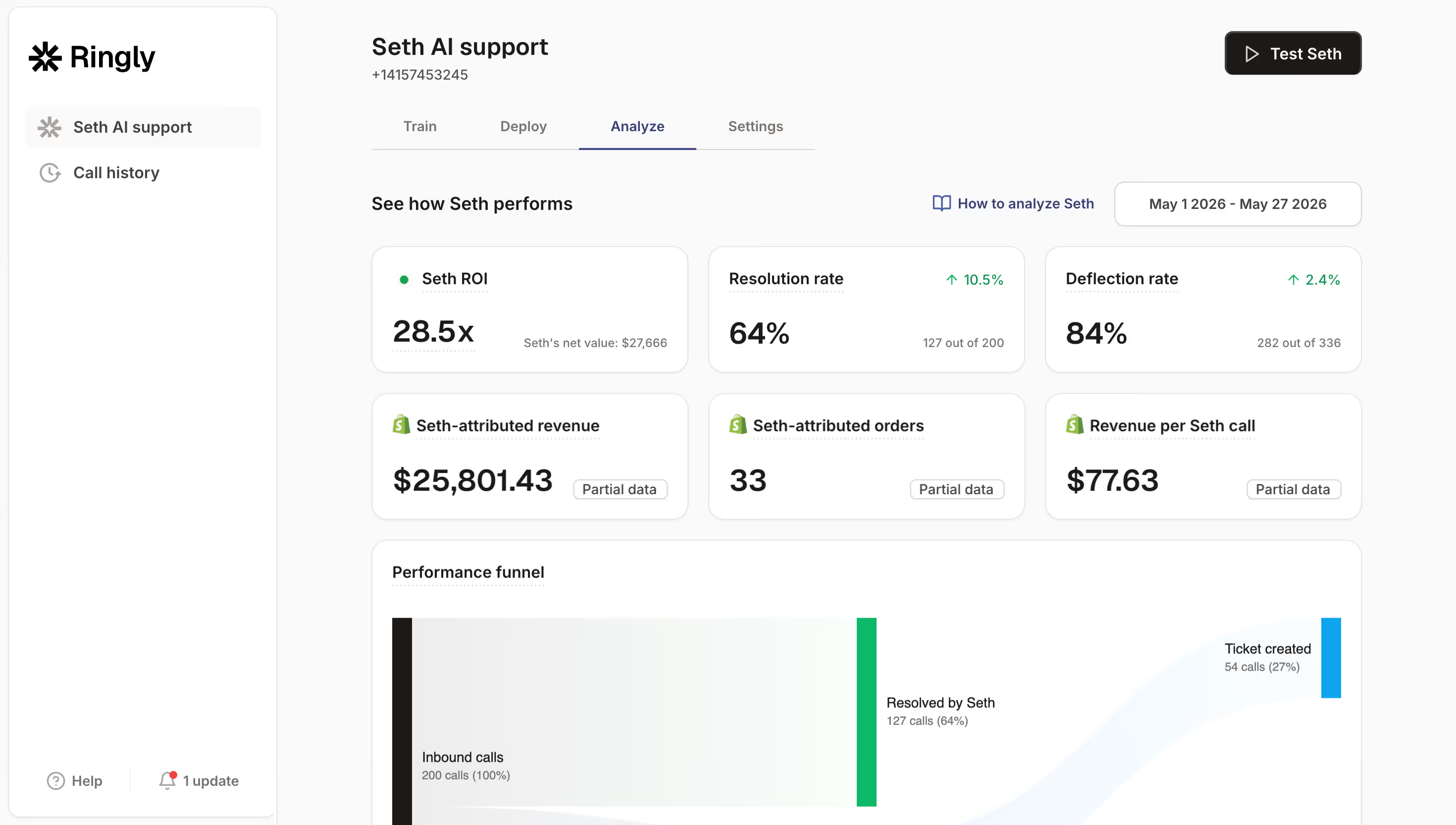
The most useful features are instant answering, 24/7 coverage, Shopify order context, clear escalation, and visibility after the call. Seth answers from your website, help docs, and policies. It escalates when it is not sure instead of guessing. Your dashboard shows recordings, transcripts, and attributed revenue. Orders placed after a call show up as Seth-attributed revenue.
For a Shopify brand that wants instant 24/7 coverage without hiring outsourced seats, Seth is an alternative to a Philippines call center for ecommerce. It answers every call at once, uses Shopify order data, and follows your policies. A human outsourcing team can still make sense when you want people handling every conversation. Seth fits routine support, peak coverage, and escalation to your team.