


OptiMonk is a solid popup tool. But when your traffic starts scaling, so does your bill.
One Shopify store owner put it bluntly: at 170,000 monthly pageviews, they were staring down $249 per month. That's not pocket change.
I've spent time with seven of the most popular OptiMonk alternatives to see how they actually stack up.
Some are cheaper. Some are faster. Some just handle better at scale.
This guide breaks down what each tool does well, where it falls short, and which one fits your specific situation.
Editor’s note: Want to hear some sample AI support calls made for your Shopify store?
- Just paste your store URL
- Get sample calls in under 20 seconds (no email required)
- Listen to demo calls for my store
What to look for in OptiMonk alternatives
Before diving into the tools, let's get clear on what matters. Not every popup builder is built the same, and the "best" choice depends on your setup.
Pricing transparency is the big one. Many tools advertise low starting prices but scale aggressively as your traffic grows.
Look for predictable pricing that won't surprise you six months in.
Platform fit matters more than you'd think. If you're on Shopify, you want deep ecommerce integrations.
WordPress users need plugins that actually work. Generic site builders need flexible embed options.
Core features are mostly table stakes now: exit-intent triggers, A/B testing, drag-and-drop builders.
The differentiators are things like AI product recommendations, web push notifications, or gamification elements like spin-to-win wheels.
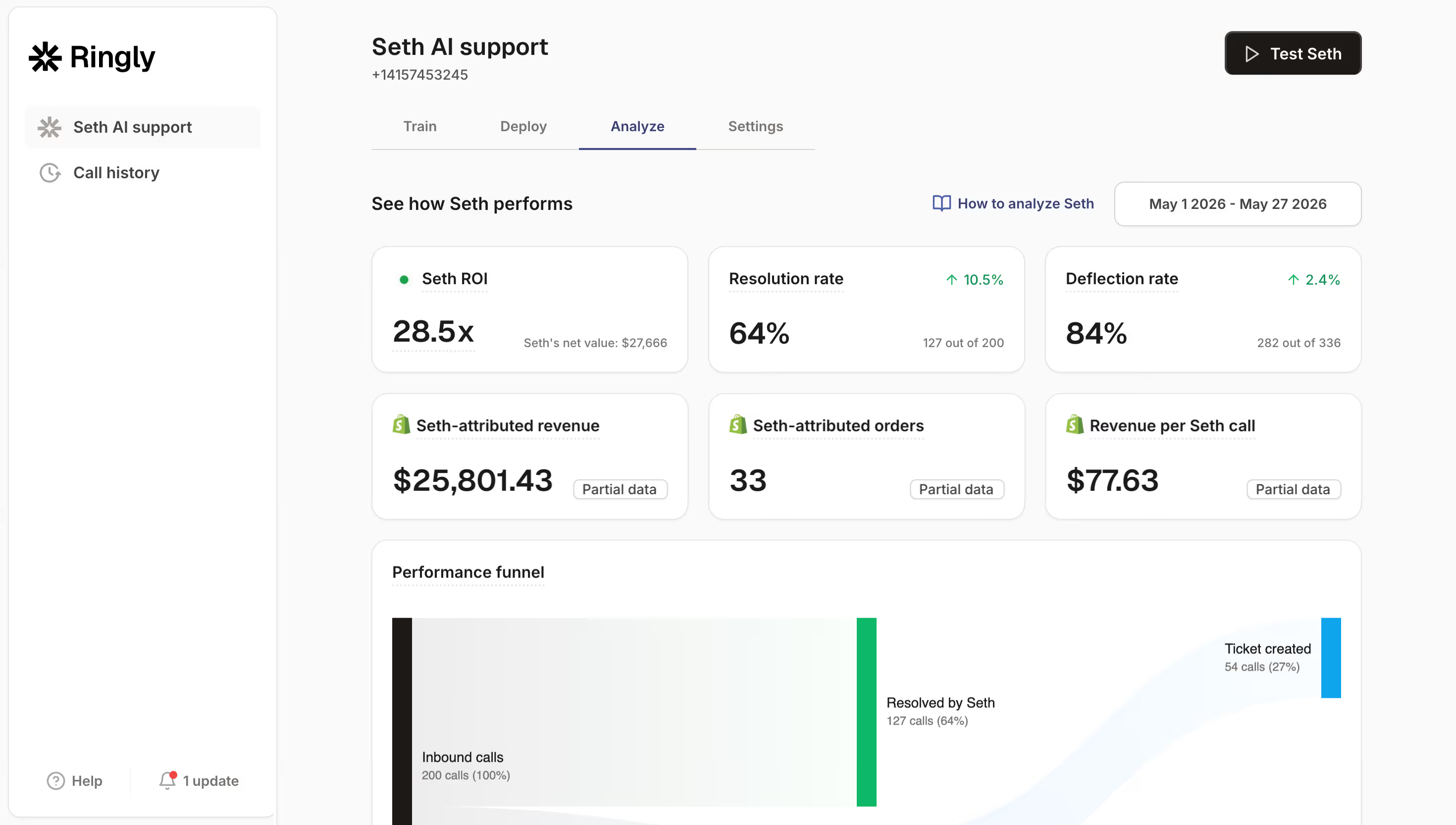
One thing popup tools don't handle? Phone calls. If customers are ringing your support line asking about orders, that's a gap no popup can fill.
Tools like Ringly.io handle that side of the equation with AI phone agents that resolve around 70% of calls without human intervention.
Quick comparison: all 7 OptiMonk alternatives
| Tool | Starting Price | Free Plan | Best For | Key Differentiator |
|---|---|---|---|---|
| OptinMonster | $16/mo (annual) | No | Power users, agencies | Most mature platform, extensive integrations |
| Wisepops | $49/mo | No (14-day trial) | Enterprise ecommerce | AI product recommendations, web push notifications |
| Poptin | $25/mo | Yes (1K visitors) | Small teams, budgets | Cheerful UI, built-in email marketing |
| Popupsmart | $39/mo | Yes (5K views) | Fast-growing stores | Fastest loading (~134ms), predictable pricing |
| Sleeknote | $49/mo (€49) | No | Ecommerce gamification | Mobile-optimized, scratch cards, spin-to-win |
| Claspo | $29/mo | Yes (3K views) | Template-heavy users | 1000+ templates, generous free tier |
| ConvertFlow | $99/mo | Yes | B2B, SaaS | Advanced personalization, quizzes, multi-step forms |
1. OptinMonster

OptinMonster is the established leader in the popup space. It's been around since 2013 and has the most comprehensive feature set of any tool on this list.
The platform offers every campaign type you might need: lightbox popups, floating bars, slide-ins, inline forms, content lockers, and gamified wheels.
The targeting rules are extensive. You can trigger campaigns based on exit intent, scroll depth, time on page, referrer source, visitor location, device type, and even specific click patterns.
Integration-wise, OptinMonster connects with virtually every email service provider and CRM worth using.
Mailchimp, Klaviyo, HubSpot, Salesforce, ActiveCampaign, ConvertKit. The list goes on.
Pricing starts at $16 per month when billed annually, but there's no free plan. The Basic plan is limited.
You need at least the Plus plan ($32/mo) for A/B testing and advanced targeting. Growth and Pro plans unlock more advanced features like countdown timers and coupon wheels.
Who it's best for: Agencies managing multiple clients, serious marketers who need granular control, and WordPress power users. The learning curve is real, but the depth is unmatched.
Pros:
- Most mature platform with 10+ years of development
- Extensive integration ecosystem
- Powerful rules engine for complex targeting
- Excellent documentation and support
Cons:
- No free plan to test before committing
- Interface feels dated compared to newer tools
- Pricing jumps significantly at higher tiers
2. Wisepops

Wisepops positions itself as the enterprise choice. Their client list includes Unilever, Harvard Business Review, and Givenchy.
That tells you something about who they're targeting.
The standout feature is AI-powered product recommendations. If you're running an ecommerce store, Wisepops can analyze your catalog and suggest relevant products within popups. This isn't just a nice-to-have. It can meaningfully impact average order value.
Web push notifications are another differentiator.
While most popup tools focus on on-site engagement, Wisepops lets you send push notifications to bring visitors back after they've left. This is sophisticated stuff usually handled by separate tools.
Targeting is smart and granular. You can segment by traffic source, device, location, browsing behavior, and purchase history.
The analytics dashboard is clean and goal-oriented. You set campaign objectives upfront and track against them.
Pricing starts at $49 per month with no free plan. There's a 14-day trial, but once that's up, you're paying.
The entry-level plan includes most features, though AI recommendations and advanced segmentation require higher tiers.
Who it's best for: Larger ecommerce brands, multi-market retailers, and teams that want push notification capabilities built-in. Not ideal for small shops on tight budgets.
Pros:
- AI product recommendations increase conversion potential
- Web push notifications included
- Clean, goal-oriented analytics
- Strong enterprise integrations
Cons:
- Expensive entry point
- No free tier
- Limited segmentation on lower plans
3. Poptin

Poptin takes a different approach. Where Wisepops feels enterprise, Poptin feels friendly.
The parrot mascot and purple color scheme make conversion optimization almost cheerful.
Don't let the playful branding fool you. Poptin packs serious functionality. You get exit-intent triggers, scroll-based triggers, time delays, and click-based activation.
The drag-and-drop builder is intuitive, and the template library covers most use cases.
One unique angle: Poptin includes built-in email marketing capabilities.
It's not going to replace your full email platform, but for simple autoresponders and follow-ups, it works. This makes it a potential one-stop shop for small businesses just getting started.
The free plan is genuinely usable. You get up to 1,000 monthly visitors, which is enough for many small sites.
Paid plans start at $25 per month for 10,000 visitors. That's competitive pricing.
Who it's best for: Solopreneurs, small teams, and anyone who wants solid popup functionality without enterprise complexity or pricing.
Pros:
- Affordable with a genuinely useful free plan
- Fun, approachable interface
- Built-in email marketing features
- Easy setup and intuitive builder
Cons:
- No auto-branding feature (you'll style campaigns manually)
- Limited advanced features compared to OptinMonster or Wisepops
- Smaller integration ecosystem
4. Popupsmart
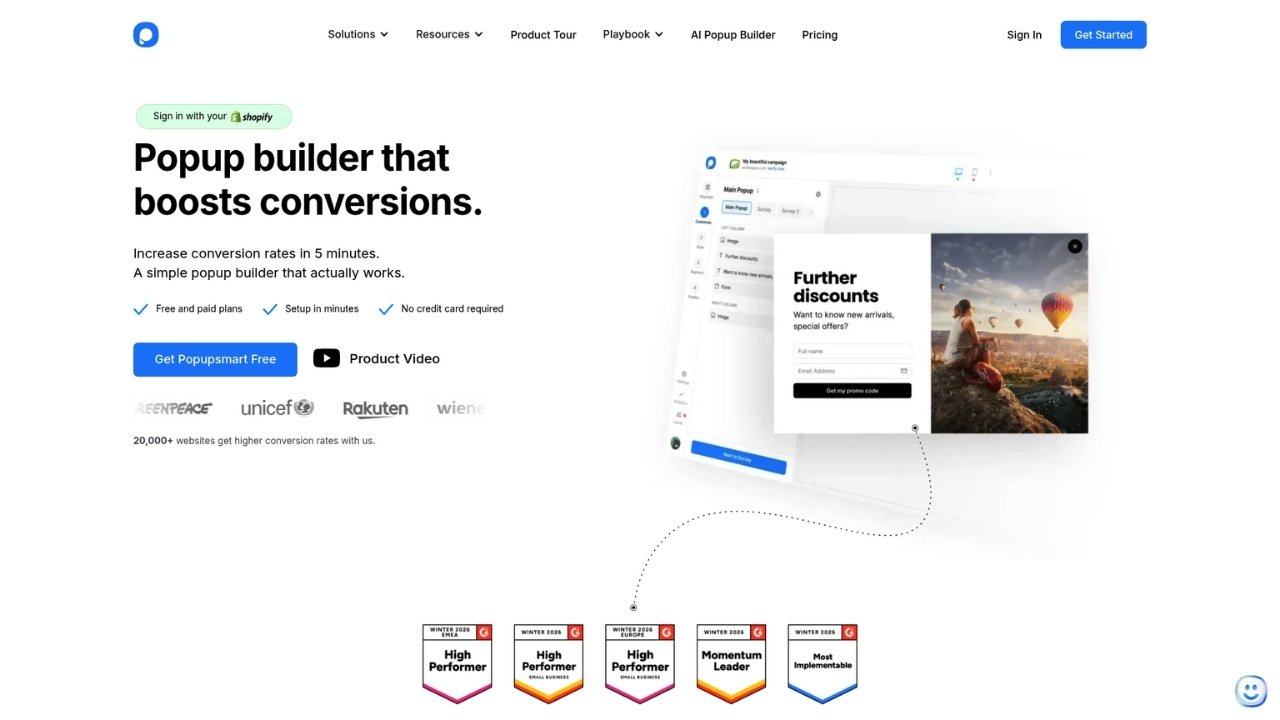
Popupsmart has one claim that should make any performance-minded marketer pay attention: their popups load in approximately 134 milliseconds.
Compare that to OptiMonk's reported 618 milliseconds. That's a significant difference in user experience and potentially SEO impact.
The pricing model is refreshingly straightforward. At 100,000 pageviews, you're paying $57.50 with Popupsmart versus $99 with OptiMonk.
Unlimited domains are included on all paid plans, which is great for agencies managing multiple sites.
The free plan covers 5,000 monthly views with no branding requirements.
That's more generous than most competitors. Paid plans start at $39 per month.
Features include all the standard triggers: exit-intent, scroll depth, time-based, and click-based.
The gamification options include spin-to-win wheels and countdown timers. Integration-wise, they cover the major email platforms and offer Zapier connectivity for everything else.
Who it's best for: Fast-growing stores concerned about site speed, agencies managing multiple client sites, and anyone frustrated with unpredictable pricing that scales with traffic.
Pros:
- Lightning-fast popup loading times
- Predictable, transparent pricing
- No branding on free plan
- Unlimited domains on paid plans
Cons:
- Smaller template library than OptinMonster
- Less established brand (founded 2019)
- Fewer advanced targeting options
5. Sleeknote
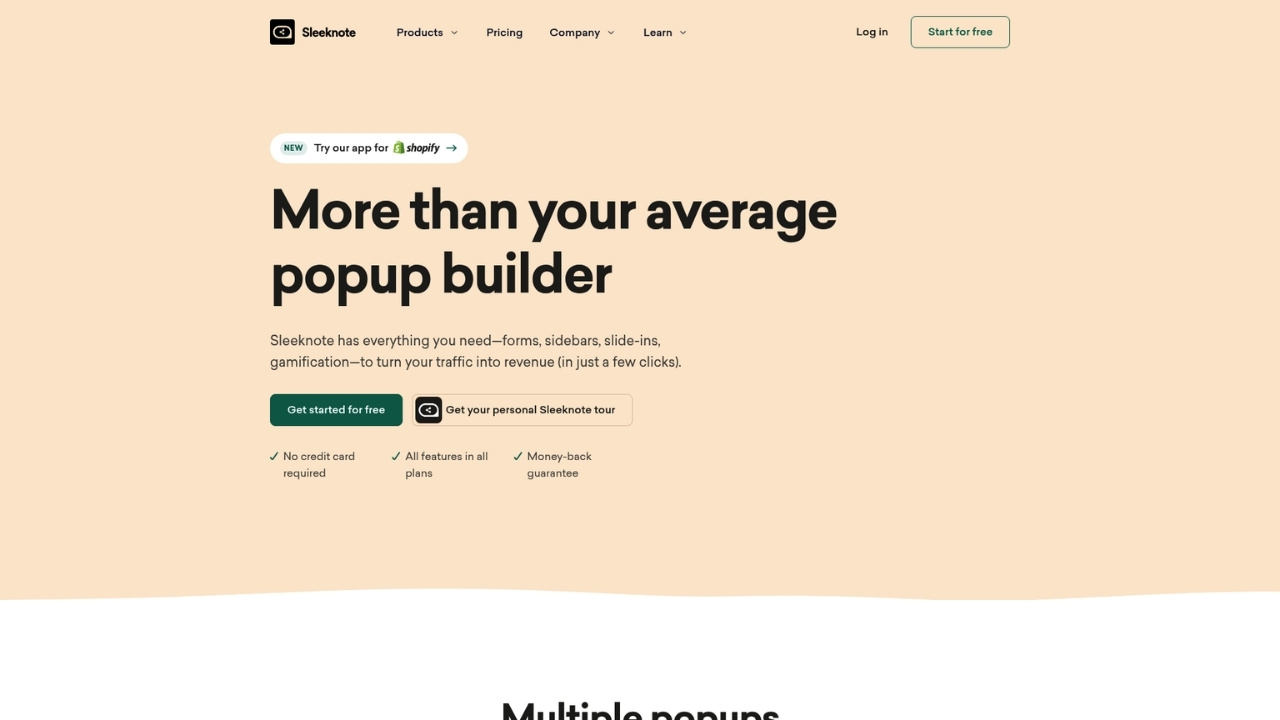
Sleeknote is built specifically for ecommerce. Every feature, every template, every integration decision seems optimized for online retailers.
The gamification features are particularly strong. Scratch cards and spin-to-win wheels come standard.
These aren't gimmicks. They genuinely drive engagement and capture emails at higher rates than standard popups.
Mobile optimization is another focus area. Sleeknote's popups are designed to work well on phones without being intrusive or triggering Google's mobile penalty. This matters when 60%+ of your traffic is likely mobile.
The Shopify integration is deep. You can target based on cart value, product categories, and purchase history.
This level of ecommerce-specific targeting is hard to find elsewhere.
Pricing starts at €49 per month (approximately $49-52 USD depending on exchange rates).
There's no free plan, but you can request a demo. Note that pricing is in Euros, which may add complexity for US-based businesses.
Who it's best for: Ecommerce brands wanting gamification features, retailers focused on mobile experience, and Shopify stores needing deep integration.
Pros:
- Excellent mobile optimization
- Strong gamification features (scratch cards, spin-to-win)
- Deep Shopify integration
- Ecommerce-focused templates
Cons:
- Euro pricing may complicate budgeting
- No free plan
- Limited appeal beyond ecommerce use cases
6. Claspo
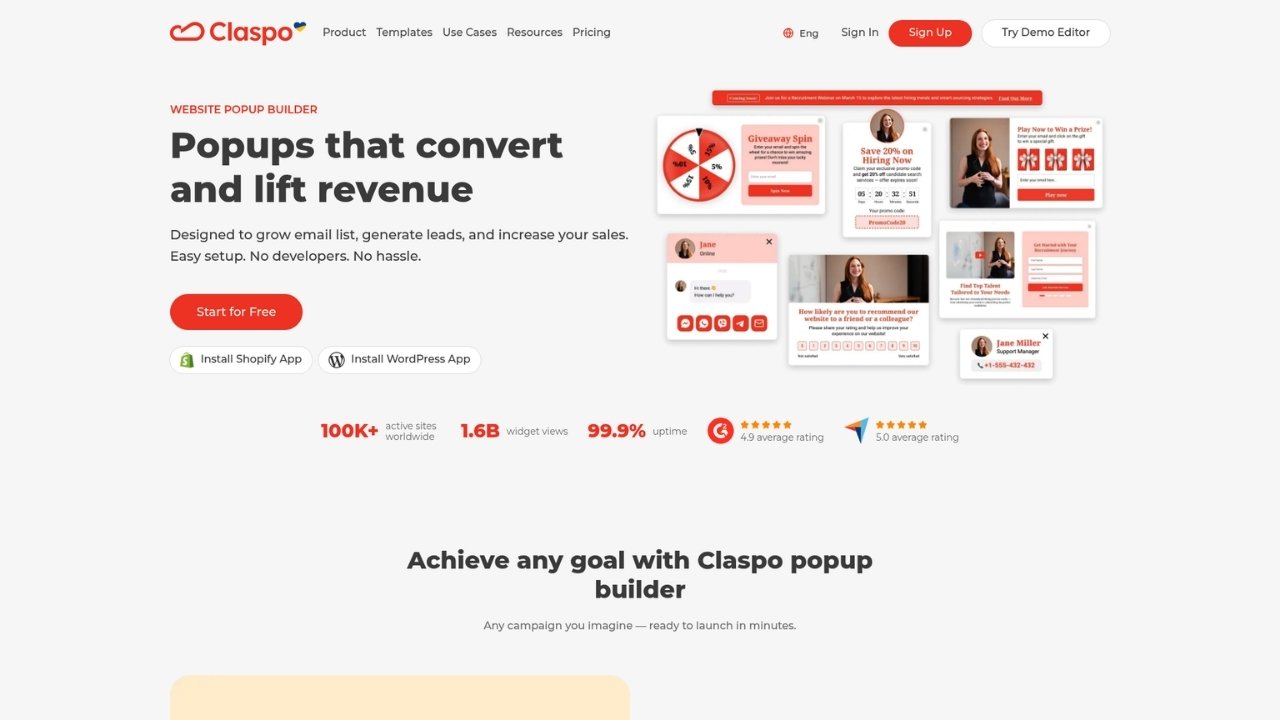
Claspo is the newest player on this list, but they're making waves with an incredibly generous free plan and a massive template library.
The free tier covers 3,000 monthly views. That's triple what Poptin offers and enough for many small to medium sites to run indefinitely without paying.
When you do upgrade, plans start at $29 per month.
The template library is the real standout. With over 1,000 templates, you're likely to find something that fits your brand without starting from scratch.
The visual builder is modern and intuitive, clearly designed with non-technical users in mind.
Features include standard triggers, A/B testing, and analytics. The integration list covers major email platforms, though it's not as extensive as OptinMonster's.
Who it's best for: Beginners who want great templates out of the box, small sites that can run on the generous free tier, and anyone who values modern UI design.
Pros:
- Most generous free plan (3,000 views)
- Largest template library (1000+)
- Modern, intuitive builder
- Affordable paid plans
Cons:
- Newer company with less track record
- Smaller integration ecosystem
- Fewer advanced features for power users
7. ConvertFlow
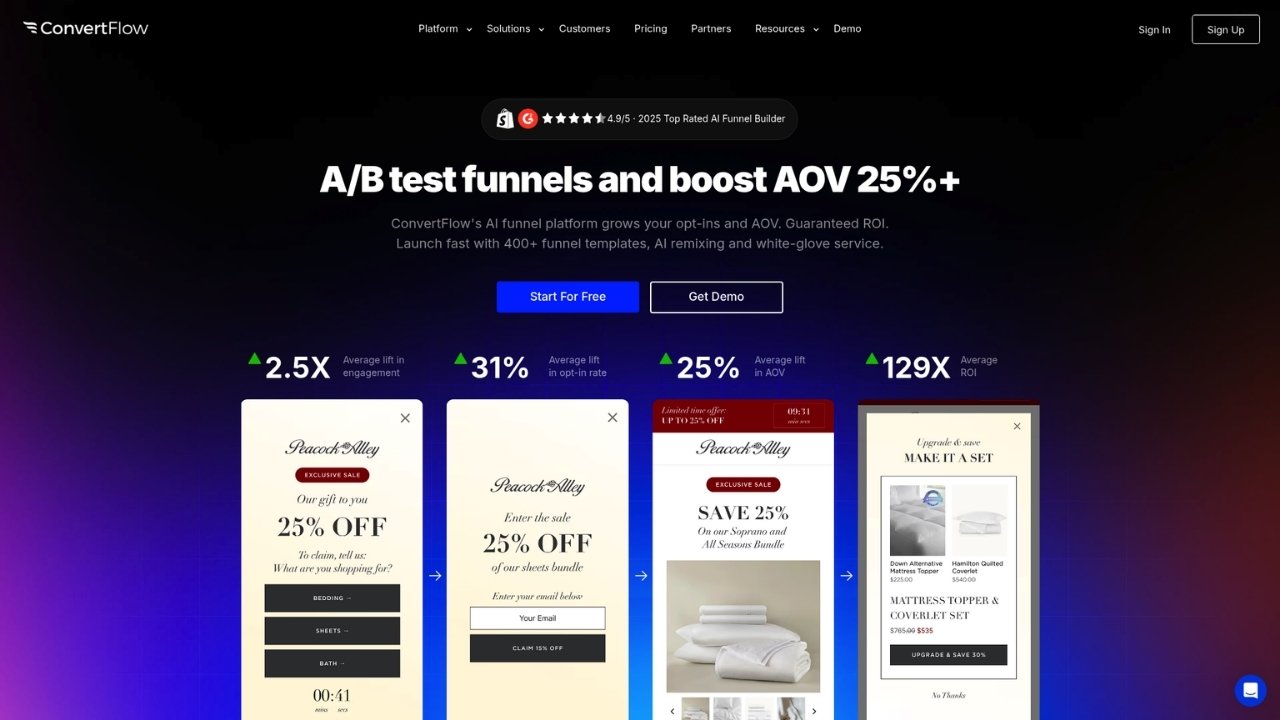
ConvertFlow takes a different approach from the other tools on this list. While most focus on simple popups and bars, ConvertFlow is built for personalization and multi-step experiences.
The quiz builder is a standout feature. You can create interactive quizzes that segment visitors and recommend products or content based on their answers.
This is powerful for B2B lead qualification or ecommerce product discovery.
Personalization goes deeper than just "Hi {FirstName}." You can show different content based on behavior, referral source, UTM parameters, and CRM data.
This requires more setup but delivers more relevant experiences.
The free plan is functional for testing. Paid plans start at $349 per month, making this the most expensive entry point on our list.
But if you need advanced personalization, the price may be justified.
Who it's best for: B2B companies needing lead qualification, SaaS businesses wanting personalized onboarding flows, and marketers running sophisticated campaigns.
Pros:
- Advanced personalization capabilities
- Built-in quiz and survey builder
- Deep CRM integrations
- Multi-step form capabilities
Cons:
- Expensive entry point ($349/mo)
- Steeper learning curve
- Overkill for simple popup needs
How to choose the right OptiMonk alternative
With seven solid options, how do you pick? Here's a simple framework based on your situation:
Low budget and growing traffic: Start with Poptin or Claspo. Both have generous free plans and affordable paid tiers.
Shopify store needing AI features: Wisepops is worth the premium for product recommendations and push notifications.
WordPress power user: OptinMonster has the deepest WordPress integration and most mature feature set.
Agency managing multiple sites: Popupsmart offers unlimited domains and predictable pricing.
Need personalization and quizzes: ConvertFlow is the only tool on this list built for sophisticated segmentation.
Ecommerce focused on gamification: Sleeknote has the best mobile experience and strongest game mechanics.
Beyond popups: completing your support stack
Popups are great for capturing leads and reducing cart abandonment. But what happens when those leads become customers and start calling your support line?
That's where most popup tools leave a gap. They handle the top of the funnel beautifully, but they don't touch post-purchase support.
If you're running an ecommerce store, you know the pain. Customers calling about order status, returns, exchanges.
These calls eat up hours your team could spend on higher-value work.
Ringly.io fills this gap with the AI, an AI phone agent that handles inbound calls 24/7. It integrates directly with Shopify to look up orders, process returns, and answer FAQs. When a call needs human attention, it escalates smoothly.
The combination is powerful: popups capture leads and drive conversions, while AI phone support handles the post-purchase experience.
Both work automatically, freeing your team to focus on growth.
Frequently Asked Questions
What are the best free OptiMonk alternatives?
Poptin, Claspo, and Popupsmart all offer genuinely useful free plans. Poptin gives you 1,000 monthly visitors, Claspo offers 3,000, and Popupsmart provides 5,000 views.
Which OptiMonk alternative is best for Shopify stores?
Wisepops and Sleeknote both offer deep Shopify integrations. Wisepops has AI product recommendations, while Sleeknote excels at gamification. Popupsmart is also a strong choice for Shopify with competitive pricing.
Are there OptiMonk alternatives that load faster?
Yes. Popupsmart specifically advertises load times of approximately 134ms compared to OptiMonk's reported 618ms. This can impact both user experience and SEO.
Which OptiMonk alternative has the best templates?
Claspo leads with over 1,000 templates. OptinMonster also has an extensive library with hundreds of options across all campaign types.
What OptiMonk alternative is best for agencies?
OptinMonster and Popupsmart are both agency-friendly. OptinMonster has the most mature feature set, while Popupsmart offers unlimited domains on all paid plans with predictable pricing.
Do any OptiMonk alternatives include email marketing?
Poptin includes basic email marketing capabilities built-in. For more sophisticated email automation, you'll want to integrate with a dedicated email platform like Klaviyo or Mailchimp.
Which OptiMonk alternative offers the most advanced targeting?
OptinMonster has the most extensive targeting rules engine. ConvertFlow offers the most sophisticated personalization for behavioral and CRM-based targeting.