
The best Optimizely alternatives are VWO for full-featured CRO testing, Convert for privacy-conscious teams, and AB Tasty for AI-driven personalization. Other strong picks include PostHog for product teams, LaunchDarkly for engineering-led feature flags, Personizely for ecommerce, and Kameleoon for AI experimentation, each cheaper or simpler than Optimizely's enterprise setup.
Optimizely has been the gold standard for enterprise A/B testing since 2010.
But here's the problem: most teams don't need (or can't afford) an enterprise-grade experimentation suite that costs five to six figures annually.
If you're looking for powerful testing and personalization without the enterprise price tag, you're in the right place.
We've tested and compared the best Optimizely alternatives for every use case, from budget-conscious startups to privacy-focused enterprises.
Whether you need simple A/B testing, advanced personalization, or developer-friendly feature flags, there's an alternative that fits your needs better than Optimizely's one-size-fits-all approach.
Editor’s note: Want to hear some sample AI support calls made for your Shopify store?
- Just paste your store URL
- Get sample calls in under 20 seconds (no email required)
- Listen to demo calls for my store
What are the best Optimizely alternatives in 2026?
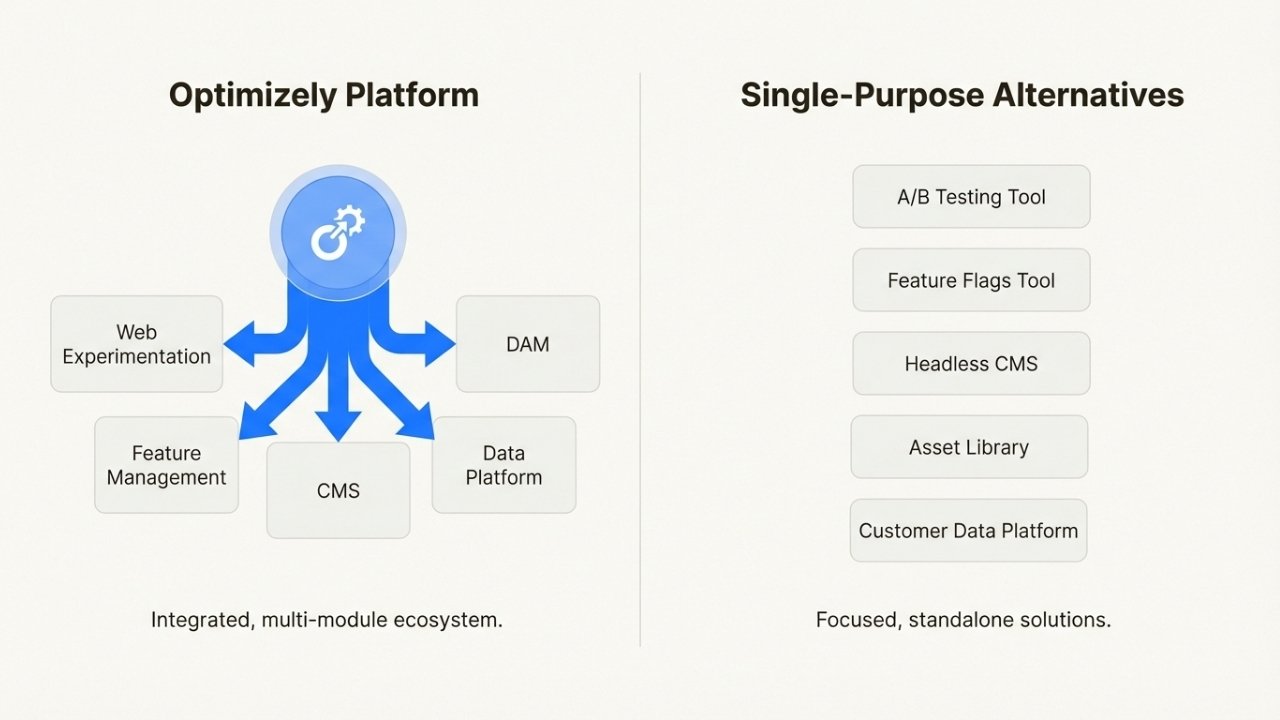
Optimizely is a digital experience platform that started as an A/B testing tool and evolved into a comprehensive suite covering web experimentation, feature management, content management, and personalization.
It serves enterprise customers like IBM, Microsoft, and eBay who run thousands of experiments across complex digital properties.
The platform's strength is also its weakness. Optimizely offers modules for web experimentation, feature flags, content marketing, CMS, personalization, commerce, and data management.
Most teams only need a fraction of these capabilities, yet Optimizely's pricing structure makes it difficult to buy just what you need.
Add in a steep learning curve and the need for dedicated developer resources, and it's clear why many teams start searching for alternatives.
How We Evaluated These Optimizely Alternatives
To create this list, we analyzed G2 and Capterra reviews, tested free trials where available, and evaluated each platform against consistent criteria:
- Pricing transparency: Tools with public pricing scored higher than those requiring sales calls
- Ease of use: How quickly can non-technical team members launch experiments?
- Feature depth: Does the tool excel at its core use case or spread itself thin?
- Support quality: What do real users say about onboarding and ongoing help?
Rather than ranking by overall score, we've segmented these alternatives by ideal use case. The best tool for an enterprise CRO team differs significantly from what's right for a startup product team.
Best Optimizely Alternatives by Use Case
1. VWO, Best for Enterprise CRO Teams
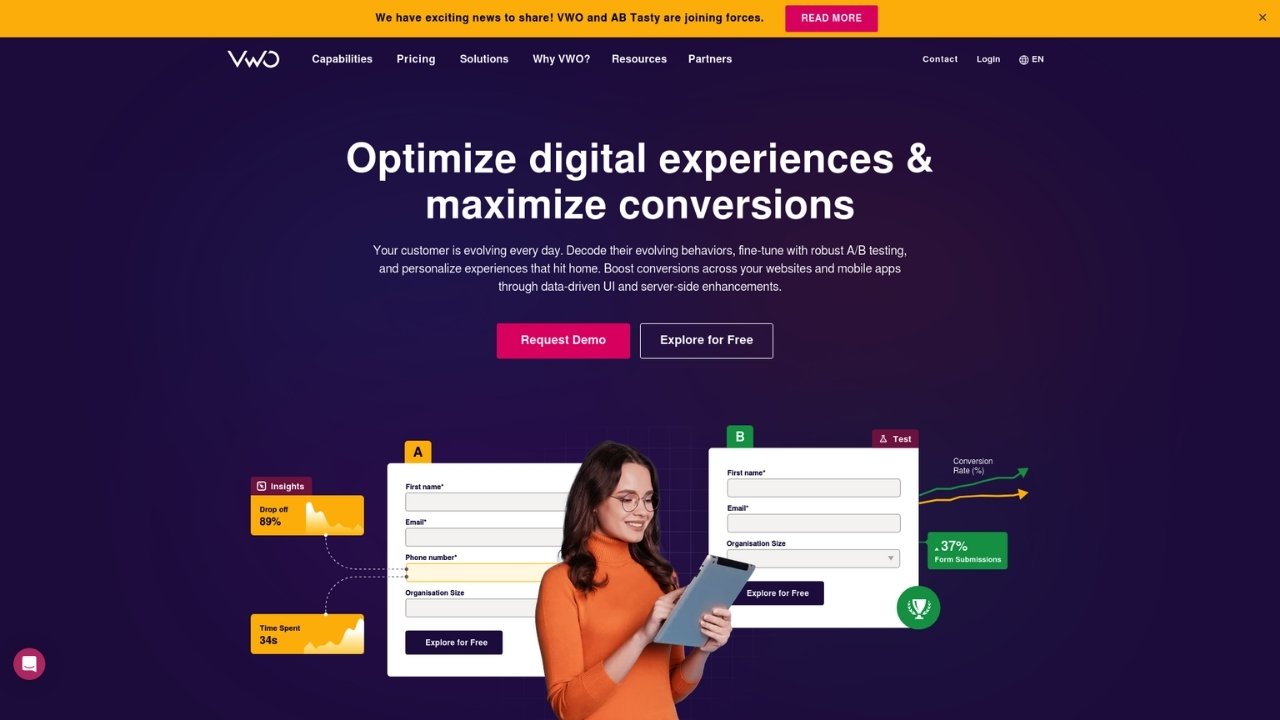
VWO (Visual Website Optimizer) is the closest direct competitor to Optimizely, offering a similarly comprehensive feature set at a more accessible price point.
Founded in 2009, it has evolved from a simple A/B testing tool into a full conversion optimization platform used by companies like eBay, Target, and Virgin Holidays.
The platform covers the entire CRO workflow: A/B testing, multivariate testing, heatmaps, session recordings, form analytics, surveys, and personalization.
VWO's visual editor allows marketers to create experiments without coding, while the code editor gives developers flexibility for complex tests.
Key features:
- A/B, multivariate, split-URL, and multi-device testing
- Heatmaps, click maps, scroll maps, and session recordings
- Behavioral targeting with advanced user segmentation
- Personalization engine with real-time targeting
- Integration with Google Analytics, Mixpanel, Segment, and more
Pricing: VWO offers a free plan for up to 50,000 monthly tracked users with limited features. Paid plans start at $190 per month for the Growth tier, scaling to $1,049 per month for Pro. Enterprise pricing is custom.
Pros: Complete CRO suite in one platform, excellent behavioral analytics, strong segmentation tools, flexible for both no-code and developer-led teams
Cons: Still expensive for small businesses, complex UI with learning curve, limited customer support on lower tiers, historical test data retention limits
Verdict: If you need Optimizely's depth but want more transparent pricing, VWO is your best bet. It's ideal for data-heavy teams with dedicated analysts who will use the full feature set.
2. Convert, Best for Privacy-Conscious Teams
Convert has built its reputation on fast, privacy-compliant experimentation since 2009. While other platforms raced to add features, Convert focused on what matters for regulated industries: reliable testing, strong data protection, and transparent pricing.
The platform supports A/B testing, multivariate testing, split-URL testing, and server-side testing.
Convert's privacy features are genuinely differentiated, with built-in compliance for GDPR, HIPAA, and CCPA. The visual editor works well for quick changes, while the code editor gives developers full control.
Key features:
- A/B, multivariate, split-URL, and multipage testing
- Server-side testing for performance-critical experiments
- Advanced audience targeting using cookies, behavior, and custom attributes
- Built-in Bayesian and Frequentist statistics
- Granular privacy settings and compliance frameworks
Pricing: Convert's pricing is based on monthly tested users. Growth starts at $299 per month, Pro at $420 per month, with Enterprise available for custom pricing. A 15-day free trial requires no credit card.
Pros: Strong privacy compliance out of the box, transparent pricing, developer-friendly without locking out marketers, lightweight and fast
Cons: Interface feels dated compared to newer platforms, learning curve for beginners, no widget builder, pricing may still be high for very small businesses
Verdict: For teams in healthcare, finance, or any regulated industry, Convert's compliance features justify the investment. It's also a solid choice if you want reliable testing without feature bloat.
3. AB Tasty, Best for AI-Driven Personalization

AB Tasty occupies the middle ground between enterprise power and usability. Founded in 2013 and headquartered in Paris, the platform has gained traction with retail and entertainment companies wanting AI-powered optimization without Optimizely's complexity.
The platform combines web experimentation, personalization, and feature management in one interface.
AB Tasty's AI tools are genuinely useful, offering predictive targeting, dynamic content adaptation, and AI-powered product recommendations for e-commerce.
Key features:
- A/B, split, multivariate, and funnel testing
- Feature experimentation with controlled rollouts
- AI-powered personalization and product recommendations
- Visual and code editors for hybrid teams
- Real-time content personalization based on behavior
Pricing: AB Tasty starts at $50 per month when billed annually for basic features. Enterprise plans are quote-based and scale with traffic volume.
Pros: Strong AI capabilities for personalization, covers both marketing and product use cases, fast visual campaign setup, reliable support and onboarding
Cons: Quote-based pricing for higher tiers, can feel complex for small teams, reporting depth relies on external analytics tools
Verdict: AB Tasty shines for mid-market retailers and entertainment companies wanting AI-driven personalization. If you're in the Adobe ecosystem, compare this against Adobe Target.
4. PostHog, Best for Startups and Product Teams
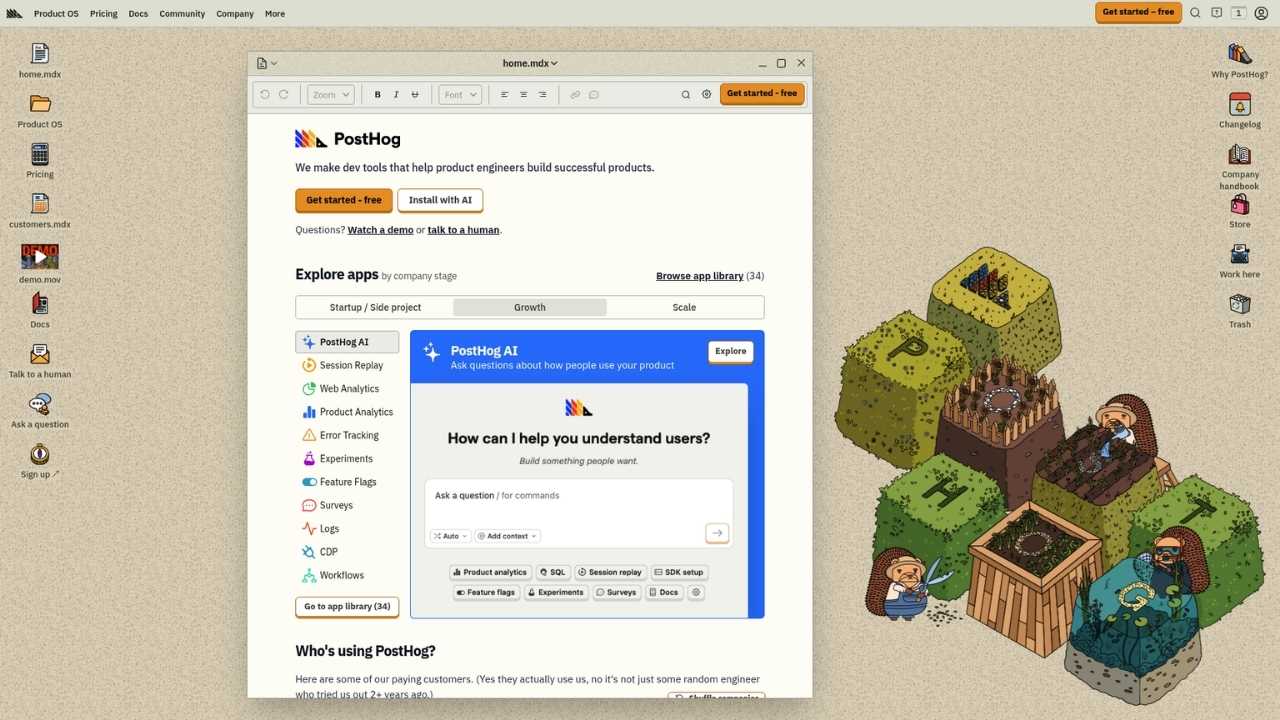
PostHog takes a fundamentally different approach.
Founded in 2020, this open-source platform combines product analytics, session replay, feature flags, and A/B testing in one tool. Instead of buying multiple point solutions, PostHog lets you consolidate your stack.
The platform is built for technical teams who want self-serve access to data and experimentation.
PostHog's generous free tier and transparent usage-based pricing make it particularly attractive for startups watching their burn rate.
Key features:
- A/B testing and feature flags
- Product analytics with funnel and retention analysis
- Session replay and heatmaps
- Surveys and user feedback tools
- Self-hosting option for complete data control
Pricing: PostHog offers a generous free tier covering most features for early-stage companies. Paid plans scale based on usage, making it predictable as you grow.
Pros: Free/open-source, replaces multiple tools, transparent pricing, self-serve setup, strong engineering culture
Cons: Visual editor still in beta, marketing teams may prefer dedicated CRO tools, requires technical resources to get full value
Verdict: For startups and scale-ups with engineering-heavy teams, PostHog is hard to beat. The ability to replace Amplitude, Optimizely, and Hotjar with one tool simplifies your stack significantly.
5. LaunchDarkly, Best for Engineering Teams
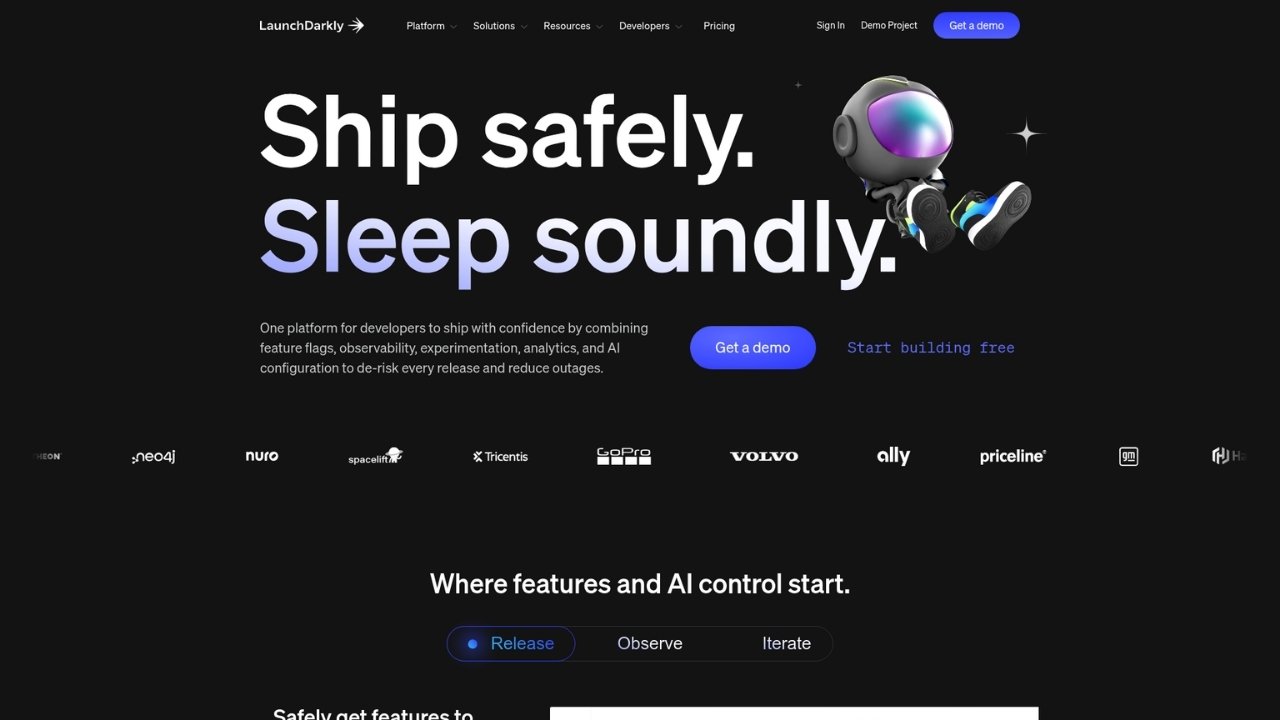
LaunchDarkly isn't a traditional A/B testing tool. Founded in 2014, it built its reputation on feature flags, the infrastructure that powers modern continuous deployment.
Over time, it added experimentation capabilities, making it a compelling choice for engineering-first organizations.
The platform excels at release management, allowing teams to roll out features gradually, target specific user segments, and kill problematic releases instantly.
The experimentation features build on this foundation, making it easy to measure the impact of feature changes.
Key features:
- Feature flags with targeting and scheduling
- A/B testing and experimentation
- Automation workflows and stale flag cleanup
- Governance and compliance features
- SDKs for every major programming language
Pricing: LaunchDarkly starts at $8.33 per seat per month for Starter, $16.67 per seat per month for Pro, with Enterprise available for custom pricing.
Pros: Excellent SDKs and developer experience, strong automation features, governance and compliance tools, high uptime and speed
Cons: Not built for marketers, can get expensive at scale with per-seat pricing, experimentation features secondary to feature management
Verdict: If your team thinks in terms of feature releases rather than marketing experiments, LaunchDarkly is the right choice. It's particularly strong for teams practicing continuous deployment.
6. Personizely, Best for E-commerce and Small Business
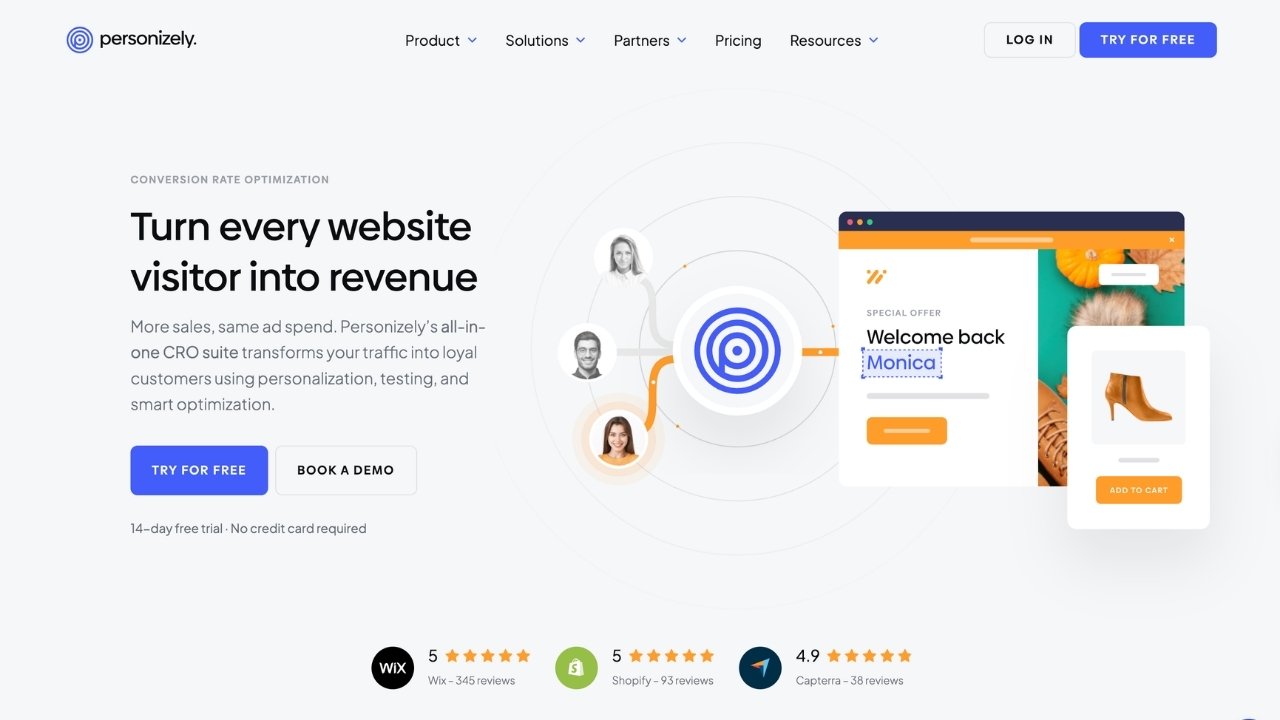
Personizely proves that powerful CRO doesn't require an enterprise budget.
Starting at just $31 per month, this platform offers A/B testing, personalization, and widget creation at a fraction of Optimizely's cost.
The platform is built for marketers and e-commerce teams who need to move fast.
The drag-and-drop visual editor requires no coding, while the widget builder lets you create popups, bars, and product recommendations in minutes.
Personizely also supports theme testing and price testing, features usually reserved for expensive enterprise tools.
Key features:
- A/B testing for content, pricing, themes, and pages
- Drag-and-drop visual editor
- Widget builder for popups, bars, and recommendations
- Advanced segmentation by device, referral source, cart data, geolocation
- Anti-flickering protection for seamless user experience
Pricing: Personizely starts at $31 per month when paid yearly. The Premium plan is $47 per month. Both include a 14-day free trial.
Pros: Affordable and transparent pricing, intuitive interface with fast learning curve, responsive support, theme and price testing included
Cons: No Bayesian statistical models, smaller integration ecosystem, no multivariate testing
Verdict: For e-commerce stores and small teams, Personizely delivers 80% of Optimizely's value at 5% of the cost. The price testing feature alone can pay for the subscription many times over.
7. Kameleoon, Best for AI-Powered Experimentation
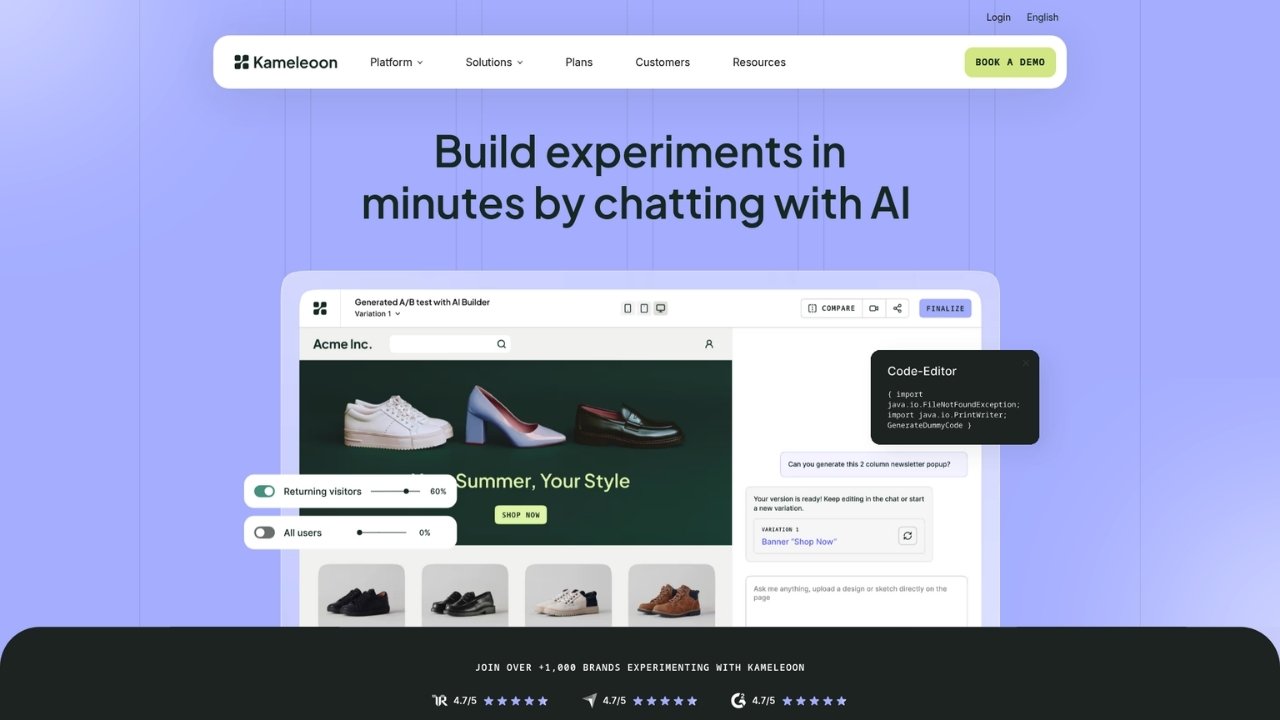
Kameleoon takes experimentation to the next level with machine learning-driven personalization and predictive targeting.
Founded in 2012 and based in Paris, the platform has won multiple awards for its AI capabilities.
The platform supports both client-side and server-side testing, making it suitable for marketing, product, and engineering teams.
Kameleoon's AI analyzes user behavior in real-time to predict which variations will perform best for each visitor segment.
Key features:
- AI-driven personalization and predictive targeting
- Full-stack experimentation (client and server-side)
- Feature flags for controlled rollouts
- Heatmaps and session recording
- GDPR, HIPAA, and CCPA compliance
Pricing: Kameleoon doesn't publish pricing. Costs vary based on traffic volume and features, with enterprise-level pricing expected.
Pros: Advanced AI/ML capabilities, full-stack flexibility, strong compliance frameworks, comprehensive campaign management
Cons: No public pricing, costly for SMBs, requires dedicated technical and analytical resources
Verdict: For data-driven enterprises wanting cutting-edge AI experimentation, Kameleoon is worth the investment. Smaller teams should look at Personizely or AB Tasty instead.
Quick Comparison Table
| Tool | Starting Price | Best For | G2 Score | Free Plan |
|---|---|---|---|---|
| VWO | $190/month | Enterprise CRO | 4.5/5 | Yes (limited) |
| Convert | $299/month | Privacy-focused | 4.7/5 | No |
| AB Tasty | $50/month | AI personalization | 4.5/5 | No |
| PostHog | Free | Startups | 4.5/5 | Yes (generous) |
| LaunchDarkly | $8.33/seat | Engineering | 4.5/5 | No |
| Personizely | $31/month | E-commerce | 4.9/5 | No (14-day trial) |
| Kameleoon | Custom | AI experimentation | 4.5/5 | No |
Choosing the Right Optimizely Alternative for Your Business
The best tool depends on your specific situation. Here's a simple framework to help you decide:
Budget under $100 per month: Personizely or PostHog (free tier)
Need privacy compliance: Convert or Kameleoon
Engineering-heavy team: LaunchDarkly, PostHog, or Statsig
Marketing-focused team: VWO, AB Tasty, or Personizely
E-commerce specific: Personizely or Intelligems (Shopify)
Before committing, ask yourself:
- How many experiments will you run monthly?
- Do you need client-side, server-side, or both?
- How technical is your team?
- Which integrations are non-negotiable?
Most teams find that a focused tool beats a bloated suite. You can always upgrade as your needs grow.
Beyond Website Testing: Optimizing Your Complete Customer Experience
A/B testing your website is important, but it's only one touchpoint.
Phone support remains critical for many businesses, especially in e-commerce where customers want immediate answers about orders, returns, and product questions.
Ringly.io offers an AI phone agent called an AI agent that handles customer calls 24/7. the AI can look up orders, process returns, answer FAQs, and escalate complex issues to your human team.
The platform integrates natively with Shopify and resolves approximately 73% of calls without human intervention.
If you're optimizing your website with A/B testing, consider optimizing your phone support too. Ringly prices per call; the pricing page has the details, and you can try it for free.
Frequently Asked Questions
What are the best Optimizely alternatives for small businesses?
For small businesses, Personizely ($31/month) and PostHog (generous free tier) offer the best value. Both provide core A/B testing and personalization without enterprise pricing.
Which Optimizely alternative has the best free plan?
PostHog offers the most generous free plan, covering most features for early-stage companies. VWO also has a free tier for up to 50,000 monthly tracked users, though with limited features.
Are there any open-source Optimizely alternatives?
PostHog is open-source and can be self-hosted for complete data control. This makes it popular with privacy-conscious teams and those wanting to avoid vendor lock-in.
What is the cheapest Optimizely alternative that still offers good features?
Personizely at $31 per month offers the best feature-to-price ratio, including A/B testing, personalization, widget building, and even price testing, features usually found in tools costing 10x more.
Which Optimizely alternative is best for e-commerce?
Personizely is built specifically for e-commerce with features like price testing, theme testing, and Shopify integration. For Shopify-only stores, Intelligems specializes in price and shipping optimization.
How do I choose between VWO and Optimizely?
Choose VWO if you want similar capabilities to Optimizely with more transparent pricing and better usability. VWO is generally more affordable and easier to implement while offering comparable testing depth.
Can I switch from Optimizely to an alternative without losing my data?
Most alternatives allow you to export experiment data, but historical data migration depends on the specific platforms involved. Convert and VWO both offer migration support for enterprise customers switching from Optimizely.