


Finding the right IT service management platform can feel like shopping for a new car.
You want something reliable, but also modern enough to handle today's challenges.
ManageEngine ServiceDesk Plus has been a solid choice for years, but it's not the only option on the road.
Whether you're frustrated with on-premises limitations, looking for better AI capabilities, or simply want transparent pricing, there are compelling alternatives worth considering. We've researched and tested the top contenders to help you make an informed decision.
Let's break down seven of the best ManageEngine ServiceDesk Plus alternatives for 2026, comparing real features, actual pricing, and honest pros and cons.
Editor’s note: Want to hear some sample AI support calls made for your Shopify store?
- Just paste your store URL
- Hear sample calls for your store (no email required)
- Listen to demo calls for my store
What is ManageEngine ServiceDesk Plus?
ManageEngine ServiceDesk Plus is an ITSM platform that handles incident management, problem tracking, change control, and asset management. It offers both cloud and on-premises deployment options, which has made it popular with organizations that need flexibility in how they host their service desk.
The platform targets mid-size to enterprise IT teams and includes ITIL-aligned processes out of the box. Many organizations choose it for its comprehensive feature set and the ability to run on their own infrastructure.
However, some users report challenges with the user interface feeling dated, API limitations for modern integrations, and a licensing model that doesn't always scale cleanly. These pain points drive many teams to explore what else is available.
How We Evaluated These ManageEngine ServiceDesk Plus Alternatives
To create a genuinely useful comparison, we looked at each platform through the lens of what matters most to IT teams:
- Pricing transparency Can you see costs upfront, or is everything "contact sales"?
- Ease of use How steep is the learning curve for administrators and agents?
- AI and automation What modern capabilities reduce manual work?
- Integration ecosystem Does it play nicely with your existing tools?
- Scalability Will it grow with your organization without breaking the budget?
Our target audience includes IT managers, service desk leaders, and MSPs evaluating their next platform.
Comparison at a Glance
Here's a quick overview of how these ManageEngine ServiceDesk Plus alternatives stack up:
| Tool | Starting Price | Free Tier | Best For | Key Strength |
|---|---|---|---|---|
| Freshservice | $19/agent/mo | No | Mid-market IT teams | Modern AI features |
| SysAid | Contact sales | Trial | AI-first organizations | Agentic AI capabilities |
| Zendesk | $19/agent/mo | No | Customer support teams | Omnichannel support |
| Jira Service Management | $0 (3 agents) | Yes | DevOps teams | Developer integration |
| Zoho Desk | $0 (3 users) | Yes | Zoho ecosystem users | Affordable pricing |
| ServiceNow | Custom | No | Large enterprises | Enterprise scalability |
| HaloITSM | Contact sales | Trial | Budget-conscious teams | Configurability |
The 7 Best ManageEngine ServiceDesk Plus Alternatives
1. Freshservice

Freshservice is the ITSM platform from Freshworks, designed with modern IT teams in mind. It combines traditional service management with AI-powered automation that actually reduces ticket volume rather than just organizing it.
The platform centers around Freddy AI, which handles everything from drafting responses to summarizing complex tickets. What makes it stand out is how accessible these features are you don't need a PhD in machine learning to get value from the AI.
Key features:
- Freddy AI Agent for 24/7 personalized support on Slack and MS Teams
- Freddy AI Copilot that drafts responses and builds help content
- Integrated IT asset management with auto-discovery
- IT operations management for alert and incident handling
- Enterprise service management workspaces for HR, Legal, and other departments
Pricing:
| Plan | Price (Annual) | Key Features |
|---|---|---|
| Starter | $19/agent/mo | Basic ITSM, email/chat support, knowledge base, SLA management |
| Growth | $49/agent/mo | Problem/change management, service catalog, intelligent routing |
| Pro | $99/agent/mo | Freddy AI Agent, workflow automation, project management |
| Enterprise | Custom | Full AI capabilities, ESM, advanced analytics |
Pros:
- Intuitive interface that agents actually enjoy using
- Strong AI capabilities at lower price tiers than competitors
- Affordable entry point for smaller teams
- 74,000+ businesses trust it, including Kansas City Chiefs and Marvel
Cons:
- Advanced AI features require Pro tier or higher
- Asset discovery can be limited compared to dedicated ITAM tools
Best for: Mid-market IT teams wanting modern AI features without enterprise complexity. Freshservice hits a sweet spot of capability and usability that makes it a strong alternative to ManageEngine.
2. SysAid

SysAid takes a different approach to ITSM by putting AI at the center of everything. Their philosophy is simple: handle issues from start to finish before they ever hit the ticket queue.
The platform includes nearly 100 prebuilt AI agents that can execute tasks autonomously. This isn't just chatbot window dressing these agents can actually resolve problems, reset passwords, and route complex issues to the right people.
Key features:
- SysAid Copilot with real-time ticket summaries for agents
- Agentic AI with nearly 100 prebuilt autonomous agents
- Asset management powered by Lansweeper for advanced discovery
- License Manager for SaaS discovery and cost optimization
- ITIL-aligned change, problem, and request management
Pricing:
SysAid doesn't publish pricing publicly. Three tiers are available:
- Standard (Help Desk): AI-assisted features for lean teams
- Pro (ITSM): AI that takes action with customizable agents
- Enterprise: Limitless AI for IT at scale
Pros:
- Most advanced AI capabilities in the ITSM space
- Comprehensive asset management out of the box
- 24/7 support included
- Strong customer list including Honda, Motorola Solutions, and Toyota
Cons:
- Pricing opacity makes budgeting difficult
- Can be complex for small teams that don't need advanced AI
- Learning curve for maximizing AI agent capabilities
Best for: Organizations prioritizing AI-driven service management and wanting to reduce manual ticket handling significantly. If you're looking to automate 50%+ of your tier-1 support, SysAid deserves serious consideration.
3. Zendesk Suite

Zendesk has evolved far beyond its help desk origins into a complete customer and employee service platform. While it's often associated with customer support, its ITSM capabilities have matured significantly.
The platform's strength lies in its omnichannel approach. Whether your users prefer email, chat, phone, or messaging apps like WhatsApp and Slack, Zendesk brings it all into a unified interface.
Key features:
- AI Agents included in Suite Team plan and above
- Zendesk Copilot available as $50/agent/month add-on
- Omnichannel support across email, chat, phone, and social messaging
- Knowledge base with generative search capabilities
- Workforce management add-on for scheduling and forecasting
Pricing:
| Plan | Price (Annual) | Key Features |
|---|---|---|
| Support Team | $19/agent/mo | Email/ticketing, social support, basic automations |
| Suite Team | $55/agent/mo | AI agents (Essential), messaging, live chat, phone support |
| Suite Professional | $115/agent/mo | Copilot writing tools, up to 5 help centers, skills-based routing |
| Suite Enterprise | $169/agent/mo | Sandbox, custom roles, audit logs, up to 300 help centers |
Pros:
- Mature platform with extensive marketplace of integrations
- Strong reporting and analytics capabilities
- Trusted by major brands like Uber, Siemens, and Lush
- Reliable uptime and enterprise-grade infrastructure
Cons:
- Can get expensive quickly as you add agents and features
- ITSM-specific features require more configuration than dedicated ITSM tools
- AI Copilot is a significant add-on cost
Best for: Customer-facing service desks and support teams that need true omnichannel capabilities. If your IT team also handles customer support, Zendesk offers compelling consolidation opportunities.
4. Jira Service Management
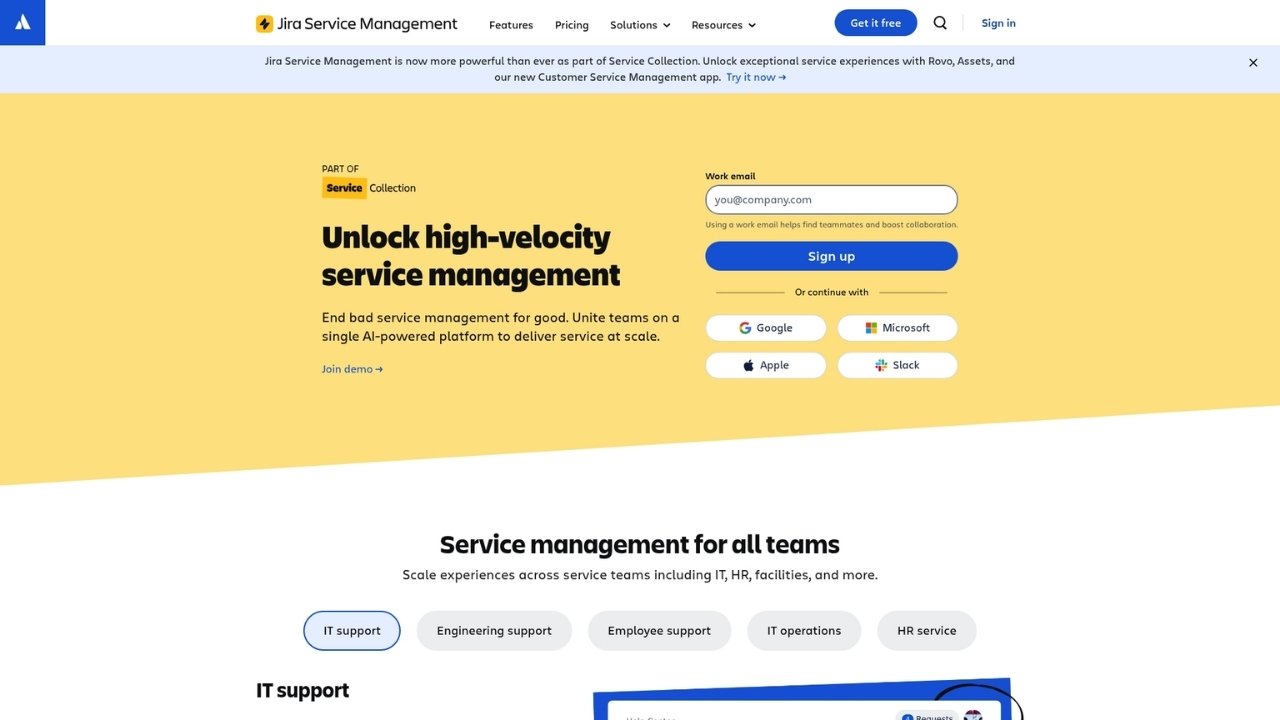
Jira Service Management brings ITSM directly into the Atlassian ecosystem, making it a natural choice for teams already using Jira, Confluence, or Bitbucket. The integration goes deeper than single sign-on tickets can flow seamlessly between service desk and development teams.
The platform emphasizes DevOps alignment with features like deployment gating and CI/CD tool integration. If your IT team works closely with developers, this connection can eliminate significant friction.
Key features:
- Rovo AI for search, chat, and AI agents
- Virtual Service Agent for conversational support (Premium+)
- AIOps for alert grouping and AI incident creation
- Asset management with scalable object limits
- Change management with AI risk assessment
Pricing:
| Plan | Price | Key Features |
|---|---|---|
| Free | $0 | 3 agents, unlimited customers, 2GB storage, community support |
| Standard | $20/agent/mo | Rovo AI, asset management, 250GB storage, 9/5 support |
| Premium | $51.42/agent/mo | Virtual service agent, AIOps, unlimited storage, 24/7 support |
| Enterprise | Custom | Advanced analytics, multiple sites (up to 150), 99.95% SLA |
Pros:
- Free tier for up to 3 agents lets you test thoroughly
- Tight integration with development workflows
- Flexible workflow customization
- Strong ITIL alignment with modern DevOps practices
Cons:
- Steeper learning curve if you're not familiar with Atlassian products
- Asset limits on lower tiers (5,000 objects on Standard)
- Virtual Service Agent only available on Premium and above
Best for: DevOps teams and organizations already invested in the Atlassian ecosystem. The value increases significantly if you're already paying for Jira Software or Confluence.
5. Zoho Desk

Zoho Desk proves that affordable help desk software doesn't have to mean basic functionality. As part of the broader Zoho ecosystem, it offers deep integration with Zoho CRM, Projects, and other business tools.
The platform's AI assistant, Zia, provides sentiment analysis, ticket auto-tagging, and anomaly detection. While not as advanced as some competitors' AI, it covers the essentials well.
Key features:
- Zia AI for sentiment analysis and ticket auto-tagging
- AI Agents capable of performing support tasks (Enterprise tier)
- Answer Bot for AI-powered replies based on knowledge base
- Multi-brand help center support
- Deep Zoho ecosystem integration
Pricing:
| Plan | Price (Annual) | Key Features |
|---|---|---|
| Free | $0 | 3 users, email ticketing, basic features |
| Express | $7/user/mo | Email, social media, web forms, workflows |
| Standard | $14/user/mo | Live chat, knowledge base, community forum, generative AI |
| Professional | $23/user/mo | Telephony, blueprints, multi-department, round-robin |
| Enterprise | $40/user/mo | AI agents, Zia AI assistant, live chat (SalesIQ), sandbox |
Pros:
- Most affordable option with a genuine free tier
- AI features available at lower price points than competitors
- Easy setup and intuitive interface
- Strong value for teams already using Zoho products
Cons:
- Limited advanced ITSM features compared to dedicated platforms
- Smaller third-party integration ecosystem
- AI capabilities lag behind Freshservice and SysAid
Best for: Small to mid-size businesses already using Zoho products or seeking affordable AI-powered help desk software. The pricing is hard to beat for budget-conscious teams.
6. ServiceNow
ServiceNow is the enterprise standard for ITSM and digital workflows. When large organizations need to manage complex service operations across multiple departments, ServiceNow is often the answer.
The platform goes far beyond ITSM into customer service management, HR service delivery, and custom app development. Its low-code platform lets organizations build tailored workflows without traditional software development.
Key features:
- Now Assist AI-powered assistance across workflows
- Comprehensive ITSM including incident, problem, change, and request management
- CMDB with service mapping capabilities
- ITOM for event management and infrastructure discovery
- Extensive low-code customization and app development
Pricing:
ServiceNow doesn't publish pricing. Enterprise quotes are customized based on:
- Number of users
- Modules required (ITSM, CSM, HR, etc.)
- Deployment scale and complexity
Pros:
- Industry-leading capabilities and scalability
- Robust reporting and analytics
- Extensive customization without coding
- Proven at Fortune 500 scale
Cons:
- High cost and complex implementation
- Overkill for smaller teams and simpler use cases
- Requires dedicated administrators and significant training
Best for: Large enterprises with complex service management needs and sufficient budget for implementation and ongoing customization. This is not a "set it and forget it" solution it requires commitment.
7. HaloITSM

HaloITSM offers a refreshing alternative to the enterprise complexity of ServiceNow and the pricing opacity of SysAid. It's a modern, highly configurable ITSM solution that includes all modules as standard.
The platform emphasizes fast setup and unlimited usage. Unlike competitors that charge per agent or module, HaloITSM takes a different approach that can be more cost-effective for growing teams.
Key features:
- ITIL-aligned incident, problem, change, and release management
- Fully customizable white-label self-service portal
- CMDB for asset tracking and dependency visualization
- AITSM features for process automation
- Automated asset discovery
Pricing:
HaloITSM requires a custom quote. Enterprise pricing is available for 250+ agents.
Pros:
- Highly configurable without enterprise complexity
- All modules included no nickel-and-diming for features
- Modern, clean interface
- Used by 100,000+ people across 75+ countries including Sky and Siemens
Cons:
- Smaller ecosystem and community than larger competitors
- Less brand recognition may require internal selling
- Pricing requires consultation call
Best for: Organizations seeking a cost-effective, highly configurable ITSM solution without the complexity and cost of enterprise platforms like ServiceNow.
Key Features to Compare When Choosing ManageEngine ServiceDesk Plus Alternatives
When evaluating these alternatives, focus on capabilities that directly impact your daily operations:
ITIL alignment and certification If you follow ITIL processes, verify the platform supports your specific workflows out of the box or through configuration.
AI and automation capabilities Look beyond marketing claims. Test whether the AI actually reduces ticket volume or just categorizes it faster.
Asset management depth Consider whether you need basic inventory tracking or advanced discovery, software license management, and dependency mapping.
Integration ecosystem Map your critical tools (Active Directory, monitoring systems, collaboration platforms) and verify native integrations exist.
Deployment flexibility While most alternatives are cloud-native, some offer on-premises options if regulatory requirements demand it.
Making the Right Choice for Your Organization
The best alternative depends entirely on your context. Here's a simple framework:
For small teams (under 10 agents): Start with Zoho Desk or Jira Service Management's free tier. Both offer genuine capability without upfront investment.
For mid-market IT teams: Freshservice offers the best balance of modern features, usability, and price. The AI capabilities are accessible without enterprise complexity.
For AI-first organizations: SysAid leads in autonomous AI capabilities. If reducing manual ticket handling is your top priority, start here.
For DevOps-focused teams: Jira Service Management integrates seamlessly with development workflows. The value compounds if you're already in the Atlassian ecosystem.
For enterprises: ServiceNow remains the gold standard for complex, multi-department service management. Just budget appropriately for implementation and ongoing administration.
For budget-conscious flexibility: HaloITSM delivers enterprise-grade configurability without enterprise-grade pricing headaches.
Our recommendation: Shortlist 2-3 options based on your size and priorities, then run parallel trials. Most platforms offer 14-30 day trials use them to test with real tickets, not just demo data.
Choosing the Best ManageEngine ServiceDesk Plus Alternative
Switching ITSM platforms is a significant decision, but staying with a tool that doesn't fit your needs costs more in the long run. Whether you're seeking better AI capabilities, transparent pricing, or a more modern interface, there's an alternative that fits.
For most organizations, Freshservice offers the best overall package of features, usability, and value. If AI automation is your priority, SysAid leads the pack. And if budget is tight, Zoho Desk delivers surprising capability for the price.
Start your evaluation with clear requirements, test thoroughly, and choose the platform that your team will actually enjoy using. The best ITSM tool is the one that gets adopted.
Frequently Asked Questions
Which ManageEngine ServiceDesk Plus alternative offers the best value for small IT teams?
For small teams, Zoho Desk and Jira Service Management both offer genuine free tiers for up to 3 users. Zoho Desk's paid plans start at just $7/user/month, making it the most affordable option with AI features included.
Are there any ManageEngine ServiceDesk Plus alternatives with better AI capabilities?
Yes. SysAid and Freshservice both offer more advanced AI than ManageEngine. SysAid's agentic AI can autonomously resolve tickets, while Freshservice's Freddy AI provides excellent copilot features for agents.
What should I look for in a ManageEngine ServiceDesk Plus alternative if I'm focused on ITIL compliance?
All alternatives listed offer ITIL-aligned processes, but ServiceNow and Freshservice have the strongest certifications and out-of-the-box ITIL workflows. Verify specific process requirements during your trial.
How do ManageEngine ServiceDesk Plus alternatives compare for asset management?
SysAid offers the strongest asset management with Lansweeper-powered discovery. Freshservice and ServiceNow also provide comprehensive ITAM capabilities, while Jira Service Management has object limits on lower tiers.
Can I migrate my existing tickets and data from ManageEngine to these alternatives?
Most alternatives offer migration tools or services. Freshservice, Zendesk, and ServiceNow have established migration paths from ManageEngine. Request a migration assessment during your evaluation.
Which ManageEngine ServiceDesk Plus alternative is best for teams already using Atlassian tools?
Jira Service Management is the obvious choice for Atlassian ecosystem users. The integration with Jira Software, Confluence, and Bitbucket eliminates data silos and streamlines workflows between IT and development teams.
Do any ManageEngine ServiceDesk Plus alternatives offer both cloud and on-premises deployment?
While most alternatives are cloud-first, ServiceNow offers on-premises options for regulated industries. HaloITSM also provides deployment flexibility. However, the industry trend is firmly toward cloud-native solutions for easier maintenance and automatic updates.