
Voice AI is transforming how businesses handle phone calls.
What used to require entire call centers can now be managed by AI agents that sound surprisingly human.
Leaping AI has made a name for itself as a self-improving voice AI platform focused on customer service, appointment scheduling, and lead qualification.
The platform promises no-code deployment and claims to handle 70-85% of conversations without human intervention.
But Leaping AI isn't the only option, and it might not be the best fit for your specific situation. Some businesses need transparent pricing.
Others require extreme scale. Some want something that works out of the box for e-commerce.
This guide breaks down seven Leaping AI alternatives worth considering in 2026.
Each one serves a different use case, and by the end, you'll know which platform matches your needs.
Editor’s note: Want to hear some sample AI support calls made for your Shopify store?
- Just paste your store URL
- Get sample calls in under 20 seconds (no email required)
- Listen to demo calls for my store
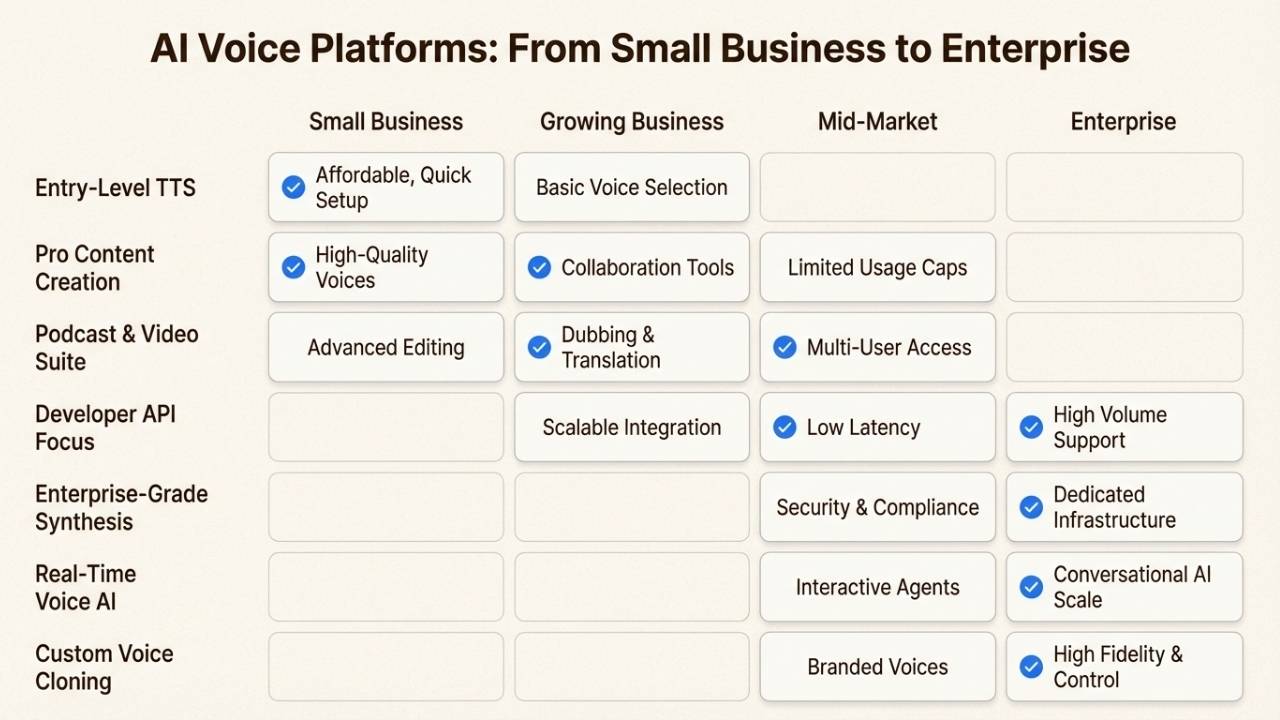
What is Leaping AI?
Leaping AI positions itself as a self-improving voice AI platform.
The system learns from conversations to get better over time without manual retraining.
The platform targets specific verticals like home improvement, offering pre-built workflows for common scenarios.
It emphasizes no-code deployment, making it accessible to teams without dedicated engineering resources.
Key selling points include:
- 70-85% resolution rates for common customer service scenarios
- No-code deployment for faster implementation
- Vertical expertise in industries like home services
- Self-improving AI that learns from each conversation
Source: Leaping AI
The platform works well for businesses that want AI phone agents without building everything from scratch.
But the custom pricing model (starting around $2,500/month) and focus on specific verticals means it won't fit every use case.
How we evaluated these Leaping AI alternatives
To make this comparison useful, we looked at five key criteria that matter when choosing a voice AI platform:
Latency and voice quality. Sub-second response times are table stakes now. If there's an awkward pause after every customer statement, the conversation feels robotic. We prioritized platforms with proven low-latency performance.
Pricing transparency. Some platforms publish clear per-minute rates. Others hide everything behind "contact sales." We favored transparency but included enterprise-focused tools where appropriate.
Integration capabilities. Your voice AI needs to talk to your CRM, help desk, and telephony systems. We looked at native integrations and API flexibility.
Deployment speed. Some platforms promise deployment in hours. Others take months. We noted which is which so you can match expectations to your timeline.
Use case fit. A platform optimized for Indian sales calls might not work for American customer support. We highlighted where each tool excels.

Top 7 Leaping AI alternatives compared
1. Retell AI

Retell AI has become the go-to platform for teams that want to move fast.
The company focuses on one thing: making it easy to build, test, and deploy voice agents at scale.
The platform's headline feature is its ~600ms latency. Independent benchmarks confirm Retell as the leader in responsiveness.
When you're having a phone conversation, half-second pauses feel natural. Two-second pauses feel broken.
Retell offers a drag-and-drop agentic framework for building conversational flows.
You can add preset functions for booking appointments, processing payments, or transferring calls. The knowledge base syncs automatically with your website content, so answers stay current.
Key features:
- Sub-second latency (~600ms)
- Transparent per-minute pricing
- Drag-and-drop conversation builder
- Real-time function calling
- Streaming RAG for knowledge bases
- Built-in simulation testing
Pros:
- Fastest deployment (hours, not weeks)
- Clear, usage-based pricing
- SOC 2 Type II, HIPAA, and GDPR compliant
- Supports any telephony provider via SIP trunking
Cons:
- Requires some understanding of LLMs and prompt configuration
- Less hand-holding than enterprise-focused competitors
Pricing: $0.07/minute on pay-as-you-go, dropping to $0.05/minute at enterprise scale. New accounts get $10 in free credits to test the platform.
G2 Rating: 4.8/5 (612 reviews)
Best for: Product teams, call centers, and outbound sales operations that need fast iteration and transparent costs.
2. SquadStack AI
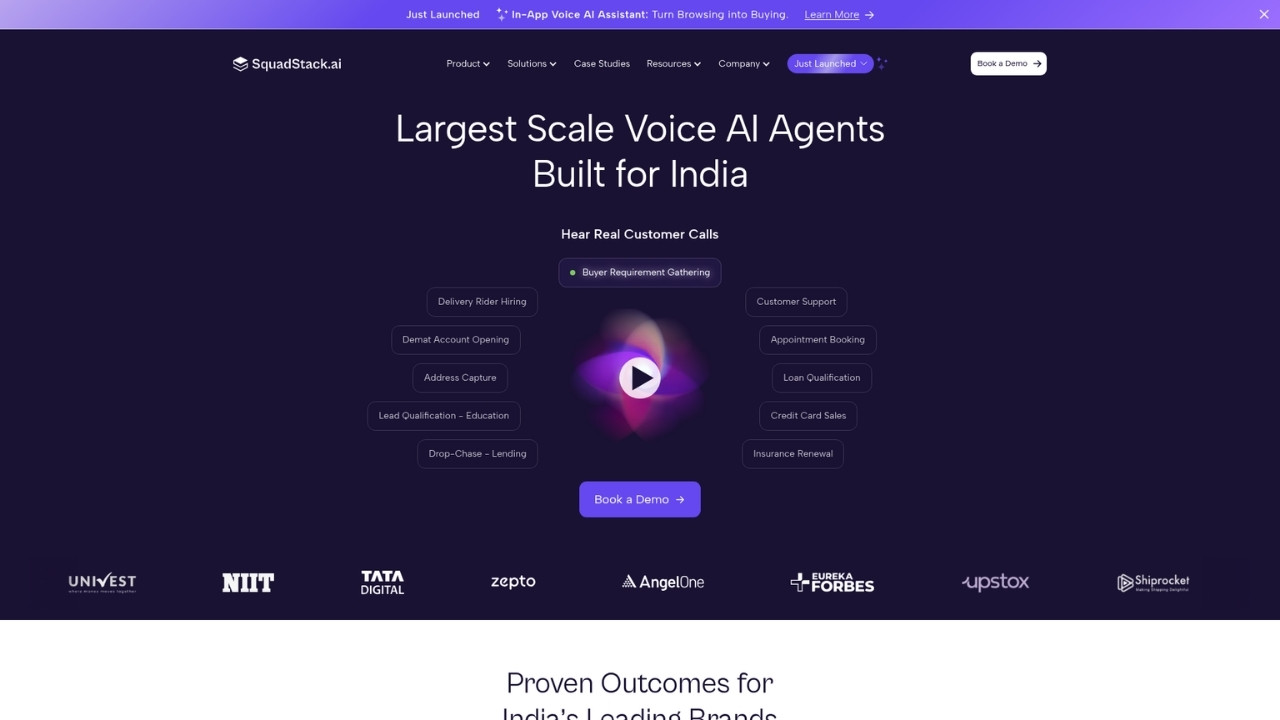
SquadStack is India's leading conversational AI platform, processing over 2 million conversations daily.
The platform is built specifically for the Indian market, with deep expertise in sales, support, and collections.
What sets SquadStack apart is its training data.
The models are trained on 600M+ minutes of real sales calls, giving them an edge in understanding conversational nuance and sales psychology.
The platform supports multiple Indian languages including Hindi, English, Hinglish, Bhojpuri, Marathi, Punjabi, and Kannada.
This isn't just translation, it's native understanding of code-switching and regional expressions.
Key features:
- Trained on 600M+ minutes of sales calls
- Sub-0.8s latency
- 4.23 MOS voice quality score
- Omnichannel (Voice, WhatsApp, SMS, Email)
- Live human handoff capability
Pros:
- Outcome-driven pricing options
- 75-90% connectivity rates
- Deep conversation intelligence
- ISO 27001 and SOC 2 Type II certified
Cons:
- Primarily optimized for Indian market
- Sales-focused rather than general customer service
Pricing: Usage-based with performance-linked options. Contact sales for custom quotes.
G2 Rating: 4.3/5
Proven outcomes:
- Eureka Forbes: 30% increase in conversions, 90% connectivity
- Kissht: 82% conversion boost, 50% lower CAC
- Upstox: 75% conversion boost, 2Cr+ leads processed
Best for: High-volume sales, lending, and collections in the Indian market (BFSI focus).
3. PolyAI
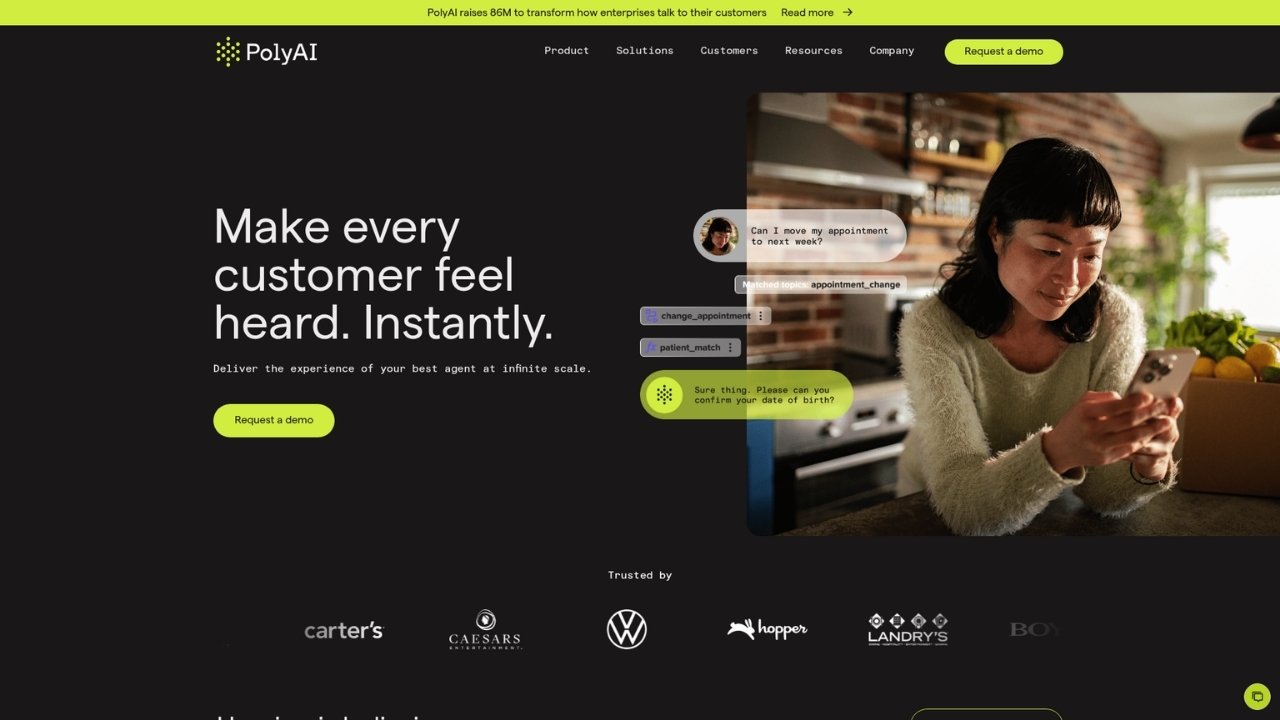
PolyAI positions itself as the only conversational AI platform delivering both unlimited scale and complete control.
The company targets large enterprises that need reliable, high-containment voice agents.
The platform's key differentiator is its pre-trained domain assistants. Instead of building from scratch, you start with an assistant that already understands your industry. PolyAI claims 80%+ call containment from day one.
PolyAI offers omnichannel deployment.
Build your agent once, then deploy across voice, chat, and SMS without rebuilding.
Key features:
- Pre-trained domain assistants
- 80%+ call containment from day one
- Natural speech handling
- Omnichannel deployment
- Agent Studio for no-code building
Pros:
- High containment rates immediately
- Enterprise-grade security and compliance
- Strong CRM integrations (Salesforce, NICE, Genesys)
- Scales automatically for peak periods
Cons:
- High minimum contracts (~$150K/year)
- Heavy implementation cycles
- Overkill for smaller operations
Pricing: Custom enterprise pricing. Contact sales for quotes.
G2 Rating: 5/5 (11 reviews)
Proven outcomes:
- Hotel and casino brand: $0.2M revenue from one voice agent
- Retail clothing brand: 50% reduction in seasonal hiring, saving $1M+
- Global delivery company: 50% of calls resolved without human agents
Best for: Large enterprises needing multilingual support and high containment rates from day one.
4. Bland AI

Bland AI is built for extreme scale. The platform supports up to 1 million concurrent calls, making it suitable for the largest enterprises with massive call volumes.
The company takes a unique approach to AI models. Instead of relying on OpenAI, Anthropic, or other providers, Bland trains and fine-tunes its own models for every part of the conversation.
This gives them more control over latency, cost, and data privacy.
Bland offers custom model training using your own recordings and transcriptions.
They'll even put you on dedicated servers and GPUs if needed.
Key features:
- Up to 1 million concurrent calls
- Proprietary voice stack (no third-party AI providers)
- Custom model training
- Multi-region deployment
- Dedicated infrastructure options
Pros:
- Extreme scalability
- Granular conversational control
- GDPR-compliant region options
- Full data encryption on dedicated servers
Cons:
- No public pricing
- Requires engineering involvement
- Overkill for smaller use cases
Pricing: Custom enterprise pricing. Contact sales.
Product Hunt Rating: 3/5 (10 reviews)
Notable customers: Samsara, Snapchat, Gallup, TravelPerk, Medallion
Best for: Enterprises needing extreme scale (1M+ concurrent calls) and governance-heavy deployments.
5. Voiceflow
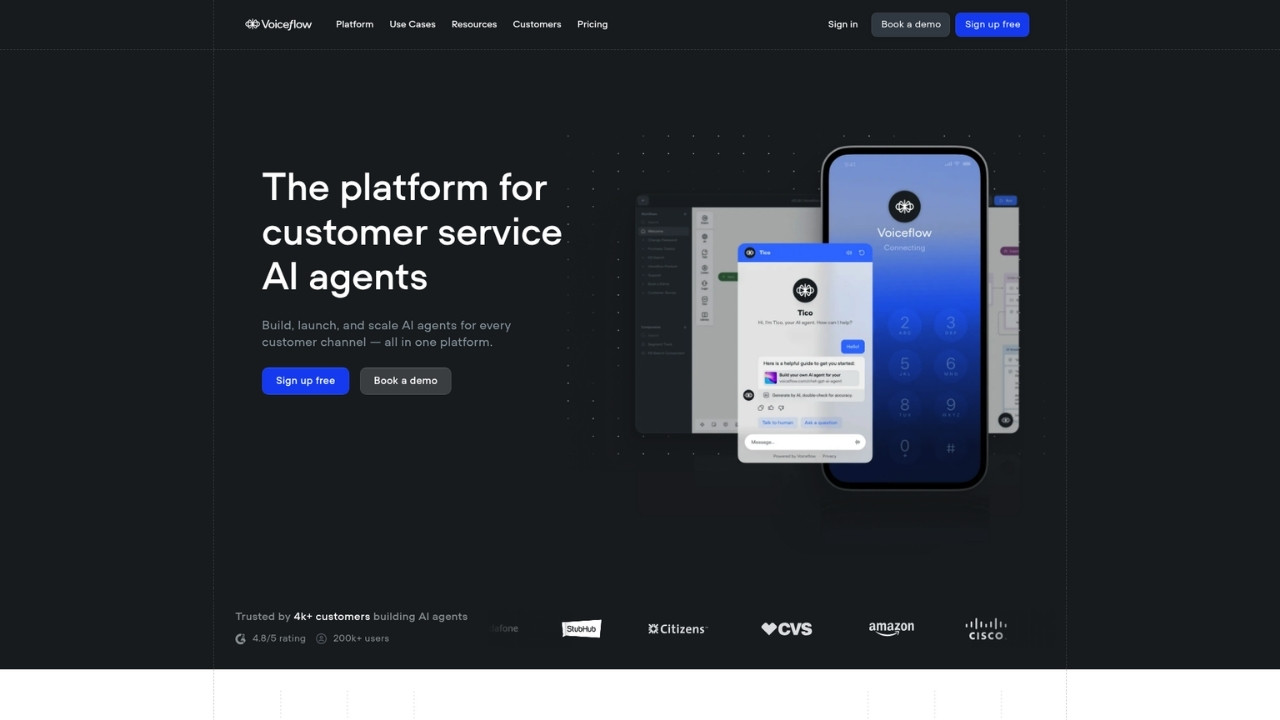
Voiceflow takes a different approach. Instead of being a full telephony stack, it's a design and prototyping platform for conversational AI.
Think of it as Figma for voice agents.
The platform offers a drag-and-drop interface for building conversational flows. It's technology-agnostic, meaning you can connect it to any LLM or API.
This flexibility makes it popular with startups and design teams.
Voiceflow excels at rapid prototyping. You can build and test conversation flows quickly, then hand off to engineering for production deployment.
Key features:
- No-code drag-and-drop builder
- Real-time team collaboration
- Technology-agnostic (any LLM/API)
- Rapid prototyping capabilities
Pros:
- Fastest prototyping
- Strong team collaboration features
- Flexible integration options
- Lower cost for small teams
Cons:
- More design layer than full telephony stack
- Costs climb at scale
- Requires separate telephony integration
Pricing:
| Plan | Monthly Price | Annual Price | Details |
|---|---|---|---|
| Free | $0 | $0 | For individuals getting started |
| Pro | $60/editor | $50/editor | For professional creators |
| Business | $150/editor | $125/editor | For teams and organizations |
G2 Rating: 4.6/5 (58 reviews)
Best for: Startups, design teams, and rapid prototyping before committing to a full telephony platform.
6. Sierra AI

Sierra focuses on brand-aligned AI agents for enterprises that care deeply about customer experience consistency.
The platform uses a multi-model architecture to handle different aspects of conversations.
The company's approach centers on "Agent OS" - a complete operating system for building, testing, and optimizing AI agents.
This includes Agent Studio for no-code building and Agent SDK for engineering teams.
Sierra emphasizes outcome-based pricing, meaning you pay for the value delivered rather than usage volume.
This aligns incentives between you and the platform.
Key features:
- Multi-model architecture
- Brand voice alignment and policy enforcement
- Agent Studio and Agent SDK
- Agent memory for personalization
- Proactive engagement capabilities
Pros:
- Strong brand governance controls
- Outcome-based pricing aligns incentives
- Comprehensive analytics and observability
- Extensive compliance certifications
Cons:
- High starting price (~$150K/year)
- Complex setup process
- Some users report bugs in newer features
Pricing: Custom enterprise pricing starting around $150K/year.
Compliance: SOC 2 Type II, ISO 27001, ISO 42001 (AI Certified), HIPAA, GDPR, EU AI Act
G2 Rating: 4.3/5 (12 reviews)
Notable customers: Rocket Mortgage, Gap Inc., SoFi, SiriusXM, Sutter Health, The North Face, Wayfair, Discord
Best for: Brand-conscious enterprises in telecom, financial services, and healthcare needing strict policy adherence.
7. Ringly.io

Ringly.io takes a focused approach: AI phone agents specifically for e-commerce stores.
The platform promises quick setup and deep Shopify integration.
The platform's the AI AI handles common e-commerce support scenarios like order tracking, returns, and product questions.
It resolves approximately 73% of calls without human intervention.
What makes Ringly.io different is its transparency. Pricing is clearly published, and the setup process is designed for store owners without technical backgrounds.
Key features:
- ~73% call resolution rate
- Deep Shopify integration
- 30 languages supported
- quick setup process
- Smart escalation to human agents
Pros:
- E-commerce specialized
- Transparent pricing from $349/mo
- No-code onboarding
- Multi-language support
Cons:
- Best suited for e-commerce vs general enterprise use
- Limited customization outside e-commerce scenarios
Pricing:
| Plan | Monthly Price | Minutes | Best For |
|---|---|---|---|
| Grow | $349 | 1,000 | Growing businesses |
| Enterprise | Custom | 5,000+ | Larger operations |
Best for: E-commerce stores needing instant phone support automation without technical complexity.
Feature comparison table
| Platform | Best For | Starting Price | Latency | G2 Rating |
|---|---|---|---|---|
| Retell AI | Fast iteration, call centers | $0.05-0.07/min | ~600ms | 4.8/5 |
| SquadStack AI | Sales, collections (India) | Custom | <0.8s | 4.3/5 |
| PolyAI | Enterprise multilingual | ~$150K/yr | Low | 5/5 |
| Bland AI | Extreme scale | Custom | Low | 3/5 |
| Voiceflow | Prototyping, startups | $60/editor/mo | Good | 4.6/5 |
| Sierra AI | Brand governance | ~$150K/yr | Low | 4.3/5 |
| Ringly.io | E-commerce support | $349/mo | Low | N/A |
Which Leaping AI alternative should you choose?
The right platform depends entirely on your situation. Here's a quick decision framework:
Choose Retell AI if you need transparent pricing and want to deploy quickly. The per-minute model means you pay for what you use, and the low latency makes conversations feel natural.
Choose SquadStack if you're operating in India and focused on sales or collections. The training on 600M+ minutes of sales calls shows in the conversion rates.
Choose PolyAI if you're a large enterprise needing multilingual support and want high containment from day one. The pre-trained domain assistants accelerate time-to-value.
Choose Bland AI if you need extreme scale (1M+ concurrent calls) or have strict data residency requirements. The custom model training is a differentiator for specialized use cases.
Choose Voiceflow if you're prototyping and iterating quickly. It's the best tool for designing conversation flows before committing to a full telephony stack.
Choose Sierra AI if brand alignment and policy governance are critical. The multi-model architecture and outcome-based pricing work well for regulated industries.
Choose Ringly.io if you run an e-commerce store on Shopify and want instant setup. The specialized focus means it works out of the box for online retail scenarios.
Getting started with AI voice automation
Voice AI has reached a point where it's practical for most businesses.
The technology works, the pricing is transparent (for most platforms), and deployment timelines have shrunk from months to days.
Start with a narrow use case. Don't try to automate everything at once.
Pick one scenario, like appointment scheduling or order tracking, and perfect that before expanding.
Measure everything. Track containment rates, customer satisfaction, and cost per call.
The data will tell you whether your AI agent is performing or needs adjustment.
Most platforms offer trials or pilots. Take advantage of them.
There's no substitute for hearing your own AI agent handle real calls.
If you're running an e-commerce store and want to see how AI phone support works in practice, start your free trial with Ringly.io.
the AI can be answering calls in under 3 minutes.
Frequently Asked Questions
What are the best Leaping AI alternatives for small businesses?
For small businesses, Retell AI offers transparent per-minute pricing starting at $0.07/minute. Ringly.io is ideal for e-commerce stores with plans starting at $349/month. Voiceflow at $60/editor/month works well for teams that want to prototype before committing to a full solution.
Which Leaping AI alternative has the lowest latency?
Retell AI leads with ~600ms latency according to independent benchmarks. SquadStack AI achieves sub-0.8s response times. Both platforms prioritize real-time performance for natural-sounding conversations.
Are there any free Leaping AI alternatives?
Most platforms offer free trials rather than permanent free tiers. Retell AI provides $10 in free credits upon signup. Voiceflow has a free plan for individuals getting started, though it has usage limitations.
Which Leaping AI alternative is best for enterprise scale?
For extreme scale, Bland AI supports up to 1 million concurrent calls. PolyAI and Sierra AI both target large enterprises with custom pricing starting around $150K/year and offer comprehensive compliance certifications.
What Leaping AI alternatives work best for sales teams?
SquadStack AI is specifically built for sales with training on 600M+ minutes of sales calls and proven conversion improvements. Retell AI also works well for outbound sales with its fast deployment and real-time function calling for lead qualification.
Can Leaping AI alternatives integrate with my existing phone system?
Yes. Retell AI supports SIP trunking to connect with any telephony provider. Bland AI and PolyAI also offer extensive telephony integrations. Most platforms can work with your existing phone numbers and infrastructure.