

An ecommerce call center handles a store's customer calls, order questions, returns, and WISMO (where-is-my-order) inquiries, either inbound (answering customers) or outbound (proactive calls). The best fit in 2026 depends on call volume, whether you need 24/7 coverage, and increasingly, whether AI can resolve routine calls before a human is needed.
In 2026, the cost of a missed customer call isn’t just a lost sale.
It’s a leak in your brand's scaling engine that human staff alone can no longer solve.
You have built a real team and a real brand, but now your payroll for support is climbing faster than your actual profit margins.
You are watching your best people burn out on "Where is my order?" tickets.
This guide will go over the best ecommerce call center services of 2026.
First, we will break down the shift from traditional outsourcing to "Agentic" AI.
Then, we will compare the 6 best tools to find your perfect fit for you.
Editor’s note: Want to hear some sample AI support calls made for your Shopify store?
- Just paste your store URL
- Get sample calls in under 20 seconds (no email required)
- Listen to demo calls for my store
What defines the best ecommerce call center services?
The idea of a "call center" has changed a lot. It's not just a big room of people on phones anymore.
Today, it’s about managing all the different ways your customers get in touch.
Modern ecommerce call center services are all about handling customer chats, emails, phone calls, and social media messages in one place. These services usually come in two flavors. The first is outsourcing to human teams, where you hire a company to provide trained agents for you.
The second way is to use technology, especially AI-powered tools, to automate and manage conversations.
As this infographic shows, the top solutions often mix smart tech with a human touch, giving you an efficient way to offer 24/7 support that doesn't cost a fortune.

Our criteria for the best ecommerce call center services
To build this list, we focused on what really matters for an online store. We weren't just looking for any call center; we wanted partners and platforms that actually get ecommerce.
Here’s what we looked for:
- Ecommerce-specific features: The service needs to understand how online retail works. That means having deep integrations with platforms like Shopify and knowing how to handle order tracking, returns, and product questions.
- Scalability: An online store’s traffic can be all over the place. A good service needs to handle the holiday rush just as easily as a quiet Tuesday morning.
- AI and automation: The top services use technology to solve common issues instantly. This frees up your team to handle the more complex problems where a human is really needed.
- Ease of setup: You don’t have months to spend on a complicated implementation. A great solution should be up and running quickly. For instance, Ringly.io can be set up within an hour for most stores.
- Transparent pricing: Clear, predictable costs are a must for managing your budget. We focused on services that tell you exactly what you’re paying for, without any hidden fees.

Comparing the top options for the best ecommerce call center services
To give you a quick overview, here’s a table comparing the main features of each service on our list. It's an easy way to see how they stack up.
| Feature | Ringly.io | eDesk | Gorgias | SupportYourApp | Zendesk |
|---|---|---|---|---|---|
| Primary Model | AI Phone Agent (Seth) | AI-powered Help Desk | Conversational AI Platform | Human Outsourcing (BPO) | Help Desk Software |
| Best For | Shopify stores automating phone support | Multichannel marketplace sellers | Shopify DTC brands | Tech-focused brands needing multilingual teams | Large enterprises needing customization |
| Key Channel | Voice (Phone) | Email, Chat, Marketplaces | Chat, Email, Social | Voice, Chat, Email | Omnichannel |
| Setup Time | 3 minutes | Hours to Days | Hours | Days to Weeks | Weeks |
| Pricing Starts At | $349/month (after guarantee) | $39/agent/month + AI add-ons | $10/month | Custom | $19/agent/month |
| AI Capability | Fully autonomous (73% resolution rate) | AI Agent (automates up to 65%) | AI Agent (automates up to 60%) | AI-assisted humans (automates up to 80%) | AI agents (automates 80%+) |
A closer look at the 5 best ecommerce call center services
Now, let's get into the details of each service. We'll cover what makes them stand out, what they do best, and what their pricing looks like so you can get a better idea of what might work for you.
1. Ringly.io

Ringly.io provides a specialized AI phone agent named the AI, made just for the 2,100+ Shopify brands that use it. the AI connects directly to your store to answer customer calls 24/7, handling common questions about orders, returns, and products on its own.
It's built to resolve about 73% of calls without any human help and smartly passes trickier issues to your team. This makes it a great choice for stores that want to offer instant phone support without hiring more people.
Pros:
The biggest advantages are its speed and independence. You can get the AI agent, the AI, up and running within an hour for most stores, and it starts answering calls immediately.
It offers true 24/7 coverage in over 30 languages, so every customer gets an answer. Its deep Shopify integration means it provides accurate, helpful responses that build trust.
Cons:
Ringly.io is designed to automate common, repetitive questions, so it isn't meant for highly nuanced or emotional conversations.
Those calls are automatically handed off to a human agent. Its focus is on voice, making it a dedicated tool for phone support rather than an all-in-one help desk.
Pricing:
Ringly.io offers a unique guarantee: you pay nothing until The AI resolves at least 65% of your first 100+ calls. After that, plans include:
- Grow Plan: $349/month for 1,000 call minutes and self-learning AI.
- Enterprise: custom pricing for stores handling 5,000+ minutes/month, with private Slack channel and custom integrations.
Why we chose it:
Ringly.io is a really practical solution for ecommerce phone support. It directly tackles the most common and time-consuming support issues with a scalable and affordable tool that you can try risk-free.
2. eDesk

eDesk is a customer service platform for sellers who work across multiple online channels. It pulls all your customer messages from over 300+ platforms (like Amazon, eBay, and social media) into a single inbox. Its AI agent can automate up to 65% of customer support tasks on every channel you use.
Pros:
Its main strength is the sheer number of marketplace integrations. If you sell on several platforms, eDesk can make your life easier by organizing everything in one spot. The AI-assisted responses help your team reply faster by giving them all the order information they need right in the ticket.
Cons:
While its automation is useful, eDesk still depends on your human agents to manage the inbox. It helps them be more efficient but doesn't offer a fully autonomous voice solution like some other tools. Important AI features, like automation and translation, are also paid add-ons.
Pricing:
- Essential Plan: Starts at $39 per agent per month.
- AI features are priced separately, with AI Automation at $0.99 per resolution.
Why we chose it:
For multichannel sellers, eDesk is one of the most complete help desks available. It helps manage the complexity of customer support when you're selling on many different platforms.
3. Gorgias
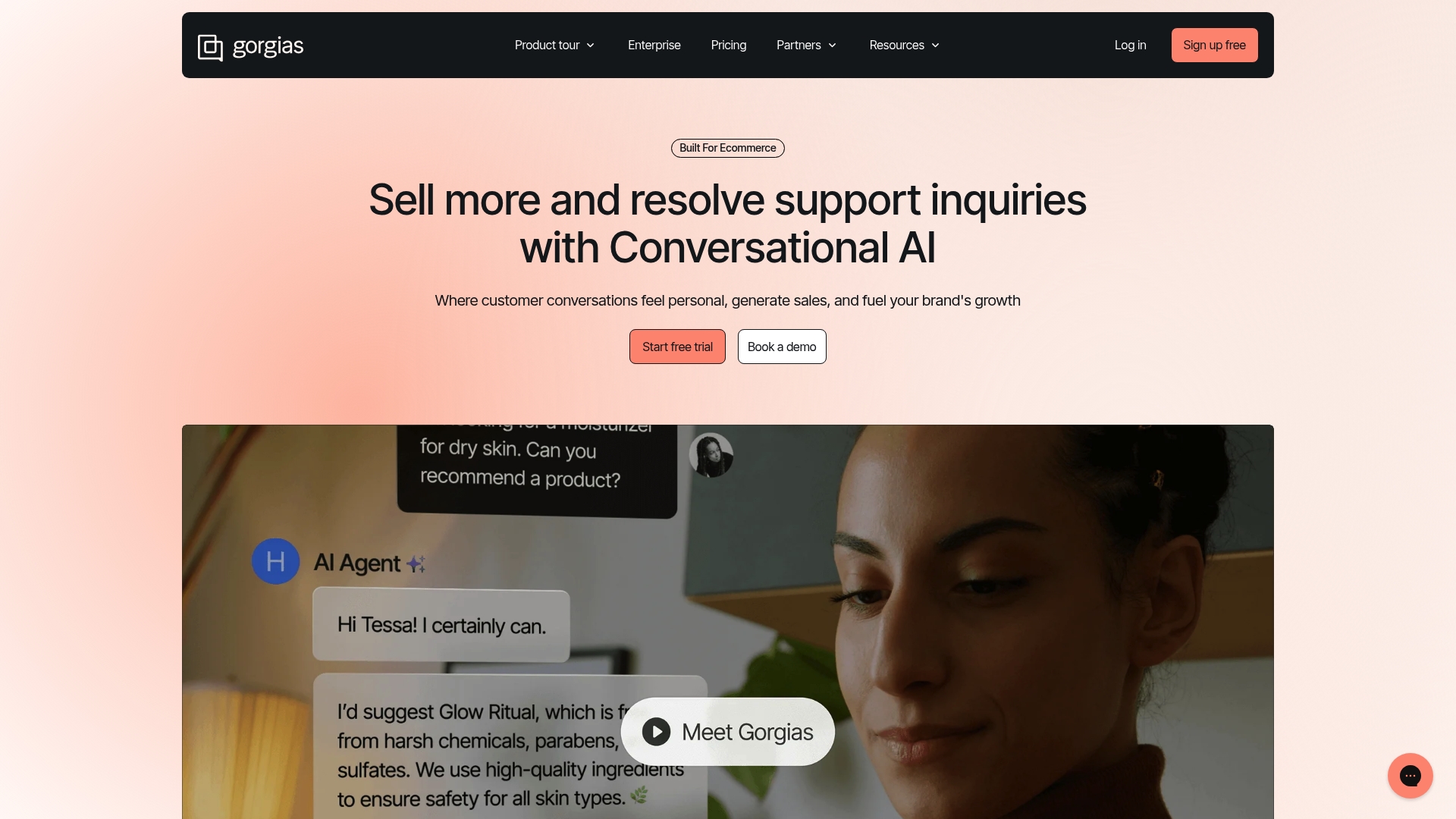
Gorgias is a well-known conversational AI platform built for direct-to-consumer (DTC) brands on Shopify. It's used by over 15,000 brands and integrates smoothly with the Shopify ecosystem. Its AI Agent can resolve up to 60% of common support inquiries, handling things like order updates and refunds automatically.
Pros:
The Shopify-first design is a huge plus for DTC brands, making customer conversation management feel effortless.
Its automation is great for common questions, and its AI can even act as a Shopping Assistant to help turn support chats into sales.
Cons:
Gorgias has limited native integrations with big marketplaces like Amazon or eBay. Voice support is an option, but it's an add-on rather than a core feature. The pricing is based on ticket volume, which can become expensive as your store grows and you get more support requests.
Pricing:
- Starter Plan: Begins at $10/month for 50 tickets.
- Higher-tier plans, like Pro, start at $300/month for 2,000 tickets.
Why we chose it:
If your business relies on Shopify and social media, Gorgias is a very powerful tool for managing customer conversations and boosting sales.
4. SupportYourApp
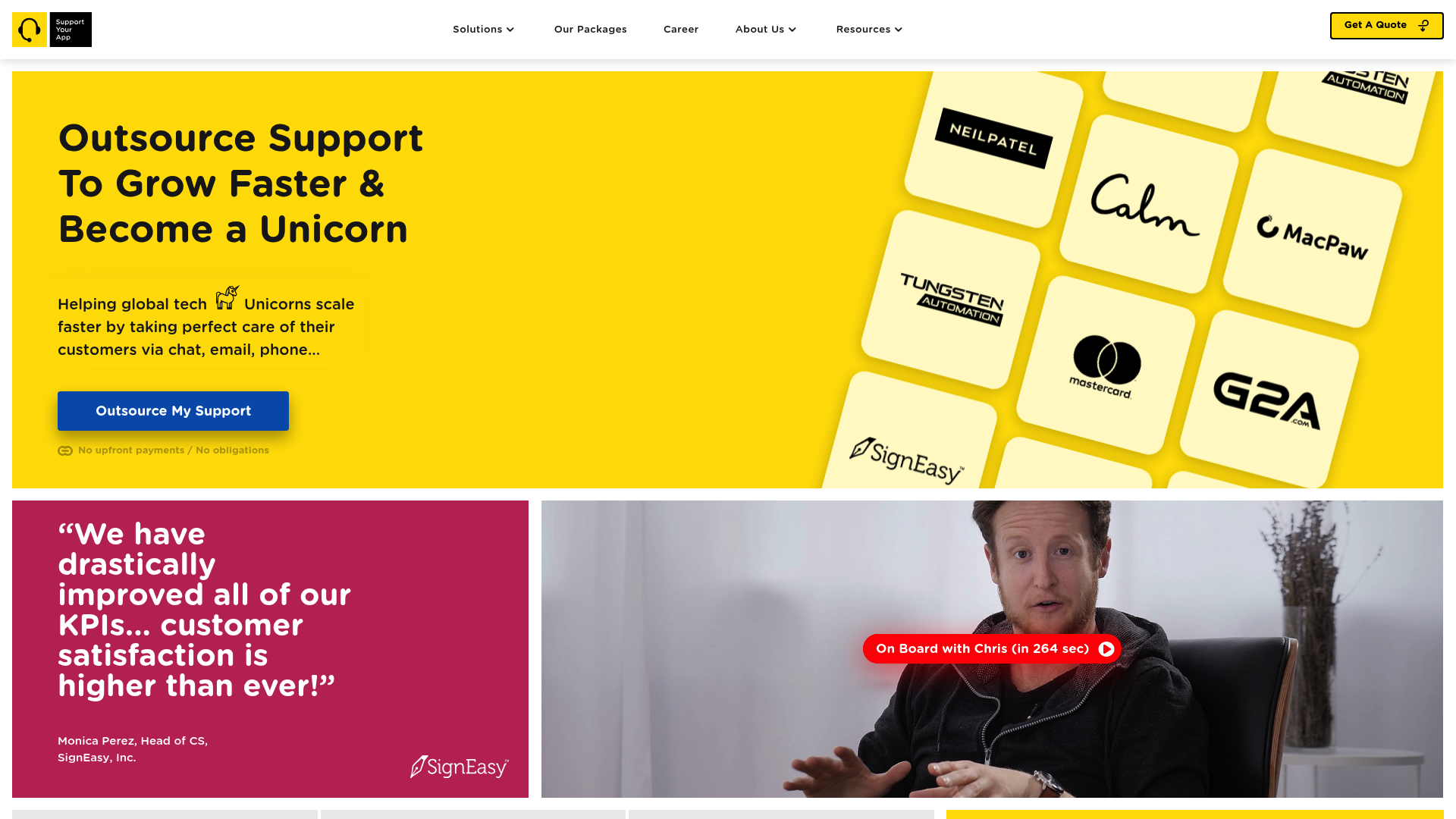
SupportYourApp is a global outsourcing provider that’s been in business for over 14 years.
It combines human agents with AI technology to offer customer and technical support. They work with major clients like Mastercard and Calm, providing secure, omnichannel support in over 60 languages.
Pros:
Their focus on security is a major benefit, with certifications like PCI DSS Level 1 and ISO. This is really important for businesses that handle sensitive customer data. Their hybrid model, which uses AI to help human agents, can automate up to 80% of routine questions, saving the human touch for more complex problems.
Cons:
As a full-service outsourcing company, their solutions might be more than a small or medium-sized ecommerce store needs.
It's not a simple plug-and-play tool, and the setup is more involved. Their custom pricing also makes it hard to estimate costs without talking to them first.
Pricing:
- Pricing is customized based on your specific needs, team size, and the work involved.
Why we chose it:
SupportYourApp is a solid choice for brands that need highly secure, multilingual support and prefer a managed service that blends human expertise with good technology.
5. Zendesk
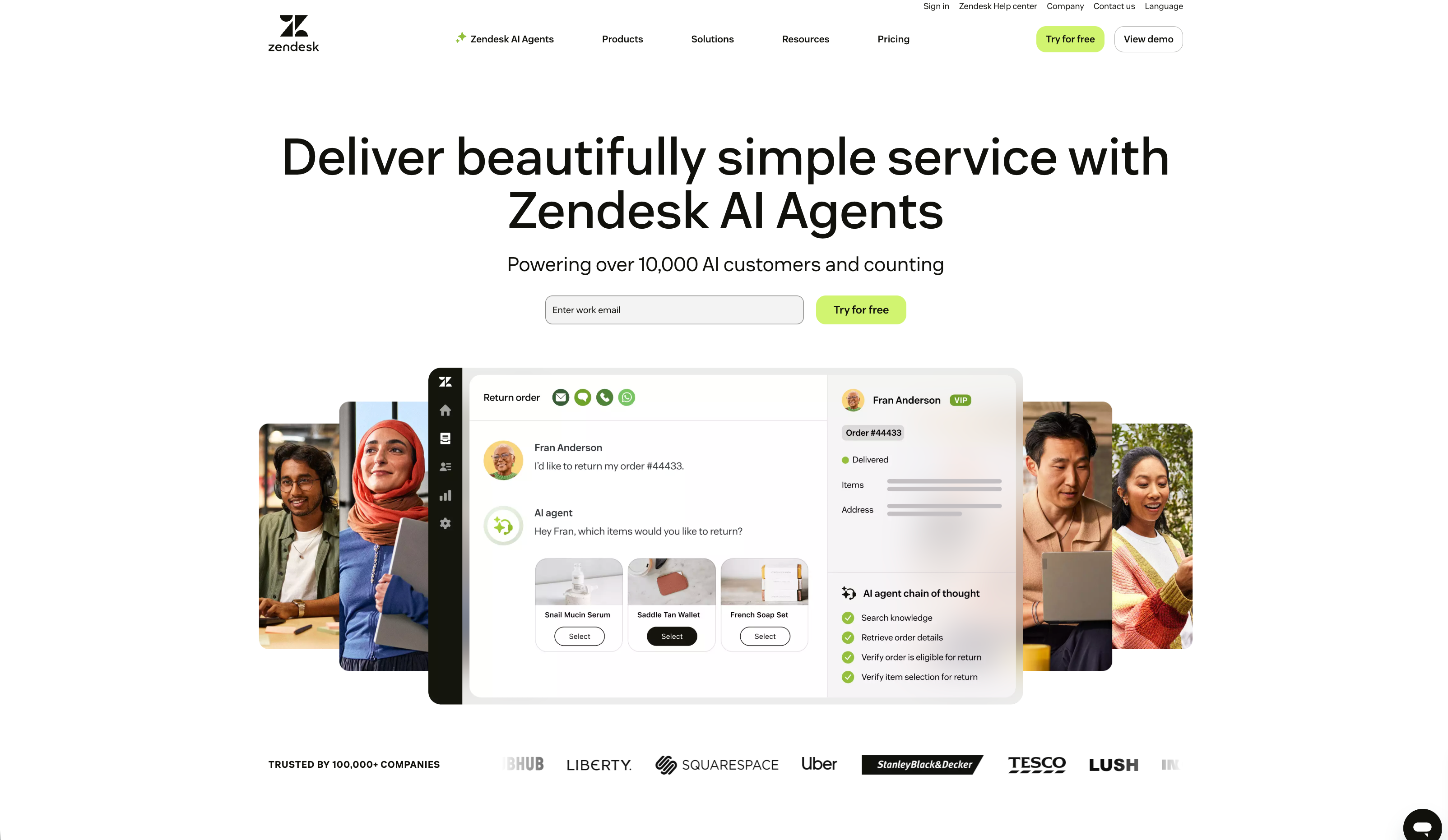
Zendesk is one of the biggest names in customer service software. It's a robust, enterprise-level platform with a full suite of tools for omnichannel support. Its AI agents can automate over 80% of customer interactions.
Pros:
Zendesk is incredibly powerful and customizable. With a marketplace of over 1,500 apps, you can connect it to almost any tool your business uses.
Its reporting and analytics are top-notch, giving you deep insights into your support operations.
Cons:
Because it's a general-purpose tool, Zendesk needs a lot of setup to work well for ecommerce. You'll often need paid, third-party apps to get the specific features you need. For smaller teams without a dedicated IT person, it can feel complicated.
Pricing:
- Support Team: Starts at $19 per agent per month for basic ticketing.
- Suite Team: Starts at $55 per agent per month to get omnichannel features and AI.
Why we chose it:
For large ecommerce businesses with the resources to manage it, Zendesk offers an endlessly flexible platform for building a completely custom support system.
How to choose from the best ecommerce call center services for your store
Feeling a bit overwhelmed? That's totally normal. The key is to think about what your store really needs. Ask yourself a few questions to point you in the right direction.

What problem are you trying to solve?
If your team is swamped with "Where is my order?" phone calls, a specialized AI tool like Ringly.io is a direct fix that resolves 73% of those calls automatically.
But if you're trying to manage messages from ten different marketplaces, a help desk like eDesk might be a better choice.
Do you want to automate or outsource?
Automation tools help your current team by handling repetitive tasks for them. Outsourcing brings in external agents to help out.
Think about your budget, how much control you want to have, and how complex your customer issues usually are.
How important is setup time?
If you need something that works right away, look for platforms with a quick, no-code setup.
An AI phone agent from Ringly.io can be live in 3 minutes, whereas some enterprise systems can take weeks to get going.
What is your primary support channel?
Think about where your customers reach out the most. If phone support is a big one, prioritize a voice-first solution.
If your customers prefer live chat and social media, a platform like Gorgias would be a better fit.
To see how these principles apply in the real world, this video breaks down some of the most effective practices for ecommerce customer service.
This video from Gorgias breaks down some of the most effective practices for ecommerce customer service.
Finding the right ecommerce call center service
Choosing the right ecommerce call center service really depends on your store's specific needs, channels, and size. There isn't one single solution that's perfect for everyone.
However, the trend is pretty clear: support is shifting from purely manual work to smart, AI-driven automation.
This change gives customers the instant answers they expect and frees up human teams for more important, high-value work.
For phone support, Ringly.io is leading this new approach. It's a tool that doesn't just manage calls but actually resolves them automatically, all backed by a strong, risk-free guarantee.
Ready to see how an AI phone agent could change your customer support? Start your free trial of Ringly.io and pay nothing until The AI resolves over 65% of your calls.
What is a call center for ecommerce?
An ecommerce call center is a support hub designed for the specific needs of online retail. The goal is to handle the types of questions and issues that your customers might have.
The main focus is on tasks directly related to the customer's shopping journey. These typically include several key categories:
- Order Management: Helping customers with tracking packages, updating shipping addresses, or canceling orders before shipment.
- Returns and Exchanges: Helping shoppers in the return process.
- Product Inquiries: Answering specific questions about product details like sizing, materials, or functionality.
- Technical Support: Helping users with issues with discount codes, account logins, or the checkout process.
The goal is to create an experience that connects the online store with effective support. Solving a customer’s problem quickly not only fixes the issue but also helps to build trust and loyalty.
The traditional call center for ecommerce: Common approaches and downsides
Up until recently, online stores had two primary options for phone support: building an in-house team or outsourcing to a business process outsourcing (BPO) company. Both options have their advantages and downsides.
Let's go over some of the common challenges.

High Operational Costs
Operating a call center is expensive. Besides salaries, costs include training, office space, equipment like computers and headsets, and necessary software.
Scalability Issues
Call volume can fluctuate a lot, peaking during events like Black Friday and slowing down in other periods.
A traditional setup makes it difficult to maintain optimal volume, which leads to either idle agents during slow times or overwhelmed teams and long wait times during busy seasons.
High Agent Attrition
The repetitive nature of answering common questions will lead to employee burnout and high turnover. Contact centers may experience an average turnover rate of up to 35%, which results in ongoing costs for recruitment and training.
Agent Inefficiency
While human agents are skilled at handling complex issues with empathy, in a traditional call center, they often spend a significant portion of their time on simple, repetitive questions.
This means their expertise is not always utilized for high-impact tasks like building customer relationships or resolving difficult problems.
How AI is revolutionizing the call center for ecommerce
AI can be seen as a tool that handles repetitive tasks, which allows human agents to focus on more strategic work and calls that require a human touch.
Here are the key AI technologies that are transforming ecommerce support.
AI Voice Agents
A modern AI voice agent can understand natural language, connect to your store’s data in real-time, and resolve issues 24/7.
Ringly.io offers an AI phone representative named the AI, which was built for Shopify stores. It can perform tasks from checking an order status to initiating a return and supports over 30 languages.
Intelligent Understanding
Traditional phone menus often require callers to navigate a series of options.
A modern AI agent like the AI eliminates this by listening to the caller's request and finding their needs directly.
Automated Workflows
AI can now manage entire ecommerce processes independently.
For example, Ringly.io automates up to 73% of inbound calls for the stores on its platform. The AI handles common order lookups and return requests without needing human intervention.
Analytics and Insights
AI tools also provide valuable data, including call transcripts, recordings, and analytics that highlight common customer questions.
This information can help identify gaps in FAQ pages or product descriptions.
Additionally, a well-designed AI has built-in safeguards. the AI is designed to escalate a call to a human if it is unsure of an answer.
The benefits include 24/7 support availability, a reduction in support costs, and a human team that can concentrate on more complex issues.
Final thoughts
The modern call center for ecommerce is evolving into a strategic asset. When powered by the right AI, it can become a tool that supports business growth and helps build customer loyalty.
Different models, such as traditional systems, agent-assist tools, and automation-first solutions, cater to different business needs. Specialized, automation-first solutions are a very good option for handling the high-volume, repetitive calls common in ecommerce.
With the right AI partner, any online brand can offer high-quality, 24/7 service that customers value, while also freeing up their human team to focus on growing the business.
What is an ecommerce call center?
An ecommerce call center handles customer phone support specifically for online stores.
Unlike general call centers that might handle insurance claims or tech support tickets, ecommerce specialists focus on order tracking, returns processing, product questions, and complaint resolution.
The "US-based" part matters for a few reasons. Time zone alignment means your agents work during your business hours for real-time escalations.
Cultural familiarity helps with customer expectations and communication nuances.
Most modern ecommerce call centers also cover more than just phone calls.
They handle live chat, email, SMS, and social media, so customers can reach you however they prefer.
.jpeg)
US-based centers handle the same channels as offshore but with real-time collaboration advantages
What to look for in a US-based ecommerce call center
Before comparing providers, you need to know what features actually matter.
Here's what separates a good ecommerce call center from a mediocre one.
Omnichannel support
Phone calls alone won't cut it anymore. Your call center should handle phone, live chat, email, SMS, and social media from a single platform.
Customers expect to start a conversation in one channel and continue it in another without repeating themselves.
24/7 availability
Ecommerce operates around the clock. If your store sells to customers in multiple time zones, you need support that matches.
Look for providers offering true 24/7/365 coverage, and ask how they maintain quality during off-hours.
Platform integrations
The best call centers connect directly to your ecommerce platform (Shopify, WooCommerce, Magento, or BigCommerce) and your helpdesk tools (Zendesk, Gorgias, Freshdesk). Direct integration means agents see order history, product details, and customer notes without switching systems.
Scalability for seasonal peaks
Black Friday. Holiday rushes. Flash sales. Your call volume might spike 300% during peak seasons. Providers should scale up instantly without requiring long-term commitments or weeks of lead time.
Compliance and security
If you're handling payment data, you need PCI DSS compliance. Selling to EU customers? GDPR matters. Healthcare-adjacent products? HIPAA applies. Ask for certifications, not just claims.
Brand voice training
Outsourced agents should sound like your in-house team. Look for providers with custom onboarding programs, QA monitoring, and regular call calibration. Your customers shouldn't notice they're talking to a third party.
Top 7 US-based ecommerce call centers
These providers were selected based on US presence, ecommerce specialization, omnichannel capabilities, and available performance data. Each one brings a different strength to the table.

1. OnBrand24

OnBrand24 brings over 30 years of ecommerce-specific experience to the table.
With 5,000+ employees across six US locations (Dallas, Killeen, Las Cruces, Savannah, Wichita, and Tampa), they offer significant redundancy and scale.
Their focus areas include fashion, jewelry, food and beverage, and consumer packaged goods.
They report a 92% average CSAT score and 98.7% operational efficiency across 370+ enterprise clients.
| Feature | Details |
|---|---|
| US Locations | 6 major centers (including Charleston, SC; Duluth, GA; and Miami, FL) |
| Experience | 30+ years |
| Languages | English, Spanish, Portuguese, Canadian French |
| Services | Inbound, order processing, email, live chat, 24/7/365 |
| Certifications | Available (specific list requires consultation) |
Pros:
- Longest track record in ecommerce-specific support
- Multiple US locations for business continuity
- Deep expertise in fashion and retail verticals
Cons:
- Pricing requires custom quote
- Website design feels dated compared to newer competitors
Best for: Mid-size ecommerce brands wanting proven, US-based teams with deep retail experience.
2. Helpware
Helpware stands out for transparent performance metrics.
They publish their numbers openly: 90% CSAT, 86% employee satisfaction, 2.8% monthly attrition, and a 4.7 Glassdoor rating.
Founded in 2015, they operate across 26+ US cities (from Phoenix to New York to Seattle) with additional nearshore and offshore options.
Their AI capabilities can automate up to 80% of routine queries when combined with human agents.
| Feature | Details |
|---|---|
| US Locations | 26+ cities (Hubs in Los Angeles, Atlanta, Dallas, and Charlotte) |
| Global Presence | 4 continents (Operations in North America, Asia, Europe, and the Caribbean) |
| Compliance | PCI, GDPR, ISO 27001, HIPAA |
| AI Automation | Up to 80% of routine queries (Powered by proprietary VXI "Performance Pro" AI) |
| Pricing Model | Flexible per-hour or per-ticket |
Pros:
- Published performance metrics for accountability
- Flexible team models (dedicated or shared)
- Can save up to 70% with nearshore options
Cons:
- Global footprint means not all agents are US-based
- Enterprise-focused pricing may not suit smaller stores
Best for: Growing ecommerce brands needing scalable CX with transparent quality controls.
3. LiveOps

LiveOps pioneered the on-demand agent network model. Instead of dedicated teams, they maintain a flexible network of US-based independent agents who work on 30-minute scheduling increments.
This model shines during seasonal peaks. They report 1000% forecasted flexibility and 185% flex for unexpected events.
One designer apparel company scaled support 300% during peak season while improving CSAT by 23%.
| Feature | Details |
|---|---|
| Model | On-demand virtual agent network (150,000+ contractors) |
| Flexibility | 1,000%+ forecasted scaling for seasonal peaks (e.g., Black Friday) |
| Cost Savings | 25–55% vs. traditional brick-and-mortar call centers |
| Average CSAT | 90%+ (Industry leading for remote BPO) |
| FCR | 90%+ First Call Resolution maintained via "WooHoo!" training |
Pros:
- Instant scaling without hiring or training cycles
- Pay only for time used during low seasons
- Proven results for seasonal retailers
Cons:
- Network model means less control over individual agents
- Not ideal for brands wanting dedicated teams with deep product knowledge
Best for: Ecommerce businesses with significant seasonal peaks (Black Friday, holiday, flash sales).
4. Callzilla

Callzilla operates from Miramar, Florida with additional capacity in Colombia and South Africa.
They've served over 1,000 clients since 2005 with a specific focus on ecommerce workflows.
| Feature | Details |
|---|---|
| HQ Location | Miramar, FL (US-based confirmed) |
| Founded | 2005+ |
| Compliance | CCPA, PCI-DSS, HIPAA, AICPA, NACS |
| AI Capabilities | Conversational AI, speech analytics |
| CRM Integration | Salesforce, Zendesk, Genesys |
Pros:
- Ecommerce-specialized from the ground up
- Extensive compliance certifications
- AI-first approach with speech analytics
Cons:
- Smaller than enterprise competitors
- Limited public information on pricing
Best for: US-based ecommerce brands prioritizing compliance and specialized support.
5. Westpark Communications
Westpark Communications has been in business since 1968, making them one of the oldest providers on this list.
They're 100% US-based with no offshore or nearshore operations.
Their strongest differentiator is platform integration depth.
They connect directly to Shopify, WooCommerce, Magento, BigCommerce, Salesforce, Zendesk, Jira, and Dynamics 365. Bilingual support (English and Spanish) comes standard.
| Feature | Details |
|---|---|
| Founded | 1968 (55+ years) |
| US-Based | 100% (confirmed) |
| Platform Integrations | Shopify, WooCommerce, Magento, BigCommerce, Salesforce, Zendesk |
| Languages | English, Spanish |
| HIPAA | Compliant |
Pros:
- Deepest platform integration capabilities
- 100% US-based guarantee
- 55+ years of operational stability
Cons:
- Less public case study data available
- Requires consultation for pricing
Best for: Ecommerce brands needing tight integration with their existing tech stack.
6. SupportYourApp

SupportYourApp leans heavily into AI automation.
Their custom AI agents can handle up to 80% of routine queries like delivery updates and order tracking, with human agents stepping in for complex issues.
Founded in 2010, they now have 1,200+ experts across 30+ countries supporting 60+ languages.
Notable clients include Calm, MacPaw, Glovo, and Mastercard.
| Feature | Details |
|---|---|
| Founded | 2010 |
| Team Size | 1,200+ experts globally |
| Languages | 60+ |
| AI Automation | Up to 80% of routine queries |
| Compliance | PCI DSS Level 1, GDPR, ISO 27001, CCPA |
Pros:
- AI integration automates routine queries
- Extensive language support (60+)
- Flexible per-hour or per-ticket pricing
Cons:
- Not exclusively US-based
- Higher-end positioning may not suit smaller stores
Best for: Tech-savvy ecommerce brands wanting AI-augmented support with global reach.
7. Speed Commerce
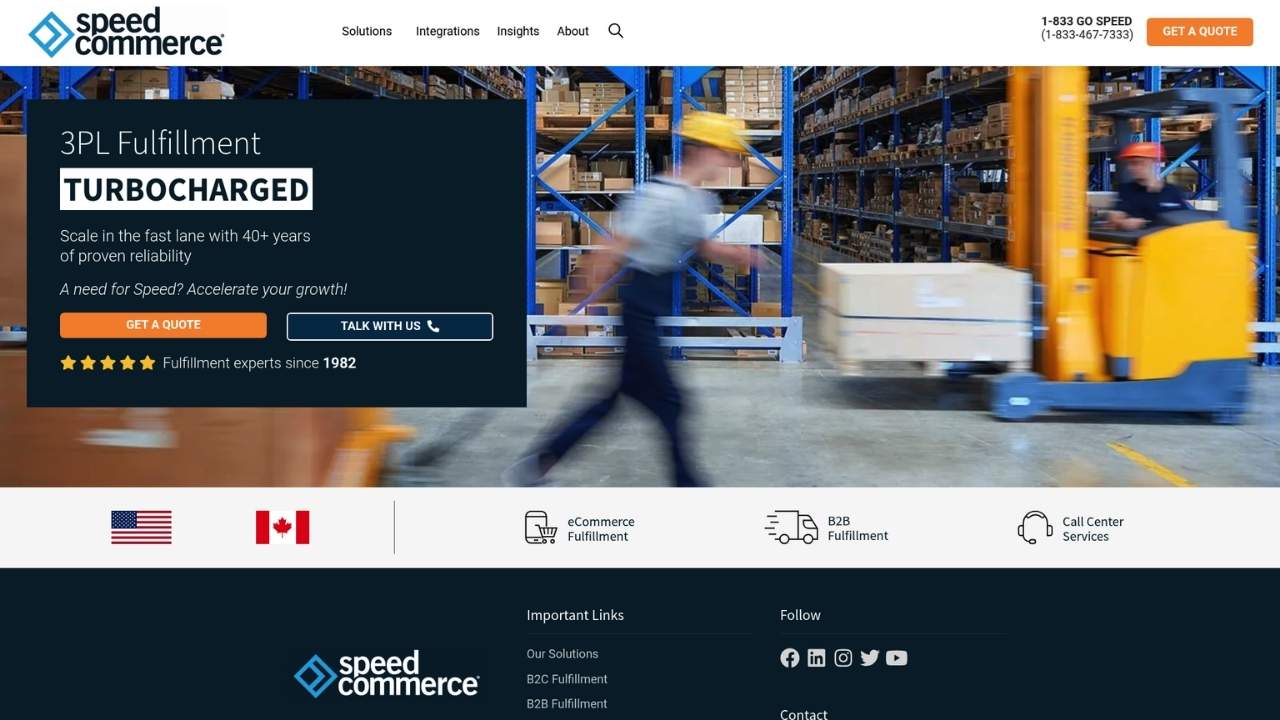
Speed Commerce takes a different approach by combining customer service with fulfillment.
They've been in 3PL operations since 1982 and added call center services to create an integrated commerce partner.
Their unique offering includes video support for complex products, something traditional call centers rarely provide.
They operate in both US and Canada.
| Feature | Details |
|---|---|
| Founded | 1982 (40+ years) |
| Coverage | US + Canada |
| Compliance | HIPAA + PCI |
| Channels | Phone, chat, email, SMS, social, video |
| Integration | Unified fulfillment + support |
Pros:
- Combines customer service with fulfillment capabilities
- Video support for complex products
- Real-time inventory visibility for support agents
Cons:
- Hybrid US/Philippines model
- More suited for full-service partnerships
Best for: Ecommerce businesses wanting an integrated support + fulfillment partner.
US-based ecommerce call center comparison
| Provider | Pricing Model | Key Strength | Best For |
|---|---|---|---|
| OnBrand24 | Custom quote | 30+ years ecommerce expertise | Mid-size brands, fashion/retail |
| Helpware | Per-hour or per-ticket | Transparent metrics, AI automation | Growing brands needing scale |
| LiveOps | Usage-based | Seasonal flexibility (1000% scaling) | Seasonal businesses |
| Callzilla | Custom quote | Compliance certifications | Compliance-focused brands |
| Westpark | Custom quote | Platform integrations, 100% US | Tech stack integration |
| SupportYourApp | Per-hour or per-ticket | 60+ languages, AI automation | Global/multilingual brands |
| Speed Commerce | Custom quote | Fulfillment + support combined | Full-service partnerships |
US-based vs offshore call centers: what's the difference?
The keyword here is "US-based," and there's a reason businesses search for it specifically.
Cost comparison: US-based centers typically cost more per hour than offshore alternatives. But higher first-call resolution rates often offset the price difference. A call that gets resolved the first time costs less than three follow-up calls.
Time zone advantages: Real-time collaboration matters. When an escalation needs management approval, same-business-hours support means faster resolution. Offshore teams operating on 12-hour delays can slow down urgent issues.
Cultural alignment: Native English speakers understand regional expressions, local holidays, and customer expectations. An agent who knows what "I need this before the Super Bowl party" means will handle that call differently.
Compliance considerations: US-based teams simplify CCPA compliance. State-level consumer protection laws, data residency requirements, and federal regulations become easier to manage when your team operates domestically.
When offshore makes sense: Budget constraints are real. Multilingual requirements spanning European or Asian languages may favor nearshore or offshore teams. Follow-the-sun 24/7 models can use offshore coverage for overnight hours effectively.
The hybrid approach: Many providers now offer US management with nearshore (Mexico, Canada) or offshore (Philippines) agents. This can reduce costs 40-70% while maintaining US oversight for quality and compliance.
A faster alternative: AI phone agents for ecommerce
For stores that want phone support without outsourcing to a traditional call center, AI phone agents offer a different approach entirely.

Ringly.io provides the AI, an AI phone support agent built specifically for Shopify stores.
Instead of routing calls to human agents, The AI handles inbound calls directly. It answers questions, looks up orders, and processes returns automatically.
Key differences from traditional call centers:
- Instant scaling: No hiring or training needed
- 24/7 by default: AI doesn't sleep or take breaks
- Pay for results: Billing starts after The AI resolves 65%+ of calls
- Deep Shopify integration: Pulls order data, product info, and policies directly from your store
When AI makes sense:
- High volume of repetitive queries (order status, returns, FAQs)
- Stores scaling faster than they can hire
- Budget-conscious brands wanting to reduce per-call costs
- After-hours coverage without overnight staffing
When human agents still win:
- Complex technical support requiring judgment calls
- High-touch luxury brands where personal connection matters
- Situations requiring empathy and nuanced problem-solving
The AI resolves around 70-73% of calls without human intervention across Shopify stores.
For the remaining 30%, calls escalate to your team or an external call center.
| Ringly.io Plan | Price | Minutes Included | Best For |
|---|---|---|---|
| Start | $349/month | 250 | Smaller stores starting with AI |
| Grow | $349/mo | 1,000 | Mid-size stores with regular call volume |
| Enterprise | Custom | 5,000+ | High-volume stores, custom integrations |
Overage minutes are billed at $0.19/min beyond your plan allowance.
Choosing the right ecommerce support solution
Your decision comes down to a few key factors.
Choose a US-based call center if:
- You need human agents for complex or sensitive interactions
- Compliance requirements demand US-based data handling
- Your brand voice requires extensive training and customization
- You value long-term partnerships with dedicated teams
Choose an AI phone agent like Ringly.io if:
- Most of your calls are repetitive (order tracking, returns, FAQs)
- You need instant scaling without hiring
- You're running a Shopify store and want deep integration
- Budget is a concern and you want pay-for-performance pricing
Consider a hybrid approach:
- AI handles routine calls, human agents handle escalations
- Reduces call center costs while maintaining quality for complex issues
- Many stores start with AI and add human backup as they scale
Ready to automate your phone support?
Start your free trial with Ringly.io and see how many calls the AI can resolve for your store.
Understanding different ecommerce call center models
There are a few ways to set up your call center. Let's look at the main options and weigh the pros and cons of each.
In-house vs. outsourced models
An in-house team is exactly what it sounds like: you hire your own support agents.
The big plus here is that you get deep product knowledge and complete control over your brand's voice. The primary consideration is the cost. You have to cover salaries, training, and equipment, and offering 24/7 support can be a significant operational challenge.
On the other hand, you could go with an outsourced call center, also known as a Business Process Outsourcing (BPO) provider. You hire a company like Unity Communications to take calls on your behalf.
This is generally more affordable, scales easily, and can provide 24/7 or multilingual support. The trade-off is less control, a potentially inconsistent brand voice, and agents who might not know your products as well as an in-house team.
Human-powered vs. AI-powered solutions
The classic human-powered model is all about people, whether they're your own employees or from a BPO.
People are great at navigating complex, emotional conversations that need a human touch. However, this approach has a higher cost, can lead to inconsistent service, and is limited by agent schedules.
Then you have the AI-powered model, where an intelligent AI agent takes customer calls from beginning to end. This option is always on, can juggle a massive volume of calls without any wait time, and provides consistent answers instantly.
Specialized AI agents like the AI agent from Ringly.io are designed for this, handling around 73% of common questions on their own.
Here’s a quick comparison of how these models stack up:
| Feature | In-House Team | Outsourced BPO | AI-Powered (like Ringly.io) |
|---|---|---|---|
| Cost | High | Medium | Low |
| Scalability | Low | High | Very High |
| 24/7 Availability | Difficult & Expensive | Yes | Yes (Standard) |
| Brand Control | High | Low-Medium | High (Programmable) |
| Setup Time | Weeks/Months | Days/Weeks | 3 Minutes |
| Consistency | Medium | Low | Very High |
Key functions and benefits of an ecommerce call center
A modern call center isn't just about answering phones; it can bring real strategic value to your business.
Core functions
Let's start with the daily tasks. A modern call center handles order management, helping customers place, modify, or track orders in real time. It also makes returns and refunds painless, which is key to keeping customers happy, even when a product isn't the right fit.
Beyond that, it provides pre-purchase support by answering questions that give shoppers the confidence to buy.
It also acts as a great source for customer feedback, gathering insights from calls that can help you improve everything from your products to your website policies.
Strategic benefits
When all those functions are working well, your business gets some serious perks. First off, you'll see increased customer retention. Solving problems quickly makes customers feel heard and encourages them to stick with you. It's a big deal, since a 5% boost in retention can lift profits by 25% to 95%.
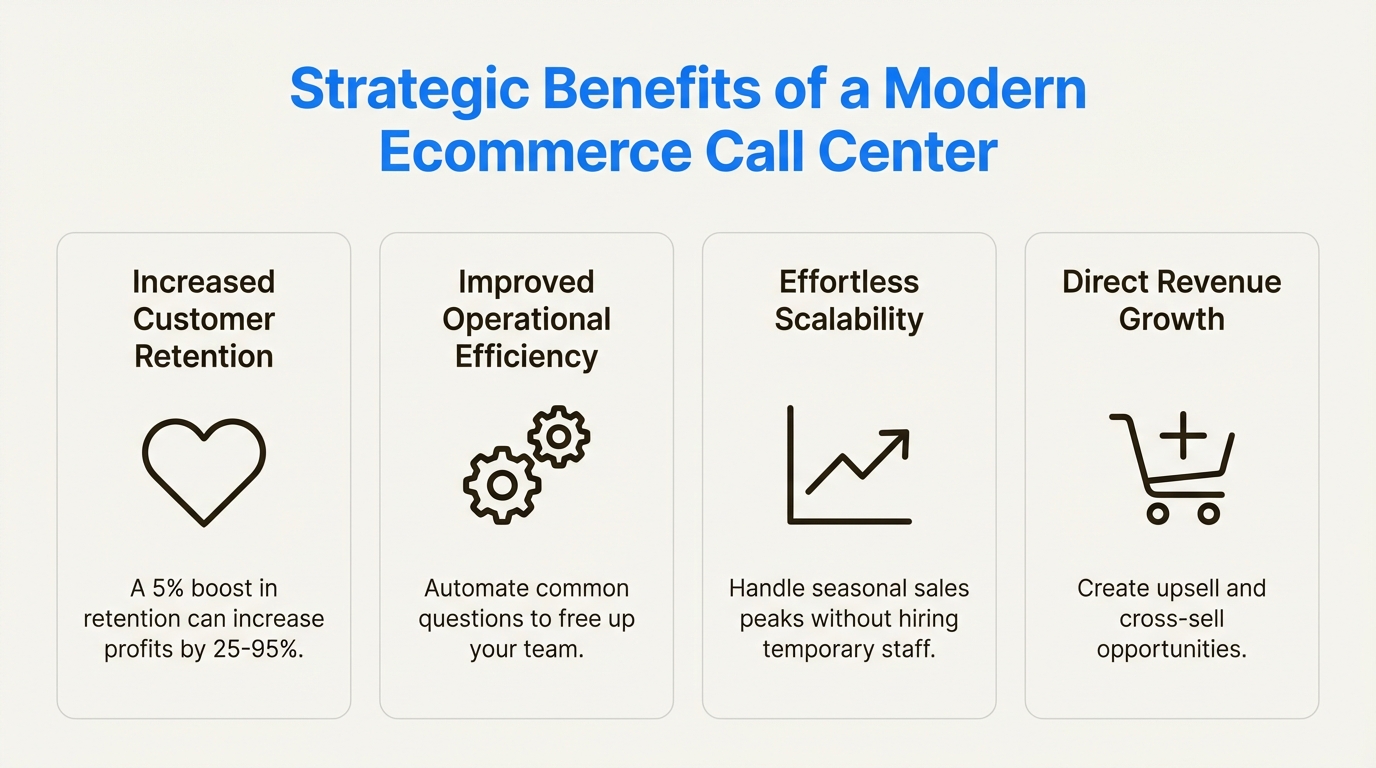
You also get improved operational efficiency. When common questions are automated, your team is free to work on bigger-picture tasks like marketing or product development. Plus, you get effortless scalability.
A modern call center can handle a Black Friday sales rush without the stress of hiring and training temporary staff.
Finally, it can lead to direct revenue growth. A positive support call can easily become a sales opportunity, as a good agent (human or AI) can suggest relevant upsells or cross-sells.
An AI phone representative like the AI agent from Ringly.io is designed to handle these tasks 24/7, providing a support system that scales with your business.
Build vs outsource: the ecommerce dilemma
Many e-commerce companies feel stuck between two bad options. Building a customer service team in-house is expensive and hard to scale. However, hiring an overseas call center often leads to robotic customer interactions and low brand loyalty.
What to look for in an ecommerce contact center
A top-tier retail contact center solution must handle the chaos of online shopping. When looking for an ecommerce call center, prioritize these center software features:
- Real-time sync with Shopify to see online transactions.
- Omnichannel support to bridge live chat and voice.
- Advanced routing to reduce call duration.
- Crystal-clear call quality for every inbound call.
Why Ringly is the best solution for ecommerce brands
Ringly is the leading ai center for e-commerce. It isn't just a center software; it's a complete ecommerce call center replacement that scales with your call volume.
Ringly vs Gorgias voice
While Gorgias is a great help desk, their voice features are often an afterthought. Ringly is a dedicated call center software built specifically for e-commerce. Ringly provides deeper analytics and more robust ivr flows that personalize the customer journey in ways Gorgias cannot.
Editor’s note: Want to hear some sample calls made for your Shopify store?
- Just paste your store URL
- Get sample calls in under 20 seconds (no email required)
- Listen to demo calls for my store
Ringly vs Callzilla
Callzilla is an experienced ecommerce call center, but they still rely on human call center agents. Ringly’s ai handles call handling 70% cheaper than traditional call center companies. While Callzilla takes weeks to hire, Ringly's cloud contact center is ready in minutes.
| Feature | Ringly AI | Callzilla (Outsourced) |
|---|---|---|
| Setup Time | Instant | 4-8 Weeks |
| Cost per Inquiry | Fixed/Low | High Hourly Rates |
| Scalability | Unlimited | Limited by Headcount |
| Shopify Data | Native Integration | Manual Lookup |
How AI improves customer experience
Using ai in your inbound call center does more than just save money. It allows you to optimize your entire customer service operation.
Improve customer satisfaction with automation
An ai center solution can handle a high-volume inquiry about shipping or returns without a human. This ensures your e-commerce customer gets an answer instantly. Ringly uses call recording and sentiment analytics to ensure every interaction stays on-brand.
Omnichannel support
Your ecommerce customer service should be seamless. Whether a customer starts on live chat or makes an inbound call, using tools like Gorgias and Ringly together will mean true omnichannel support for your store. This contact center software ensures that your customer interactions are always informed by previous online shopping history.
The future of the ecommerce industry
By 2026, e-commerce businesses often realize that they aren't just selling products, they are selling a customer experience. Choosing an ai center for ecommerce allows you to focus on growth while the ai handles the call center operations.
Call centers can play a huge role in your cx strategy. Don't settle for a basic answering service. Choose a contact center that understands the ecommerce industry.
FAQs
Does Ringly offer a guarantee? Yes. You don’t pay until we resolve at least 65% of your calls autonomously.
Does Ringly work with my current helpdesk? Yes. Ringly can escalate tickets to your existing helpdesk, and you have full control over what gets escalated. Ringly works with platforms like Gorgias, Richpanel, and others.
How does the AI handle order tracking? Our AI pulls data directly from Shopify to answer "where is my order" questions on every live phone call.
Can I forward my existing number? Absolutely. You can use call forwarding to send your business calls to your team.
How do I get started? We offer a free trial so you can start without any risk.
For more on guest post submission checklist, ecommercecoffeebreak.com has a helpful overview.
For more on multichannel customer support, clickpost.ai has a helpful overview.
For more on how to improve customer service in ecommerce, clickpost.ai has a helpful overview.
For more on ecommerce ai automation, bigcommerce.com has a helpful overview.
For more on ecommerce call center, hackmd.io has a helpful overview.
For more on ecommerce call center, chatonbo.com has a helpful overview.
Frequently Asked Questions
What should I look for when choosing the best ecommerce call center services for a small business?
Small brands need a call center for ecommerce that is simple to start. Look for a call center service that fits your specific business needs. The best ecommerce call center services offer a clear way to handle customer calls. You want a call center solution that helps you grow. This allows your ecommerce business to deliver exceptional customer care without hiring too many people.
How do the best ecommerce call center services integrate with Shopify?
A professional ecommerce call center connects directly to your store. This allows the center team to see order data in real-time. It helps the customer service team answer questions about shipping or returns fast. This call center solution for ecommerce makes the call center process smooth. When you use an e-commerce call center with deep links to Shopify, you improve customer trust. It helps you meet customer expectations for fast and accurate help.
Are the best ecommerce call center services fully automated or do they use humans?
Most e-commerce companies use a mix of both. You can use an AI call center for e-commerce to manage common inbound call tasks. This improves the overall customer service experience. For very hard issues, a human customer support team is still the best choice. This hybrid call center customer service approach leads to higher customer satisfaction. It ensures that every customer gets exceptional service every time.
What is the typical cost for an e-commerce call center?
The price for a call center for e-commerce can change based on the service providers. Some call center outsourcing company options charge for each agent. Other call center software tools use a flat fee based on use. This ecommerce call center outsourcing approach is good for a growing e-commerce business. It helps you manage high call volumes during big sales. This helps you increase customer satisfaction while keeping your costs low.
Can an e-commerce call center handle support in multiple languages?
Yes, a top-notch call center can help shoppers in many languages. This is very important in the e-commerce industry today. A specialized customer service tool like Ringly.io handles calls in over 30 languages. This helps you provide customer support that feels personal to everyone. It is a key part of the success of ecommerce when selling to people around the world. It helps you create exceptional customer experiences for a global market.
How can I improve customer satisfaction with my center software?
You can improve customer satisfaction by giving fast and helpful answers. Use your contact center software to track how long a call takes. A high-quality customer service setup means customers never wait on hold. This provides a superior customer feeling and better customer experience. You can also use personalized customer service to make people feel special. Using an ecommerce customer service call center helps you meet customer needs. This is the best way to deliver exceptional customer help to every shopper.
Why should I outsource your ecommerce call center needs?
You should outsource your ecommerce call center to save your team time. Hiring a call center outsourcing partner means you do not have to train new staff. You should outsource to keep your focus on sales. Many brands choose to outsource ecommerce tasks like email support. When you outsource, your online business can grow without stress. To outsource effectively, pick a partner that knows the e-commerce industry well. It is easy to outsource your phone lines to an outsourced call center.
How do I choose the right call center for ecommerce?
Look for a provider that offers contact center services made for retail. You need an ecommerce contact center that can handle customer inquiries 24/7. Check if they offer a center solution that fits your budget. Some call center agents work in an inbound call center and handle many things at once. Other outsourced call center solutions use AI to improve customer loyalty. Always check the call flow to ensure a seamless customer journey. This will help you increase customer satisfaction.
What are the benefits of call center for e-commerce automation?
Automation handles common customer calls like order tracking. This type of call center technology helps your service team stay calm. It ensures a high first call resolution rate for simple questions. Using a call center solution for ecommerce reduces the work for your customer support team. This helps your e-commerce business save money and time. AI helps you handle customer needs even when you have high call volumes. This is key for the success of ecommerce brands today.
How does ecommerce customer service outsourcing help with sales?
Good customer service outsourcing can help with sales and customer growth. When you deliver exceptional customer experiences, people buy more. An ecommerce customer support team can answer product questions to help a buyer. This leads to better customer interactions and higher customer trust. By using a professional ecommerce call center, you ensure every caller gets help. This high-quality customer service keeps your store running well. It helps you deliver exceptional customer results every day.
Is it hard to set up an e-commerce call center services plan?
Setting up a solution for ecommerce can be very fast. An AI tool for e-commerce can be live in minutes. Traditional call center service options might take longer. If you outsource ecommerce customer service, you need to share your store rules. This helps the customer service agents give the right help. When you outsource your e-commerce customer support, you get more time for marketing. It is a great way for e-commerce business owners to scale up.
What should my customer service team focus on?
Your customer service team should focus on complex sales and customer problems. They should provide personalized customer service that makes your brand stand out. While AI handles the inbound call tasks, humans build customer trust. This customer service experience is what keeps shoppers coming back. Using a specialized customer service approach ensures you meet customer expectations. It is the best way to grow your online business in 2026.
Inbound vs outbound ecommerce call centers: what's the difference?
Most stores need one more than the other, so it's worth being clear:
- Inbound — answering customer calls: order status, returns, product questions, complaints. This is where most ecommerce support volume sits.
- Outbound — the store calling customers: abandoned-cart recovery, delivery confirmations, win-back, review requests.
Pricing models vary (per-minute, per-agent, or per-resolution), so compare the all-in cost for your actual call volume rather than the headline rate. The fastest-growing option is AI call handling that resolves routine inbound calls automatically and escalates the rest.
Ecommerce call centers: common questions
How much does an ecommerce call center cost?
It depends on the model: per-minute, per-agent, or per-resolution pricing, plus whether you need 24/7 coverage. Outsourced human call centers cost far more per interaction than AI handling for routine, repetitive calls.
What does an ecommerce call center handle?
Mostly inbound support: order status (WISMO), returns and refunds, product questions, and complaints. Some also run outbound campaigns like abandoned-cart recovery and delivery confirmations.