
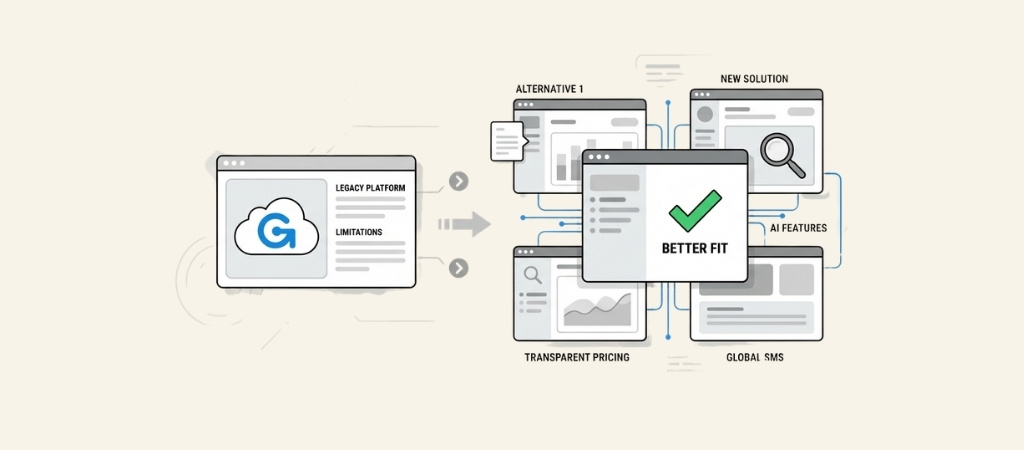
Most teams don't leave GoTo Connect because they hate it. They leave when their business outgrows what the platform was designed to handle.
Limited integrations, SMS restrictions, and pricing complexity push growing companies to look elsewhere.
The good news? The VoIP market has evolved significantly.
Whether you need better AI features, more affordable pricing, or a completely different approach to phone support, there's likely a better fit for your specific situation.
Let's look at seven GoTo Connect alternatives worth considering in 2026, ranging from traditional VoIP providers to AI-powered solutions that change how you think about phone support.
Editor’s note: Want to hear some sample AI support calls made for your Shopify store?
- Just paste your store URL
- Hear sample calls for your store (no email required)
- Listen to demo calls for my store
What to look for in a GoTo Connect alternative
Before we compare specific tools, let's establish what matters most when switching phone systems.
Pricing transparency tops the list for many teams. GoTo Connect requires contacting sales for quotes, which creates friction during evaluation. Most alternatives now show clear pricing upfront.
Integration ecosystem matters more than ever. Your phone system should connect seamlessly with your CRM, helpdesk, and other tools. GoTo Connect's limited integration options force manual data entry that wastes time.
Mobile reliability is non-negotiable for remote teams. GoTo Connect users report call drops and lagging notifications on mobile apps, undermining productivity.
AI features separate modern platforms from legacy ones. Real-time transcription, call summaries, and automated insights save hours of manual work.
SMS capabilities vary widely. GoTo Connect limits SMS to US and Canada only, with toll-free numbers unable to send texts at all. If you serve global customers or use SMS marketing, this is a dealbreaker.
Quick comparison table
| Provider | Starting Price | Best For | Key Differentiator | Free Trial |
|---|---|---|---|---|
| Quo | $15/user/mo | Growing teams | Modern UI + Sona AI | 7 days |
| RingCentral | ~$20/user/mo | Enterprises | Microsoft Teams integration | 14 days |
| Dialpad | $15/user/mo | Sales teams | Best-in-class AI transcription | 14 days |
| Nextiva | ~$15/user/mo | Omnichannel needs | True omnichannel platform | 7 days |
| Aircall | $30/user/mo | High-volume sales | 100+ integrations | Demo only |
| Unitel Voice | $9.99/mo flat | Solopreneurs | Most affordable flat rate | 30 days |
| Ringly | From $99 a month (50 conversations included) | E-commerce | AI resolves up to 90% of calls | Free to try |
1. Quo
.jpeg)
Quo (formerly OpenPhone) brings a modern approach to business phone systems. The Y Combinator-backed company recently raised $105 million and serves over 90,000 businesses.
Pricing:
| Plan | Monthly | Annual | Key Features |
|---|---|---|---|
| Starter | $19/user | $15/user | Unlimited US/Canada calling, voicemail transcripts |
| Business | $33/user | $23/user | AI summaries, CRM integrations, auto recording |
| Scale | $47/user | $35/user | Priority support, dedicated onboarding |
What makes it different:Quo includes Sona, an AI agent that answers calls 24/7. Every plan includes 1,000 free automation credits (10 AI-handled calls). Beyond that, you purchase credit tiers starting at $25/month for 40 calls.
The platform emphasizes collaboration with shared numbers, internal threads, and team messaging. HubSpot, Salesforce, Slack, and Zapier integrations come standard on Business and Scale plans.
Pros:
- Clean, modern interface
- AI agent included on all plans
- Strong collaboration features
- Transparent pricing
Cons:
- SMS requires Campaign Registry registration ($19.50 one-time)
- No hardware support (softphone only)
- International calling requires add-on
Best for: Growing teams wanting modern collaboration features with built-in AI capabilities.
2. RingCentral

RingCentral targets enterprises needing a mature, reliable communications platform. The company emphasizes its 99.9% uptime SLA and deep Microsoft ecosystem integration.
Pricing: Based on available data, plans start around $20/user/month for Core, $35 for Advanced, and $45 for Ultra. Contact sales for current pricing.
What makes it different:RingCentral's Microsoft Teams integration stands out. If your organization lives in Microsoft 365, this creates a seamless workflow. The platform also offers extensive global calling capabilities and contact center add-ons for larger operations.
The AI features include conversation intelligence, real-time analytics, and automated call summaries. However, SMS remains limited on lower tiers (around 25 messages monthly on Core plans).
Pros:
- Mature, enterprise-grade platform
- Excellent Microsoft integration
- Global calling capabilities
- Strong reliability track record
Cons:
- Higher pricing than competitors
- Limited SMS on entry plans
- Can feel complex for small teams
Best for: Enterprises already invested in the Microsoft ecosystem.
3. Dialpad

Dialpad built its reputation on AI-first communications. The platform offers the best real-time transcription and conversation intelligence in this comparison.
Pricing:
| Plan | Price | Key Features |
|---|---|---|
| Standard | $15/user/mo | HD calls, AI meetings, real-time transcripts |
| Pro | $25/user/mo | CRM integrations, 24/7 support |
| Enterprise | Custom | SSO, unlimited offices |
What makes it different:Dialpad's AI Recaps automatically generate call summaries with action items. Real-time sentiment analysis helps managers coach sales teams during live calls. The transcription accuracy impresses even on complex technical calls.
The platform supports numbers in 50+ countries, making it suitable for international operations. Google Workspace integration works particularly well.
Pros:
- Industry-leading AI transcription
- Clean, intuitive interface
- Mobile-first design
- Real-time coaching features
Cons:
- SMS limited to US, Canada, UK, Australia
- Fewer integrations on Standard plan
- Enterprise features require upgrade
Best for: Sales teams wanting AI coaching and accurate transcription.
4. Nextiva

Nextiva positions itself as a true omnichannel platform, combining voice, video, SMS, chat, and social messaging in one interface.
Pricing: Plans start around $15/user/month for Essential, $25 for Professional, and $35 for Enterprise.
What makes it different:Nextiva's omnichannel approach means customers can reach you through their preferred channel without switching platforms. AI voice intelligence analyzes conversations for insights. Visual call flows make routing setup intuitive.
The platform emphasizes reliability, with multiple data centers and automatic failover. For businesses wanting everything in one place, this consolidation reduces tool sprawl.
Pros:
- True omnichannel capabilities
- Strong reliability infrastructure
- Visual call flow builder
- Comprehensive feature set
Cons:
- Can overwhelm smaller teams
- Pricing jumps with features
- Learning curve for full utilization
Best for: Businesses wanting unified communications across all channels.
5. Aircall

Aircall focuses specifically on sales and support teams needing high call volumes and extensive integrations. The platform requires a 3-user minimum.
Pricing:
| Plan | Price | Minimum Users | Key Features |
|---|---|---|---|
| Essentials | $30/user/mo | 3 | 1 number, unlimited US/Canada calls, 3 teams |
| Professional | $50/user/mo | 3 | Unlimited teams, unlimited recordings |
| Custom | Contact sales | 25 | Analytics+, custom features |
Additional numbers cost $6/month each.
What makes it different:Aircall's 100+ integrations include deep CRM connections with Salesforce, HubSpot, and Pipedrive. The power dialer helps sales teams work through call lists efficiently. AI Assist provides real-time suggestions during calls.
The Shopify connector particularly interests e-commerce businesses, enabling order lookup and customer context during calls.
Pros:
- Excellent CRM integrations
- Built for high-volume calling
- Power dialer included
- Strong analytics
Cons:
- 3-user minimum
- Higher starting price
- No free trial mentioned
Best for: High-volume sales teams and e-commerce operations.
6. Unitel Voice
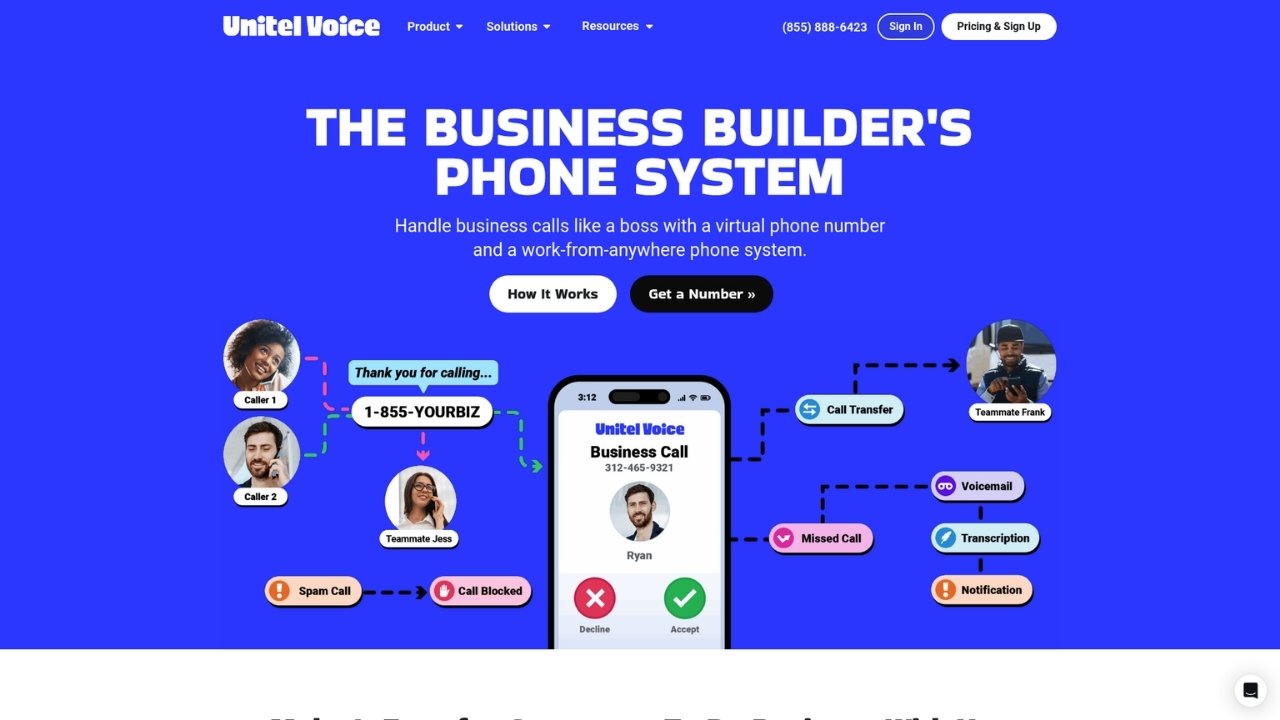
Unitel Voice takes a different approach with flat-rate pricing rather than per-user fees. This makes it the most affordable option for solopreneurs and very small teams.
Pricing:
| Plan | Price | Minutes | Users | Key Features |
|---|---|---|---|---|
| Start-Up | $9.99/mo | 500 | 3 | Mobile app, call forwarding |
| Unlimited | $24.99/mo | Unlimited | Unlimited | Mobile app only |
| Office | $29.99/mo | Unlimited | 3 + $9.99/additional | Desktop softphone, desk phones |
| Office-Max | $69.99/mo | Unlimited | 10 + $9.99/additional | All Office features |
What makes it different:The flat-rate model means your costs don't scale linearly with team size. Every plan includes a free professional voice recording from their studio. USA-based live support comes standard.
Office plans add desktop softphones and physical desk phone support, rare at this price point. The 30-day risk-free trial exceeds industry standards.
Pros:
- Most affordable option
- Flat-rate pricing (not per-user)
- Free professional voice recording
- USA-based support
Cons:
- Limited advanced features
- Fewer integrations
- 500-minute cap on Start-Up plan
Best for: Solopreneurs and small teams on tight budgets.
7. Ringly

Ringly represents a fundamentally different category: AI phone agents that handle calls autonomously rather than just routing them. This isn't traditional VoIP. It's automated phone support.
Pricing:
| Plan | Price | Included | Key Features |
|---|---|---|---|
| Pay per call | $99 a month | 50 conversations, then $1.99 each | Seth on your support line 24/7; spam, hang-ups and wrong numbers are free |
Spam, hang-ups and wrong numbers are free. Add-ons include dedicated Slack channel ($299/mo) and custom integrations (from $500).
What makes it different:the AI, Ringly's AI phone support rep, resolves up to 90% of calls without human intervention. The platform integrates natively with Shopify, enabling order lookup, returns processing, and tracking updates automatically.
Setup takes under 1 hour. The AI speaks 30 languages and escalates complex calls to your team when needed. You only start paying after The AI resolves 65% of calls over your first 100 calls within 21 days.
Pros:
- Handles calls without human agents
- Native Shopify integration
- 40 language support
- quick setup
- Unique "pay for results" model
Cons:
- Different paradigm from traditional VoIP
- Per-minute pricing (not unlimited)
- Shopify-focused (other platforms via API)
Best for: E-commerce stores wanting to automate phone support and reduce agent headcount.
How to choose the right GoTo Connect alternative
Your choice depends on team size, budget, and what you're actually trying to accomplish.
Small teams and solopreneurs: Unitel Voice offers unbeatable value at $9.99/month flat. Quo provides more modern features at $15/user if you have a few team members.
Growing businesses (10-50 employees): Dialpad and Nextiva offer the best balance of features and scalability. Dialpad wins for AI transcription. Nextiva wins for omnichannel needs.
Enterprises: RingCentral remains the safe choice for large organizations, especially Microsoft shops. The reliability and compliance features justify the premium.
High-volume sales or support: Aircall's power dialer and CRM integrations make it purpose-built for this use case. The 3-user minimum keeps it out of reach for smaller operations.
E-commerce automation: Ringly occupies a unique position. If you want to reduce human agent workload rather than just equip them better, the AI-first approach fundamentally changes your cost structure.
Making the switch from GoTo Connect
Migrating phone systems requires planning beyond just picking a new provider.
Number porting typically takes 1-2 weeks. Most providers handle this free, but keep GoTo Connect active until porting completes to avoid downtime.
Trial periods let you test with a subset of your team. Run parallel systems during evaluation rather than cutting over immediately.
Training varies by platform complexity. Unitel Voice and Quo require minimal training. RingCentral and Nextiva need more structured onboarding.
Consider the paradigm shift. Traditional VoIP alternatives (the first six options) improve how humans handle calls. Ringly changes whether humans need to handle most calls at all. That's a bigger decision than feature comparison.
Start with the right phone solution for your business
GoTo Connect served its purpose, but better options exist for most teams in 2026. The key is matching the tool to your actual needs rather than just finding a similar replacement.
If you want traditional VoIP with better features, Quo and Dialpad lead their respective categories. For enterprise reliability, RingCentral remains solid. For budget-conscious small teams, Unitel Voice delivers surprising value.
If you're ready to rethink phone support entirely, try Ringly's AI phone agent for free. The AI handles order lookups, returns, and common questions automatically, escalating only when necessary. For e-commerce stores drowning in repetitive calls, this approach often proves more cost-effective than hiring additional agents.
The best alternative isn't necessarily the one with the most features. It's the one that solves your specific phone support problems with the least friction.
Frequently Asked Questions
What are the main reasons businesses look for GoTo Connect alternatives?
The most common complaints include limited integration options, SMS restricted to US and Canada only, no transparent pricing (requires sales contact), basic analytics on lower tiers, and mobile app reliability issues. Teams also outgrow the platform as they scale.
Which GoTo Connect alternative offers the best AI features?
Dialpad leads for real-time transcription and conversation intelligence. Quo includes Sona, an AI agent that answers calls on all plans. Ringly takes a different approach with the AI, an AI that resolves calls autonomously rather than just assisting humans.
Are there affordable GoTo Connect alternatives for small businesses?
Unitel Voice starts at $9.99/month flat (not per-user), making it the most affordable option for solopreneurs. Quo and Dialpad both start at $15/user/month for teams needing more features.
How does GoTo Connect pricing compare to alternatives?
GoTo Connect doesn't publish transparent pricing, requiring sales contact. Most alternatives show clear pricing upfront. Entry-level plans range from $9.99/month (Unitel Voice) to $30/user/month (Aircall).
Can I keep my existing phone number when switching from GoTo Connect?
Yes, all major alternatives support number porting. The process typically takes 1-2 weeks and is usually free. Keep GoTo Connect active during porting to avoid service interruption.
Which GoTo Connect alternative works best for e-commerce businesses?
Aircall offers a Shopify connector for order lookup during calls. Ringly goes further with native Shopify integration that lets the AI handle order status, returns, and tracking automatically without human involvement.