
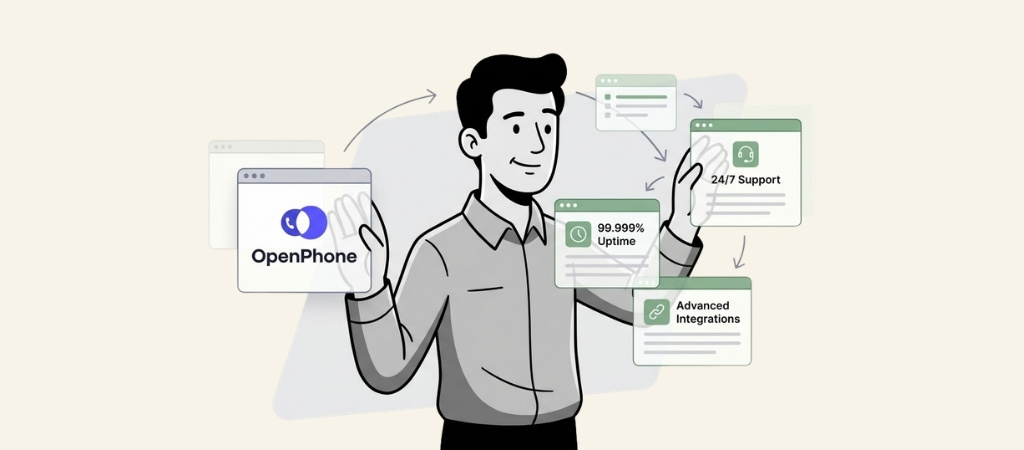
OpenPhone has been a popular choice for small businesses needing a simple business phone system.
But in 2025, the company rebranded to Quo, and many users started looking elsewhere.
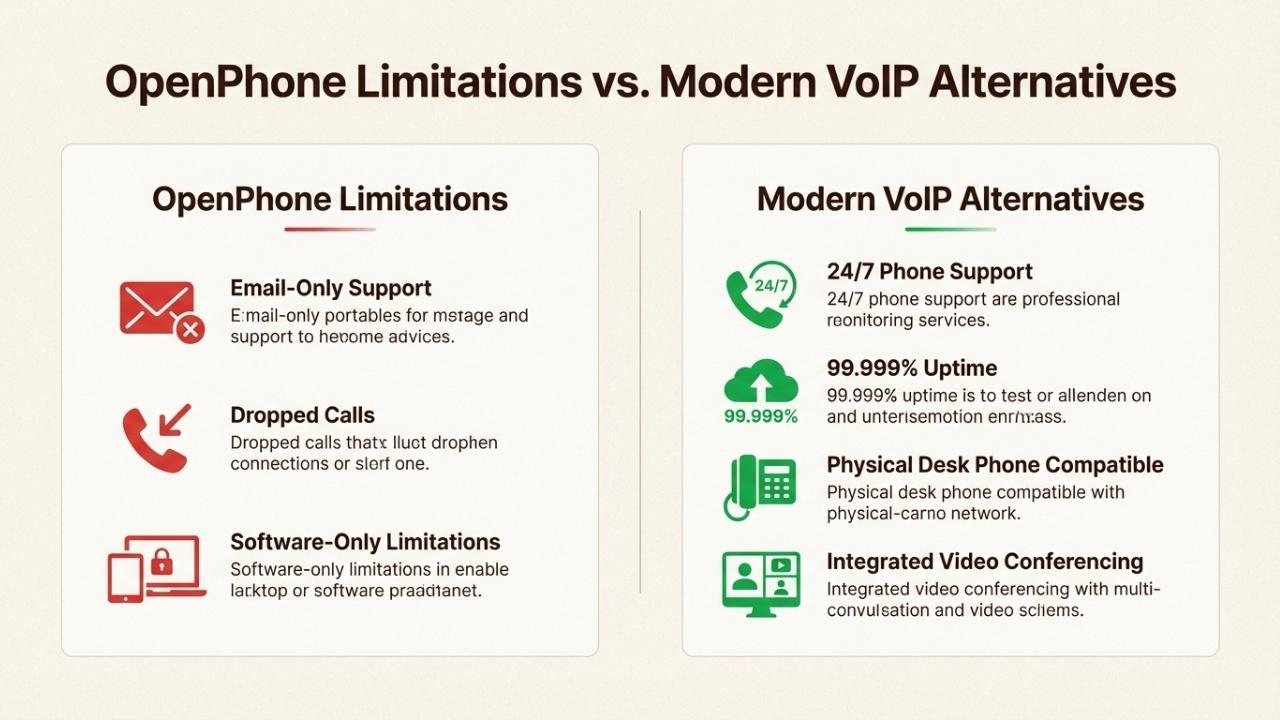
The complaints are consistent: email-only support when your phones are down, dropped calls that frustrate customers, and missing features as you grow.
If you're searching for something better, you're not alone.
We've tested and compared the top OpenPhone alternatives to help you find a phone system that actually fits your business needs.
Editor’s note: Want to hear some sample AI support calls made for your Shopify store?
- Just paste your store URL
- Get sample calls in under 20 seconds (no email required)
- Listen to demo calls for my store
What is OpenPhone (Quo)?
OpenPhone, now called Quo, is a cloud-based VoIP phone system designed for startups and small teams. It combines business calling, SMS messaging, and a shared inbox into one app. You get local or toll-free numbers, contact management, and basic integrations with tools like Slack and HubSpot.
Pricing starts at $15 per user per month, which looks attractive on paper. But here's the problem: when you need help, you're stuck submitting email tickets. When your phone system is down and customers can't reach you, waiting for an email response isn't just frustrating. It's costing you business.
Users also report frequent call quality issues, buggy features, and no support for physical desk phones. For growing businesses, these limitations become dealbreakers fast.
How We Evaluated These OpenPhone Alternatives
We compared each alternative across the criteria that matter most when you're switching phone systems:
- Support quality: Can you call someone when things break?
- Reliability: What's the uptime guarantee?
- Features: Does it include video, advanced routing, and integrations?
- Pricing transparency: Are there hidden fees or usage limits?
- Scalability: Will it grow with your business?
Every option on this list solves at least one major OpenPhone limitation. Some solve them all.
Comparison Table: OpenPhone Alternatives at a Glance
| Provider | Starting Price | Best For | Key Advantage |
|---|---|---|---|
| Nextiva | $20/user/mo | Growing businesses | 24/7 phone support, 99.999% uptime |
| RingCentral | $25/user/mo | Enterprises | 330+ integrations, desk phone support |
| Dialpad | $15/user/mo | AI features | Real-time transcription, AI coaching |
| Grasshopper | $14/mo | Solopreneurs | Unlimited users, flat-rate pricing |
| Google Voice | $10/user/mo | Google Workspace teams | Seamless integration, lowest cost |
| Aircall | $30/user/mo | Sales/support teams | 100+ integrations, call center features |
| Ringly.io | $349/mo | E-commerce automation | AI phone agent, 24/7 availability |
The 7 Best OpenPhone Alternatives
1. Nextiva

Nextiva is the logical upgrade for businesses outgrowing OpenPhone. It's a unified communications platform that combines business phone, video conferencing, team chat, and SMS in one application.
The standout difference? Nextiva offers 24/7 phone support on all plans. When your phones are down, you can actually call someone for help. That's a major improvement compared to OpenPhone's email-only support.
Key features:
- Unlimited voice calling in the US and Canada
- HD video meetings with up to 200 participants
- Multi-level auto attendant (IVR) for professional call routing
- Call queues and skills-based routing
- Mobile and desktop apps
- CRM integrations with Salesforce, HubSpot, and Microsoft Dynamics
Pricing:
| Plan | Annual Price | Key Features |
|---|---|---|
| Digital | $20/user/mo | Live chat, social media management (no phone) |
| Core | $30/user/mo | Phone system, video, team chat, basic IVR |
| Power Suite | $35/user/mo | Advanced routing, AI tools, analytics |
| Super Suite | $50/user/mo | Call center features, advanced analytics |
Source: https://www.nextiva.com/pricing
Why it's better than OpenPhone:
- 24/7 phone, chat, and email support (not just email tickets)
- 99.999% uptime SLA (less than 6 minutes downtime per year)
- Full desk phone support (OpenPhone is software-only)
- Video conferencing included (OpenPhone lacks this entirely)
Best for: Growing businesses that need reliability and human support when issues arise.
2. RingCentral

RingCentral is the most feature-complete option on this list. With over 330 integrations and enterprise-grade capabilities, it's built for businesses that need their phone system to connect with everything else they use.
The RingEX platform unifies calls, meetings, and messaging with AI-powered features like real-time transcription and automated summaries. If your team lives in Salesforce, HubSpot, or Zendesk, RingCentral's deep integrations will save hours of manual work.
Key features:
- Unlimited domestic calling (US and Canada)
- HD video meetings up to 200 participants
- 330+ app integrations including major CRMs
- Multi-level IVR and advanced call routing
- AI Assistant with transcriptions and summaries
- Desk phone rentals and support
- Call recording (on-demand or automatic)
Pricing:
| Plan | Annual Price | Monthly Price | Key Features |
|---|---|---|---|
| Core | $25/user/mo | $35/user/mo | 100 SMS/user, 100 toll-free min, on-demand recording |
| Advanced | $30/user/mo | $40/user/mo | CRM integrations, 1,000 toll-free min, auto recording |
| Ultra | $40/user/mo | $50/user/mo | 10,000 toll-free min, unlimited storage, device analytics |
Source: https://www.ringcentral.com/pricing
Free trial: 14 days with up to 20 phone lines
Why it's better than OpenPhone:
- Massive integration ecosystem (330+ apps vs OpenPhone's limited options)
- True enterprise reliability with 99.999% uptime SLA
- Physical desk phone support (rentals available)
- Advanced AI features included
Best for: Enterprises and teams that need extensive integrations and advanced features.
3. Dialpad

Dialpad stands out for its AI-first approach to business communications. Every call gets real-time transcription, automatic summaries, and AI-powered coaching. If you want to understand what's happening in your customer conversations without listening to hours of recordings, Dialpad delivers.
The platform includes voice, video, and messaging unified in one interface. But the AI features are what justify the switch from OpenPhone: real-time transcription, sentiment analysis, and post-call summaries that actually capture what was discussed.
Key features:
- AI-powered voice transcription in real-time
- AI Recaps with automatic summaries and action items
- HD video meetings with AI assistance
- Voicemail transcription
- Call analytics and sentiment analysis
- Mobile apps, desktop, and desk phone support
- 50+ countries for local numbers
Pricing:
| Plan | Price | Key Features |
|---|---|---|
| Standard | $15/user/mo | Unlimited calls, AI meetings, real-time transcripts |
| Pro | $25/user/mo | CRM integrations, 24/7 support, multi-office management |
| Enterprise | Custom | SSO, unlimited offices, advanced controls |
Source: https://www.dialpad.com/pricing
Free trial: 14 days
Why it's better than OpenPhone:
- Real-time AI transcription (OpenPhone has no equivalent)
- AI coaching and sentiment analysis
- 24/7 support on Pro plans and above
- 50+ countries for local numbers (vs OpenPhone's limited geographic coverage)
Best for: Sales teams, support teams, and anyone wanting AI-driven insights from their calls.
4. Grasshopper

Grasshopper takes a different approach: flat-rate pricing instead of per-user fees. For small businesses and solopreneurs, this can mean significant savings as you grow.
The platform focuses on simplicity. You get a business phone number, call forwarding, voicemail transcription, and unlimited texting without the complexity of enterprise features you'll never use. Over 400,000 businesses use Grasshopper for this reason.
Key features:
- Local, toll-free, or vanity business numbers
- Unlimited users (on Solo Plus and above)
- Call forwarding to any device
- Business texting included
- Voicemail transcription
- Mobile and desktop apps
- Custom greetings
Pricing:
| Plan | Annual Price | Monthly Price | Includes |
|---|---|---|---|
| True Solo | $14/mo ($168/yr) | $18/mo | 1 user, 1 number, 1 extension |
| Solo Plus | $25/mo ($300/yr) | $32/mo | Unlimited users, 1 number, 3 extensions |
| Small Business | $55/mo ($660/yr) | $70/mo | Unlimited users, 4 numbers, unlimited extensions |
Source: https://grasshopper.com/pricing
Free trial: 7 days (no credit card required)
Why it's better than OpenPhone:
- Flat-rate pricing (not per-user) saves money as you add team members
- 24/7 support included
- Simpler interface with no unnecessary complexity
- No per-user fees means predictable costs
Best for: Solopreneurs, freelancers, and small teams wanting simple, affordable phone service.
5. Google Voice
If your team already lives in Google Workspace, Google Voice is the obvious choice. It integrates seamlessly with Gmail, Calendar, and Meet, giving you a business phone number that works across all your devices.
Google Voice uses AI to block spam calls automatically and transcribe voicemails to text. The interface is familiar if you use other Google products, which means minimal training for your team.
Key features:
- Business phone number across all devices
- Unlimited domestic calling (US and Canada)
- Unlimited US texting
- AI-powered spam blocking
- Voicemail transcription
- Call recording and three-way calling
- Desk phone support
- Gmail and Calendar integration
Pricing:
| Plan | Price | Includes |
|---|---|---|
| Starter | $10/user/mo | Up to 10 users, 14 countries, voicemail transcription |
| Standard | $20/user/mo | Unlimited users, auto attendants, ring groups, on-demand recording |
| Premier | $30/user/mo | Automatic recording, BigQuery reporting, international billing |
Source: https://workspace.google.com/products/voice
Note: Requires Google Workspace subscription (separate cost)
Why it's better than OpenPhone:
- Seamless integration with Google Workspace tools
- AI spam blocking (OpenPhone lacks this)
- 24/7 Google Voice support
- Lower cost for Google Workspace users
Best for: Teams already using Google Workspace who want unified communications.
6. Aircall

Aircall is built specifically for sales and support teams that need their phone system deeply connected to their CRM. With 100+ integrations and call center features like queue management and real-time analytics, it's a step up from basic business phone systems.
The platform requires a minimum of 3 users, so it's not for solopreneurs. But for teams that live in Salesforce, HubSpot, or Zendesk, Aircall's integration depth justifies the higher price point.
Key features:
- Cloud phone system with local/toll-free numbers
- Call center software with IVR and queues
- 100+ integrations including major CRMs
- Call recording (up to 1 year on Essentials, unlimited on Professional)
- Real-time analytics and reporting
- Business SMS/MMS
- Mobile apps for iOS and Android
Pricing:
| Plan | Price | Includes |
|---|---|---|
| Essentials | $30/user/mo | 3 users min, 1 number, unlimited US/Canada calls, basic analytics |
| Professional | $50/user/mo | 3 users min, unlimited teams, advanced analytics, unlimited recording |
| Custom | Contact sales | 25+ users, international calling, Analytics+ |
Source: https://www.aircall.io/pricing
Why it's better than OpenPhone:
- Deep CRM integrations for sales and support workflows
- Call center features like queues and advanced routing
- Real-time analytics (OpenPhone's analytics are limited)
- Better suited for teams managing high call volumes
Best for: Sales teams, support teams, and businesses needing CRM connectivity.
7. Ringly.io

Ringly.io takes a completely different approach from the others on this list. Instead of giving your team phones to answer, the AI (Ringly's AI phone agent) handles customer calls for you.
This isn't a traditional phone system. It's an AI agent that answers calls 24/7, looks up orders, processes returns, answers FAQs, and only escalates complex issues to your human team. For e-commerce businesses, this means phone support without hiring a call center.
Ringly integrates directly with Shopify to pull order information in real-time. When a customer calls asking about their order, the AI can instantly check status, tracking, and delivery details. The AI handles 70-73% of calls without human intervention.
Key features:
- the AI AI agent handles calls 24/7
- Shopify integration for order lookups
- Automated returns and exchange processing
- FAQ handling with knowledge base integration
- Human escalation for complex issues
- Call recordings and transcripts
- Analytics and knowledge gap detection
- 30 languages supported
Pricing:
| Plan | Price | Includes |
|---|---|---|
| Grow | $349/mo | 1,000 minutes, self-learning AI, analytics |
| Enterprise | Custom | 5,000+ minutes, Slack channel, custom integrations |
Source: https://www.ringly.io/pricing
Overage: $0.19/minute for extra minutes
Free trial: 14 days with full features
Why it's different from OpenPhone:
- Fully automated phone support (not a tool for humans to answer phones)
- Handles 70-73% of calls without human intervention
- 24/7 availability without hiring night staff
- E-commerce focused with deep Shopify integration
Best for: E-commerce stores wanting to automate phone support entirely.
Choosing the Right OpenPhone Alternative for Your Business
The best choice depends on your specific situation:
Small business or solopreneur: Grasshopper offers the best value with flat-rate pricing and unlimited users. Google Voice works well if you're already in the Google ecosystem.
Growing team needing reliability: Nextiva gives you 24/7 phone support and 99.999% uptime. When your business depends on phone availability, this matters.
Enterprise with complex needs: RingCentral's 330+ integrations and advanced features justify the cost for larger organizations.
Sales or support team: Aircall's CRM integrations and call center features are built for high-volume calling environments.
AI-focused team: Dialpad's real-time transcription and AI coaching provide insights you can't get elsewhere.
E-commerce automation: Ringly.io replaces your need for a human phone team entirely, handling routine calls automatically.
Which OpenPhone Alternative Will You Choose?
OpenPhone's rebrand to Quo hasn't solved its core problems: limited support, reliability issues, and missing growth features. The alternatives above each solve these problems in different ways.
If you're running an e-commerce business and want to stop worrying about phone support entirely, try Ringly.io free for 14 days. the AI can handle your routine calls while you focus on growing your business.
For traditional phone systems, most providers offer free trials. Test the support quality yourself: call their support line with a question and see how quickly you get a human response. That's often the difference that matters most.
Frequently Asked Questions
What are the best OpenPhone alternatives for small businesses?
Grasshopper and Google Voice are the top choices for small businesses. Grasshopper offers flat-rate pricing with unlimited users, while Google Voice integrates seamlessly with Google Workspace at just $10 per user per month.
Which OpenPhone alternatives offer 24/7 phone support?
Nextiva, RingCentral, and Dialpad all offer 24/7 phone support on most plans. This is a major advantage over OpenPhone, which only provides email support. When your phone system is down, being able to call for immediate help is crucial.
Are there any free OpenPhone alternatives?
Google Voice offers a free personal plan for individuals, but business features require a paid subscription. Most business phone systems, including Grasshopper, Nextiva, and RingCentral, offer free trials ranging from 7 to 14 days.
What OpenPhone alternatives work best for sales teams?
Aircall and Dialpad are the best choices for sales teams. Aircall offers deep CRM integrations with Salesforce and HubSpot, while Dialpad provides real-time AI coaching and transcription that helps sales reps improve their calls.
Can I keep my existing phone number when switching from OpenPhone?
Yes, all major alternatives including Nextiva, RingCentral, Grasshopper, and Google Voice support number porting. The process typically takes 7-10 business days and most providers handle the transfer at no cost.
Which OpenPhone alternatives include video conferencing?
Nextiva, RingCentral, and Dialpad all include video conferencing in their base plans. OpenPhone lacks video entirely, so if you need unified communications (phone + video + messaging), these alternatives are better choices.
Also read: