

The best Google Voice alternatives are OpenPhone, Dialpad, Grasshopper, RingCentral, and 8x8 for business calling, plus Ringly.io if you want an AI agent that answers every call instead of just routing it. Choose based on what Google Voice cannot do for you: toll-free numbers, international texting, shared inboxes, or CRM integration.
Google Voice works fine when you're just starting out. It is free for personal use and cheap for business. But most teams outgrow it quickly.
The problems start piling up. You cannot get toll-free numbers. Texting only works for US customers.
There are no shared team inboxes, so everyone works in silos. And if you need to integrate with your CRM, you are out of luck.
If you are hitting these limits, it is time to look at alternatives. This guide compares 7 of the best Google Voice alternatives for business, from full-featured UCaaS platforms to AI-powered phone agents.
Editor’s note: Want to hear some sample AI support calls made for your Shopify store?
- Just paste your store URL
- Get sample calls in under 20 seconds (no email required)
- Listen to demo calls for my store
What is the best Google Voice alternative?
Before diving into the options, let's break down what matters when choosing a replacement.
Shared numbers and team collaboration. Google Voice assigns numbers to individuals.
Modern business phone systems let multiple people share a number, see the same inbox, and collaborate on responses.
Call routing and IVR. You want auto-attendants that can route calls to the right department without human intervention.
Look for visual IVR builders that do not require IT help.
CRM integrations. Your phone system should talk to your existing tools. Native integrations with Salesforce, HubSpot, and Zendesk save hours of manual data entry.
Pricing model clarity. Some providers charge per user, which gets expensive fast. Others offer flat-rate pricing. Understand the total cost before committing.
Compliance requirements. If you are in healthcare, you need HIPAA compliance. For business texting, A2P 10DLC registration matters. Not all providers support these.
Top 7 Google Voice alternatives
Here is how the leading alternatives compare at a glance.
| Provider | Starting Price | Best For | Key Features | Free Trial |
|---|---|---|---|---|
| RingCentral | $20/user/month | Teams needing collaboration | Video for 200, multi-level IVR, AI transcription | 14 days |
| OpenPhone | $15/user/month | Startups needing shared numbers | Shared inbox, HubSpot integration, AI summaries | 7 days |
| Grasshopper | $14/month | Freelancers and solopreneurs | Flat rate, toll-free numbers, extensions | 7 days |
| Dialpad | $15/user/month | Sales and support teams | Real-time AI coaching, sentiment analysis | 14 days |
| Nextiva | $20/user/month | Teams wanting ease of use | Visual IVR, team chat, toll-free included | Varies |
| Ooma Office | $19.95/user/month | Teams needing legacy features | Virtual receptionist, overhead paging | No |
| Ringly.io | $99/mo for the first 50 calls, then $1.99 per call | E-commerce businesses | 24/7 AI agent, order lookups, 40 languages | Try it for free |
1. RingCentral

RingCentral is the most comprehensive option if you want everything in one place. It combines voice, video, messaging, and contact center features into a single platform.
The RingEX platform supports video meetings with up to 200 participants, which is significantly larger than most competitors.
You get multi-level IVR, call queues, and AI-powered call transcription on higher tiers.
Integration is a strength. RingCentral connects natively with Salesforce, HubSpot, Zoho, Microsoft Dynamics, Google Workspace, and Slack.
If your team lives in these tools, the workflow benefits are real.
Pricing starts at $20 per user per month when billed annually for the Core plan. That includes unlimited domestic calling but only 25 texts per user per month.
The Advanced plan at $25 per user adds auto call recording and more integrations. Ultra at $35 per user unlocks the full feature set with 200 texts per user and 10,000 pooled toll-free minutes.
The downside is complexity. RingCentral has a steeper learning curve than simpler alternatives, and the base plan's texting limits are restrictive.
Call recordings are also deleted after 90 days unless you upgrade.
Best for: Teams that need video conferencing, team messaging, and phone in one integrated platform.
2. OpenPhone
.jpeg)
OpenPhone recently rebranded to Quo after raising $105 million in funding. The platform is built specifically for growing teams that need collaboration features around their business phone.
The standout feature is shared numbers. Multiple team members can access the same number, see all conversations in a unified inbox, and collaborate using internal threads. This eliminates the chaos of individual Google Voice numbers that nobody else can see.
Quo integrates with HubSpot, Salesforce, and 8,000+ other apps through Zapier. You also get AI-generated call summaries, scheduled texts, and auto-replies for missed calls.
Pricing is straightforward. The Starter plan is $15 per user per month annually and includes one local or toll-free number per user, unlimited calling and texting to the US and Canada, voicemail transcription, and call recording. Business at $23 per user adds IVR, call transferring, and CRM integrations.
Scale at $35 per user includes dedicated onboarding and priority support.
The main limitation is no video conferencing. If you need video meetings alongside your phone system, you will need a separate tool or choose a different provider.
Best for: Startups and small teams that prioritize collaboration and transparent pricing.
3. Grasshopper

Grasshopper takes a different approach from most competitors. Instead of charging per user, it offers flat-rate pricing based on the number of phone numbers and extensions you need.
This makes Grasshopper particularly attractive for freelancers and small teams. The Solo Plus plan at $25 per month includes unlimited users, one phone number, and three extensions. Compare that to Google Voice, where five users would cost $85 per month including the required Workspace subscription.
You get toll-free, vanity, and local numbers. Features include voicemail transcription, call forwarding, custom greetings, business SMS, and 24/7 live support.
The mobile and desktop apps let you work from anywhere.
The trade-offs are significant. Grasshopper lacks CRM integrations entirely. There is no Zapier connection, no Salesforce sync, no HubSpot integration.
The interface also feels dated compared to newer competitors.
Pricing starts at $14 per month for the True Solo plan with one user, one number, and one extension. Solo Plus at $25 per month adds unlimited users.
Small Business at $55 per month includes four numbers and unlimited extensions.
Best for: Solopreneurs and small teams that want simple phone features at a predictable flat rate.
4. Dialpad

Dialpad leads the pack when it comes to AI-powered features. If you want real-time transcription, coaching, and analytics, this is the platform to beat.
The AI transcription works in real-time, not after the call ends. Managers can see live sentiment analysis, tracking whether customer conversations are trending positive or negative. The AI Live Coach feature pops up helpful cards during calls, guiding agents through objections or complex topics.
For sales teams, AI Scorecards automatically grade calls based on criteria you define. This eliminates the manual work of reviewing recordings for quality assurance.
Dialpad also offers standard VoIP features including IVR, automatic call distribution, business texting, and call recording. The mobile app is particularly well-designed.
Pricing starts at $15 per user per month annually for the Standard plan, which includes unlimited calling, SMS, AI transcription, and basic integrations with G Suite and Office 365. Pro at $25 per user adds CRM integrations with Salesforce, HubSpot, and Zendesk, plus API access. Enterprise pricing is custom and includes 100% uptime SLA.
The Pro plan requires a three-user minimum, which may exclude solo operators. International calling is also more limited than some competitors.
Best for: Data-driven sales and support teams that will use AI coaching and analytics to improve performance.
5. Nextiva

Nextiva focuses on user-friendliness. If you want advanced phone features without a steep learning curve, this platform delivers.
The visual IVR builder lets you create call flows through a drag-and-drop interface. No coding or IT help required. Team chat and video huddles are built in, so you can switch from a call to a video conference seamlessly.
Nextiva includes toll-free numbers on all paid plans, which Google Voice does not offer at all. The contact profiles feature adds CRM-like notes to customer records, giving agents context before they answer.
Pricing varies based on team size, with larger teams getting better per-user rates. The Core plan starts around $20 per user per month and includes voice, SMS, video, auto-attendant, and toll-free minutes. The Engage plan at $25 per user adds advanced analytics and deeper CRM integrations.
Analytics are not as comprehensive as Dialpad or RingCentral. Video meetings are also limited to 250 participants with only 16 on video at once.
Best for: Growing teams that want an intuitive platform without sacrificing essential business phone features.
6. Ooma Office
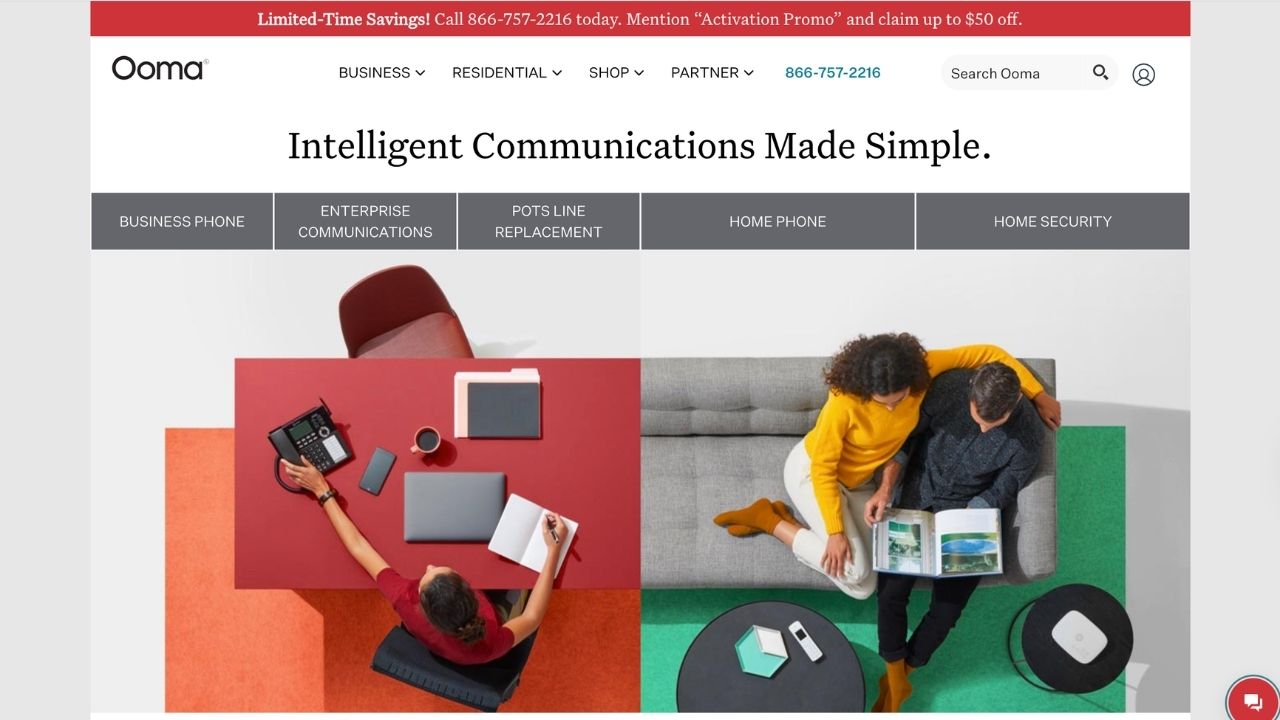
Ooma Office targets businesses that want traditional phone system features delivered through modern VoIP technology.
The platform includes legacy capabilities like overhead paging and virtual fax that many competitors have dropped.
The virtual receptionist can handle complex call routing based on schedules and menus.
Video conferencing supports up to 100 participants, which is respectable for the price point. Mobile and desktop apps are available for iOS, Android, Windows, and Mac.
Pricing is $19.95 per user per month for the Essentials plan with over 50 features including virtual receptionist and mobile app. Pro at $24.95 adds video conferencing, call recording, and voicemail transcription. Pro Plus at $29.95 includes CRM integration and advanced call management.
The limitations are integration depth and texting. Ooma does not connect with as many third-party tools as RingCentral or OpenPhone. Texting also requires an upgrade from the base plan.
Best for: Teams that need traditional business phone features like overhead paging and want straightforward, affordable pricing.
7. Ringly.io

Ringly.io is not a traditional phone system. It is an AI phone agent built specifically for e-commerce businesses, and it represents a fundamentally different approach to handling customer calls.
Instead of just routing calls to humans, the AI (Ringly's AI agent) actually handles them.
It answers questions, looks up orders, processes returns and exchanges, and only escalates to your team when necessary. The platform currently resolves about 73% of calls without human intervention across its 2,100+ Shopify store deployments.
For e-commerce businesses, the integration is deep. the AI pulls order data directly from Shopify, so customers get real-time answers about shipping status and order history. The AI supports 30 languages, making it viable for global stores.
Pricing is based on phone conversations, not users or minutes. Ringly charges per phone conversation (see Ringly's pricing).
This model eliminates per-user fees entirely. Whether you have three team members or thirty, you pay for the minutes you use. For stores with high call volumes, this can mean significant savings compared to per-seat pricing.
The trade-off is focus. Ringly is built for e-commerce, specifically Shopify stores. If you need a general business phone system for consulting, professional services, or B2B sales, this is not the right fit.
Best for: E-commerce businesses, especially Shopify stores, that want to automate repetitive customer calls and scale without hiring more support staff.
How to choose the right Google Voice alternative
With seven solid options, how do you pick the right one? It comes down to your specific situation.
Choose RingCentral if you need video conferencing, team messaging, and phone in one platform and have the budget for it.
Choose OpenPhone if you are a startup or small team that values collaboration features and transparent pricing.
Choose Grasshopper if you are a freelancer or solopreneur who wants simple phone features at a flat monthly rate.
Choose Dialpad if you run a sales or support team that will benefit from AI coaching and real-time analytics.
Choose Nextiva if you want an intuitive platform that your team can start using quickly without extensive training.
Choose Ooma Office if you need traditional phone features like overhead paging and fax at an affordable price.
Choose Ringly.io if you run an e-commerce store and want to automate customer calls rather than just route them.
One more thing to consider: number porting. All of these providers support porting your existing Google Voice number, though the process varies. You will typically need to unlock your number from Google Voice first, which takes a few days. Plan for a brief transition period.
Start automating your business calls today
Google Voice served you well in the early days, but growth demands more. Whether you need better collaboration, AI-powered insights, or full call automation, there is an alternative that fits.
If you run an e-commerce business and want to see what AI phone agents can do, try Ringly.io free for 14 days. The AI handles your calls 24/7, integrates with your Shopify store, and frees your team to focus on complex issues that actually need human attention.
The best phone system is the one your customers never have to wait for.
Frequently Asked Questions
Can I keep my Google Voice number when switching to one of these Google Voice alternatives?
Yes, all the providers listed support number porting. You will need to unlock your number from Google Voice first, which typically takes 3-5 business days. Most providers will walk you through the process during setup.
Which Google Voice alternative is best for a small team on a tight budget?
Grasshopper offers the best value for small teams with its flat-rate pricing. The Solo Plus plan at $25 per month covers unlimited users, while most competitors charge per seat. For per-user pricing, OpenPhone at $15 per user per month is the most affordable option with modern features.
Do any Google Voice alternatives offer AI features for call handling?
Yes, Dialpad offers real-time AI transcription and coaching for sales and support teams. Ringly.io takes this further with a full AI phone agent that handles calls autonomously, resolving about 73% of e-commerce customer inquiries without human intervention.
Are there Google Voice alternatives that work well for international calling?
RingCentral and Nextiva both offer competitive international calling rates. OpenPhone supports global calling and messaging. However, Dialpad has more limited international coverage, so verify the countries you need before choosing.
Which Google Voice alternative integrates best with CRM tools?
RingCentral has the deepest integration ecosystem, connecting natively with Salesforce, HubSpot, Zoho, and Microsoft Dynamics. OpenPhone also offers strong CRM integrations through native connections and Zapier. Dialpad integrates well with CRMs at the Pro tier and above.
Is there a Google Voice alternative that does not charge per user?
Grasshopper uses flat-rate pricing based on phone numbers and extensions, not users. Ringly.io charges based on call minutes included in the plan. Both can be more cost-effective than per-seat pricing for certain team structures.
What is the main difference between traditional VoIP providers and AI phone agents like Ringly.io?
Traditional VoIP providers route calls to humans. AI phone agents like the AI at Ringly.io actually handle the conversation, answering questions and processing requests automatically. This is ideal for repetitive e-commerce calls like order status checks and returns, while humans handle escalations.