


This post in 30 seconds.
- A pet food CS function isn't generic ecommerce support. It runs on five call families nobody else has to handle: diet and allergy questions, recall surges, autoship cancel-saves, feeding transitions, and perishable-delivery issues.
- The autoship cancel call is your single most valuable call. It decides whether a customer keeps buying 8 to 18 more orders or walks. Most pet food brands route it to voicemail.
- Built for founders, COOs, and Heads of CX at $10M-$100M Shopify and Shopify Plus pet food brands running a paid helpdesk with a visible phone number.
Running customer service for a pet food brand is not the same job as running it for a candle store or a t-shirt brand. The product gets eaten. It ships cold. It's on a subscription. And the person calling is upset because their dog won't eat, or scared because they saw a recall headline. That's a different discipline, and most of the advice written about ecommerce CS ignores all of it.
If you run a $10M-$100M pet food brand on Shopify and your phone goes to voicemail after 6 p.m., this playbook is the thing your CS team should be built around. We've launched AI phone agents for 50+ Shopify brands trying to fix exactly this. Book a 30-min call and we'll show you what your pet food line is leaving on the table after-hours.
In this post:
How I built this playbook
I'm Ruben, co-founder of Ringly. I run AI phone support for 50+ Shopify brands, which means I look at pet brand call logs constantly, not as a critic, as the person who has to make the phone work.
For this guide I did two things. First, I called the published phone line of nine direct-to-consumer pet food brands at 8 p.m. on a Tuesday. Four of them rolled straight to voicemail, and one of those four had an active recall going that same week, which is the worst possible time to not pick up. Second, I pulled the call-type breakdown from the pet brands we run, so the routing rules below come from real call patterns instead of a best-practices listicle.
The playbook is organized the way you'd actually build the function: map the calls, find the high-value ones, write the protocols for the hard ones, pick your metrics, do the staffing math, then decide what a human handles and what doesn't. Where pet food differs from generic ecommerce CS, I've called it out, because that's the whole point.
Why pet food customer service is its own discipline
Most CS advice treats every Shopify brand the same. Tickets come in, you answer them fast, you keep CSAT up. Fine for a brand selling phone cases. Useless for a brand selling something a dog eats twice a day.
Pet food sits at the intersection of four things that almost no other category combines: it's ingestible, it's perishable, it's emotional, and it's recurring. Each one creates a call type your team has to be ready for, and the combination is what makes the function hard.
Ingestible means safety questions. "Is this okay for a dog with a chicken allergy?" is a real call, and it's adjacent to a vet question, which your reps are not allowed to answer. Perishable means delivery anxiety with a deadline, because a thawed box of fresh food is a problem today, not next week. Emotional means a meaningful share of your calls involve a sick or dying pet. And recurring means most of your revenue rides on autoship, so a cancel call is a retention event, not a support ticket.
The market context makes this worse, not better. US pet care e-commerce hit $102.3 billion in 2025 and is forecast to reach $147.6 billion by 2030, and the subscription side of that is growing at roughly 17% a year (Mordor Intelligence). More subscribers means more autoship calls, more delivery questions, and a bigger queue every time something goes wrong. The function doesn't get easier as you grow. It gets denser.
If you're already feeling the volume, this is the same problem we map out for pet brands handling autoship and recall calls. The point of the rest of this playbook is to give the volume a shape.
Map your call volume: the pet-food call-type taxonomy
You can't staff or route a function you haven't measured. Before anything else, pull a month of calls and sort them into families. For a typical pet food brand, the breakdown looks roughly like this.
| Call family | Rough share | What it needs | Who should handle it |
|---|---|---|---|
| WISMO / order status / delivery | 30-40% | Tracking lookup, reship if spoiled | Automatable |
| Autoship management (pause, skip, swap, cancel) | 20-30% | Subscription lookup + save flow | Automatable, with a save script |
| Diet / ingredient / allergy questions | 10-15% | Product-data answer, never vet advice | Automatable from the knowledge base |
| Feeding transition / portion guidance | 5-10% | Brand's feeding guide | Automatable, escalate the edge cases |
| Recall / safety | Spikes to 40%+ during an event | Lot lookup + clear script | Mixed: routine automatable, fear escalates |
| Grief / sick pet / end-of-life | 3-8% | A human who slows down | Human, always |
The number that surprises most operators is the first two lines. Between half and two-thirds of pet food calls are WISMO and autoship management, the same questions over and over, and almost none of them need a human to be solved well. That's the repeatable layer Tobi Lütke's "AI before you hire" memo is really about.
TechCraft Studio, a Ringly customer, handles 88% of its calls without a human by routing exactly this kind of routine volume away from the team. The reps still exist. They just stop answering the fiftieth "where's my order" of the day and start handling the calls that actually need judgment.
Once you have the taxonomy, the rest of the playbook is about the families that are either high-value (autoship) or high-risk (recall, diet, grief). Those are where a pet food CS function is won or lost. For the routine layer, the same logic applies as in any ecommerce customer service operation, with WISMO calls leading the volume.
The autoship save call is your most valuable call
Here's the call your function should be optimized around, and the one most pet food brands handle worst.
Autoship is up to 80% of sales at the leading platforms, and Chewy's autoship revenue alone runs over $2 billion a quarter (Mordor Intelligence). When a customer calls to cancel, they're not closing a ticket. They're deciding whether to keep buying 8 to 18 more boxes or to walk to a competitor. The lifetime value sitting on that one call is enormous, and it's time-sensitive, because they're usually calling to cancel before the next box ships and charges them.
A cancel-save call that goes to voicemail doesn't lose a ticket, it loses the whole subscription. And the data on that is brutal. 85% of callers who can't reach a person never call back, and 62% of them switch to a competitor (PCN).
The friction is real even at the brands that should know better. Chewy autoship complaints have climbed through 2025 and into 2026, with a recurring Trustpilot theme of customers spending 30 to 45 minutes on hold only to get transferred and start over. If the category leader leaks subscriptions on hold time, a $20M brand routing cancels to voicemail is leaking far more.
A good autoship flow on the phone does four things, fast:
- Pulls the subscription instantly, so the customer doesn't repeat their order number three times.
- Offers the real alternatives to canceling: pause for a month, skip the next box, change frequency, or swap the recipe. Pet diets shift faster than supplements as the animal ages, so a recipe swap saves more cancels here than in almost any other category.
- Processes the cancel cleanly when the customer means it, without a guilt-trip script that ends up on Reddit.
- Sends an SMS confirmation, so the customer has it in writing and doesn't call back to check.
Want to see how many of your autoship calls are currently hitting voicemail? Book a 30-min call and we'll pull your missed calls live. This is also the engine behind pet brand customer retention, because a saved subscription is retention you didn't have to re-acquire.
A recall protocol your CS team can actually run
Every pet food operator knows a recall is coming eventually. Recalls hit the category 3 to 8 times a year, split between voluntary recalls a brand issues itself and recalls the FDA orders (Pet Food Institute). 2025 alone saw salmonella recalls across Blue Ridge Beef, Raw Bistro, and Viva Raw. In January 2024, the FDA logged 971 pet food complaints in a single month.
Here's the operational trap. A recall surge is unstaffable by definition. You can't predict when it hits, and you can't keep extra reps idle all year waiting for it. So the volume spikes exactly when you have the least slack, and your hold times blow out at the worst possible moment. 60% of callers hang up within 60 seconds on hold (Brightmetrics), which during a recall means scared pet parents giving up and posting about it instead.
It gets worse. During a recall event, roughly half the queue isn't even the recall itself, it's autoship customers trying to cancel before their next box of recalled food ships. So a recall is simultaneously a safety event and a mass cancellation event, landing on a team that's already underwater.
A protocol your team can run during the surge looks like this:
- Lot-number lookup at the front. The first question is always "is my batch affected?" If your knowledge base can check a lot number against the recall list, you answer it in seconds instead of escalating every call.
- A clear "should I keep feeding?" script. Pre-write it with your QA team before you ever need it. Reps should not improvise on safety.
- A fast cancel-or-refund path for the affected lots, so the autoship-cancel wave doesn't clog the line behind the safety calls.
- A hard escalation rule for fear. "My dog is sick" or "my pet ate this" goes to a human immediately, no exceptions.
- After-hours coverage. Recall news breaks on a Friday night as often as a Tuesday morning. A line that's only staffed 9-to-5 misses the first 18 hours of the panic.
The manufacturers' side of recall readiness is well documented. The customer-call side, the part where 800 scared people dial your number in an afternoon, is the part nobody staffs for. That's the gap.
Diet, allergy, and feeding questions: the vet-advice line you can't cross
Pet food gets a category of call that t-shirt brands never see: the implicit medical question. "Is this safe for a dog with a chicken allergy?" "Can dogs be on a plant-based diet?" "How do I switch my cat off her old food?"
Every one of these is answerable from your product data, and none of them is a vet question, as long as your reps and your knowledge base stay on the right side of the line. The rule is simple to state and easy to violate: answer from ingredient lists, feeding guides, and product specs. Never diagnose, never recommend a treatment, never give medical advice. The moment a call turns into "my dog has been vomiting, what should I feed her," it stops being a support call and becomes an escalation to a human, and ideally a nudge to see a vet.
This is also where the emotional calls live. A pet food brand will get grief calls, end-of-life calls, and sick-pet calls that no script should ever try to automate. Chewy built a reputation on handling these well, sending flowers when a customer's pet died, and that kind of moment is worth more to a brand than any deflection metric. The right design isn't to automate these. It's to make sure they're caught by trigger words and routed to a person who can slow down and be human.
"My customers also feel like it's a normal person. They feel like they can communicate if they have questions."
— Claudia Droge, TechCraft Studio
That's the bar. The routine 90% should be fast and accurate enough that nobody minds it's automated, and the hard 10% should always reach a person who can hold the moment. Get the diet and grief routing right and you can build the rest of the function around the calls that actually need a human. The knowledge base and the smart call transfer rules are what enforce the line.
The metrics that actually matter for a pet-food CS team
Generic CS dashboards track ticket count and first response time and call it a day. For a pet food brand, those miss the two things that actually move the business. Here's the set worth putting on the wall.
- Autoship-save rate. Of the customers who called to cancel, what share did you keep, even partially (pause, skip, recipe swap)? This is the highest-value number in the whole function and most brands don't measure it.
- After-hours answer rate. What share of calls outside business hours actually got answered versus hit voicemail? In our nine-line test, four brands scored zero here. If yours is low, that's your fastest revenue fix.
- Recall-response time. When an event hits, how fast can your line answer "is my lot affected?" Measure it during a drill, not for the first time during a real recall.
- First response time and CSAT. Still matter. The ecommerce CSAT average is around 4.6, and delivery-anxiety calls are where FRT earns its keep.
- Resolution rate. What share of calls got fully solved without a human touching them or a callback. This is the number that tells you how much of the routine layer you've actually offloaded.
The reason ticket count alone is a bad north star for pet food is that it treats a $4 sticker-replacement call and a $600-lifetime-value autoship-cancel call as the same unit. They're not. Weight the metrics toward the calls that carry revenue and risk. If you want the full ecommerce list to build from, the customer service KPIs guide covers the standard set, and this section is how you bias it for pet food.
Staffing the function: what it costs and where it breaks
Now the math. A pet food CS team is expensive in a specific way: the volume is uneven, so you either overstaff for the spikes or understaff and miss calls.
A typical $20M pet brand runs something like this:
- 3 weekday reps at $4,000/month loaded = $12,000/mo
- 1 weekend rep at $4,000/month loaded = $4,000/mo
- Total: $16,000/mo, with weekends still understaffed and recalls completely unstaffable
And every rep is a recurring cost beyond the salary. Replacing one CS rep runs about $13,745, industry turnover sits around 31%, and a new hire takes 8 to 12 months to ramp to full productivity (SharpenCX). So the team you finally got trained churns, and you start the 8-to-12-month clock again. That's the loop most operators are stuck in, and it's why the headcount budget conversation never ends.
The break point is always the spike. Weekend mornings, post-launch surges, and recalls all demand more reps than steady-state, and you can't hire for a Tuesday-night recall. WashCo, a Shopify brand we launched recently, handled 271 calls in its first 7 days at $0.91 per call versus $2.70 for a human-handled call, which is the kind of unit economics that makes the spike affordable instead of terrifying.
Some brands reach for a BPO or outsourced customer service team to cover the gap. That solves coverage but not the per-call cost or the recall surge, and it adds a vendor who doesn't know your recipes. The other option is to offload the routine layer to AI and keep your humans for the calls that need them.
Where AI phone support fits in the function
This is the part most operators get backwards. The goal isn't to replace your CS team. It's to take the 70-80% of calls that are the same questions over and over off their plate, so the people you hired can be present for the calls that matter.
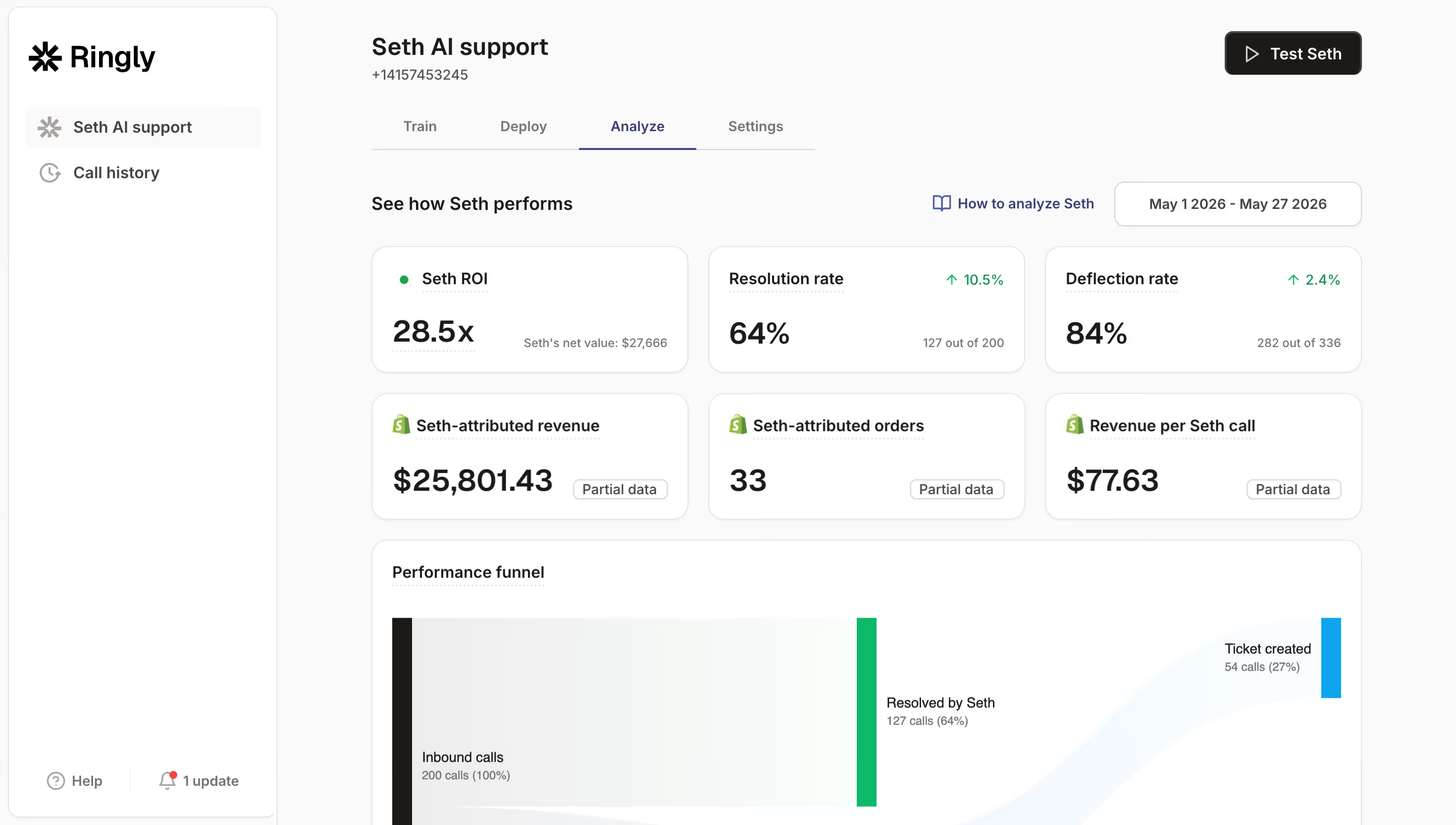
Ringly.io is AI phone support for Shopify brands. Instead of growing your support headcount every time autoship volume goes up, the AI takes the routine inbound calls so your team can focus on the work that actually moves revenue. The AI answers calls 24/7, finds orders in your Shopify store, manages subscriptions, answers ingredient and feeding questions from your knowledge base, and checks recall lot numbers, then escalates cleanly to whatever helpdesk you already run. Across 50+ brands, the AI resolves 73% of calls autonomously at roughly $0.42 per resolved call. The grief call, the sick-pet call, the genuinely complex case still goes to your team, by a hard-coded handoff rule.
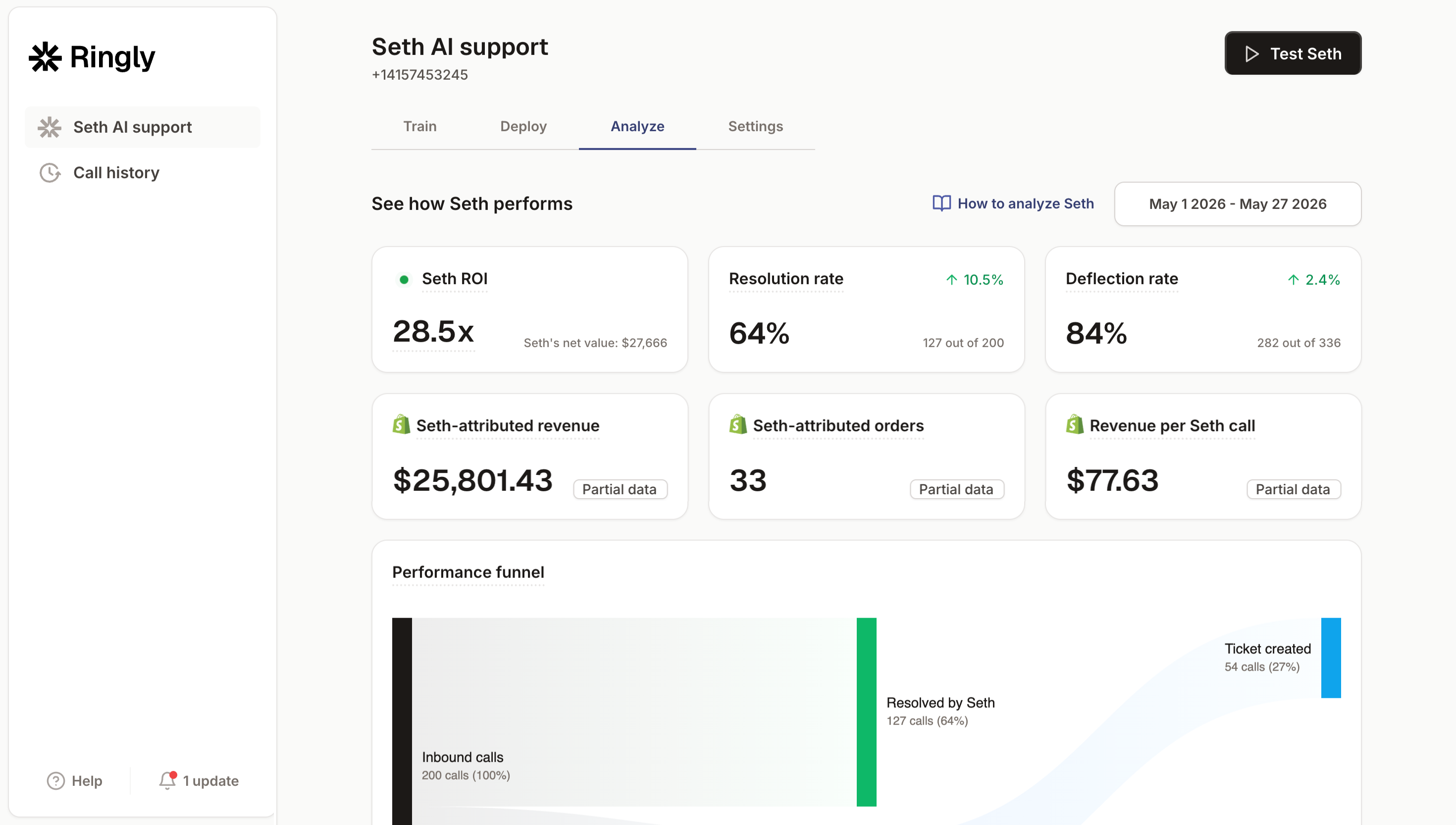
The frame that lands with pet brands: we handle the 90% so your humans can be present on the 10% that matter. That's also why the AI receptionist approach for pet brands works better than a generic chatbot bolted onto your site, and it pairs with the same order-status checking and knowledge base that run the routine layer.
Run the numbers on the $20M example above. The team costs $16,000/mo and still misses weekends. An AI layer at roughly $3,000-$5,000/mo handles the WISMO, autoship, ingredient, and recall-lookup volume, which nets out to around $11,000/mo saved, or $132K a year, and the weekends and the recall surge finally get answered.
The call makes sense if:
- You're a Shopify or Shopify Plus pet food brand doing $10M-$100M
- You run a paid helpdesk (Gorgias, Zendesk, Gladly, Re:amaze, or Intercom)
- You have a visible phone number on your store
- Your CS team is 3-12 people
If that's you, the math usually works. Book a 30-min call and we'll run it live on your store.
What happens on the call.
- We pull your last 7 days of missed calls live, on the call. No homework for you.
- We show you the recovered revenue at the resolution rates we see for pet food brands.
- You decide if it's worth a deeper conversation. No deck, no follow-up sequence.
If you're weighing this against hiring rep number four, book a 30-min call and we'll do the math on your actual call volume. You can also see how this looks for a pet brand phone support setup or check the pricing before you do.
Frequently asked questions
What does customer service look like for a pet food brand? It runs on five call families that generic ecommerce CS doesn't see: diet and allergy questions, recall surges, autoship cancel-saves, feeding transitions, and perishable-delivery issues. Build the function by mapping those families, automating the routine ones, and reserving your human reps for grief, sick-pet, and complex calls.
How do you handle pet food recall calls? Lead every call with a lot-number lookup so customers learn fast whether their batch is affected. Pre-write a "should I keep feeding?" script with your QA team, give the autoship-cancel wave a fast refund path, and hard-escalate any "my pet is sick" call to a human. Cover after-hours, because recall news breaks at night as often as midday.
How do you stop autoship cancellation calls from going to voicemail? The fix is 24/7 coverage on the phone, because a cancel call is time-sensitive and 85% of people who can't reach you never call back. Pull the subscription instantly, offer pause, skip, frequency change, or recipe swap before processing the cancel, and confirm by SMS. A saved subscription is worth 8 to 18 future orders.
Can AI answer pet food diet and allergy questions? Yes, as long as it answers from your product data, not as a vet. AI phone support can confirm an ingredient list, flag an allergen, or share a feeding guide, then hand off to a human the moment a call turns medical. The line you never cross is diagnosis or treatment advice.
What customer service metrics should a pet food brand track? Beyond first response time and CSAT (the ecommerce average is around 4.6), track autoship-save rate, after-hours answer rate, recall-response time, and autonomous resolution rate. Ticket count alone is a bad north star because it weights a sticker-replacement call the same as a $600-lifetime-value cancel call.
How much does a pet food customer service team cost? A typical $20M brand runs around $16,000/mo for 3 weekday reps and a weekend rep, and still misses weekends and recalls. Each rep also carries about $13,745 in replacement cost at roughly 31% turnover, plus an 8-to-12-month ramp. The uneven volume is what makes pure headcount expensive.
Should pet food brands outsource customer service? A BPO solves coverage but not per-call cost or the recall surge, and the agents won't know your recipes. Offloading the routine 70-80% of calls to AI and keeping your own team for the hard calls usually pencils out better, especially once you price in turnover and ramp.
Talk to us

If you run a $10M-$100M Shopify pet food brand and you're losing autoship saves and after-hours recall calls to voicemail, a 30-min call is the fastest way to see what you're leaving on the table.
The 3-layer guarantee.
- Live in 14 days or it's free until launched.
- 65% resolution in 90 days or we refund the last 3 months of subscription fees.
- We keep working free until we hit it.
Ruben (Ringly co-founder) takes these calls personally.