

Gourmet customer service is a peak problem, not a steady-state one.
- The whole operating model bends around the Q4 gifting spike, the perishable clock, and an older customer who'd rather call than click.
- WISMO, ship-by, and freshness questions are 30-40% of your tickets in a normal week and over 50% at peak (Salesforce). The genuinely hard calls, spoiled-on-arrival and late gifts, are a small slice that needs a human.
- Built for founders, COOs, and Heads of CX at $10M-$100M Shopify gourmet and specialty-food brands running a paid helpdesk and a visible phone number.
Most of the expensive calls at a gourmet brand happen at the worst possible time. I spent a stretch listening to real gourmet-brand call logs, and the pattern is hard to miss: a customer gets a "your order is delayed" email at 8 p.m. on a Friday, does the math on the weekend, realizes their frozen gift is about to spoil in a depot, and calls. Nobody picks up. By Monday they've left a one-star review and ordered from someone else.
That's the shape of the problem. The product is on a physical clock, the customer skews older and phone-first, and the volume isn't steady, it triples for six weeks every winter. So the question isn't "how do we answer faster," it's "how do we build a customer service function that survives the gifting spike without hiring eight reps in November and firing them in January."
If you run a gourmet or specialty-food brand on Shopify and you're staring down another Q4 staffing decision, this is the playbook. We've launched AI phone agents for 50+ Shopify brands trying to fix exactly this, and the call patterns below come from their real queues. Book a 30-min call and we'll pull your last week of missed calls live so you can see what the after-hours window is actually costing you.
In this post:
Where your call and ticket volume actually comes from
Before you change anything, you need to know what's hitting the queue. For a gourmet brand the mix is predictable, and it's not what most founders assume. It isn't complaints. It's logistics and reassurance.
At a perishable brand, four of every five inbound contacts are people who just want to know their food is going to arrive on time and arrive cold. Here's the breakdown we see across specialty-food queues:
- WISMO ("where's my order"). The biggest bucket by far. 30-40% of tickets normally, over 50% at peak (Salesforce). For gifts it's worse, because the sender is tracking an order going to someone else's house.
- Ship-by and arrives-by questions. "If I order today, will it get there before her birthday?" This is gourmet's version of WISMO with a deadline attached. The deadline is what makes it urgent.
- Freshness and cold-chain. "Will the cheese still be cold?" "What's the roast date?" These spike with summer heat and with any perishable launch, because the customer can't inspect the product before it ships.
- Gift logistics. Send to a different address, add a gift message, ship three boxes to three recipients. Fiddly, repetitive, and high-volume in November and December.
- Spoiled-on-arrival and damaged-in-transit. The small slice that's genuinely hard. This one needs a human, a refund decision, and some empathy. Goldbelly's Trustpilot reviews are full of melted, late, and "not packed in dry ice" stories, which is exactly what happens when this bucket gets ignored.
The first four buckets are the same questions over and over. They're repeatable, they don't need judgment, and they're where your team is spending most of its day. The fifth is where you actually want human attention.
The reason this matters: when a customer can't reach you, they don't wait. 78% abandon a brand after a single unanswered call, and 85% who can't reach a person never call back (PCN). Most businesses answer only about 38% of inbound calls (AmbsCallCenter). For a brand selling a $90 gift box on a deadline, a missed call isn't a missed ticket. It's a refunded order and a churned gifter.
If your phone goes to voicemail after 6 p.m. and your email backlog stretches past a day, you already know which of these buckets is leaking. The fix isn't more people. It's a model that routes the routine 80% away from your team so the team can own the 20% that matters. The rest of this guide is that model. See your own numbers on a call.
The channel and SLA model that fits a perishable brand
Most CS advice treats all channels the same. For a perishable brand they're not the same, because the cost of being slow is different on each one.
The rule for gourmet: the more time-sensitive the question, the faster the channel has to be, and shipping questions are the most time-sensitive thing you sell. Here's how to think about each channel and what to target.
- Phone. Highest stakes and your oldest, most loyal customers live here. The pattern is real across the vertical: a chunk of buyers call to place gift orders because they won't trust the website. Phone is also where the after-hours gift-deadline panic lands. Target: answer 90%+ of calls, including evenings and weekends.
- Email. The default for non-urgent everything. The benchmark that moves retention: sub-one-hour first response wins 71% retention versus 48% at 24 hours, and Zendesk calls anything under an hour best-in-class. Target: under 1 hour during business hours, under 4 hours always.
- Live chat. Good for pre-purchase "will this arrive in time" questions on the product page. CSAT peaks at 84.7% when the first reply lands in 5-10 seconds (2026 benchmark). Target: under 40 seconds.
- SMS. Underused in gourmet and perfect for proactive ship updates. A "shipped, arriving Thursday, kept cold" text kills a huge share of WISMO before it becomes a call.
Here's a clean SLA table you can lift straight into your helpdesk:
| Channel | What it carries | First-response target | Why it matters for gourmet |
|---|---|---|---|
| Phone | Gift orders, ETA panic, freshness | Answer 90%+, incl. after-hours | Older buyers, deadline anxiety |
| Order changes, non-urgent issues | Under 1 hour (4 hours max) | 71% retention at sub-1h | |
| Live chat | Pre-purchase ETA questions | Under 40 seconds | Catches the sale before it bounces |
| SMS | Proactive ship + delay alerts | Same-day, proactive | Deflects WISMO before it calls |
Gear Rider, a specialty brand on Ringly, cleared 1,595 calls in 90 days without a phone rep, which is the kind of volume a single perishable brand hits in a busy gifting quarter. The point isn't the tool yet. The point is that the SLA on phone is the one most brands quietly abandon after 6 p.m., and it's the one that costs the most when you miss it.
For a deeper cut on the numbers behind these targets, our customer service response-time benchmarks breakdown has the channel-by-channel data.
The perishable escalation matrix
Once you've set SLAs, you need a routing rule for every call type, because the worst outcome at a food brand isn't a slow answer. It's a confident wrong answer about a spoiled order, or a human spending an hour on a gift-message change while a real spoilage complaint sits in voicemail.
The single rule that makes this work: automate the calls that have one correct answer, escalate the calls that need a judgment, a refund, or an apology. Everything below sorts into one of those two lanes.
| Call type | Route to | Target | Notes |
|---|---|---|---|
| Order status / WISMO | Automated | Instant, 24/7 | Pull tracking from Shopify |
| Ship-by / arrives-by ETA | Automated | Instant | Quote cutoffs from carrier data |
| Freshness / roast date / cold-chain how-to | Automated | Instant | Answer from your knowledge base |
| Gift message / address change | Automated or human | Same-day | Automate read-only, escalate edits |
| Place an order by phone | Human | Business hours | We don't take orders, transfer cleanly |
| Spoiled / damaged on arrival | Human | Under 1 hour | Refund + empathy, never a bot |
| Allergen / safety / recall | Human | Immediate | Liability, always a person |
Two things worth flagging. First, the FTC's holiday-delivery rule says that if you can't ship in the window you promised, you have to give the buyer the choice to accept the delay or take a full refund (FTC). That means delayed-shipment calls in December are a compliance moment, not just a service moment, and they need a fast, correct, documented answer.
Second, the spoiled-order and allergen rows are non-negotiable humans. A bot apologizing for a ruined birthday cake is the screenshot that ends up on Twitter. Trade Coffee's grind-preference mixups and Death Wish Coffee's unanswered-call reviews are what happens when the matrix has no human lane at all. Get the routing right and your team stops drowning in WISMO and gets to spend its hours on the calls that actually build loyalty. Our WISMO call guide goes deeper on automating that top bucket.
The seasonal staffing problem (and the math)
This is the part that keeps gourmet founders up at night, and it's the real reason a steady-state CS playbook doesn't work here.
A typical $20M specialty-food brand runs a small team year-round and a much bigger one for six weeks of gifting. The math looks like this:
| Line item | Cost |
|---|---|
| 4 reps × $4,000 loaded, year-round | $16,000/mo ($192K/yr) |
| 4 seasonal reps × $4,000 × 3 months | $48,000/yr peak |
| True annual CS spend | ~$240,000/yr |
And the seasonal half is the expensive half in ways that don't show up on the line item. Seasonal reps are cheaper to hire than year-round staff, but they don't know your products, so quality drops exactly when volume peaks. Training a food-service hire runs around $821 per person and total turnover cost lands near $5,864 each (Homebase), and you're paying that to onboard people you'll let go in January. Replacing a full-time CS rep is worse, about $14,113 with the industry at 31.2% turnover (Insignia).
You're paying premium onboarding costs for your least-experienced staff during your highest-stakes weeks. That's the trap. The way out isn't a better seasonal hiring funnel. It's making the routine 70-80% of calls not require a human at all, so the spike stops translating into a headcount decision.
Run the same brand with an AI phone layer absorbing WISMO, ship-by, freshness, and gift logistics around the clock, and the seasonal hire mostly disappears. Net savings land somewhere around $140K-$180K a year depending on volume, and your year-round team keeps doing the work it's actually good at. For more on the cost side, see our breakdown of outsourced customer service tradeoffs.
The call makes sense if:
- You're a Shopify or Shopify Plus gourmet/specialty-food brand doing $10M-$100M
- You run a paid helpdesk (Gorgias, Zendesk, Gladly, or Re:amaze)
- You have a visible phone number on your store
- Your CS team is 3-12 people and balloons every Q4
What happens on the call.
- We pull your last 7 days of missed calls live, on the call. No homework for you.
- We show you the recovered revenue at the resolution rates we see for perishable brands.
- You decide if it's worth going further. No deck, no follow-up sequence.
If that's your shape, book a 30-min call and we'll run the gifting-season math against your real numbers.
The tooling stack: helpdesk, tracking, and phone
You don't need a dozen tools. You need three layers that talk to each other.
The stack that works for a gourmet brand is a helpdesk for tickets, an order-tracking integration to kill WISMO, and a phone layer that actually answers. Here's how to think about each.
- Helpdesk. Where email, chat, and social tickets live, ideally tagged and SLA-tracked. Gorgias is the most common on Shopify, with Zendesk, Gladly, and Re:amaze close behind. Any of them works. What matters is that it's tagged so you can see your WISMO percentage.
- Order tracking. A tracking integration (TrackingMore, AfterShip, or your helpdesk's native one) that surfaces real-time status inside the ticket. This is what lets you answer "where's my order" without a human looking it up. Pair it with proactive SMS shipping alerts and you deflect a third of your WISMO before it ever becomes a contact. Our ecommerce order tracking guide covers the setup.
- Phone. The layer most gourmet brands underbuild. A traditional phone system like Aircall routes calls to humans, which is fine until 6 p.m. or December. An AI phone agent answers every call 24/7 and only hands off the spoiled-order and order-placement calls. That's the layer that fixes the after-hours gift-panic problem.
The trick is integration. A helpdesk that doesn't see Shopify order data is a glorified inbox. A phone line that can't read tracking is just a person reading tracking out loud. Wire the three layers together and the routine questions answer themselves. For the broader picture, our ecommerce customer service overview maps the full stack.
Where AI phone support fits (one section, not the whole answer)
AI phone support is one layer of this playbook, not the playbook itself. It earns its place by owning the channel gourmet brands abandon first: the phone, after hours, during the spike.
Ringly.io is AI phone support for Shopify brands. Instead of hiring a seasonal phone team every November, the AI takes the routine inbound calls so your team can focus on the spoiled-order and gift-recovery calls that actually need a person.
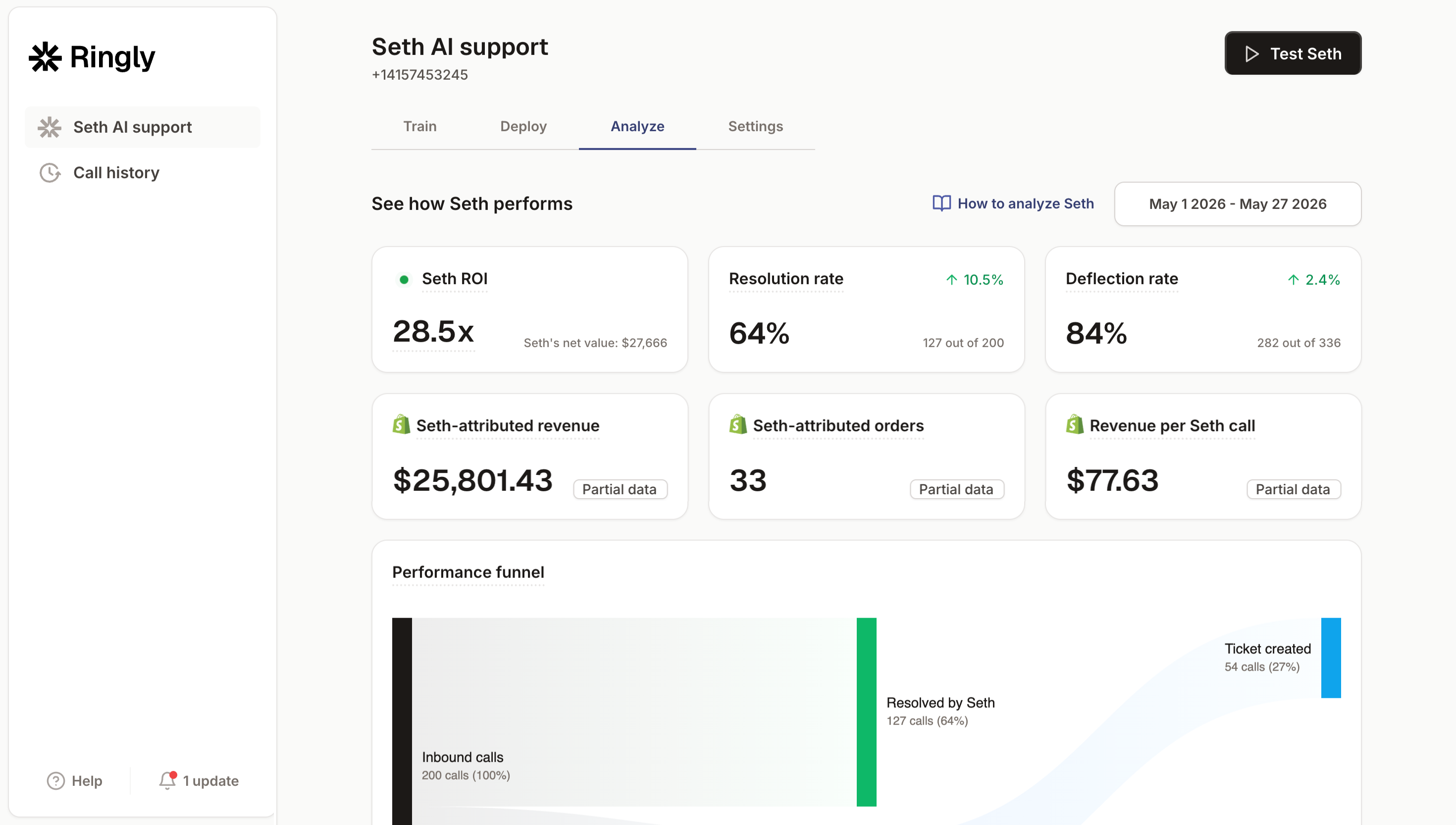
The AI answers inbound calls 24/7 in 40 languages. It finds orders in your Shopify store, quotes ship-by and arrives-by dates, answers freshness and roast-date questions from your knowledge base, handles gift-message and address lookups, and checks order status without anyone touching a keyboard. Across 50+ brands, it resolves 73% of calls autonomously at roughly $0.42 per resolved call, versus $7-$16 a call for human BPO. Calls that need a human, spoiled orders, allergen questions, phone orders, escalate cleanly to whatever helpdesk you already run.
The objection in this vertical is always the same, and it's fair: older customers won't accept AI. So here's the thing worth testing. The most repeated compliment we get is from exactly that demographic:
"My customers also feel like it's a normal person. They feel like they can communicate if they have questions."
— Claudia Droge, TechCraft Studio
What it handles well
- The routine 70-80%. WISMO, ship-by, freshness, gift logistics, all day and all night.
- After-hours and weekends. The exact window where gift-deadline panic lives and your team is offline.
- The gifting spike. Volume scales without a seasonal hire. No quality cliff in December.
- Clean handoff. Spoiled-order and order-placement calls transfer to a human with the context attached.
What it doesn't do
- It won't take orders over the phone natively. For brands where a big share of buyers place gift orders by voice, it transfers those to a human or sends an SMS payment link. If most of your revenue is phone orders, you're not a fit yet, and we'll tell you that on the call.
- Inventory is a daily refresh, not real-time. Fine for most gourmet catalogs, worth checking if you sell flash-limited drops.
Plans: Grow $349/mo (1,000 minutes), Pro $799/mo (2,500 minutes), Enterprise custom and sold by call. 14-day free trial on Pro. Live in under an hour. And a 65% resolution guarantee: if the AI resolves under 65% of your calls in 90 days, we refund the last 3 months. If you want to see how this looks for a phone-first brand, our phone support for specialty food brands playbook and the gourmet food brand phone support breakdown go deeper.
A 30-day plan to get this running
You don't need a six-month transformation project. Here's a four-week version that gets you to the gifting season ready.
- Week 1: measure. Tag every ticket and call by type for one week. Find your WISMO percentage and your after-hours miss rate. Most brands are shocked by the after-hours number.
- Week 2: set SLAs and the matrix. Lock the channel SLA targets and the escalation matrix above into your helpdesk. Decide which call types are automated and which are always human.
- Week 3: wire the stack. Connect order tracking to your helpdesk, turn on proactive shipping SMS, and stand up the phone layer so after-hours calls stop hitting voicemail.
- Week 4: pressure-test. Run a fake spoiled-order call, a fake gift-ETA call, and a fake after-hours call. Confirm the routine ones resolve and the hard ones land on a human fast.
To make the after-hours and spike numbers concrete: WashCo, a Shopify brand we launched recently, generated $22,664 in attributed revenue in the first 7 days post-launch, with 271 calls handled, an 85% deflection rate, and $0.91 per call versus $2.70 for a human-handled one. That's the recovered-revenue side of fixing the calls you're currently dropping.
Frequently asked questions
What customer service channels do gourmet food brands actually need? Phone, email, and live chat at minimum, with proactive SMS shipping alerts as the highest-impact add. Phone matters more than in most DTC categories because gourmet buyers skew older and call to place gift orders. Email handles non-urgent issues, and SMS deflects WISMO before it becomes a call.
Why is customer service harder for perishable and gourmet brands? The product is on a physical clock, so a delayed or spoiled shipment is a destroyed product and a refund, not just a bad experience. Volume also triples during Q4 gifting, and a large share of calls carry gift-deadline anxiety that hits after hours when teams are offline.
How do gourmet brands handle the holiday gifting spike without overhiring? Automate the routine 70-80% of calls (WISMO, ship-by, freshness, gift logistics) so volume can spike without a headcount decision, and reserve your year-round team for spoiled-order, allergen, and phone-order calls. This avoids paying premium onboarding costs for inexperienced seasonal staff during your highest-stakes weeks.
What's a good first-response time for a gourmet food brand? Aim for under 1 hour on email (best-in-class per Zendesk), under 40 seconds on live chat, and answering 90%+ of calls including after hours. Sub-one-hour email response is tied to 71% retention versus 48% at 24 hours.
Can AI handle gourmet customer service calls without sounding robotic? Yes for the routine buckets, and the most common compliment from older customers is that it feels like a normal person. Spoiled-order, allergen, and emotional gift-recovery calls should always route to a human, which is how the matrix in this guide is built.
Does this replace my helpdesk like Gorgias or Zendesk? No. The phone layer sits in front of your existing helpdesk and escalates the calls that need a human into it, so you keep your current stack, tags, and workflows. You're adding the channel most brands underbuild, not swapping the one you already run.
Talk to us

If you run a $10M-$100M gourmet or specialty-food brand on Shopify and you're losing calls after-hours and bracing for another Q4 staffing scramble, a 30-min call is the fastest way to see what the gifting spike is actually costing you.
The 3-layer guarantee.
- Live in 14 days or it's free until launched.
- 65% resolution in 90 days or we refund the last 3 months of subscription fees.
- We keep working free until we hit 65%.
Ruben (Ringly co-founder) takes these calls personally.