
Most of a gourmet brand's phone volume is reassurance, not complaints.
- Sort every inbound call into two piles: routine calls you can route to an AI agent 24/7, and the calls a human has to take (a spoiled gift, an allergen question, complex gift logistics).
- The perishable clock changes the math. A delayed-shipment caller at 8 p.m. Friday needs an answer before the weekend kills the cold chain, and 78% of buyers abandon a brand after one unanswered call.
- Built for founders, COOs, and heads of CX at $10M-$100M Shopify gourmet and specialty-food brands with a visible phone number and a paid helpdesk.
A gourmet food brand's phone line is a logistics-and-reassurance desk, not a complaints desk. Pull a week of your call logs and you'll see it: most callers aren't angry, they're anxious. Will it arrive cold. Will the chocolate melt. Will it get there before the party. The hard calls (the spoiled gift, the allergen question) are a small slice, but they're the slice that needs a real person, fast.
I went through a week of real gourmet and specialty-food call logs across the Shopify brands we run at Ringly and sorted every call into two piles. That sort is the whole playbook. If you run customer experience at a $10M-$100M food brand and your weekend line goes to voicemail, you already know the seasonal spike and the "where's my order" loop. Book a 30-min call and we'll show you what your after-hours queue is actually costing you.
First, sort your calls into two piles
Before you change anything about your phone setup, do the boring part. Listen to (or read transcripts of) one normal week of calls. Then sort each one into routine or human-must-take. Almost everything sorts cleanly, and the split tells you exactly what to automate and what to protect.
Roughly 70-80% of a gourmet brand's calls are routine logistics, and those are the ones eating your CS team's day. Here's the breakdown most food brands land on.
| Call type | Pile | Why |
|---|---|---|
| Where's my order, tracking, gift-ETA | Routine | Pulls straight from Shopify. Same answer every time. |
| Ship-by and cutoff dates | Routine | Calendar math from your shipping rules. |
| Cold-chain reassurance ("will it arrive cold") | Routine | Scripted from your packaging policy (gel packs, dry ice, insulated box). |
| Store hours, shipping cost, simple product questions | Routine | Knowledge-base lookups. |
| Spoiled or late perishable gift | Human | Emotional, time-sensitive, usually a refund. |
| Allergen or "is this gluten-free / nut-free" | Human | Safety-grade. Never improvise this one. |
| Complex gift logistics (multi-address, gift messages) | Human | Judgment calls your team handles better. |
| Place an order over the phone | Human | Older customers who won't use the website. |
WISMO calls ("where's my order") alone run 30-40% of support tickets in normal periods and over 50% at peak, according to Salesforce. For a food brand, gift-ETA questions stack on top of that during the gifting season. Those are the calls your reps answer over and over, the same questions over and over, and they're also the easiest to hand to an AI phone agent.
If you want the longer version of this for your vertical specifically, we've also written a fuller phone support playbook for specialty food brands that goes deeper on the shelf-stable vs refrigerated vs frozen call mix.
The point of the sort isn't to automate everything. It's to free your team for the 20% that actually needs them.
The perishable clock changes the missed-call math
A coffee brand can let a Friday-evening voicemail sit until Monday. A perishable food brand can't. The cold chain has a clock on it, and that clock is the whole reason after-hours coverage matters more in this vertical than almost any other.
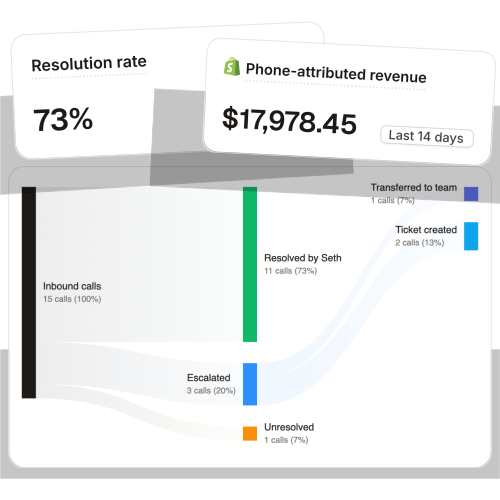
Picture the call. A customer gets a "your order is delayed" email at 8 p.m. on a Friday. They want to talk to someone before the weekend, because they know what two extra days in a warm truck does to a cheese or a frozen meal kit. Your line goes to voicemail. By Monday you don't have a delayed order, you have a spoiled order, a refund, and a customer who's already telling the story online.
The numbers back the urgency. 85% of callers who can't reach a person never call back, and 62% switch to a competitor. 78% of buyers abandon a brand after a single unanswered call. And on hold, 60% hang up within the first 60 seconds. For a perishable order, "call back Monday" isn't an option, the product is gone.
There's a compliance angle too. The FTC requires sellers to ship within the window they promise, and if there's a delay, to give the buyer the choice to accept it or cancel for a full refund. A customer calling about a late gift order isn't just anxious, they have a rule on their side. They need an answer in real time, not a voicemail. That's why 24/7 phone coverage is the difference between a recovered order and a refund.
This is the case for an after-hours answering setup that does more than take a message. A voicemail box doesn't save a cold-chain order, it just records the loss. The point is to actually resolve the gift-ETA or delayed-shipment call while the customer is still on the line, then escalate only the ones that need a person. Done right, even the voicemail you do leave is a transcribed, actioned ticket, not a black hole.
Allergen and spoiled-gift calls are the ones a human takes
Here's the rule that makes the whole thing safe to automate: the AI never improvises a safety answer. Allergen calls and spoiled-gift calls get hard-escalated to a human, every time.
Allergen questions are safety-grade. When a customer asks "is this gluten-free" or "is it made in a nut-free facility," a wrong answer isn't a bad review, it's a medical event. Cross-contact happens when a gluten-free food is exposed to a gluten-containing ingredient, and for someone with celiac, even a trace amount triggers a reaction. So you build a rule: any allergen or ingredient-safety question routes straight to a trained human or a verified knowledge-base answer that's been signed off, never a guess.
Spoiled or late gift calls are the other human pile. They're emotional (someone's birthday cake arrived warm and late), they're usually a refund, and they need a person who can make it right on the spot. An AI agent should recognize the call type in the first ten seconds and transfer it, not try to talk a frustrated customer out of being upset. That's a smart call transfer rule, configured once.
This is also where the older-demographic worry shows up. Specialty food skews to an older customer base, and a chunk of them won't place an order on the website at all, they call to read you the order. The good news is voice quality is exactly what wins that customer over.
"My customers also feel like it's a normal person. They feel like they can communicate if they have questions."
Claudia Droge, TechCraft Studio
Handle the two seasonal spikes without seasonal hires
Gourmet food has two seasonal spikes, not one. There's the Nov-Dec gifting rush everyone plans for, and there's the summer heat window where cold-chain anxiety spikes on its own. Both flood the phone with routine questions: will it arrive in time, will it arrive cold, can you ship to two addresses.
The usual answer is to hire seasonal reps, train them in October, and let them go in January. It's expensive and the timing never lines up. Replacing or hiring around one CS rep runs about $14,113 once you count recruiting, training, and ramp, and seasonal hires never reach full productivity before the spike is over.
The alternative is to let the routine spike volume hit an AI agent that doesn't need training and doesn't burn out, and keep your humans for the gift-logistics and complaint calls. Gear Rider, a Ringly customer, handled 1,595 sales calls in 90 days without a phone rep. That's the volume shape a gifting season throws at you, absorbed without a single seasonal hire. Your team stops drowning in calls and the seasonal-hire line item shrinks.
Build the routing: AI for the routine, humans for the rest
Once you've sorted the calls, the build is straightforward. You keep your phone number, keep your helpdesk, and add an AI agent in front of the line that handles the routine pile and escalates the rest.
Ringly.io: AI phone support for gourmet food brands
Ringly.io is AI phone support for Shopify brands. Your team wasn't hired to answer "will it arrive cold" fifty times a day during a heat wave. The AI takes the routine inbound calls so your team can focus on the spoiled-gift and allergen calls that actually need a person.
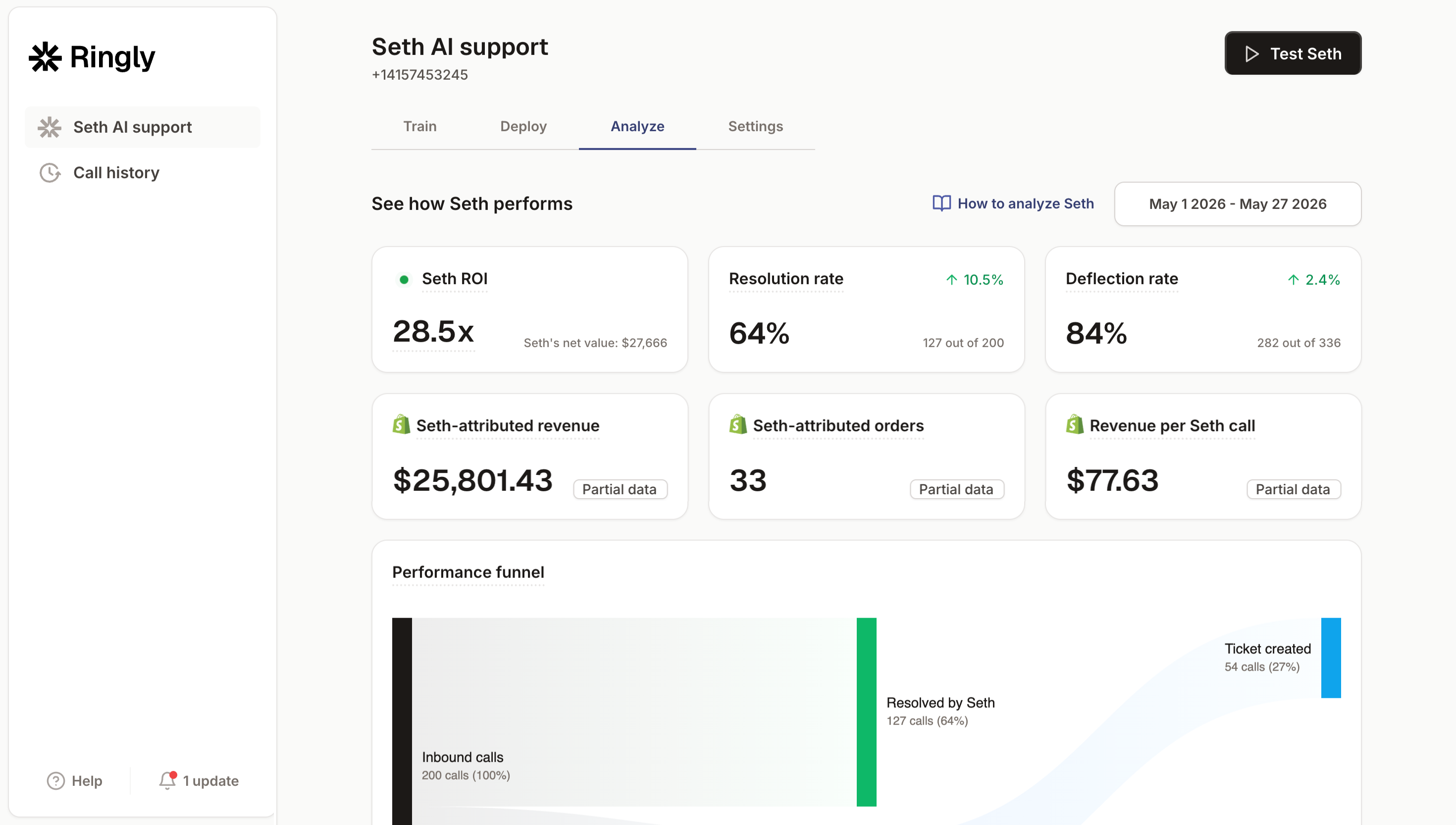
The AI answers inbound calls 24/7 in 40 languages. It finds orders in your Shopify store, answers gift-ETA and ship-by questions, reads your cold-chain packaging policy from your knowledge base, and checks order status without a human. Seth resolves up to 90% of calls autonomously. Calls that need a human (allergen, spoiled gift, phone-orders) escalate cleanly to Gorgias, Richpanel, Reamaze, or whatever helpdesk you already run.
What it handles well: the routine pile. WISMO, gift-ETA, ship-by, cold-chain reassurance, order status, simple product questions, after-hours coverage when the cold chain can't wait.
What it doesn't do: it doesn't take orders over the phone natively. For the older customer who wants to place an order by voice, the agent transfers to a human or sends a payment link by SMS as a custom action. If most of your revenue is phone orders, be honest with yourself about that gap before you buy.
The most repeated thing customers say after talking to the agent is "you don't sound like AI," which is the single objection that matters most with a skeptical, older food-brand customer. Pricing: $99 a month for the first 50 conversations, then $1.99 each. Live in under an hour, backed by a 65% resolution guarantee. (If you want it framed for your category, we keep a running guide to gourmet food brand phone support too.)
If you're weighing this against outsourcing your Shopify customer service to a BPO, the trade-off is training and consistency. A BPO needs weeks of nested calling and refresher training every quarter to handle your perishable rules. An AI agent reads the same rules the same way on call one and call ten thousand.
What this costs vs what it saves
Run the math on a typical $20M specialty food brand that staffs up for the gifting season.
| Line item | Today |
|---|---|
| 4 reps × $4K loaded, year-round | $16,000/mo ($192K/yr) |
| 4 seasonal reps × $4K × 3 months | $48,000/yr peak |
| True annual CS spend | ~$240,000/yr |
An AI agent handling the routine pile year-round, and absorbing the gifting and summer spikes, runs a fraction of that. Across our brands the net savings land around $140K to $180K a year depending on volume, and the seasonal-hire scramble disappears. The reason it pencils out isn't a magic price, it's that 70-80% of the calls were repeatable to begin with, so you stop paying loaded reps to answer the same five questions during peak.
None of this means firing your team. It means your existing reps stop spending their day on gift-ETA lookups and get their time back for the calls that build loyalty. If you're thinking about ecommerce customer service more broadly, the phone is usually the channel where the math is most lopsided, because a single rep can only be on one call at a time and the gifting spike doesn't care.
Want the math on your actual call volume instead of a typical brand? Book a 30-min call and we'll pull your last week of missed calls and run it live.
Frequently asked questions
Should an AI handle allergen or gluten-free questions for a food brand? No. Allergen and ingredient-safety questions are safety-grade and should hard-escalate to a trained human or a signed-off knowledge-base answer, never an improvised one. The right setup recognizes the question type and transfers it in the first few seconds.
Can AI phone support take an order over the phone? Ringly doesn't take orders over the phone natively. For the older customer who calls to place an order, the agent transfers to a human or sends a payment link by SMS as a custom action. If most of your revenue is phone orders, that's a gap to weigh before buying.
How do you handle a spoiled or late perishable gift call? Route it to a human fast. These calls are emotional and time-sensitive, usually a refund, and the AI's job is to recognize the call type and transfer it, not to manage the complaint itself. The perishable clock means you can't let it wait for a callback.
What percentage of gourmet food calls can be automated? Most brands find 70-80% of their calls are routine logistics (WISMO, gift-ETA, ship-by, cold-chain reassurance), which an AI agent can resolve. The remaining 20-30% (allergen, spoiled gift, complex gift logistics, phone-orders) stays with your team.
Will older customers accept an AI on the phone? Voice quality is the deciding factor, and it's where the demographic worry usually flips. The most repeated thing customers say after a call is "you don't sound like AI." Pair that with a clean transfer rule for anyone who asks for a person.
How do you cover the Nov-Dec gifting rush and the summer cold-chain spike? Let an AI agent absorb the routine spike volume, which is most of it, instead of hiring and training seasonal reps who never reach full productivity before the spike ends. Your team handles the gift-logistics and complaint calls, and you skip the seasonal-hire line item.
Talk to us

If you run a $10M-$100M Shopify food brand and the phone goes to voicemail after 6 p.m., a 30-min call is the fastest way to see what the weekend queue is actually costing you. We'll pull your last week of missed calls and sort them into the two piles live.
Our 3 promises.
- Live in under 1 hour. Setup and test calls are free.
- 30-day money back on the $99 plan fee.
- 65% resolution guarantee: if Seth resolves under 65% of your support calls in a month, that month comes back as credit (after 90 days on Pay per call).
Ruben (Ringly co-founder) takes these calls personally.