
I sorted a week of one Shopify coffee brand's call logs into types, and the spread was almost boring. Five questions, on repeat, all day. "Where's my order, will it make it by Christmas, is this going to be fresh, can I pause my subscription, can I just order over the phone." That's most of the volume. WISMO alone runs 30% to 50% of retail support contacts, and it climbs higher in December when half your orders are gifts.
The reason coffee calls feel chaotic isn't the volume. It's that the calls arrive when nobody's staffed for them (evenings, weekends, the Nov-Dec gifting rush) and that a small slice of them are brand-critical and need a human, while the rest are routine and don't. If you run a $10M-$100M Shopify coffee brand and your support team is drowning every Q4, the fix is mostly sorting: knowing which call is which before you decide who answers it.
Coffee brands punch above their weight on phone volume because the demographic skews older and a chunk of customers genuinely prefer to call. So this is the operational playbook: the five call types you actually get, the three buckets you route them into, and how to staff the windows where the calls really land. It pairs with our broader take on coffee brand customer service and the general ecommerce phone support playbook. If you want us to do this sorting against your own call logs, book a 30-min call and we'll walk through them with you.
The short version.
- Most of a coffee brand's phone volume is five questions on repeat. Sort them before you staff for them.
- Three buckets handle everything: resolve, transfer, escalate. The routine 70% lands in resolve; the brand-critical calls go to a human.
- Built for $10M-$100M Shopify coffee brands running a paid helpdesk with a visible phone number, drowning in evening, weekend, and Q4 calls.
The 5 calls a coffee brand actually gets
Every coffee brand thinks its call mix is unique. It mostly isn't. When you tag a week of inbound and count, the same five types show up in roughly the same proportions. Sorting your calls into types is the one move that makes everything downstream easier, because you can't route or staff what you haven't named.
Here's the spread, with what the caller actually wants and where the call should end up.
| Call type | Share of inbound | What they want | Where it goes |
|---|---|---|---|
| Where's my order + gift ETA | 30-45% | tracking, "will it arrive by [date]" | Resolve |
| Freshness + roast date | 10-20% | reassurance, brew advice | Resolve |
| Subscription pause / skip / cancel | 10-20% | change cadence or stop | Resolve or transfer |
| Phone-order requests | 5-15% | place an order by phone | Transfer |
| Taste + damage complaints | 5-10% | refund, replacement, "this tastes off" | Escalate |
A few notes that matter for coffee specifically.
Where's my order is the giant. It's the same in every ecommerce vertical (Salesforce puts WISMO at 30-40% of tickets, 50%+ at peak), but coffee adds a wrinkle: half the December volume is gift orders with a hard arrival date. "Will it get to my dad by the 24th" is a different call than "where's my order," even though they look the same in the queue. The answer needs a real ship-by date, not a tracking link, which is why your AI agent needs to check order status live in Shopify rather than reading from a stale export. We go deeper on this in our guide to WISMO calls.
Freshness is your vertical's signature call. Roast date, "is this stale," "how should I store it." Nobody calls a supplement brand to ask about freshness. Coffee customers do, constantly, and the answer is almost always a clean knowledge-base lookup. This is the most automatable call you have and the one generic retail playbooks completely miss. If you already lean on phone support for your coffee brand, this is the bucket to hand off first.
Subscription calls are where the money hides. A pause-or-cancel call is a retention moment. Handle it well and you save twelve months of recurring revenue. Handle it badly and you lose the customer over a cadence problem you could have fixed in thirty seconds. These split: the simple ones (skip next box, change frequency) resolve fine, the "I have too much coffee and I'm done" ones sometimes need a human with a save offer. Coffee compounds this, since nearly 1 in 5 DTC coffee orders arrive damaged and 1 in 10 late, which feeds cancel calls.
Phone-order requests are real revenue you're probably ignoring. Older coffee buyers will pick up the phone to order rather than fight the website. That's a sale waiting to happen, and it's the one call type that can't just resolve, because most setups don't take orders by voice. It has to transfer somewhere.
Taste and damage complaints are tiny but load-bearing. Five to ten percent of calls, but they carry your brand reputation. Black Rifle Coffee learned this the hard way when their automated line told callers it was "busy fulfilling orders" and then disconnected them. These calls go to a person, every time.
The 3-bucket routing rule
Once calls are typed, routing gets simple. Three buckets cover everything, and you can hand this rule to a new rep on day one or wire it into an AI phone agent. If you can answer a call from your knowledge base without taking an action or making a judgment call, it resolves; if it needs an action you don't trust to a script, it transfers; if it carries brand risk, it escalates.
Bucket 1, resolve. Order status, roast-date and freshness questions, store-and-brew advice, simple subscription edits. The caller wants information you already have written down somewhere. The target here is a fast, accurate answer, no hold music, no "let me transfer you." This is the routine 70% that should never touch a human's calendar.
Bucket 2, transfer. Phone orders, complex subscription saves, anything that needs a payment taken or an account change you'd rather a person confirm. The call gets handed to a rep, or to an SMS payment link, with the context attached so the customer doesn't repeat themselves. A clean AI call transfer carries the call history along with it. The mistake here is letting transfers feel like starting over. Carry the context.
Bucket 3, escalate. Taste disputes, a gift that arrived broken the morning of a birthday, anything emotional or reputation-shaped. These never get a script. They go to your most experienced person with the full call history in front of them. Gear Rider, a brand we work with, handled 1,595 calls in 90 days without a phone rep by sending exactly these three buckets to the right place.
The whole point of typing first and routing second is that you stop treating a roast-date question and a broken-gift complaint as the same "support call." They're not. One is a lookup, the other is a relationship.
When the calls actually come in (and how to staff for it)
Here's the part that breaks most coffee teams. You size the team for Tuesday at 2 p.m., and the calls come Saturday at 10 a.m. and December 14th at 8 p.m. Coverage is a timing problem before it's a headcount problem.
Three windows do the damage:
- Evenings. Older customers call after dinner. If the line rolls to voicemail at 6 p.m., you're leaking orders, because 80% of voicemail-routed callers hang up without leaving a message. An after-hours answering setup catches the evening orders your team isn't around for.
- Weekends. Saturday morning is a coffee-shopping moment. Most lean teams don't staff it.
- Q4 gifting. Holiday call volume jumps about 41% between Thanksgiving and Cyber Monday, and it stays elevated through mid-December.
The trap is staffing for the peak. A coffee brand that hires enough reps to cover December is overstaffed for the other ten months, and every one of those reps costs about $4,000 a month loaded. Then you let them go in January, and you're back hiring and training again next October, where replacing a single CS rep runs about $14,113.
Run the math on a typical $20M coffee brand. Four reps year-round at $4K loaded is $16,000 a month, call it $192K a year. Add four seasonal reps for three months at $4K each and that's another $48,000. True annual support spend lands near $240K, and the team is still understaffed exactly when it matters.
The cleaner model: keep a small, sharp team for the transfer and escalate buckets, and put a 24/7 layer on the resolve bucket so evenings, weekends, and the gifting spike are covered without seasonal hiring. WashCo, a Shopify brand we launched, recovered $22,664 in its first 7 days once the routine calls stopped going to voicemail. That's the coverage gap, paid back.
Want us to map your call windows against your current staffing? Book a 30-min call and we'll do it live.
What you should never hand to a script
The resolve bucket is automatable. The other two have a hard line, and crossing it is how brands end up screenshotted on Twitter.
Never script these:
- Taste disputes. "This tastes burnt" is subjective and emotional. A person tastes the problem with the customer, a script argues with them.
- A gift that went wrong. Late, broken, wrong roast on someone's birthday. This is a relationship-repair call, not a lookup.
- Wholesale and cafe accounts. Different queue, different stakes, different person. Don't let these land in the consumer flow.
- Anything that smells like a refund argument. Money plus emotion plus your reputation. Always a human.
In specialty coffee, customer service is the differentiator, and the brands that win the emotional calls are the ones that don't try to automate them. The goal of routing the routine 70% away from your team isn't to remove humans. It's to free your best people for the calls that actually need them.
"My customers also feel like it's a normal person. They feel like they can communicate if they have questions."
Claudia Droge, TechCraft Studio
Where Ringly fits: the routine layer, not the whole job
Ringly.io is AI phone support for Shopify brands. It sits on the resolve bucket: order status, roast-date and freshness questions, simple subscription edits, the same five things over and over. It finds orders in your Shopify store, answers from your knowledge base, and the calls it can't or shouldn't handle escalate cleanly to Gorgias, Reamaze, or whatever helpdesk you already run.
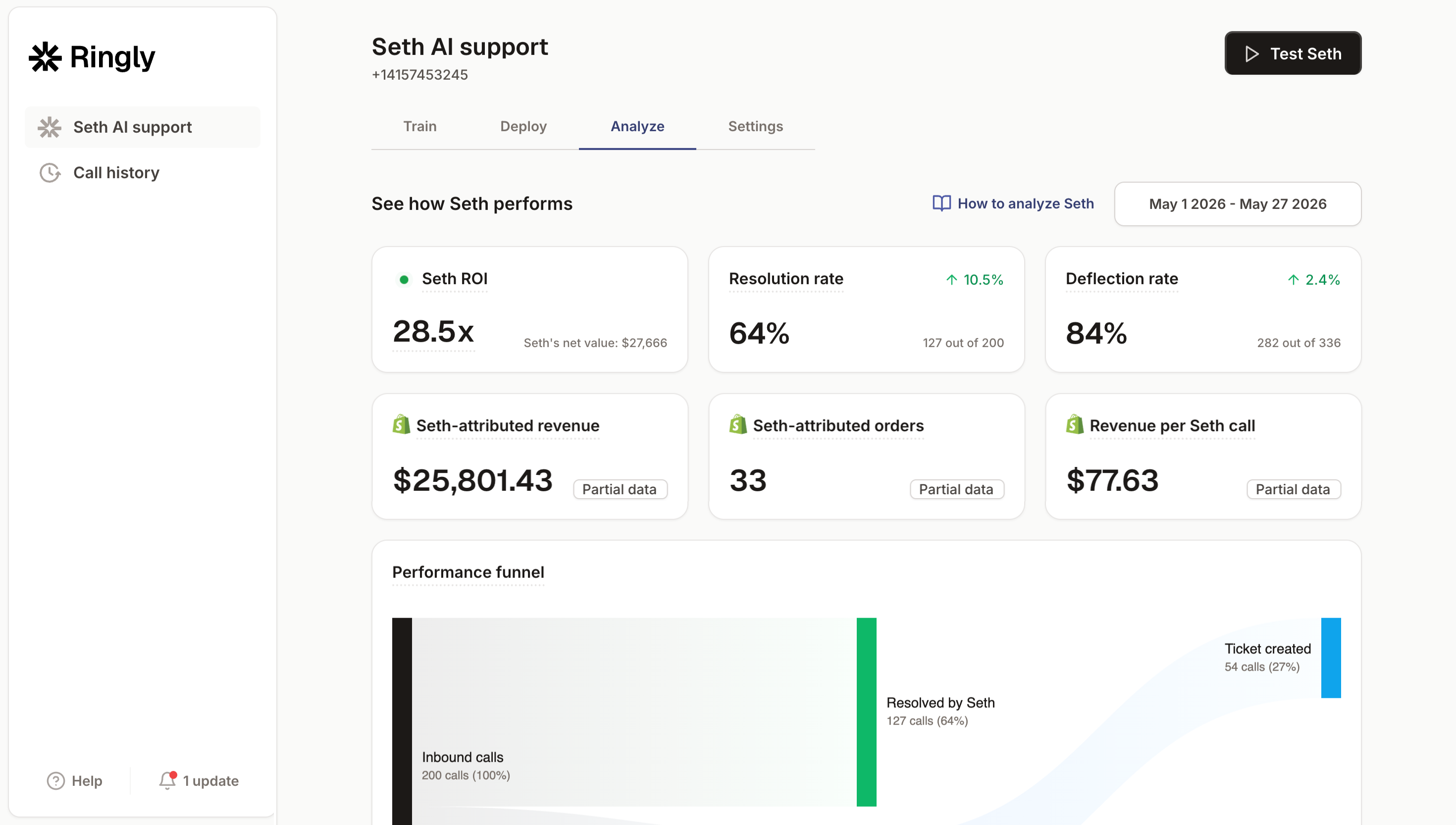
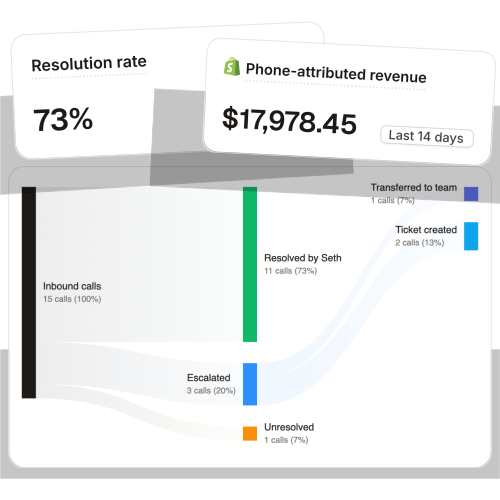
Across 50+ brands, the AI resolves about 73% of calls on its own, at roughly $0.42 per resolved call. That's the routine layer running 24/7, so evenings, weekends, and the December spike are covered without a seasonal hire. Your team keeps the transfer and escalate buckets, which is the work they were actually hired to do. If you want the deeper version, see how the AI customer support phone agent for Shopify plugs into your existing Shopify customer service app stack.
It is not a replacement for legacy phone tools like Aircall, Dialpad, or RingCentral in the sense that those route calls but don't resolve anything on their own. Ringly answers and resolves. Plans run Grow at $349/mo and Pro at $799/mo, with Enterprise set by call. Live in under an hour, and there's a 65% resolution guarantee: if the AI resolves under 65% of your calls in 90 days, we refund the last 3 months.
Frequently asked questions
How many calls does a DTC coffee brand actually get? More than most ecommerce verticals, because the demographic skews older and many customers prefer the phone. A $20M brand commonly fields several hundred calls a week, climbing sharply in Q4 when gift orders spike. The exact number depends on how visible your phone number is and how much your buyers lean on it.
Can you take coffee orders over the phone with AI? Not natively, and that's the honest answer. Phone orders sit in the transfer bucket: the call hands off to a rep or to an SMS payment link rather than the AI taking a card by voice. If a large share of your revenue is phone orders, tell us on a call and we'll be straight about fit.
Will older coffee customers accept an AI phone agent? This is the sharpest objection in coffee, and it comes down to voice quality. The most common thing customers say after a Ringly call is "you don't sound like AI." For the routine calls, older buyers care that they got a clear, fast answer, not who gave it.
How do you handle after-hours coffee calls? You put a 24/7 layer on the resolve bucket so evenings and weekends are covered without a night shift. The alternative is voicemail, and most callers who hit voicemail just hang up. The escalate calls that come in after hours get logged and queued for your team the next morning.
How do you handle subscription cancellations on the phone? Split them. Simple changes (skip a box, change frequency) resolve in seconds. A true cancel with a "save" opportunity goes to a person, because retention is worth a human conversation. Trying to fully automate the cancel call is how you lose customers you could have kept.
How fast can a coffee brand set up phone support like this? Live in under an hour for the basics. You add your website, docs, or knowledge base, connect Shopify, and the AI is ready to take the resolve-bucket calls. Tuning the escalation rules for your taste-and-damage calls takes a little longer and we help with that.
Talk to us

If you run a $10M-$100M Shopify coffee brand and the phone goes to voicemail after 6 p.m., a 30-min call is the fastest way to see what your evenings, weekends, and Q4 are leaving on the table. We'll sort your real call logs into the five types and show you what lands in each bucket.
The 3-layer guarantee.
- Live in 14 days or it's free until launched.
- 65% resolution in 90 days or we refund the last 3 months of subscription fees.
- We keep working free until we hit 65%.
Ruben (Ringly co-founder) takes these calls personally.