
Building customer service for a cosmetics brand is not a headcount problem. It's an org-design problem.
- How to structure the team by call type (tier 1, tier 2 beauty advisor, escalation owner), not by raw headcount.
- The next-hire trigger math, the channel you're probably ignoring, the KB and escalation rules, and the 6 metrics that actually matter.
- Built for founders, COOs, and Heads of CX at $10M-$100M Shopify cosmetics brands running a paid helpdesk and a visible phone line.
Most articles about customer service for cosmetics brands are written for the marketing team. They talk about personalization, brand voice, and how 89% of shoppers leave after one bad experience. All true. None of it tells you how to actually build and run the function.
This is the operator version. I read the call logs from beauty brands running on Ringly, and the same five questions run the entire queue: where's my order, can I return this, which shade, is this safe for my skin, how do I cancel. On one brand, WashCo, the AI handled 271 of those calls in the first 7 days at $0.91 a call versus $2.70 for a human-handled one. That gap is the whole game, and it's where most cosmetics CS teams quietly bleed payroll.
If you run customer experience at a Shopify cosmetics brand doing $10M-$100M, you already know the launch-week queue and the voicemails nobody returns by Monday. This is what 50+ brands we work with do with theirs. Book a 30-min call and we'll show you what your store is leaving on the table after-hours.
In this post:
How I built this playbook
I'm Ruben, co-founder of Ringly. We run AI phone support for 50+ Shopify brands, so I spend most weeks inside real call data, not survey decks. For this guide I pulled the call patterns from the beauty and cosmetics brands on our platform, counted what actually fills the queue, and matched it against the team-size and ticket-volume benchmarks operators use to plan headcount.
Where I name a number, it's either from our dashboard or from a sourced industry study, and I say which. I left out the advice that sounds good on a panel but falls apart the first time a customer calls about a reaction to a serum. Those calls are the ones that decide whether your CS function is built right.
Where a cosmetics CS function breaks as you scale
The thing that makes cosmetics support hard isn't volume. It's the shape of the volume.
A cosmetics brand's CS load is bimodal. There's a steady baseline of WISMO, returns, and "is this in stock" that never stops. Then there are the spikes: an influencer posts, a shade drops, BFCM hits, and call volume goes vertical for 48 hours. Beauty brands see launch spikes of 5 to 10x normal volume in two days, and during BFCM support volume jumps 80% or more for most stores, with some seeing 2-4x (Health & Beauty was 16% of all Shopify BFCM sales in 2025).
A team you staff for the launch spike sits idle nine months of the year, and a team you staff for the baseline drowns the week you most need it. That's the trap, and no amount of "hire great people" fixes it.
Then there's the second structural problem: returns. Makeup carries a 12-15% return rate because sensory mismatch is unavoidable. Wrong shade, wrong undertone, didn't work for my skin. Virtual try-on tools only cut that 10-25%, so a real chunk of your queue is post-purchase friction baked into the category (Eightx return-rate data).
The fix isn't a bigger team. It's an org designed around the three kinds of call you actually get. WashCo runs at $0.91 per call on the routine volume, which is what frees a human team to handle the calls that are genuinely hard.
How to structure the team
Stop thinking in headcount. Think in call types. A cosmetics CS function has three, and they need different people and different rules.
- Tier 1: the routine queue. Order status, WISMO, returns, exchanges, "is this in stock", how to cancel a subscription. This is 70-80% of your volume and almost none of it needs judgment. It needs speed and accuracy.
- Tier 2: the beauty advisor. Shade and undertone matching, ingredient questions, routine-building, "will this work for my skin." These are consultative, semi-sales calls. The rep needs product depth, not just a macro. This is where loyalty and AOV get made.
- Tier 3 / escalation owner: the hard calls. Adverse reactions, allergies, a distressed customer, a public complaint. One named person owns the escalation path and the SLA. These never get triaged by a junior rep.
The org chart for a cosmetics brand should map to call type, not to a generic support box. Most brands hire a flat row of reps and then wonder why shade consults get rushed and reaction calls get fumbled. The structure is the product.
For the consultative tier specifically, beauty operators we talk to repeatedly flag one thing: customers want to feel like they're talking to a real person who knows the line. A scripted Tier 1 rep reading shade codes off a sheet loses that. So the design rule is simple: automate or templatize Tier 1 hard, invest your best humans in Tier 2, and protect Tier 3 with a real escalation policy. We get into the escalation rules below, and our knowledge base feature page shows how the routine layer pulls answers without a human.
When to make your next hire
Here's the math nobody in the SERP will give you, because the vendor pages want you to outsource and the news lists don't care.
A founder or product lead can usually handle support alone up to roughly 200-400 tickets a month. Past that, the founder is the bottleneck and you make your first dedicated hire. After that, the planning number is tickets per agent per day. The modern realistic target is 25-35 tickets per agent per day, or about 600-900 a month, with the caveat that CSAT and first-contact resolution matter more than raw count (per Companysights and eDesk benchmarks).
So the next-hire trigger is straightforward: when your sustained daily volume divided by your team size pushes each rep past about 35 tickets a day for more than a couple weeks, you're about to hire. But the better operators ask a different question first: is this volume routine, or is it the kind of work a system should be handling?
That matters because hiring is expensive and sticky. A US rep runs about $4,000/month loaded; offshore around $2,000. And replacing one CS rep costs $14,113 on average, with industry turnover at 31.2% (Gartner via Insignia). Beauty CS reps burn out fast in launch season, so that replacement cost is not theoretical.
The reframe: if the rep you're about to hire would mostly do WISMO and returns, you're hiring a human to do work a system handles at a fraction of the cost. Hire for Tier 2 depth. Let the routine layer scale without payroll. Many ecommerce brands absorb 2-3x their normal volume without adding headcount by routing the repeatable stuff away from people. If you're weighing the team-vs-system tradeoff, our take on outsourcing Shopify customer service walks the full math.
Designing your channels (and the one most beauty brands ignore)
Most DTC cosmetics brands pour everything into chat and email and treat phone as legacy. That's backwards for a category where the purchase is high-consideration and personal.
For products over $50, customers want reassurance before they buy, and a lot of them want to hear a voice. Multichannel customers spend about 10% more than single-channel shoppers, and the phone is the channel beauty brands most consistently underbuild. The brands that win aren't running more channels. They're running the right ones well.
- Chat and email carry the asynchronous routine load. Good for WISMO, returns labels, order edits.
- Phone carries the high-intent, high-anxiety calls: pre-purchase shade reassurance, "is this safe", the older or VIP customer who won't type. This is the channel most cosmetics brands leave on voicemail after 6 p.m.
- Social and SMS catch the launch-day surge and the "send me a picture of the shade" request that's common in beauty.
The channel you're ignoring is the one your highest-AOV customers reach for when they're nervous about a $60 purchase. If your phone rolls to voicemail after hours, those calls don't wait, they buy from someone who picks up. There's a separate question of which helpdesk to run underneath all this; we cover that in the customer service software breakdown for Shopify so this playbook can stay focused on the function itself.
One beauty-specific note on phone: brand voice is everything here, and some founders worry an AI voice can't carry it. The voice library plus a brand-voice knowledge base handles most of that, and the most repeated thing customers say after a call is that it doesn't sound like AI.
Build the knowledge base and macro library
This is the unglamorous work that makes everything above run. Without it, every rep improvises and your brand voice fragments.
Structure the knowledge base so a human or a system can search it three ways: by product, by ingredient, and by concern. Then build ingredient cheat sheets for the questions that come up daily: parabens, sulfates, fragrance, retinol, common allergens. Connect your product database to your support tools so reps pull live stock and order data instead of guessing.
- Macros for the top 10 questions. Identify your most frequent inquiries, write clear standard responses, and bake your brand vocabulary in. About 70% of your volume is repeatable; macros are how you answer it consistently without sounding like a robot.
- Ingredient cheat sheets so a Tier 1 rep can answer "does this have fragrance" without escalating.
- A brand-voice guide the KB enforces, so the answer sounds like your brand whether a human or a system sent it.
"My customers also feel like it's a normal person. They feel like they can communicate if they have questions."
— Claudia Droge, TechCraft Studio
A knowledge base built by product, ingredient, and concern is what lets you automate the routine layer without losing the voice. That's also exactly what an AI phone agent needs to resolve calls, which is why this step pays off twice.
Write the escalation matrix (the beauty-specific calls)
This is the section the marketing-team articles skip, and it's the one that protects your brand.
Cosmetics has calls that must never auto-resolve and must never sit in a Tier 1 queue. Write the rules down before you need them.
- Adverse reaction or allergy. Hard escalation to a trained human, fast SLA, logged every time. The customer is scared and possibly hurt. This is non-negotiable and never gets a macro.
- Shade mismatch or "wrong for my skin" return. Route to Tier 2, not Tier 1. It's a consult and a retention moment, not a returns-label transaction.
- Distress or public-complaint flag. Any call or message with anger, a threat to post publicly, or visible distress jumps the queue to your escalation owner.
The escalation matrix is what keeps an automated routine layer safe: it defines, in writing, the calls a system hands straight to a human. Get this right and you can automate aggressively on Tier 1 without ever risking the call that ends up on Twitter. Our smart call transfer is built around exactly these handoff rules.
Staffing the launch-drop and BFCM peak
Back to the bimodal load, because this is where most cosmetics CS budgets get wrecked.
A launch or influencer moment can drive 5-10x normal call volume inside 48 hours. BFCM pushes support volume up 80% or more, sometimes 2-4x. If you staff for that peak, you carry idle payroll for the other nine months. If you don't, your team is underwater exactly when the brand is most visible.
The disciplined move is to forecast from your last drop, not from a spreadsheet guess. Pull the call volume from your previous launch, your previous BFCM, and size the routine layer to absorb it automatically. Keep your human team sized for Tier 2 depth and the escalation load, and let the routine surge get handled by a system that doesn't need overtime.
The call makes sense if:
- You're a Shopify (or Shopify Plus) cosmetics brand doing $10M-$100M
- You run a paid helpdesk (Gorgias, Zendesk, Gladly, Re:amaze, or Intercom)
- You have a visible phone number on your store
- Your CS team is 3-12 people
If that's you, the math usually works. Book a 30-min call and we'll run it live on your store.
What happens on the call.
- We pull your last 7 days of missed calls live, on the call. No homework for you.
- We show you the recovered revenue at typical resolution rates we see for cosmetics brands.
- You decide if it's worth a deeper conversation. No deck, no follow-up sequence.
If your launch weeks are the thing breaking your team, book a 30-min call and we'll map what the routine surge looks like on your store.
What this costs a $50M cosmetics brand during a launch
Cosmetics brands don't run on a steady-state team. They run hot during launches and crawl between them. A typical $50M brand staffs 8 reps to handle the launch month and pays the load year-round:
| Line item | Today | With Ringly |
|---|---|---|
| 8 reps × $4K loaded per rep | $32,000/mo | — |
| Ringly handles the launch surge (~$8K/mo) | — | $8,000/mo |
| Net monthly CS spend on the routine layer | $32,000/mo | $8,000/mo |
| Monthly savings | — | ~$24,000/mo |
| Annual savings | — | ~$288,000/yr |
That's roughly $384K a year for a team that's idle nine months of the twelve. Shift the routine surge to a system and you stop paying eight reps to wait for the next drop. Your humans still own the shade consults and the reaction calls, they just stop drowning in WISMO. Want the numbers run on your actual volume? Book a 30-min call and we'll do the math live.
The 6 customer service metrics that actually matter
If you measure everything, you manage nothing. For a cosmetics brand, six numbers tell you whether the function is healthy.
- First response time (FRT). Chat in seconds, email under an hour, phone answered live. Beauty shoppers expect near-immediate responses.
- CSAT. Industry average sits around 78%; aim for 85%+. 88% of high-performing companies use CSAT as their primary measure (Klaviyo).
- First-contact resolution (FCR). Average is 70%, top performers hit 85%. Low FCR in beauty usually means your KB and Tier 2 routing are weak.
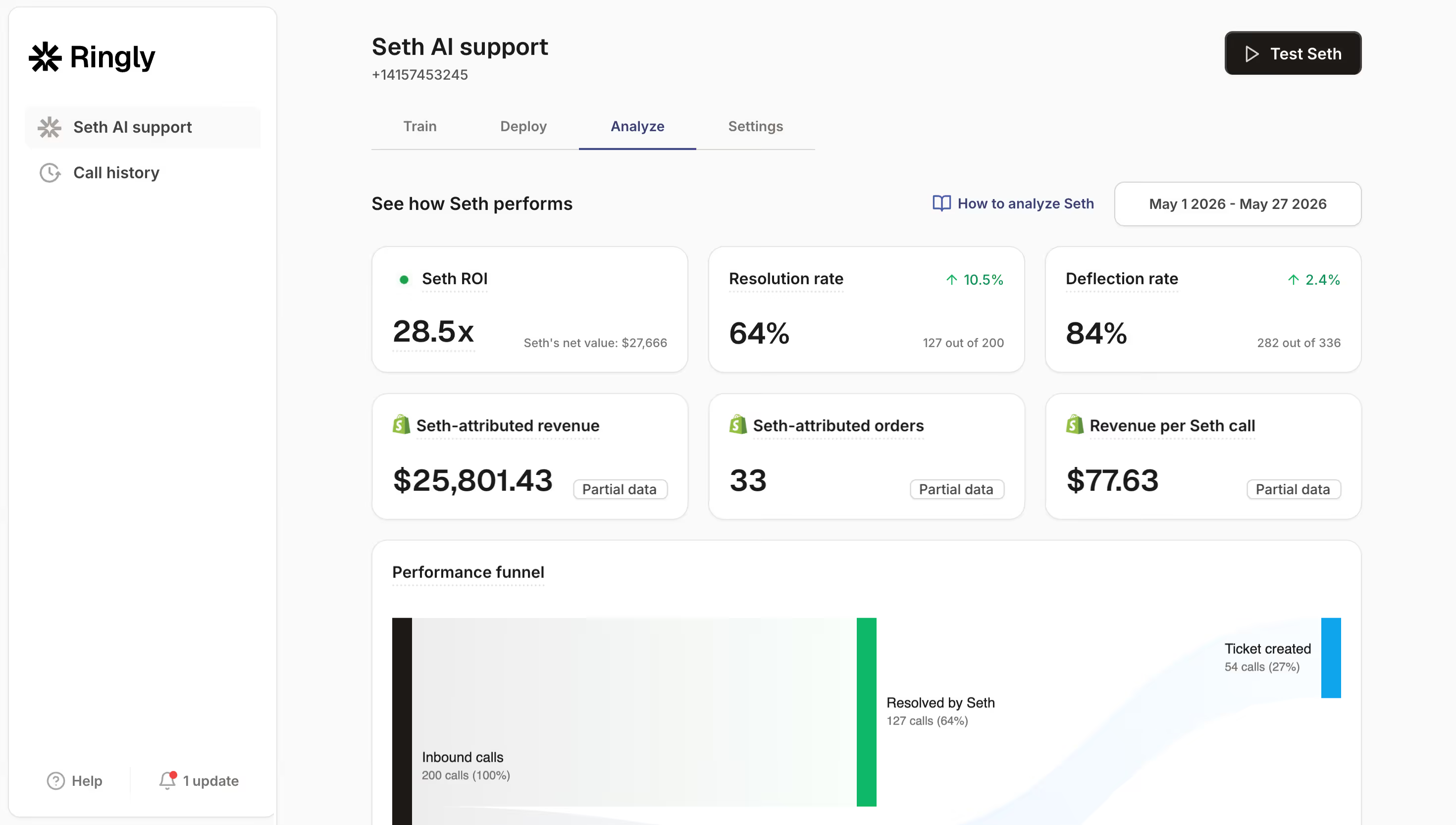
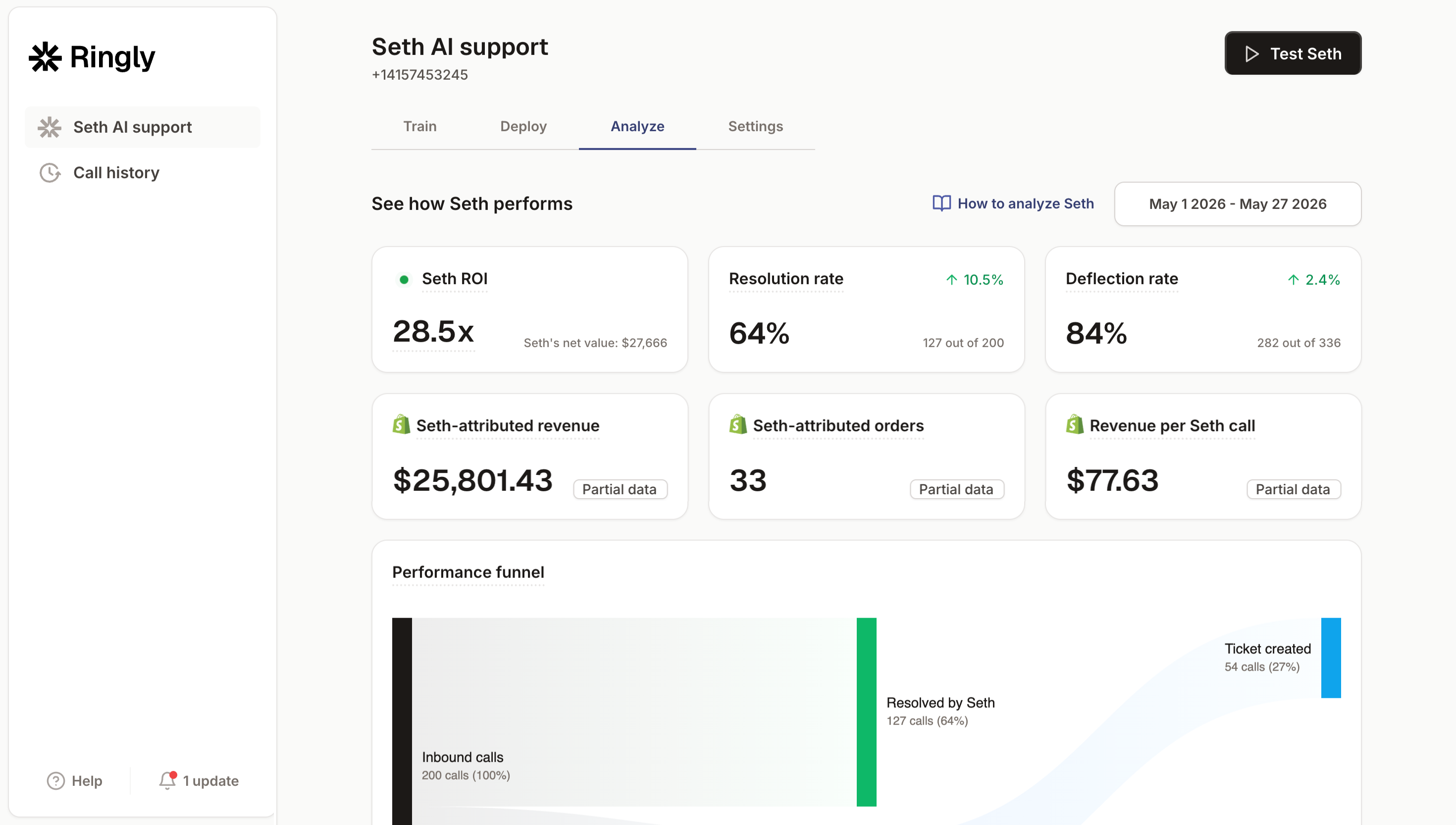
- Resolution rate. What share of contacts get fully closed without bouncing around. Our routine layer resolves 73% of calls autonomously across 50+ brands.
- Return rate. Track it as a CS signal, not just a logistics one. A spike on a specific shade tells you the product page is mismatched.
- Cost per contact. In-house runs about $2.70 per call loaded. Our routine layer runs roughly $0.42 per resolved call, and WashCo specifically came in at $0.91 per call.
The metric most cosmetics brands underweight is cost per contact, because it's the one that exposes how much payroll is going to work a system could do. If you only add one number to your dashboard this quarter, add that one. For a deeper benchmark set, our guide to ecommerce customer service and ecommerce customer retention both go further.
Where AI fits in a cosmetics CS function
By now the placement should be obvious. AI takes the routine layer. Humans keep the consult and the crisis.
Concretely: an AI phone agent answers the inbound calls, finds orders in your Shopify store, processes returns and exchanges, answers product and ingredient questions from your knowledge base, and rescues abandoned carts. It handles WISMO, "is this in stock", and "how do I cancel." When a call is a shade consult or, especially, an adverse-reaction report, it escalates cleanly to your team via the rules you wrote in the escalation matrix.
Ringly.io is AI phone support for Shopify brands. The phone shouldn't be a tax on your support team. The AI answers inbound calls 24/7, escalates cleanly to Gorgias, Richpanel, Re:amaze, or whatever helpdesk you already run, and goes live in under an hour. Across 50+ brands it resolves 73% of calls autonomously at roughly $0.42 per resolved call.
TechCraft Studio handles 88% of calls without a human, and BioLongevity Labs resolves 79% autonomously. Those are cross-vertical numbers, but the pattern holds in beauty: the routine layer is automatable, and the human team gets its time back for the calls that need a person. If you want the full deep-dive on the automation specifically, we wrote a cosmetics brand AI customer service post and an AI phone support for cosmetics brands breakdown. For the broader picture of how the function looks, our beauty brand customer service strategy and the common beauty support challenges posts are the companions to this one.
Pricing, if you're scoping it: Grow is $349/mo, Pro is $799/mo, and Enterprise is by call. Plans on the pricing page carry a 65% resolution guarantee. And if WISMO is the bulk of your queue, our WISMO calls guide and returns management guide are worth a read.
Frequently asked questions
When should a cosmetics brand make its first customer service hire? Most founders can handle support solo up to roughly 200-400 tickets a month. Past that, the founder becomes the bottleneck and it's time for a dedicated rep. After the first hire, plan around 25-35 tickets per agent per day as the threshold for adding the next one.
How should I structure a beauty customer service team? Structure by call type, not headcount. Tier 1 handles routine WISMO, returns, and order questions; Tier 2 are trained beauty advisors who handle shade, ingredient, and routine consults; and one named escalation owner handles adverse reactions and distressed customers. Most brands wrongly hire a flat row of reps and rush the consultative calls.
Do cosmetics brands need phone support or is chat enough? Phone matters more in beauty than most operators think. For products over $50, customers want voice reassurance before buying, and multichannel customers spend about 10% more. Most brands underbuild phone and leave high-intent calls on voicemail after hours.
How do I handle adverse-reaction and allergy calls? These get a hard escalation to a trained human, a fast SLA, and a logged record every time. They should never sit in a Tier 1 queue or get answered by a macro. Write the rule into your escalation matrix before you need it.
What customer service metrics matter most for a beauty brand? First response time, CSAT (aim for 85%+), first-contact resolution (70% average, 85% top performers), resolution rate, return rate, and cost per contact. Cost per contact is the one most brands underweight, and it's the one that exposes payroll spent on work a system could do.
How do I handle the launch-drop or BFCM spike without overhiring? Forecast from your last drop instead of guessing, then size the routine layer to absorb the surge automatically. Keep your human team sized for Tier 2 consults and escalations, and let a system handle the repeatable surge so you're not carrying idle payroll the rest of the year.
Where does AI fit in cosmetics customer service? AI takes the routine layer: order status, returns, product and ingredient questions, abandoned-cart rescue, and after-hours phone coverage. Humans keep the shade consults and the adverse-reaction calls. The escalation matrix defines exactly which calls hand off to a person.
Talk to us

If you run a cosmetics brand on Shopify and your CS team spends launch week underwater, a 30-min call is the fastest way to see what the AI would take off their plate.
The 3-layer guarantee.
- Live in 14 days or it's free until launched.
- 65% resolution in 90 days or we refund the last 3 months of subscription fees.
- We keep working free until we hit 65%.
Ruben (Ringly co-founder) takes these calls personally.