

Chatfuel has been a go-to chatbot platform since 2015, helping over 7 million businesses automate conversations on Facebook Messenger and Instagram.
But times have changed. Businesses now need more than social media automation. They want true AI capabilities, omnichannel support, and deeper integrations.
If you're hitting Chatfuel's limits, you're not alone. The platform's narrow channel focus and basic AI features are pushing users to explore alternatives.
This guide covers 7 platforms that solve these problems, with real pricing and specific use cases to help you choose.
Editor’s note: Want to hear some sample AI support calls made for your Shopify store?
- Just paste your store URL
- Hear sample calls for your store (no email required)
- Listen to demo calls for my store
What is Chatfuel?
Chatfuel launched in 2015 as one of the first chatbot builders for Facebook Messenger. It quickly became popular for Instagram automation too, offering a visual flow builder that let non-technical users create chatbots without coding.
The platform works well for basic social media automation. But it has significant gaps. Chatfuel offers limited AI (mostly rule-based flows), no native website chat, and minimal integrations with CRMs or e-commerce platforms. Conversations don't carry context across sessions, and customization options are limited for complex workflows.
These limitations explain why businesses are looking elsewhere.
Quick Comparison: All 7 Chatfuel Alternatives
| Platform | Best For | Starting Price | Key Strength |
|---|---|---|---|
| Ringly.io | AI phone support | From $99 a month (50 conversations included) | Handles up to 90% of calls autonomously |
| ManyChat | Social media marketing | Free | Best Instagram/Facebook automation |
| Tidio | E-commerce live chat | Free | AI + human handover combined |
| Botpress | Developer AI projects | Free | Most advanced AI customization |
| UChat | Omnichannel deployment | Free | One bot across 15+ channels |
| Chatbase | Quick AI setup | Free | Train on documents in minutes |
| Wati | WhatsApp focus | $39/mo | Complete WhatsApp Business API |
The 7 Best Chatfuel Alternatives
1. Ringly.io
Best for: E-commerce businesses needing AI phone support

Ringly.io takes a different approach from typical chatbot platforms. Instead of text-based chat, we specialize in AI phone agents. Our product, the AI, handles inbound customer calls 24/7. It answers questions, looks up orders, processes returns and exchanges, and only escalates to your team when necessary.
The numbers speak for themselves. The AI resolves up to 90% of calls without human intervention, across 200,000+ calls handled so far. The platform supports 30 languages and integrates deeply with Shopify for real-time order data.
Pricing:
| Plan | Monthly Price | Included | Key Features |
|---|---|---|---|
| Pay per call | $99 a month | 50 conversations, then $1.99 each | Seth on your support line 24/7; spam, hang-ups and wrong numbers are free |
Each conversation after the first 50 costs $1.99. Ringly.io is free to try.
Pros:
- True phone support automation (not just chat)
- Handles complex e-commerce tasks like returns
- Multilingual support across 30 languages
- quick setup with no technical skills needed
Cons:
- Phone-focused (not for chat-only businesses)
- Requires Shopify for full feature set
2. ManyChat
Best for: Marketing automation on Instagram and Facebook

ManyChat is the most popular alternative for businesses heavily invested in Meta platforms. Founded in 2015, it now serves over 1 million businesses worldwide. The platform's visual flow builder is more intuitive than Chatfuel's, and the multi-channel support extends beyond social media to WhatsApp, SMS, and Telegram.
What sets ManyChat apart is its growth tools. The platform can automatically reply to comments on your posts, respond to Instagram story mentions, and generate QR codes for offline-to-online engagement. These features make it particularly valuable for marketers focused on lead generation.
Pricing:
| Plan | Monthly Price | Annual Price | Key Features |
|---|---|---|---|
| Free | $0 | $0 | 1,000 contacts, basic channels |
| Pro | $15 | $180/year | Unlimited contacts, all channels, A/B testing |
| AI Add-on | +$29 | +$348/year | AI Assist for message generation |
Pros:
- Best Instagram automation capabilities available
- Affordable scaling with unlimited contacts on Pro
- Extensive template library for quick deployment
- Strong focus on marketing and lead generation
Cons:
- No native website chat widget
- AI capabilities limited compared to dedicated AI platforms
- Separate message counts per channel
3. Tidio
Best for: E-commerce stores needing both AI and live chat

Tidio combines the best of both worlds: AI-powered automation through its Lyro assistant, plus real human support through integrated live chat. Founded in 2013 and serving over 300,000 businesses, Tidio has built particularly strong e-commerce integrations.
The platform shines for Shopify stores. Lyro can handle order tracking queries, recommend products, and recover abandoned carts. When conversations need a human touch, the handover is seamless. The unified inbox means your team sees AI and human conversations in one place.
Pricing:
| Plan | Monthly Price | Annual Price | Key Features |
|---|---|---|---|
| Free | $0 | $0 | 50 conversations, 3 operators |
| Starter | $29 | $348/year | 100 conversations, unlimited operators |
| Growth | $59 | $708/year | 250 conversations, Lyro AI (50 convos) |
| Tidio+ | $749+ | Custom | Custom volume, dedicated support |
Pros:
- Excellent Shopify integration with deep e-commerce features
- Seamless bot-to-human transition
- Fast setup with pre-built templates
- Combines AI and live chat in one platform
Cons:
- Higher-tier plans get expensive for small businesses
- Limited social media marketing features compared to ManyChat
- AI conversation limits on lower-tier plans
4. Botpress
Best for: Developers and enterprises needing advanced AI

Botpress is an open-source AI agent platform built for technical teams. Founded in 2017, it processes over 1 billion LLM tokens per hour. Unlike no-code tools, Botpress offers deep customization through code injection, custom APIs, and a proprietary LLMz inference engine.
The platform supports sophisticated use cases. Knowledge bases let agents reference uploaded documents. The AI can summarize conversations, translate between languages, and even understand images. With 100+ integrations including HubSpot, Salesforce, and Zendesk, Botpress fits into complex enterprise workflows.
Pricing:
| Plan | Monthly Price | Annual Price | Key Features |
|---|---|---|---|
| Free | $0 | $0 | 500 messages, 1 bot |
| Pay-as-you-go | From $5 | Varies | Per-message pricing |
| Plus | $89 | $1,068/year | 5,000 messages, unlimited bots |
| Team | $495 | $5,940/year | 50,000 messages, priority support |
| Managed | From $1,495 | Custom | Custom AI agents built by Botpress |
Pros:
- Open-source foundation with maximum customization
- Advanced AI with knowledge bases and context management
- Developer-friendly with code injection and API access
- Strong enterprise features with SLA guarantees
Cons:
- Steep learning curve for non-technical users
- Requires technical knowledge for advanced features
- More complex setup compared to no-code alternatives
5. UChat
Best for: True omnichannel deployment across 15+ channels

UChat solves a specific problem: deploying one bot across every channel your customers use. While most platforms require separate bots for different channels, UChat lets you build once and deploy everywhere. This includes Facebook Messenger, Instagram, WhatsApp, Telegram, SMS, web chat, WeChat, and Line.
The platform serves businesses in 100+ countries and offers 50+ integrations. Built-in ChatGPT integration adds AI capabilities without complex setup. For agencies, white-label options and client management features make it easy to manage multiple accounts.
Pricing:
| Plan | Monthly Price | Annual Price | Key Features |
|---|---|---|---|
| Free | $0 | $0 | 1 bot, 100 subscribers |
| Pro | $15 | $180/year | 5 bots, 5,000 subscribers |
| Partner | $199 | $2,388/year | Unlimited bots, agency features |
Pros:
- Widest channel support in the market
- True omnichannel (one bot, all channels)
- Strong agency and white-label capabilities
- Affordable pricing for small businesses
Cons:
- Interface can overwhelm beginners
- Less polished UI compared to competitors
- Limited native AI beyond ChatGPT integration
6. Chatbase
Best for: Quick AI deployment without flow building

Chatbase takes a different approach from traditional chatbot builders. Instead of creating flows and decision trees, you simply upload documents or add URLs. The AI trains on your content in minutes and starts answering questions naturally. No visual builder required.
Founded in 2023, Chatbase has already attracted over 10,000 businesses including major brands like Sage, Chuck E. Cheese, and Miele. The platform supports multiple LLMs including GPT-4, Claude, and Gemini. AI Actions let you connect to external APIs for order lookups and other tasks.
Pricing:
| Plan | Monthly Price | Annual Price | Key Features |
|---|---|---|---|
| Free | $0 | $0 | 50 messages, 1 agent, 400KB data |
| Hobby | $32 | $384/year | 500 messages, 2 members, 10MB per agent |
| Standard | $120 | $1,440/year | 4,000 messages, API access |
| Pro | $400 | $4,800/year | 15,000 messages, advanced analytics |
Pros:
- Fastest setup time (minutes vs hours)
- No flow building needed
- Strong AI with multiple LLM options
- Trusted by major enterprises
Cons:
- No visual flow builder for structured conversations
- Limited marketing automation features
- No live chat capability (AI-only)
7. Wati
Best for: WhatsApp-focused businesses
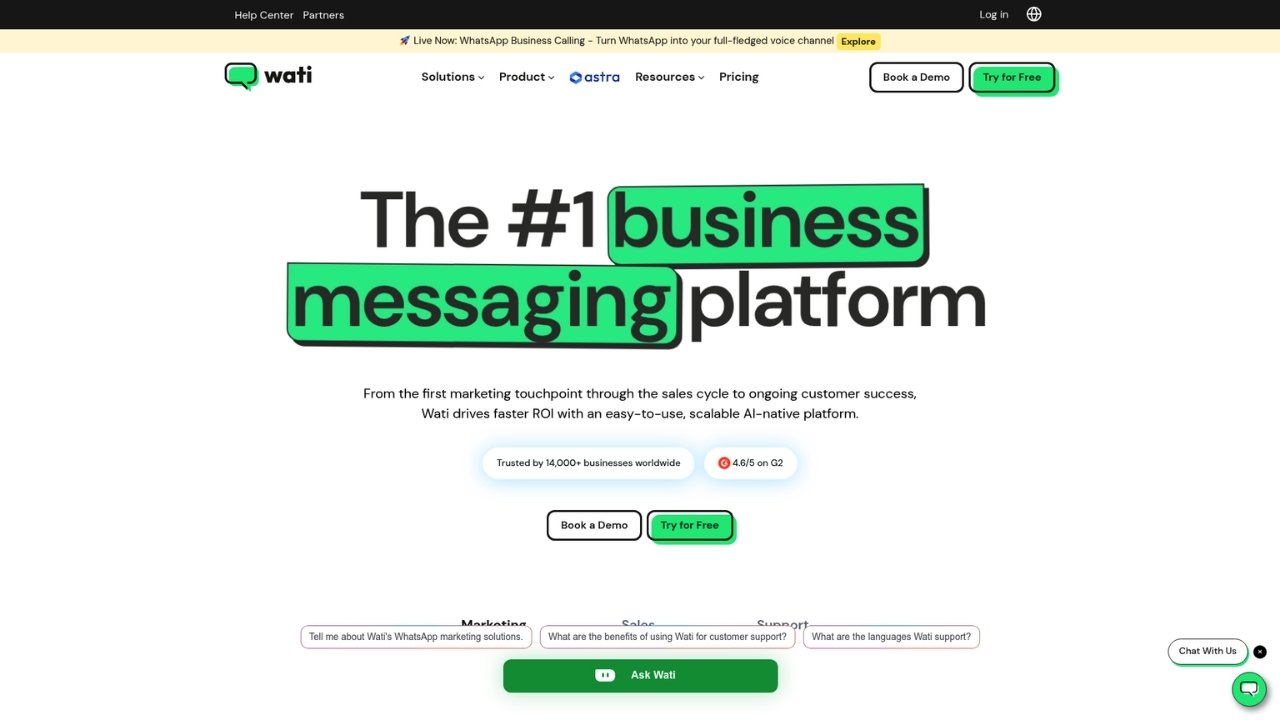
Wati is an official Meta Business Partner for WhatsApp Business API. With over 16,000 customers across 100+ countries, the platform focuses exclusively on making WhatsApp work for business communication. This specialization shows in features like broadcast messaging, shared team inboxes, and compliance with WhatsApp's strict policies.
The platform includes KnowBot AI for automated responses and integrates with Shopify and WooCommerce for e-commerce use cases. For markets where WhatsApp dominates customer communication (India, Brazil, Southeast Asia), Wati offers the most complete solution.
Pricing:
| Plan | Monthly Price | Annual Price | Key Features |
|---|---|---|---|
| Growth | $39 | $468/year | 1,000 conversations, 5 users |
| Pro | $89 | $1,068/year | 5,000 conversations, 10 users |
| Business | $279 | $3,348/year | 20,000 conversations, 25 users |
Note: WhatsApp conversation fees from Meta are charged separately.
Pros:
- Official WhatsApp Business API provider
- Complete WhatsApp solution with broadcasts and team inbox
- Strong e-commerce integrations
- Affordable entry point
Cons:
- WhatsApp-only (no other channels)
- WhatsApp conversation fees add to total cost
- Limited AI capabilities compared to dedicated AI platforms
How to Choose the Right Chatfuel Alternative
Picking the right platform depends on your specific needs. Here's a simple framework:
Start with your primary channel:
- Phone support is your main channel? Consider Ringly.io.
- Instagram and Facebook drive your business? Look at ManyChat.
- WhatsApp dominates your market? Wati is purpose-built for this.
- Need to be everywhere? UChat offers the widest channel support.
Consider your technical resources:
- No technical team? Stick with ManyChat, Tidio, or Chatbase.
- Have developers available? Botpress offers the most power.
Factor in AI requirements:
- Need sophisticated AI with knowledge bases? Botpress or Chatbase.
- Want AI plus human backup? Tidio handles this well.
Migration tips from Chatfuel:
- Export your subscriber lists before canceling
- Rebuild critical flows in the new platform before going live
- Run both platforms parallel for a week to catch issues
- Notify subscribers of the change via your existing Chatfuel bot
Final Thoughts: Finding Your Best Chatfuel Alternative
Chatfuel served businesses well for years, but the chatbot landscape has evolved. The alternatives above offer more channels, better AI, and deeper integrations. Your choice depends on where your customers are and what level of automation you need.
For businesses handling phone support, especially e-commerce stores on Shopify, Ringly.io offers something unique. The AI handles the repetitive calls so your team can focus on complex issues. Try Ringly.io for free and see how AI phone support can transform your customer service.
Frequently Asked Questions
Which Chatfuel alternative is best for small businesses?
For small businesses, ManyChat and UChat offer the best value with generous free plans. If you need live chat, Tidio is a solid choice. For phone support, Ringly.io begins at $99 a month for the first 50 conversations, then $1.99 each.
Can I migrate my Chatfuel subscribers to another platform?
Most platforms allow you to export subscriber lists from Chatfuel, but you'll need to rebuild your flows and automation in the new platform. Some platforms like ManyChat offer migration guides specifically for Chatfuel users.
Do any Chatfuel alternatives offer better AI capabilities?
Yes. Botpress, Chatbase, and Tidio with Lyro all offer significantly more advanced AI than Chatfuel's rule-based system. These platforms use modern LLMs for natural conversation understanding.
What is the most affordable Chatfuel alternative?
ManyChat, UChat, Tidio, and Chatbase all offer free plans with meaningful functionality. For paid plans starting under $20 per month, ManyChat Pro at $15 and UChat Pro at $15 are the most affordable.
Which Chatfuel alternative works best for e-commerce?
For e-commerce, Tidio excels at live chat and Shopify integration. Ringly.io is ideal for stores receiving phone orders or support calls. ManyChat works well for social commerce on Instagram and Facebook.
Are there any Chatfuel alternatives that support phone calls?
Most alternatives focus on text-based chat. Ringly.io is specifically built for AI phone support, handling inbound calls with natural conversation. This makes us unique among Chatfuel alternatives for businesses where phone remains an important channel.