
$18 billion is lost every year because online stores can’t catch shoppers at the exact moment they’re ready to buy or have a quick question.
You are maybe also feeling the weight of a team that’s stretched too thin to answer every ring.
It feels like you have to choose between hiring a small army of support agents or watching your hard-earned traffic walk away to a competitor.
But there is a fix.
This guide will go over how to automate 74% of your phone support.
We will compare Callfy.ai to Ringly.io to see which fits your strategy.
Then, we break down the pricing and features so you can pick the right partner for your brand's growth.
Editor’s note: Want to hear some sample AI support calls made for your Shopify store?
- Just paste your store URL
- Hear sample calls for your store (no email required)
- Listen to demo AI calls for my store
Callfy.ai vs. Ringly.io: Core differences
Even though both tools use conversational AI to talk to customers, they have very different jobs. It's like comparing a salesperson to a customer support manager.
One focuses on closing deals and bringing in revenue, while the other is all about solving problems and keeping customers happy for the long run.
What is Callfy.ai?

Callfy.ai is a highly specialized AI tool with one main job: recovering abandoned carts. It isn't there to answer general support questions; it’s there to win back lost sales.
Here’s how it works. When a customer adds items to their cart but leaves without buying, Callfy.ai gets to work. It makes proactive outbound calls and sends SMS messages to that customer.
The AI then starts a natural, persuasive conversation to find out why they left. Was shipping too expensive? Did they get distracted? Was the price a little steep?
Depending on the conversation, it can offer a custom discount code or just a friendly nudge to get them to complete the purchase. It’s all about handling sales objections on the spot and turning a potential lost sale into revenue.

What is Ringly.io?

Ringly.io gives you a different kind of AI assistant: a full-service AI phone support representative named the AI. Instead of making outbound sales calls, the AI’s job is to handle all your inbound support calls, 24/7.
When a customer calls your support line, the AI picks up right away. It’s trained to handle all the common questions that usually clog up your support team’s inbox, like "Where's my order?", "How do I make a return?", or "Can you tell me more about this product?".
Across more than Shopify stores, the AI resolves up to 90% of calls without ever needing a human. It’s designed to automate phone support, cut costs, and make sure your customers always get a fast, helpful answer.
And for those tricky situations it can't handle, it smoothly passes the call to a human agent on your team.
Core use cases: Callfy.ai vs. Ringly.io
So, the main difference between Callfy.ai and Ringly.io is strategy.
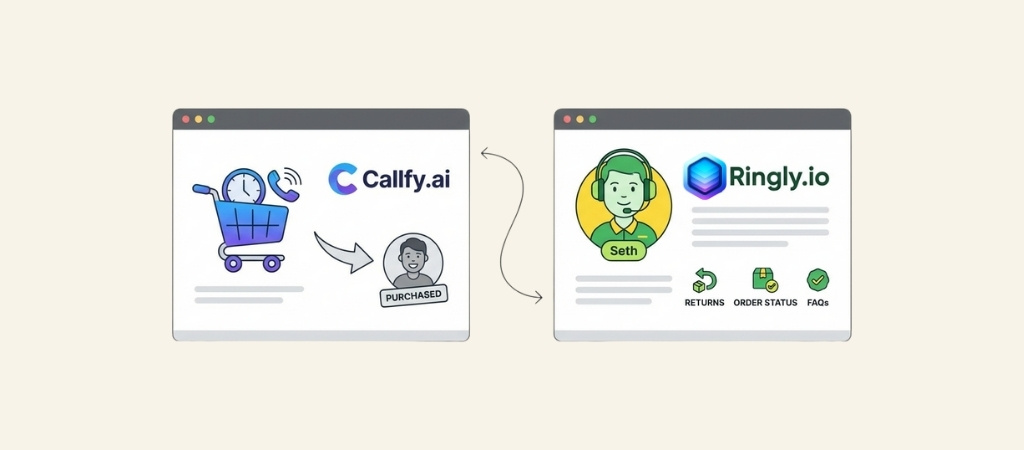
Are you trying to fix one leak in your sales funnel, or build a stronger foundation for your entire customer experience? This infographic helps visualize the difference.
Callfy.ai is a "specialist" tool. It’s laser-focused on a single, high-impact problem: cart abandonment.
Its value is straightforward to measure, you just look at how much revenue it has recovered. If your store has a huge issue with people leaving items in their cart, and that's your number one headache, a tool like Callfy.ai can be a targeted solution.
It’s a direct, revenue-generating move.
On the other hand, Ringly.io is a "foundational" platform. It’s designed to rethink your whole approach to phone support.
Its value is measured in a few different ways: lower support costs (because you need fewer human agents answering the same calls), better team efficiency (because your team can focus on complex issues), 24/7 availability (so you never miss a call), and higher customer satisfaction (because people get instant answers).
Think about it this way. A store that’s mostly struggling with its conversion rate at the final step might look at Callfy.ai.
But a store that’s swamped with "where is my order?" calls, return requests, and other general questions would get far more value from Ringly.io's broader skill set.
Ultimately, Ringly.io is designed for businesses focusing on scaling their support operations for the long term.
When you automate the 70-80% of support calls that are simple and repetitive, you free up your human agents to handle the complex, relationship-building conversations that really drive loyalty.
Its focus is on building an efficient, scalable customer service operation, as opposed to a direct sales recovery function.
Feature comparison: Callfy.ai vs. Ringly.io
Let's get past the high-level stuff and into the details of what these platforms actually do. Here’s how they compare on key features.
AI conversation and task handling
Callfy.ai is all about outbound, persuasive conversations. Its AI is trained to understand and counter common sales objections. It knows how to respond when a customer says, "shipping is too expensive" or "I'll think about it."
You design these conversations using a visual, drag-and-drop workflow builder, creating a sequence of calls and texts meant to nudge the customer over the finish line.
Ringly.io, however, is built for inbound, informational, and action-oriented conversations. the AI, the AI rep, connects directly to your Shopify store's backend.
This deep integration is a key feature. It means the AI can pull up live order information, check shipping statuses, look up product details from your catalog, and even start the return process based on your store’s policies. This allows it to perform actions based on real-time data, resolving a wide range of customer issues independently.
Integrations and ecosystem
Callfy.ai’s main integration is, of course, with Shopify. The context also mentions an integration with Klaviyo, which makes perfect sense. Its focus is on the marketing and sales tech stack, helping you line up your cart recovery calls with your email and SMS marketing campaigns.
Ringly.io also has a deep, native Shopify integration, but its ecosystem is built around the customer service and operations world. It connects with essential support tools like Gorgias and Zendesk, allowing for smooth ticket creation and agent handoffs.
It also works with automation platforms like Zapier, which means you can connect it to thousands of other apps. This positions Ringly.io as a central hub, not just a single-purpose tool.
Analytics and business intelligence
Callfy.ai provides analytics that are tightly focused on its one job: cart recovery. You’ll see dashboards showing you how much revenue has been recovered, your recovery rate, and the most common reasons customers give for abandoning their carts.
It's incredibly valuable data for optimizing your checkout process and has been called a "CRO cheat code."
Ringly.io provides broader analytics since it handles all inbound support calls. You get full call transcripts, recordings, and insights into why your customers are calling in the first place.
Are people constantly confused about a specific product? Is your return policy unclear? This positions it as a comprehensive "voice of the customer" platform, providing insights to improve overall business operations.
Language and setup
Callfy.ai supports over 50 languages. It also promotes a quick 5-minute setup using its visual builder to get your first campaign live.
Ringly.io supports 30 languages, which still covers a massive global audience.
Its setup is also designed for simplicity. You can get Seth live in under 1 hour. There's no complex flow-building because the AI is already pre-trained on the most common e-commerce support tasks.
You just connect your store, pick a phone number, and it's ready to go. This no-code approach makes it incredibly easy for non-technical teams to get started right away.
| Feature | Callfy.ai (Outbound Sales) | Ringly.io (Seth - Inbound Support) |
|---|---|---|
| Primary Goal | Outbound Abandoned Cart Recovery | Comprehensive Inbound Phone Support |
| Call Direction | Primarily Outbound (Sales focus) | Primarily Inbound (Service focus) |
| Key Tasks | Overcome sales objections, offer discounts, recover lost revenue | Look up orders, process returns, answer FAQs, check inventory |
| Shopify Integration | Connects to checkout data & cart links | Deep write-access for orders, products, and customer data |
| Key Integrations | Klaviyo, Postscript, SMS Marketing tools | Gorgias, Zendesk, Zapier, Twilio |
| Language Support | 50+ languages | 40+ languages |
| Analytics Focus | Reasons for cart abandonment, recovery rate, ROI | Resolution rate, CSAT, common inquiry topics |
| Setup | 5-minute visual flow builder | Under 1 hour, with a pre-trained AI agent |
| Starting Price | $29/mo (approx. 50 calls/SMS) | From $99 a month (50 conversations included) |
| Risk Reversal | 14-day free trial (10 calls/mo) | 65% resolution guarantee (that month comes back as credit if not met) |
Pricing models: Callfy.ai vs. Ringly.io
The pricing models for these services reflect their different approaches and can affect upfront risk and return on investment.
Callfy.ai pricing
Callfy.ai uses a pay-for-performance model, where you primarily pay based on results. It’s a revenue-sharing system.
- First 10 Free: $0/month, and you pay a 15% commission on sales recovered. The first 10 recoveries are completely commission-free.
- Pro: $149/month + a 7% commission on recovered sales. This plan includes a 30-day free trial.
- Enterprise: $399/month + a 5% commission on recovered sales. This also includes a 30-day free trial.
This model can be suitable for businesses that prefer to test a service without a large upfront commitment.
You’re paying for direct, measurable results. If it doesn't recover any sales for you, your costs are minimal. It’s a low-risk way to tackle a very specific sales metric.
Ringly.io pricing
Ringly.io uses a more standard subscription-based model that’s based on call volume.
- Pay per call: $99 a month for the first 50 conversations, then $1.99 each.
- Spam, hang-ups and wrong numbers are free.
While a subscription may seem different from a revenue-share model, Ringly.io includes a performance guarantee. Ringly.io is free to try, and if Seth resolves under 65% of your calls in a month, that month comes back as credit (after 90 days on Pay per call).
This is designed to reduce the investment risk. You don't have to wonder if it will work for your store; you get to see it in action, handling your real customers' calls, and you don't pay a dime until it hits that performance benchmark.
Callfy.ai vs. Ringly.io: Which is right for your store?
After all that, which one should you pick? The answer really boils down to what problem you're trying to solve.
Choose Callfy.ai if: Your single biggest, most urgent challenge is a high cart abandonment rate.
You're looking for a specialized tool that can directly pay for itself by recovering lost revenue, and you're comfortable with a revenue-sharing model that ties cost directly to performance. It's a tactical solution for a specific sales problem.
Choose Ringly.io if: You're looking for a long-term, scalable solution to automate your entire phone support operation.
Your main goal is to reduce operational costs, make your team more efficient, offer 24/7 support, and get deep insights into what your customers are really thinking. It's designed as a foundational platform that can scale with a growing business.
For many growing stores, managing customer support challenges like constant calls, after-hours tickets, and repetitive questions can be a significant operational bottleneck. Addressing this area can help build a more efficient and customer-friendly brand.
The performance guarantee allows businesses to evaluate the platform's impact before making a financial commitment.
Ready to see how a dedicated AI phone rep can resolve up to 90% of your support calls, risk-free? Try Ringly.io for free and have Seth answering calls in under 1 hour.
Frequently Asked Questions
What is the main difference in a Callfy.ai vs. Ringly.io comparison for a Shopify store?
The biggest difference is their job. Callfy.ai is a specialist tool for outbound calls to recover abandoned carts. Ringly.io provides a comprehensive inbound AI support agent, the AI, to handle customer service calls like order tracking and returns.
When considering Callfy.ai vs. Ringly.io, which is better for reducing support costs?
Ringly.io is designed specifically to reduce support costs by automating up to 90% of inbound calls. Callfy.ai is focused on increasing revenue through cart recovery, not cutting operational costs.
How does the pricing differ when looking at Callfy.ai vs. Ringly.io?
Callfy.ai uses a revenue-sharing model, where you pay a commission on the sales it recovers. Ringly.io charges per call ($99 a month for the first 50 conversations, then $1.99 each) and comes with a 65% resolution guarantee.
In the Callfy.ai vs. Ringly.io debate, which one is easier to set up?
Both are designed for quick setup. Ringly.io boasts a quick setup because its AI, the AI, is pre-trained for e-commerce support. Callfy.ai has a 5-minute setup using a visual builder for its outbound campaigns.
If I need to handle customer questions about my products, which tool should I choose in the Callfy.ai vs. Ringly.io choice?
Ringly.io is the clear choice here. Its AI agent, the AI, integrates with your Shopify store to answer product questions, check order statuses, and handle returns, acting as a full-service support rep. Callfy.ai focuses only on sales objections for abandoned carts.
Can both tools in the Callfy.ai vs. Ringly.io comparison handle multiple languages?
Yes, both offer multilingual support. Callfy.ai supports over 50 languages for its outbound sales calls, while Ringly.io supports 30 languages for inbound customer support.
Also read: