


Boost.ai has built a strong reputation for enterprise conversational AI.
But with a reported starting price around $50,000 per year and a sales-led process that can take weeks, it's not the right fit for every business.
Maybe you need something more affordable. Maybe you want to get started this week, not next quarter.
Or maybe you just want to see what else is out there before committing to a year-long contract.
I looked at the top alternatives to Boost.ai and compared them on pricing, features, and use cases. Here's what I found.
Editor’s note: Want to hear some sample AI support calls made for your Shopify store?
- Just paste your store URL
- Get sample calls in under 20 seconds (no email required)
- Listen to demo calls for my store
What to look for in a Boost AI alternative
Before diving into the options, let's establish what to look for. A good conversational AI platform should deliver on a few key dimensions:
Pricing transparency: Some platforms hide their prices behind sales calls. Others publish rates upfront. Depending on your budget and timeline, this matters.
Deployment speed: Enterprise solutions can take months to implement. Some alternatives get you live in days or even hours.
Channel coverage: Voice, chat, email, social. The best platform covers the channels your customers actually use.
Integration depth: Your AI agent needs to connect with your existing tech stack. Shopify, Salesforce, Zendesk. The more native integrations, the better.
Resolution rate: Ultimately, this is about automation that actually works. Look for platforms that publish real resolution metrics, not just response rates.
Quick comparison: all 7 alternatives at a glance
| Platform | Starting Price | Best For | Key Differentiator |
|---|---|---|---|
| Cognigy.AI | Custom/Enterprise | Large contact centers | Voice + digital omnichannel |
| Kore.ai | Custom/Enterprise | Global 2000, regulated industries | Industry-specific AI apps |
| Ada | Custom/Enterprise | High-volume omnichannel | Unified Reasoning Engine™ |
| Yellow.ai | Custom/Enterprise | Multi-LLM flexibility | 15+ LLM architecture |
| Ringly.io | $349/month | Shopify/e-commerce | Phone-first, e-commerce focused |
| Tidio | $24.17/month | SMBs, budget-conscious | Affordable + 14-day free trial |
| Dialogflow CX | Usage-based | Google Cloud users | Gemini-powered, 40+ languages |
The 7 best Boost AI alternatives
1. Cognigy.AI

Cognigy is a German company that's been around since 2016.
They've positioned themselves as the go-to choice for enterprise contact centers that need serious voice capabilities alongside digital channels.
What it does well
The platform excels at handling complex voice interactions at scale.
Their Voice Gateway infrastructure supports global telephony with natural-sounding AI agents.
If your customers still pick up the phone (and many do), Cognigy treats voice as a first-class channel, not an afterthought.
The Agent Copilot feature is another standout. It doesn't just automate customer conversations.
It gives your human agents real-time suggestions, summaries, and next-best actions during live calls.
Where it falls short
Cognigy doesn't publish pricing, which tells you everything about their target market. This is enterprise software with enterprise sales cycles.
If you're a smaller shop or need to move fast, the process alone might be a dealbreaker.
The platform's sophistication also means complexity. You'll need technical resources to get the most from it.
Pricing
Custom enterprise pricing. Contact sales for quotes.
Who it's best for
Large contact centers with 100+ agents, complex IVR replacement projects, and organizations that need voice and digital channels tightly integrated.
2. Kore.ai
Kore.ai was named a Leader in the 2025 Gartner Magic Quadrant for Conversational AI Platforms.
That's not just marketing fluff. It reflects their strength in serving Global 2000 companies across regulated industries.
What it does well
Kore takes a different approach from generic chatbot platforms. They offer pre-built AI applications tailored to specific industries.
Banking, healthcare, retail, HR, IT, recruiting. Each comes with domain-specific training and compliance considerations built in.
The multi-agent orchestration is genuinely impressive.
Their AI agents can collaborate, share memory, and handle complex decision-making tasks that go beyond simple FAQ responses.
Where it falls short
Like Cognigy, Kore.ai is built for enterprises with enterprise budgets and timelines. The platform's power comes with a learning curve.
If you want something you can set up over a lunch break, this is not it.
Pricing
Custom enterprise pricing. No self-serve option.
Who it's best for
Global 2000 companies, regulated industries (healthcare, banking), and organizations that need industry-specific AI solutions rather than generic chatbots.
3. Ada

Ada has made a name for itself with bold claims about automation rates.
They advertise up to 83% automated resolution, which is significantly higher than most competitors quote.
What it does well
Ada's unified Reasoning Engine™ is the core differentiator.
Instead of managing separate AI models for each channel, you get one intelligence layer that powers consistent experiences across voice, email, chat, WhatsApp, SMS, and social.
The platform has handled over 1.5 billion customer interactions, so they have seen most conversation patterns before.
Their Playbooks feature lets you build structured workflows for complex multi-step tasks without rigid scripting.
Where it falls short
Ada's pricing page doesn't list numbers. Instead, it asks about your annual conversation volume and steers you toward a demo.
This suggests they're targeting companies with significant scale (they mention 300,000+ annual conversations as a good fit).
Pricing
Custom pricing based on volume. Designed for companies with 300,000+ annual customer service conversations.
Who it's best for
High-volume businesses that need true omnichannel AI, companies with complex support workflows, and teams that want one AI brain across all channels.
4. Yellow.ai

Yellow.ai positions itself as an "Agentic AI Platform" that goes beyond traditional chatbots.
Their big bet is on multi-LLM architecture, giving customers flexibility to choose the best model for each task.
What it does well
The 15+ LLM architecture means you're not locked into a single AI provider.
If one model works better for sentiment analysis and another for technical troubleshooting, you can use both.
Their omnichannel orchestration supports voice, chat, and email with full conversational context maintained across channels.
The platform also includes automated testing tools to help you ship reliable AI agents faster.
Where it falls short
Yellow.ai's marketing can feel buzzword-heavy. "Agentic AI," "Universal Agentic Interface," "Service as a Software."
Underneath the jargon is a solid platform, but you'll need to cut through the hype to evaluate it properly.
Pricing
Custom enterprise pricing. Demo required.
Who it's best for
Enterprises that want LLM flexibility without vendor lock-in, global brands needing multilingual support, and organizations that value being able to switch AI models as the technology evolves.
5. Ringly.io

We take a different approach from the enterprise platforms above.
Instead of trying to be everything to everyone, we focus specifically on AI phone support for e-commerce businesses, particularly Shopify stores.
What we do well
Setup is remarkably fast. You can deploy the AI, our AI phone agent, within an hour for most stores. No technical team required.
Our deep Shopify integration means the AI can look up orders, process returns, and handle "where's my order" calls automatically.
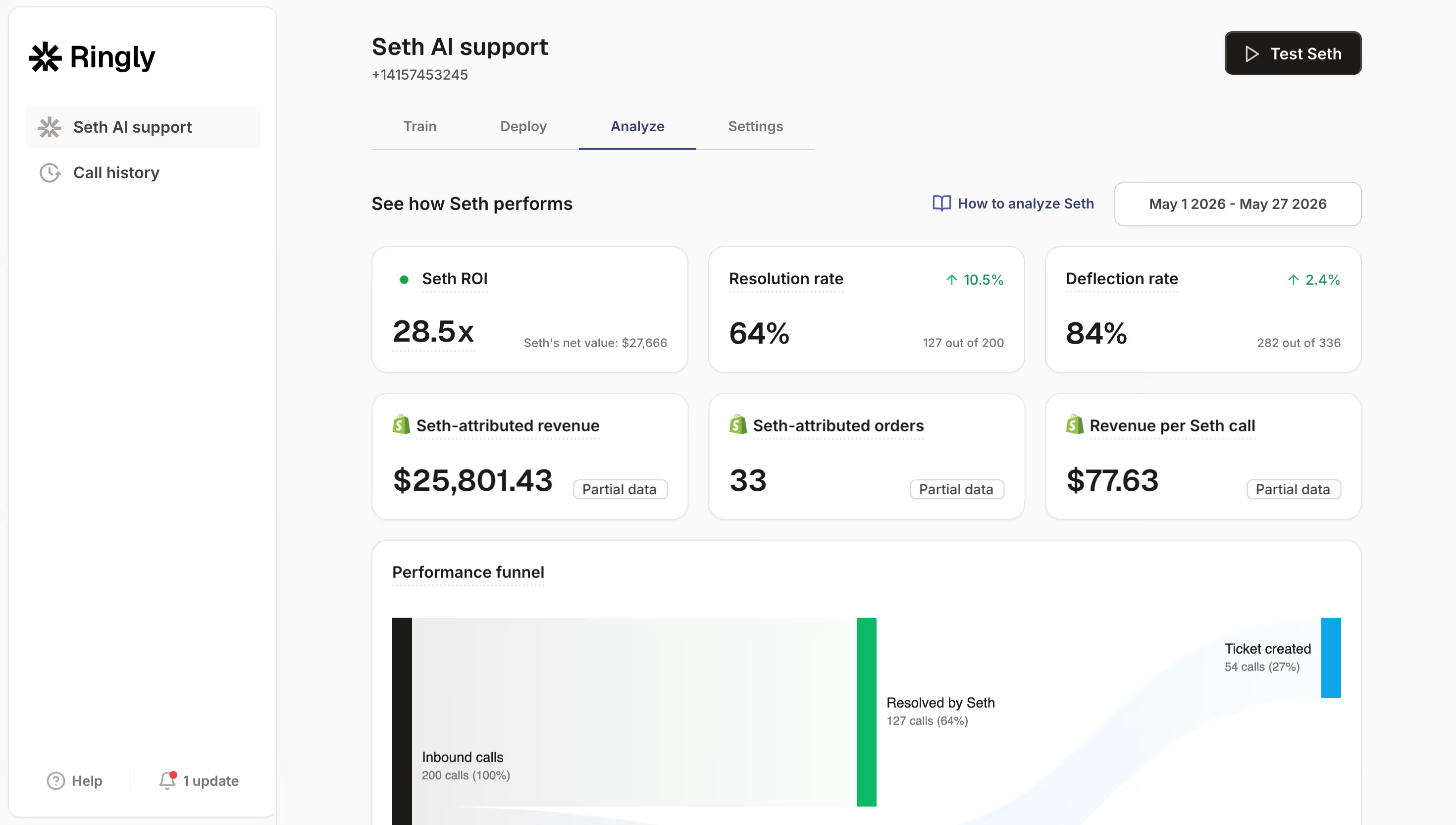
The resolution rate is impressive for a specialized tool. The AI resolves around 73% of phone calls without human intervention.
When the AI cannot help, it escalates smoothly to your team with full context.
Multilingual support across 30 languages is built in, which matters if you sell internationally.
And unlike the enterprise platforms, our pricing is completely transparent.
Where we fall short
We are purpose-built for phone support in e-commerce.
If you need AI across chat, email, and social simultaneously, you will want to look at the omnichannel platforms above. Our focus is phone-first.
Pricing
| Plan | Price | Minutes | Best For |
|---|---|---|---|
| Starter | $349/month | 250 | Small stores testing AI phone support |
| Growth | $349/month | 500 | Growing stores with regular call volume |
| Scale | $349/month | 1,000 | High-volume stores needing advanced features |
Overage: $0.19 per minute. Additional phone numbers: $5/month each. Custom integrations from $500.
Free trial: 14 days with full features. You do not pay until The AI resolves at least 65% of calls over your first 100 calls in 21 days.
Who we are best for
Shopify store owners, e-commerce businesses with phone support needs, and companies that want 24/7 phone coverage without hiring overnight staff.
6. Tidio

Tidio has served over 300,000 businesses with a focus on accessible pricing and quick setup.
Their Lyro AI Agent offers a low-risk entry point for businesses curious about AI automation.
What it does well
The free plan is genuinely usable. You get 50 conversations per month, 3 chatbot flows, and basic analytics.
For small businesses just starting out, that is often enough.
Lyro AI, their conversational agent, resolves about 67% of customer issues instantly according to their published metrics.
The visual chatbot builder is intuitive, and integrations with Shopify, WordPress, Wix, and Magento cover most common e-commerce setups.
Where it falls short
Tidio's AI capabilities are solid but not as sophisticated as the enterprise platforms.
Complex multi-step workflows and deep system integrations are harder to achieve. The focus is on SMBs, so scaling to enterprise volumes may require migrating to a different platform.
Pricing
| Plan | Price | Conversations | Key Features |
|---|---|---|---|
| Free | $0 | 50/month | 3 chatbot flows, basic analytics |
| Starter | $24.17/month | 100/month | Unlimited flows, visitors |
| Growth | $49.17/month | 2,500/month | Advanced analytics |
| Plus | $82.50/month | 5,000/month | Priority support |
| Premium | $332.50/month | Unlimited | Dedicated support |
Lyro AI add-on: $0.50 per conversation, with 50 free conversations to start.
Who it's best for
Small to medium businesses, budget-conscious teams, and companies wanting to test AI automation without a significant upfront investment.
7. Google Cloud Dialogflow CX (CX Agent Studio)
Dialogflow has been around for years, but Google has significantly evolved the platform.
Now branded as Customer Experience Agent Studio (CX Agent Studio), it's powered by Gemini and integrated deeply with Google Cloud.
What it does well
The Gemini integration brings Google's latest AI capabilities to conversational agents.
Multimodal support means your agents can handle text, audio, and even images in the same conversation.
Language coverage is unmatched. 40+ languages with human-like voices, plus direct audio-to-audio translation in 10 core languages.
If you serve a global customer base, this matters.
The 35 pre-built agent templates help you get started faster than building from scratch.
And for organizations already invested in Google Cloud, the integration story is compelling.
Where it falls short
Dialogflow CX is powerful but complex. You will need technical expertise to build sophisticated agents.
The platform assumes you're comfortable with Google Cloud concepts and pricing models.
Pricing
Usage-based pricing through Google Cloud. No simple monthly fee.
You will pay for requests, audio processing, and other resources consumed. Contact sales for estimates based on your volume.
Who it's best for
Google Cloud customers, organizations needing advanced multilingual support, and teams with technical resources to build custom AI agents.
How to choose the right Boost AI alternative
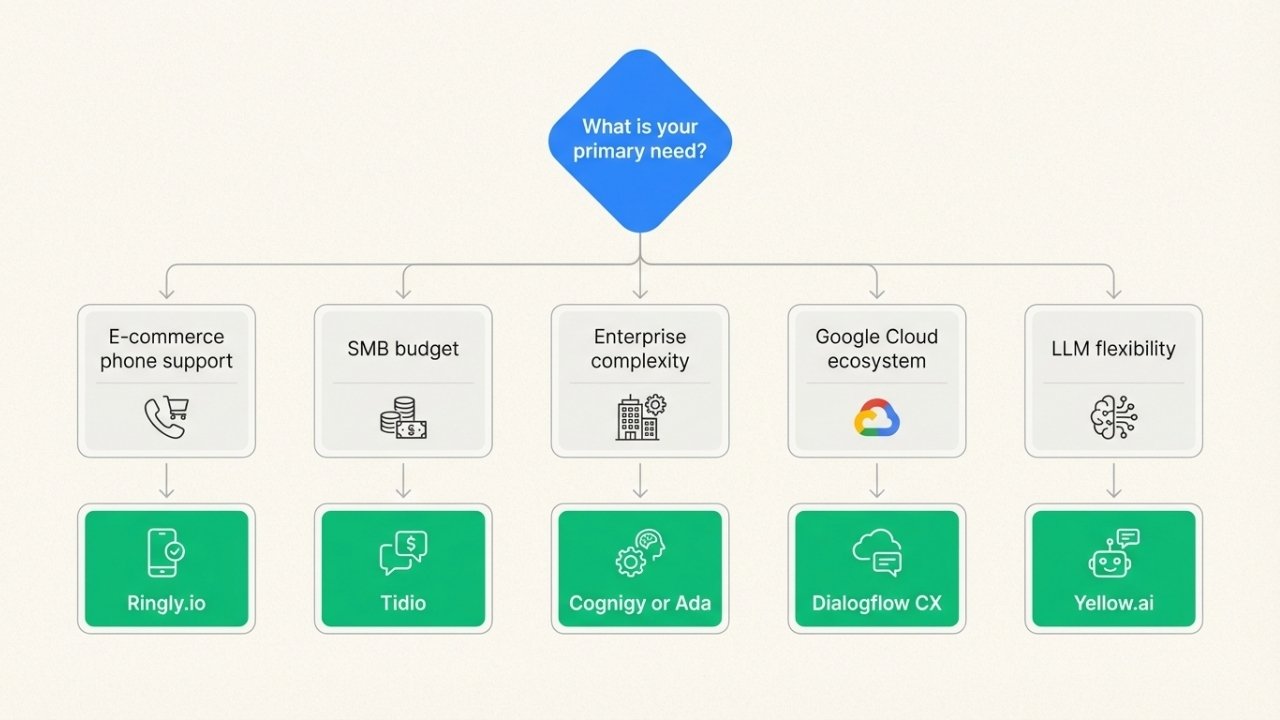
With seven solid options, how do you pick? Here's a simple framework:
If you need phone support for e-commerce: We are purpose-built for this. Our Shopify integration and 73% resolution rate make us hard to beat for online stores.
If you're a small business on a budget: Tidio's free plan and $24 Starter tier let you test AI automation without risk.
If you're an enterprise with complex needs: Cognigy, Kore.ai, or Ada offer the sophistication and support large organizations require.
If you're already on Google Cloud: Dialogflow CX integrates naturally with your existing infrastructure.
If LLM flexibility matters: Yellow.ai's multi-LLM architecture lets you adapt as AI models improve.
The bottom line
Boost.ai isn't your only option. Depending on your size, budget, and specific needs, one of these alternatives might serve you better.
For e-commerce businesses specifically, our combination of affordable pricing, fast setup, and deep Shopify integration makes us worth a serious look.
You can start a free trial and have the AI answering calls within minutes, not months.
The best choice is the one that fits your actual needs, not the one with the most features or the biggest brand name.
Start with your use case, work backward to the platform, and don't be afraid to test before you commit.
Frequently Asked Questions
What is the most affordable Boost AI alternative for small businesses?
Tidio offers the lowest entry point with a genuinely usable 14-day free trial ($0 for 50 conversations/month). For phone-specific needs, Ringly.io starts at $349/month with a 14-day free trial and a unique pay-only-if-it-works guarantee.
Which Boost AI alternative has the best phone support capabilities?
For enterprise contact centers, Cognigy.AI offers the most sophisticated voice infrastructure. For e-commerce businesses, Ringly.io provides specialized phone support with deep Shopify integration and a 73% resolution rate.
Can I try these Boost AI alternatives before committing to a paid plan?
Most platforms offer free trials or demos. Tidio has a 14-day free trial you can use indefinitely. Ringly.io offers 14 days free. Enterprise platforms like Cognigy, Kore.ai, and Ada require demo calls but typically offer proof-of-concept periods.
Which Boost AI alternative works best with Shopify?
Ringly.io is built specifically for Shopify stores with native integration that lets the AI look up orders, process returns, and handle product questions automatically. Tidio also offers solid Shopify integration for chat-based support.
Do any Boost AI alternatives offer transparent pricing without sales calls?
Yes. Ringly.io and Tidio both publish their pricing clearly on their websites. Most enterprise-focused alternatives (Cognigy, Kore.ai, Ada, Yellow.ai) require contact with sales for custom quotes.
What resolution rates can I expect from these Boost AI alternatives?
Published resolution rates vary: Ada claims up to 83%, Ringly.io achieves around 73%, Tidio's Lyro AI resolves about 67%, and Kore.ai customers report 70%+ automation. Actual results depend on your use case and implementation quality.