
Running a Shopify store can feel like a juggling act. As you grow, providing great phone support can seem like you're trying to juggle flaming torches while riding a unicycle. Customers call with questions, and your support team has to scramble to find their order details, turning a simple query into a frustrating scavenger hunt.
Getting your team the right customer info at the right time makes all the difference. It’s what separates a quick, happy resolution from a long, painful call that leaves everyone feeling drained.
This is where an integration between and Shopify can help. This post is a complete overview of what it is, how it works, and what it really means for a modern e-commerce business. We'll dig into its features, benefits, and the practical things you need to consider before jumping in.
Every second your support team spends answering generic questions, you are paying for them to do nothing of value.
You’ve built a solid brand and a real team, but you are likely still losing money on long, manual calls that frustrate your staff and your customers.
You know your team needs better tools to stay fast, but adding more people every time you grow is a trap.
But there is a fix.
Connecting your phone system to your store data is the best way to decrease call times and stop the endless hunt for customer info.
First, I will show you how this Aircall integration works.
Then, I will break down the costs and limits so you can decide if it is right for your brand.
Editor’s note: Want to hear some sample calls made for your Shopify store?
- Just paste your store URL
- Hear sample calls for your store (no email required)
- Listen to demo calls for my store
Understanding the core components
Before we get into the nitty-gritty, let's break down the main players here.
What is Aircall?

Aircall is an "integrated customer communications and intelligence platform," which is a fancy way of saying it's a cloud-based phone system for businesses.
It's built on VoIP technology, so all your calls run over the internet, with no clunky hardware needed.
It’s designed for sales and support teams to manage their phone conversations more effectively.
More recently, they've started adding AI-powered tools, including an AI Voice Agent that can handle some calls automatically.
What is the Aircall Shopify integration?
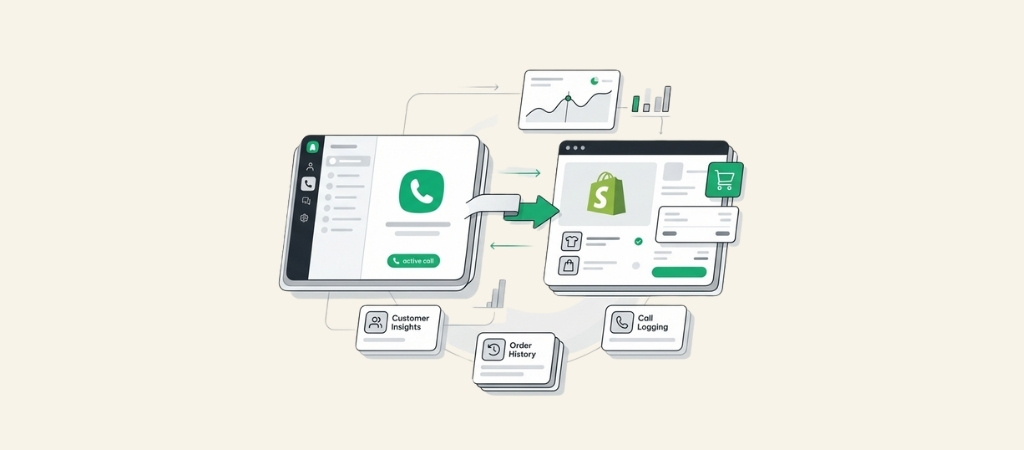
Put simply, the Aircall Shopify integration connects your Aircall phone system directly to your Shopify store's data.
The main goal is to give your customer service agents a bunch of real-time customer and order information the second a customer calls.
This info pops up directly in the Aircall app in what they call "Insight Cards," so your team knows exactly who they're talking to and what they might need.

Key features of the Aircall Shopify integration
The integration is really all about making your human agents more efficient by giving them instant context.
When they have the right info at their fingertips, they can solve problems faster and give customers a much smoother experience.
Get immediate customer context
The star of the show is the "Insight Card" feature. When a customer's phone number matches a record in your Shopify store, a card automatically appears in the Aircall app as the phone rings.
This card displays the customer's name, email, and, most importantly, their recent order details and tracking numbers.
It even includes a direct link to the courier's status page. This means your agents can skip the whole "Can I get your order number?" dance and dive straight into helping.
Streamline workflows
To speed things up even more, agents can click a link directly from the Aircall app to open the customer’s profile or order page in Shopify.
No more switching tabs and manually searching for customer records.

Aircall suggests this can save up to two minutes per call.
That might not sound like much, but when you're handling hundreds of calls a day, those minutes add up fast.
Centralize communication and automate logging
The integration helps you keep all your customer communication in one place.
After a call ends, details like notes, tags, and even the call recording can be automatically logged in a connected helpdesk like Gorgias or Zendesk, or a CRM like HubSpot. This creates a single, unified timeline of every interaction you've had with a customer, which is incredibly useful for providing consistent service.
While this context is powerful for a human agent, it's only available when they are.
For calls that come in after hours or during a holiday rush, this valuable context sits unused. An AI phone agent like the AI agent from Ringly.io was built to use this same Shopify data 24/7 to resolve issues instantly, without needing an agent to be present.
Operational considerations
The integration sounds great on paper, but what does it actually look like in practice for a growing Shopify store? Let's talk about the real-world impact.
Improving customer support efficiency
There's no question that having order information pop up automatically helps agents resolve common questions much faster.
Those endless "Where is my order?" (WISMO) calls become quick, two-minute conversations instead of lengthy investigations. This leads to shorter call times, happier customers, and a more efficient support team.
Limitations of the agent-assistance model
The Aircall integration is a useful tool for assisting agents, but it's important to understand its limitations, especially as you scale.
- Dependency on agent availability: The integration is designed to empower human agents, which means it relies on agent availability. It doesn't help with missed calls or after-hours inquiries. For businesses aiming for 24/7 support, this model means there's still a gap in coverage outside of agent working hours.
- Automation comes at an extra cost: Aircall provides the information, but a human agent is still the one doing the work. Aircall does offer an AI Voice Agent add-on for automation, but it's priced separately on a per-minute basis. This adds a variable cost on top of your base subscription if you want to automate calls.
- Scaling costs and complexity: To handle more calls with this model, you have to hire more people. Aircall's pricing is per user, and it comes with a three-user minimum, so every time you need to scale your support capacity, your monthly bill goes up.

Tools designed for autonomous resolution, not just agent assistance, offer a different approach.
Ringly.io was built for Shopify to automate the resolution of up to 90% of calls, handling tasks like order lookups and returns without human involvement.
This model directly addresses the topics of scaling and availability with straightforward pricing.
Setting up the Aircall Shopify integration
Getting the integration up and running is thankfully pretty straightforward. Here's a quick look at what's involved.
The setup process at a glance
First, you'll need active Aircall and Shopify accounts. From there, you just find the Aircall app on the Shopify App Store, click to install it, and authorize the connection between the two platforms.

The whole process is generally quick and doesn't require any custom coding, so you can get your team up and running without needing a developer.
Connecting with your wider tech stack
Aircall is known for its extensive library of integrations, connecting with over 100 other tools, including popular helpdesks like Gorgias and CRMs like Salesforce.
This is great for building a connected ecosystem.
However, to get the full benefit of centralized call logging, you often need to set up and manage another integration.
This can add a layer of complexity to your tech stack, which means another tool to maintain and pay for.
For stores looking for a dedicated phone solution built specifically for e-commerce, platforms like Ringly.io offer an alternative.
It integrates directly with Shopify to handle the call lifecycle from answering to resolution, with a setup process that takes just a few minutes.
Aircall pricing and plans
Aircall’s pricing is based on a per-user, per-month model, and it's important to know that their standard plans require a minimum of three user licenses.
Standard subscription plans
Here’s a breakdown of their two main plans for a team of three:
| Feature | Essentials Plan | Professional Plan |
|---|---|---|
| Price (3 users) | $120/month (monthly billing) $1,080/year (annual billing) | $210/month (monthly billing) $1,500/year (annual billing) |
| Key Features | IVR, call recording, SMS/MMS, 100+ integrations, API access | Everything in Essentials, plus Power Dialer, advanced analytics, live call monitoring, Salesforce integration |
| Best For | Teams needing a solid cloud phone system with essential call center features. | Sales and support teams requiring advanced productivity and performance tools. |
Optional AI add-ons
Aircall's AI features are not included in the standard plans and are billed separately, which is a key detail to remember when budgeting.
- AI Assist: This costs an extra $9 per user, per month. It gives you AI-generated call summaries, key topic recognition, and sentiment analysis to help with agent coaching and performance reviews.
- AI Voice Agent: This is their automation tool, and it's priced on a per-minute basis, starting from $0.49/minute. This agent can handle inbound calls, answer FAQs, and qualify leads 24/7, but the costs can add up depending on your call volume.

To see how these features come together in a real-world setting, watching a demonstration can be helpful.
The following video provides a visual walkthrough of the Aircall and Shopify integration, showcasing how it looks and feels for a support agent during a live call.
This video demonstrates the Aircall Shopify integration in action, showing how customer data appears for an agent during a live call.
Empowering agents vs. automating resolutions
The Aircall Shopify integration is an effective tool for one specific job: giving your human agents the context they need to deliver faster, more personalized service.
It’s designed to enhance your team's productivity by cutting down the time they spend on manual data lookups.
Its primary function is assistance, not automation. It makes agents more efficient, but it doesn't address the challenges of 24/7 availability or scaling support without hiring more staff, unless you add the separate, usage-based AI products.
An alternative: True phone support automation
For Shopify stores that need to address availability and cost at scale, one path is autonomous resolution.
While the Aircall integration equips your team, an AI phone agent like the AI agent from Ringly.io was built from the ground up to autonomously handle up to 90% of your inbound calls.
the AI answers questions about orders, processes returns, and provides information 24/7 in over 30 languages, escalating to your team only when a human touch is truly needed.
This approach complements the goal of helping teams work faster by automating repetitive tasks, allowing agents to focus on more complex issues.
Ringly.io offers a guarantee: if Seth resolves under 65% of your calls in a month, that month comes back as credit (after 90 days on Pay per call), providing a way to test the impact of automation.
If you're ready to transform your support operations, try Ringly.io for free.
Frequently Asked Questions
What are the main benefits of the Aircall Shopify integration for an e-commerce store?
The main benefit is giving your support agents instant access to a customer's order history and details right when they call. This speeds up resolutions for common questions like "Where is my order?" and leads to a better customer experience.
How does the Aircall Shopify integration handle calls after business hours?
The integration itself doesn't handle calls; it provides information to your human agents. For after-hours calls, you'd still rely on voicemail or another solution, as the integration's context is only useful when an agent is available to see it.
Is the Aircall Shopify integration difficult to set up?
No, the setup is quite simple. You can install the Aircall app from the Shopify App Store and authorize the connection without needing any code. Most users can get it running quickly.
Can the Aircall Shopify integration automate customer support tasks?
Not on its own. The core integration is designed to assist human agents by providing them with data. Aircall does offer a separate, usage-based AI Voice Agent add-on if you want to automate some calls, but this comes at an extra cost per minute.
What are the pricing requirements for the Aircall Shopify integration?
To use the integration, you need an Aircall subscription, which has a minimum requirement of three user licenses. Pricing starts at $120/month for three users on the Essentials plan when billed monthly.
Does the Aircall Shopify integration work with other helpdesks?
Yes, Aircall integrates with over 100 other tools, including popular helpdesks like Gorgias and Zendesk. This allows you to log call details and recordings in a centralized system, though it requires setting up and managing an additional integration.