
This post in 30 seconds.
- AI or human is the wrong way to frame it. On a DTC phone line the split runs about 70/30, and the line between the two is predictable.
- An AI resolution runs about $0.62 vs $7.40 for a human (SurveyMonkey), yet 79% of customers still want a human for the hard calls. Both numbers are true at once.
- You'll get the exact call-type routing table: which calls AI should take, which 30% has to stay human, with real cost and resolution data on both sides.
- Built for founders, COOs, and Heads of CX at $10M-$100M Shopify brands running a paid helpdesk and a visible phone line.
An AI resolution costs about $0.62. A human one costs about $7.40 (SurveyMonkey). And in the same survey, 79% of people said they'd rather talk to a human. Both of those are true, and if you only look at one of them you'll make the wrong call.
So the question that actually matters isn't "AI voice support or human reps." It's which calls go to which. Get that line right and you keep the cost of the routine stuff near zero while keeping a human on the calls where a human is the whole point. That's the whole game in ecommerce customer service right now.
If you run a $10M-$100M Shopify brand with a paid helpdesk and a phone number on your site, you already know the routine part of your queue by heart. Order status, returns, the same product questions over and over. That's the 70% an AI voice agent should be handling so your team stops doing it. The 30% that's left is where your reps earn their keep. We run AI phone support for Shopify brands, and if you want to see what your own 70/30 split looks like, book a 30-min call and we'll review your last week of calls live.
The short answer
AI voice support wins the repeatable calls. Humans win the calls that carry emotion or stakes. The trick is that on a phone line those two buckets are stable and easy to draw a line between.
Roughly 70% of inbound DTC support calls are the same five things, and none of them need a human. Order status (WISMO), returns and exchanges, product questions answered from your knowledge base, store hours, shipping policy. The other 30% is the angry call, the grief call, the one-off exception, the VIP, the thing nobody's KB has an answer for. That's the human work.
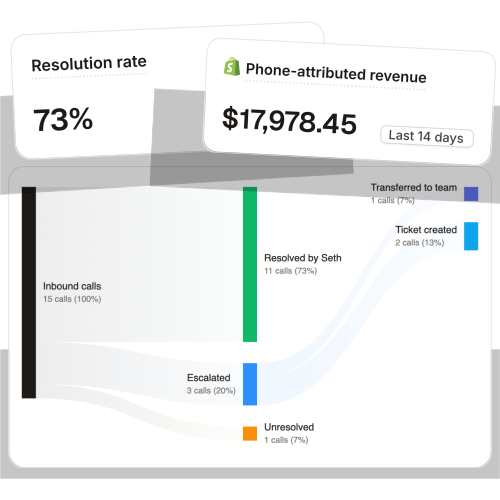
Across the brands we run, the AI resolves up to 90% of calls on its own. The point of that number isn't to retire your team. It's to stop your team answering "where's my order" for the fortieth time today so they can take the calls that actually move a customer. If you want the deeper version of this, our AI voice agents for customer support guide walks through the mechanics.
Where AI voice support wins
There are real, measurable places where an AI voice agent beats a human, and they're all on the routine 70%.
The cost gap on routine calls is not close. A human resolution runs $6-$12 per conversation; an AI one lands around $0.62, with voice-AI specifically near $1.18 (Fin AI). Our own number is $1.99 a call after the first 50, against $7-$16 for a human BPO. On a WISMO call that takes two minutes and the same script every time, paying a loaded human is just expensive.
Here's where AI clearly comes out ahead:
- 24/7 and weekends, no overtime. The call that comes in at 11 p.m. gets answered instead of rolling to a voicemail nobody returns. 80% of voicemail-routed callers hang up without leaving a message (Eden), and businesses answer only about 37.8% of inbound calls (AmbsCallCenter).
- Volume spikes don't break it. A creative scales orders 3x and the phone queue triples the next morning. An AI agent takes 5 calls or 500 the same way. A human team can't.
- It's consistent. Same policy, same answer, every time. No bad-day variance, no "the new hire didn't know the return window."
- Speed. Average handle time on a resolved AI voice call sits around 2-4 minutes, and 61% of customers say they appreciate that speed (Kustomer).
And customers are fine with it here. Between 29% and 39% of people actually prefer AI for transactional tasks: checking an order, cancelling, paying, booking (Kustomer). On the routine 70%, nobody's writing an angry tweet because a machine read them their tracking number.
Where human reps still win
Now the honest part. AI does not win every call, and pretending it does is how brands end up trapping customers in a phone tree and earning a one-star review for it.
On the calls that carry real emotion or real money, a human still wins, and customers know it. 79% of people strongly prefer a human, 84% think humans are more accurate, and 89% believe a brand should always offer a way to reach one (SurveyMonkey). 42% say they'd pay extra for guaranteed human access, and half would cancel a service that was AI-only.
Where humans win:
- Angry or escalated calls. A frustrated customer needs to feel heard, not processed. That's a human's job.
- Grief, health, and sensitive situations. A pet brand getting a call about a passed pet does not route that to a bot. Ever.
- Policy exceptions and goodwill. "I know the window closed two days ago, but here's what happened." Deciding when to bend the rule is judgment, not a script.
- High-value and VIP relationships. The customer who buys $4,000 a year gets a person.
- Anything genuinely novel. If the answer isn't in the knowledge base, a good system hands off rather than guesses.
"My customers also feel like it's a normal person. They feel like they can communicate if they have questions."
Claudia Droge, TechCraft Studio
This is also the point most people get wrong about the "do customers hate AI" stat. They don't hate AI on the routine stuff. They hate being stuck with AI on the hard stuff with no way out. The fix isn't to pick a side. It's to draw the line in the right place and make the handoff to a human clean. More on the operator side of that in our in-house vs outsource support breakdown.
What the "customers prefer humans" data actually tells you
The headline stats look like an argument against AI until you read what they're measuring. 79% prefer a human, 84% think humans are more accurate, 56% have negative feelings about companies using AI in CX (SurveyMonkey). If you stopped reading there you'd never put an AI on your phone line.
But the same people, asked about specific routine tasks, flip. 29-39% actively prefer AI for finding a product, cancelling, paying, or booking, and 61% appreciate the speed (Kustomer). The "I prefer humans" answer is really "I prefer humans when something's gone wrong." Nobody is emotionally invested in how they get a tracking number.
The number that actually matters for setup is 89%: that's how many people say a brand should always offer a way to reach a human. Read it as a design rule, not a verdict on AI. It means your AI can take the 70% all day as long as the 30% always has a door to a person. The brands that ignore that 89% are the ones generating the 50% "I'd cancel an AI-only service" backlash. The brands that respect it get the cost of the routine calls near zero and keep their customers. The full numbers are in our AI customer service statistics for 2026 roundup.
The 70/30 routing model: which calls go where
This is the part nobody in the "AI vs human" debate actually gives you: the call-type table. We run AI phone support for Shopify brands, and when you read enough call logs the split stops looking like a judgment call and starts looking like a rule. The same roughly 70% of calls are repeatable, the same roughly 30% need a human, and the line barely moves between brands.
| Call type | Routes to | Why |
|---|---|---|
| Order status / WISMO | AI | Same lookup every time. 30-40% of all tickets (Salesforce) |
| Returns and exchanges | AI | Policy-bound, repeatable |
| Product questions (in the KB) | AI | Answered from your knowledge base |
| Store hours, shipping, basic account | AI | Pure information lookups |
| After-hours and weekend overflow | AI | The calls a human isn't staffed for anyway |
| Angry / escalated complaints | Human | Needs empathy and a real apology |
| Grief / health / sensitive calls | Human | Hard-coded handoff, never AI |
| One-off policy exceptions, goodwill | Human | Judgment call, not a script |
| VIP / high-value accounts | Human | The relationship is the value |
| Anything the KB can't answer | Human | Escalate, don't guess |
That top block is your 70%. TechCraft Studio handles 88% of calls without a human by scoping its AI to exactly that block and hard-escalating the rest. BioLongevity Labs, a supplement brand we run, resolves 79% end to end the same way.
The production pattern across the industry backs this up: deployments tend to land at 55-78% autonomous resolution, 8-15% human-in-the-loop, and the rest warm-transferred to a specialist. The brands that get it right aren't the ones that automate the most. They're the ones that automate the right 70% and route the 30% cleanly. A smart call transfer that actually works is what makes the line hold.
What it actually costs, both sides
Put real numbers on it. The cost case for shifting the 70% isn't just the per-call gap, it's the part of the human cost that never shows up on a job-board salary.
A fully loaded in-house CS rep runs $55,000-$73,000 a year (Helpware), which is roughly $26-$35 an hour once you count benefits, payroll tax, and management. Wages and benefits alone eat 60-80% of a support budget. And reps don't stay. Customer service runs 30-45% annual turnover with a 13-15 month average tenure, and every departure costs $10,000-$20,000 to replace. So you're paying to train people who answer WISMO calls, then paying again to replace them when they burn out doing it.
That turnover number is the one the per-call comparison misses. A team of 6 at 38% turnover loses a bit over 2 reps a year, which is $20,000-$40,000 in replacement cost on its own, before the CSAT dip while the new hire ramps. The repeatable calls are exactly the ones that burn people out fastest, because answering "where's my order" forty times a day is the part of the job nobody signed up for. Move that volume to an AI and the work that's left is the work that keeps reps around.
Here's the shape of the math on a typical 6-rep team:
| Line item | Today | With an AI agent on the routine 70% |
|---|---|---|
| 6 reps × $4K loaded per rep | $24,000/mo | n/a |
| AI phone agent (~$5K/mo) | n/a | $5,000/mo |
| Net monthly CS spend | $24,000/mo | $5,000/mo |
| Monthly savings | n/a | $19,000/mo |
| Annual savings | n/a | $228,000/yr |
That's roughly 70% of repeatable calls routed to the AI. The other 30%, the calls that actually need a person, still go to your team, who now have the time to handle them well instead of clearing a backlog. WashCo, a Shopify brand we launched, recovered $22,664 in its first 7 days on the phone at about $0.91 per call. And the ROI on AI support broadly lands around $3.50 back for every $1 spent (Fin AI).
If you want this run against your real numbers instead of a 6-rep example, book a 30-min call and we'll do the math live off your actual call volume.
How to set up the hybrid without dropping the 30%
The whole thing falls apart if the 30% leaks. A customer with a real problem getting stuck with an AI that won't let go is worse than no AI at all. So the setup work is mostly about the handoff, not the automation.
Three things make the line hold:
- Scope the AI to the 70%, not "everything." Point it at order status, returns, KB product questions, hours, and shipping. Don't ask it to improvise on anything emotional or novel. A tight knowledge base is what keeps it inside its lane.
- Hard-code the human triggers. Sensitive topics, repeat callers, escalation language, and high-value accounts get a forced handoff to a person, no matter what. This is a rule, not a guess.
- Keep your existing helpdesk and team. The AI sits in front of Gorgias or whatever you run, and escalations land in the same place your reps already work. You're not ripping anything out. If you're rethinking your stack, our Gorgias alternatives rundown is a fair starting point.
Where Ringly fits
Ringly.io is AI phone support for Shopify brands. Instead of growing your support headcount every time call volume goes up, the AI takes the routine inbound calls so your team can focus on the work that actually moves revenue.
The AI answers inbound calls 24/7. It finds orders in your Shopify store, processes returns and exchanges, answers product questions from your knowledge base, and cancels orders when a caller asks. Seth resolves up to 90% of calls on its own. Calls that need a human escalate cleanly to Gorgias, Richpanel, Reamaze, or whatever helpdesk you already run, so the 30% never gets dropped.
Pricing: $99 a month for the first 50 conversations, then $1.99 each. Live in under an hour. There's a 65% resolution guarantee: if Seth resolves under 65% of your calls in a month, that month comes back as credit (after 90 days on Pay per call). You can see the full pricing for the self-serve tiers, or check our check order status feature to see how WISMO gets handled. For the broader category context, the voice AI customer support overview and our 24/7 ecommerce phone support guide both go deeper.
Frequently asked questions
Is AI voice support better than human customer service? Neither is better across the board. AI is better on the repeatable 70% of calls (order status, returns, product questions) on cost, speed, and 24/7 coverage. Humans are better on the 30% that need empathy, judgment, or handling an exception. The right setup uses both.
Will customers be annoyed they're talking to AI? Not on routine calls. 29-39% of people actually prefer AI for transactional tasks like order status and cancellations (Kustomer). They get annoyed when AI traps them on a hard call with no way to reach a person, which is why the human handoff has to be clean.
How much cheaper is AI than a human rep? A human resolution runs $6-$12; an AI one lands around $0.62 (Fin AI). On top of that, a loaded human rep costs $55,000-$73,000 a year with 30-45% turnover (Helpware), so the real saving includes the hiring and training you stop doing.
What resolution rate can AI voice support actually hit? Ecommerce brands typically land 70-84% with optimization (Fin AI). Across the Shopify brands we run, Seth resolves up to 90% of support calls autonomously. The number depends on how tightly you scope the AI to the repeatable calls.
Does AI voice support replace my support team? No. It takes the routine calls off them so they can handle the 30% that needs a human. Home Depot found associates reported higher job satisfaction once AI handled the routine volume. It's an augmentation layer, not a replacement.
What happens to a call the AI can't handle? It escalates to a human. A well-built system hard-codes triggers (sensitive topics, escalation language, VIP accounts) that force a handoff, and routes the call into your existing helpdesk so a rep picks it up with context.
Can AI voice support work with my existing helpdesk? Yes. It sits in front of Gorgias, Zendesk, Richpanel, or Reamaze and escalates the 30% into the same queue your team already works. You keep your phone number, your helpdesk, and your reps.
Talk to us

If you run a $10M-$100M Shopify brand and you're trying to figure out which calls to automate and which to keep human, a 30-min call is the fastest way to draw the line on your actual queue. We'll pull your last week of calls and show you the 70/30 split live.
Our 3 promises.
- Live in under 1 hour. Setup and test calls are free.
- 30-day money back on the $99 plan fee.
- 65% resolution guarantee: if Seth resolves under 65% of your support calls in a month, that month comes back as credit (after 90 days on Pay per call).
Ruben (Ringly co-founder) takes these calls personally.