
This post in 30 seconds.
- The native Zapier Gorgias app gives you two write actions (Create Ticket and Create Ticket Message) and no instant trigger, so real Gorgias events have to come from a different place.
- That place is Gorgias HTTP Integrations, which fire Ticket Created, Ticket Updated, and Ticket Message Created out to a Zapier webhook, the move most guides skip.
- Built for the founder, COO, or Head of CX at a $10M-$100M Shopify brand running Gorgias with a visible phone line and a support backlog eating payroll.
If you run support at a $20M Shopify brand, you already know the shape of the problem. Tickets stack up over the weekend, your CS team copies the same order details from Gorgias into Slack and a returns app by hand, and the one channel that never makes it into any of your automations is the phone. Zapier is the obvious fix for the copy-paste part, but the Gorgias connector behaves in a way that trips most people up on day one.
This guide is for the operator running a paid Gorgias instance who wants to wire it to the rest of the stack without a developer babysitting it. I run AI phone support for 50+ Shopify brands, so I touch Gorgias automations constantly, and the trigger-vs-action confusion below is the single most common thing I get asked. If you want to skip the reading and see what your missed calls are costing you, book a 30-min call and we'll do the math live.
What you can actually do with Gorgias on Zapier
Here's the thing that catches everyone. When you connect Gorgias inside Zapier and look for a trigger, you won't find a useful one. The native Gorgias app on Zapier is built to receive data, not send it.
The native Zapier Gorgias app exposes two write actions and zero instant triggers, which means you push data into Gorgias, you don't pull events out of it. According to Zapier's Gorgias integration page, the two supported actions are Create Ticket and Create Ticket Message, and Zapier connects Gorgias to roughly 9,000 other apps. So you can turn a Typeform submission into a ticket, or write a Shopify order note into an existing ticket. What you can't do from that same app is start a Zap the moment a ticket gets created.
The real Gorgias triggers live somewhere else. They come from Gorgias HTTP Integrations, an outbound-webhook feature inside Gorgias itself. Per the Gorgias documentation, an HTTP Integration can fire on three events: Ticket Created, Ticket Updated, and Ticket Message Created. Point that webhook at a Zapier "Catch Hook" and now you have a real Gorgias-event trigger feeding your Zaps.
| What you want | Native Zapier Gorgias app | Gorgias HTTP Integration (webhook) |
|---|---|---|
| Start a Zap when a ticket is created | No | Yes (Ticket Created) |
| Start a Zap when a ticket is updated | No | Yes (Ticket Updated) |
| Start a Zap on a new ticket message | No | Yes (Ticket Message Created) |
| Create a ticket from another app | Yes (Create Ticket) | n/a |
| Add a message to an existing ticket | Yes (Create Ticket Message) | n/a |
| Setup effort | Low (connect + map fields) | Medium (build a catch hook, paste the URL) |
Read the table once and the whole integration makes sense. Inbound writes go through the Zapier app. Outbound events go through the HTTP Integration. Mix the two and you can build almost anything.
How I built this guide
I'm Ruben, co-founder of Ringly. I didn't pull this from competitor blog posts. I set up the integration on a live Shopify store the way an operator would.
- I connected the native app and counted what's there. Two actions, no instant trigger. Create Ticket and Create Ticket Message, exactly as the docs say.
- I built the webhook path end to end. I created a Gorgias HTTP Integration on Ticket Created, pasted in a Zapier Catch Hook URL, opened a test ticket, and watched the payload land in Zapier in real time, then fan out to a Slack channel and a Google Sheet.
- I stress-tested the order of operations. I confirmed that tagging and routing logic still has to live in Gorgias Rules, and Zapier reads the tag from the webhook payload rather than deciding it.
- I checked the failure modes. I looked at what happens when ticket volume spikes and a Zap plan runs low on tasks.
Everything below comes from running it, not reading about it. Where a step depends on your plan or your stack, I say so.
How to connect Gorgias to Zapier
There are two setups, and most real workflows use both. Do the inbound one first because it's faster, then add the webhook trigger when you need events.
Path 1: write into Gorgias (the Create Ticket action)
- Grab your Gorgias REST API credentials. In Gorgias, the base URL is your subdomain (yourbrand.gorgias.com), the username is your account email, and the password is your API key from Settings.
- Add Gorgias as an action step in Zapier. Pick Create Ticket or Create Ticket Message and connect using those credentials (basic auth).
- Choose a trigger app. A form tool like Typeform or Google Forms, a Shopify event, or a row added in Google Sheets all work.
- Map the fields. Send the customer email, subject, channel, and message body into the ticket. Test it, turn it on.
That's the easy half. A warranty form becomes a ticket, a wholesale inquiry becomes a ticket, and nobody on your team retypes anything.
Path 2: trigger off a Gorgias event (the HTTP Integration)
- Create a Catch Hook in Zapier. Start a new Zap, pick Webhooks by Zapier as the trigger, choose Catch Hook, and copy the custom URL Zapier gives you.
- Open Gorgias HTTP Integrations. Go to Settings, Integrations, HTTP Integrations, then Create integration.
- Pick your event and paste the URL. Choose Ticket Created (or Updated, or Message Created), set the method to POST, and drop in the Zapier Catch Hook URL.
- Fire a test ticket. Watch the payload arrive in Zapier, then add your action steps (Slack, Sheets, a returns app, whatever).
A Gorgias HTTP Integration on Ticket Created is the closest thing you'll get to a real-time trigger, and it's the piece that turns a one-way connector into a two-way automation. It needs an endpoint that can absorb bursts, which the Zapier Catch Hook handles fine at normal volume.
6 real automations support teams build
These are the recipes that actually save your CS team time. None of them need custom code.
- Form to ticket. Typeform or Google Forms submission creates a Gorgias ticket with the customer's details prefilled. Good for warranty claims, wholesale, and B2B inquiries that don't belong in your normal inbox.
- High-priority ping to Slack. Ticket Created webhook checks the tag and posts urgent tickets (VIP, chargeback threat, influencer) into a Slack channel so a human sees them inside a minute, not an hour.
- Lightweight reporting to a Sheet. Every Ticket Created or Ticket Updated appends a row to Google Sheets. Your team gets a reporting view they control without waiting on a Gorgias dashboard build.
- Return handoff to your 3PL or returns app. A Ticket Message Created event with a "return" tag pushes the order into your returns queue, so the request lands where it gets actioned instead of sitting in the queue.
- Resolved-ticket follow-up. A ticket flipped to resolved triggers a survey in your email tool a few days later. The escalation and resolution loop closes itself.
- Order issue to ticket context. A flagged Shopify order writes a Create Ticket Message into the existing ticket with the order number and status, so the rep isn't tabbing between tools to answer a where's my order question.
That last one matters more than it looks. WISMO runs around 18% of Shopify support volume and climbs to 40-50% at peak per 2026 ecommerce data, so any automation that kills order-status copy-paste pays for itself fast.
The limits you'll hit, and what to do about them
Zapier plus Gorgias is solid, but it's not magic. Four things will bite you if you don't plan for them.
The native app only writes two object types, so anything richer than a ticket or a message needs the Gorgias API directly or the HTTP webhook path. You can't update a customer record or pull a full conversation history from the native action list.
- Polling delay on the inbound side. Zaps that watch other apps on a schedule add a few minutes of lag. If you need instant, use the HTTP Integration webhook, which fires the moment the event happens.
- Tag and routing logic lives in Gorgias Rules, not Zapier. Set up your tagging and ticket routing inside Gorgias. Zapier reads the tag from the payload and fans it out. Don't try to rebuild routing in Zapier, you'll fight it.
- Zapier task caps. High ticket volume burns through tasks fast. A brand doing thousands of tickets a month can blow a Zapier plan limit, so watch your usage and batch where you can.
- Webhook bursts. During a launch or a seasonal spike, a flood of Ticket Created events can outrun a fragile endpoint. The Zapier Catch Hook holds up, but if you route to your own service, queue the webhooks.
One honest note on the marketing numbers. Gorgias promotes around 60% support automation, but that figure is vendor-published, so treat it as a ceiling, not a promise. Your real number depends on how repeatable your tickets are.
What none of this covers: the phone
Here's the gap in every Zapier-and-Gorgias setup. You've automated forms, tickets, Slack, sheets, and returns. The phone is still a black hole. When a customer calls after 6 p.m. and hits voicemail, no Zap fires, because there was no ticket and no event. The call just disappears.
That's the piece Ringly.io fills. Ringly is AI phone support for Shopify brands. The AI answers inbound calls 24/7, finds orders in your Shopify store, processes returns and exchanges, answers product questions from your knowledge base, and rescues abandoned carts. Across 50+ brands, the AI resolves 73% of calls autonomously at roughly $0.42 per resolved call. Calls that need a human escalate cleanly into Gorgias or whatever helpdesk you already run.
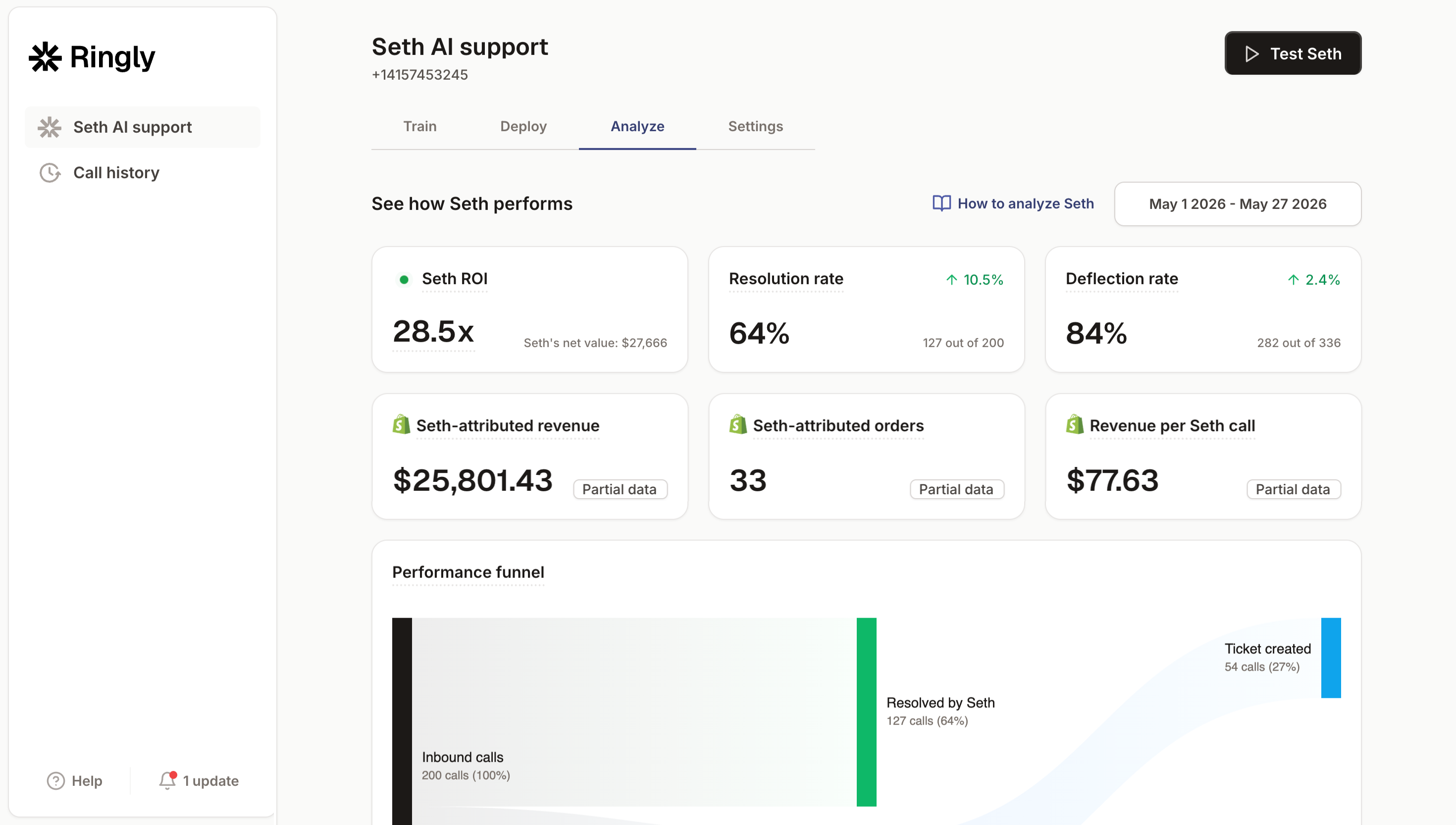
The point for this guide: every one of those call events can flow into the same Zapier and webhook stack you just built. A resolved call, an escalation, an after-hours missed call, a recovered cart, all of it becomes an event you can route to Slack, a Sheet, or back into a Gorgias ticket. Your phone stops being the one channel that lives outside your automations.
WashCo, a Shopify brand we launched, recovered $22,664 in its first 7 days on the phone. That's the revenue that was previously rolling to voicemail with no event attached.
If you're already wiring Gorgias into your stack and the phone is the obvious hole, book a 30-min call and we'll map how call events plug into your existing Zaps.
"My customers also feel like it's a normal person. They feel like they can communicate if they have questions."
Claudia Droge, TechCraft Studio
TechCraft handles 88% of its calls without a human, and those handled calls still leave a clean record you can route anywhere. If you've been trying to scale support without hiring, the phone is usually the cheapest place to find the next win.
Frequently asked questions
Does Gorgias have a Zapier trigger? Not a useful instant one in the native Zapier app, which is built around the Create Ticket and Create Ticket Message actions. To trigger a Zap from a Gorgias event, use a Gorgias HTTP Integration on Ticket Created, Ticket Updated, or Ticket Message Created and point it at a Zapier Catch Hook.
What can Zapier do with Gorgias? Two things, in two directions. It can create tickets and ticket messages in Gorgias from other apps (forms, Shopify, sheets), and through Gorgias HTTP Integrations it can react to ticket events by sending them to Slack, Google Sheets, a returns app, or your email tool.
Do I need a developer to set this up? No. The inbound Create Ticket action is point-and-click, and the webhook trigger is a copy-paste of a Zapier Catch Hook URL into Gorgias HTTP Integrations. You only need a developer if you route webhooks to your own service and want to queue them at high volume.
Should I use Zapier or Make for Gorgias? Both work and both rely on the same two Gorgias actions plus the HTTP Integration webhook for triggers. Zapier is faster to set up; Make gives more control over branching logic. For most Shopify support teams, Zapier is the quicker path.
Can Zapier route Gorgias tickets by tag? Indirectly. The tagging and routing decision happens in Gorgias Rules. Zapier reads the tag from the webhook payload and fans the ticket out to other tools, so you build the routing in Gorgias and the cross-app delivery in Zapier.
How do I get phone calls into Gorgias automations? A standard Zapier-and-Gorgias setup has no phone events to react to. An AI phone agent like Ringly turns calls into structured events (resolved, escalated, missed) that flow into the same Zapier or webhook stack and can open or update a Gorgias ticket.
Talk to us

If you run a $10M-$100M Shopify brand and you've automated everything except the phone, a 30-min call is the fastest way to see what those missed calls are costing you and how to wire them into the Zaps you already run.
The 3-layer guarantee.
- Live in 14 days or it's free until launched.
- 65% resolution in 90 days or we refund the last 3 months of subscription fees.
- We keep working free until we hit 65%.
Ruben (Ringly co-founder) takes these calls personally.