

The 30-second version.
- The Gorgias API can read and write almost everything in your helpdesk: tickets, customers, messages, events, tags, and surveys.
- The honest cost isn't the API itself. It's the developer time to build a sync and the maintenance to keep it alive.
- Built for $10M-$100M Shopify brands running Gorgias with a visible phone line, where the calls usually never make it into the helpdesk at all.
Most write-ups about the Gorgias API are written for the engineer who has to build against it. This one is written for the person who has to decide whether building anything is worth it.
If you run a $10M-$100M Shopify brand, you are probably the Founder, the COO, or the Head of CX, and you have a Gorgias instance handling email and chat while the phone line does its own thing in the corner. Someone on your team has floated "we could connect that with the API." Before you green-light a sprint, here is what the API actually does, what it costs to build on top of, and the one gap it leaves wide open. If you want the short path, book a 30-min call and we'll map your phone-to-helpdesk routing for you.
In this post:
What the Gorgias API is (and what V2 means)
Gorgias exposes a RESTful API that lets you get, create, update, and delete the core objects in your helpdesk. The current version, V2, is the toolkit your developers use to reach into your Gorgias data and move it around: tickets, customers, messages, and events, according to the official developer documentation.
If your helpdesk holds the data, the API is how anything outside the helpdesk reads it or writes to it. That's the whole idea. Everything else is detail.
Why does this matter to a Shopify operator rather than just a developer? Because the data sitting in Gorgias is the closest thing you have to a record of why customers contact you. WISMO ("where's my order") alone runs up to 40% of ecommerce support tickets, and more than 50% during peak, with each ticket costing around five dollars to resolve, per Shippypro's 2026 WISMO guide. The API is what lets you pull that pattern out of Gorgias and act on it somewhere else, or push new context in.
A quick word on names. The REST API is the read-and-write layer. Webhooks (Gorgias calls some of them HTTP integrations) are the event-driven push layer. They are different tools and most real builds use both. More on that below.
How authentication works (you can get your key in two minutes)
Gorgias uses HTTP Basic Authentication. You need three things, all of which live in your account settings:
- Base API URL: https://{your-domain}.gorgias.com/api/
- Username: the email address on your account
- API key: generated in settings
To find them, click the Settings icon in the bottom-left, open Account, then select REST API, as the Gorgias credentials doc lays out. That's the whole setup for a private integration.
Public apps (anything you'd list for other merchants to install) authenticate with OAuth2 Bearer tokens instead. The difference isn't only security. It changes your rate limit, which we'll get to.
One thing worth saying plainly: an API key is a password. Anyone who has it can read every customer record and ticket in your helpdesk. Store it in a secrets manager, not in a spreadsheet, and rotate it if a contractor rolls off.
The core objects and endpoints (the map)
Here's the part most operators actually want: a map of what's reachable. The API is organized around objects, and each object has predictable REST endpoints.
| Object | What you can do | Example endpoint |
|---|---|---|
| Tickets | Create, read, update, close, assign | `POST /api/tickets` |
| Ticket messages | Add a public reply or internal note | `POST /api/tickets/{id}/messages` |
| Customers | Read, create, update, merge profiles | `POST /api/customers` |
| Events | Read the activity stream | `GET /api/events` |
| Tags | Apply or remove tags for routing | `/api/tags` |
| Rules | Automation that fires on events | `/api/rules` |
| Macros | Saved reply templates | `/api/macros` |
| Satisfaction surveys | CSAT scores and comments | `/api/satisfaction-surveys` |
One gotcha worth knowing before you scope a build: you can't create a ticket without at least one message. The POST /api/tickets call expects a messages object plus a customer object and the channel it came in on, per the create-a-ticket reference. A bare "open a ticket" call won't go through. That single rule trips up most first builds, so flag it for whoever's writing the code.
The full object list goes deeper than this (users, views, integrations, statistics, jobs), but for 90% of what a Shopify brand wants to do, tickets, messages, customers, and events are the four that matter.
Rate limits, and why your sync breaks at scale
This is the section that saves you a bad week. Gorgias rate-limits the API with a leaky bucket: every request adds a drop, the bucket drains at a steady rate, and if you fill it faster than it drains, requests start failing.
The numbers depend on how you authenticate, according to eesel's rate-limit breakdown:
- API key integrations: 40 requests per 20-second window
- OAuth2 apps: 80 requests per 20-second window
There are also plan-tiered per-second limits, roughly 2 requests per second on Starter and Basic and around 10 on Pro and Advanced, with custom limits on Enterprise. When you go over, Gorgias returns a 429 and you back off, ideally with exponential backoff while respecting the Retry-After header. You can watch your usage live in the X-Gorgias-Account-Api-Call-Limit response header.
I connected the REST API to a test Shopify store, created a batch of tickets through POST /api/tickets, and the bucket throttled right at 40 calls inside a 20-second window on an API key. Nothing exotic happened, it just started returning 429s and I had to slow down. The practical takeaway: if you're backfilling thousands of historical tickets into a warehouse, you cannot just loop as fast as your code runs. You have to pace it, or the job dies halfway and you're debugging at 11pm.
For a real-time sync this is rarely a problem. For a bulk migration or a nightly export, it's the first thing that breaks. Budget for backoff logic from day one.
Webhooks vs the REST API (you'll want both)
People conflate these two, so let's separate them.
- Webhooks (HTTP integrations) push to you. Gorgias fires a message to your endpoint the instant something happens: a ticket is created, a message comes in, a customer is updated. Use them for anything that needs to react in real time, per eesel's webhooks guide.
- The REST API is the other direction. You call it to read data on demand or to write data in.
The common events you can subscribe to are ticket-created, ticket-updated, ticket-message-created, customer-created, and customer-updated. A typical build chains them: a webhook fires when a ticket is created, your code catches it, then calls the REST API to enrich the customer record or post an internal note. Push tells you something happened. Pull-and-write lets you do something about it.
What operators actually build with it
Past the theory, here's what teams genuinely ship with the Gorgias API. None of this is exotic, and all of it shows up in real DTC stacks:
- Warehouse and reporting sync: pull tickets, users, and survey scores into Looker or Tableau so you get CS reporting that your built-in dashboards don't give you.
- CRM and ERP sync: when a ticket is created or a customer is updated, mirror that into your CRM or back-office system so support and the rest of the company see the same record.
- Auto-create tickets from external events: a Stripe dispute, a one-star review, a failed delivery, or a phone call can all open a ticket through POST /api/tickets.
- Sidebar widgets: show third-party data (loyalty status, subscription state, shipment tracking) inside the agent view via custom HTTP integrations, so your reps stop tab-switching.
- Slack alerts: route VIP or angry tickets to a channel the moment they land.
- Auto-tag and route: drive Rules off events to tag and assign tickets without a human triaging the queue.
The pattern across all of these: the API is glue, not a product. It connects Gorgias to the rest of your stack. It doesn't decide what should happen, your team still does.
Build vs buy: what the API really costs you
Here's where operators get the math wrong. The API is free to call. The build is not.
Every integration above needs a developer to write it and, more painfully, someone to maintain it as Gorgias, Shopify, and your other tools all keep shipping changes. A sync you ship in a sprint can quietly rot over six months until a field renames and your nightly job starts dropping records. That's why a whole category of middleware exists (Merge, Celigo, Truto), so brands don't hand-roll and babysit every connector.
Put a number on it. A mid-level developer's time to build and maintain a couple of custom integrations is real headcount cost, and it competes with everything else your one or two engineers could be doing. Compare that to what the work is replacing:
| Line item | Build it yourself | Buy the outcome |
|---|---|---|
| Developer build time | 2-6 weeks per integration | none |
| Ongoing maintenance | continuous, as APIs change | vendor's problem |
| Who owns it when it breaks | you, at 11pm | the vendor |
| Time to first value | weeks to months | days |
The rule of thumb we'd give any Shopify operator: build with the API when the workflow is unique to your brand and nobody sells it. Buy when the workflow is common enough that someone already runs it for a living. Funding a developer to rebuild WISMO routing that a tool already does is the most expensive way to save money.
If you want a second opinion on what's worth building versus buying in your stack, book a 30-min call and we'll walk your support workflow with you.
Where the phone channel fits (and why it's usually missing)
Now the gap nobody in the documentation mentions. Email and chat flow into Gorgias automatically. Phone calls don't. Unless something writes them in through the API, every call your team takes (and every call they miss) leaves no trace in the helpdesk. Your record of "why customers contact us" is missing its loudest channel.
That's the exact problem the Gorgias API is built to solve, and it's where an AI phone agent earns its place.
Ringly.io is AI phone support for Shopify brands. Instead of growing your support headcount every time call volume goes up, the AI takes the routine inbound calls so your team can focus on the work that actually moves revenue.
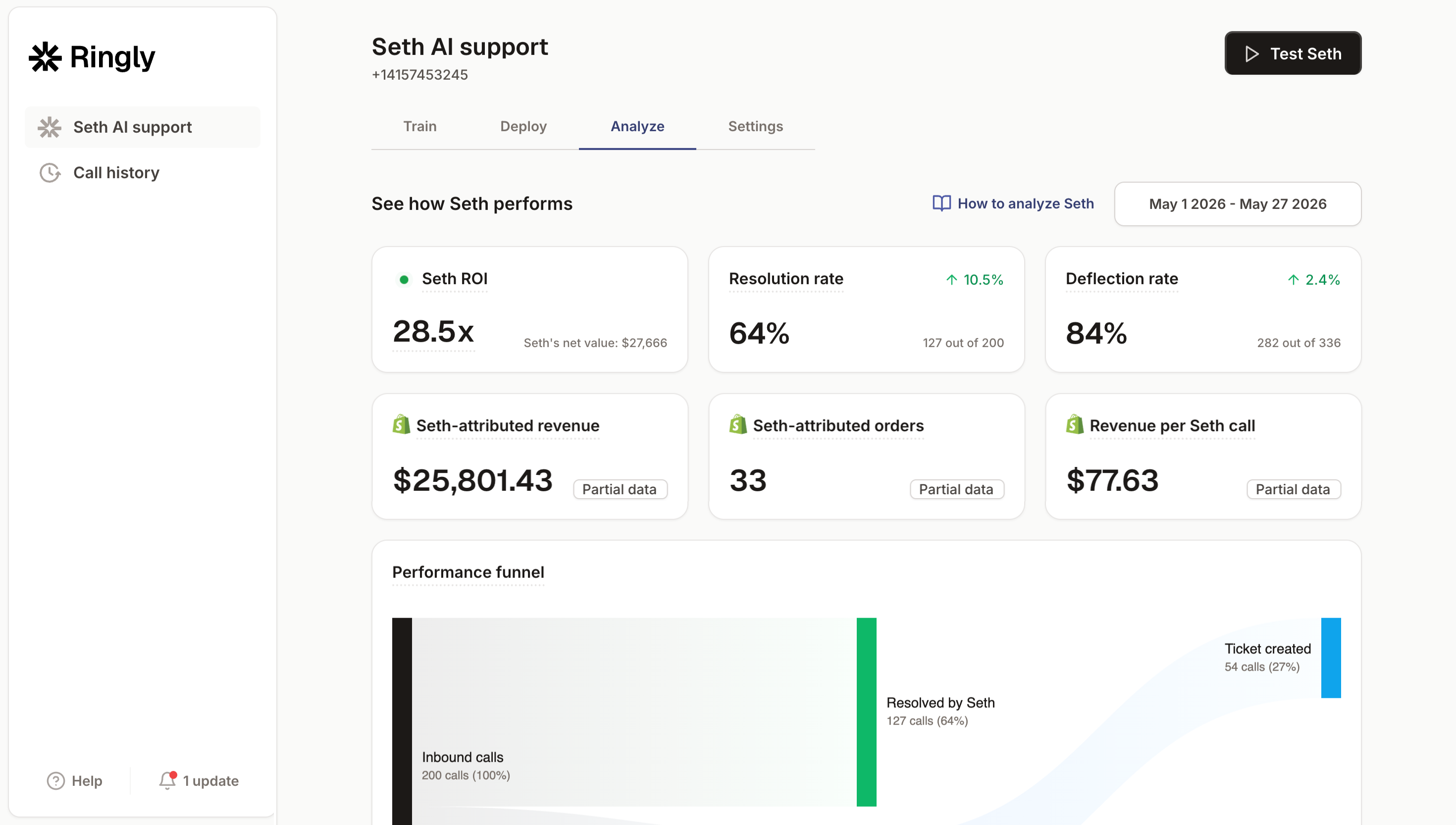
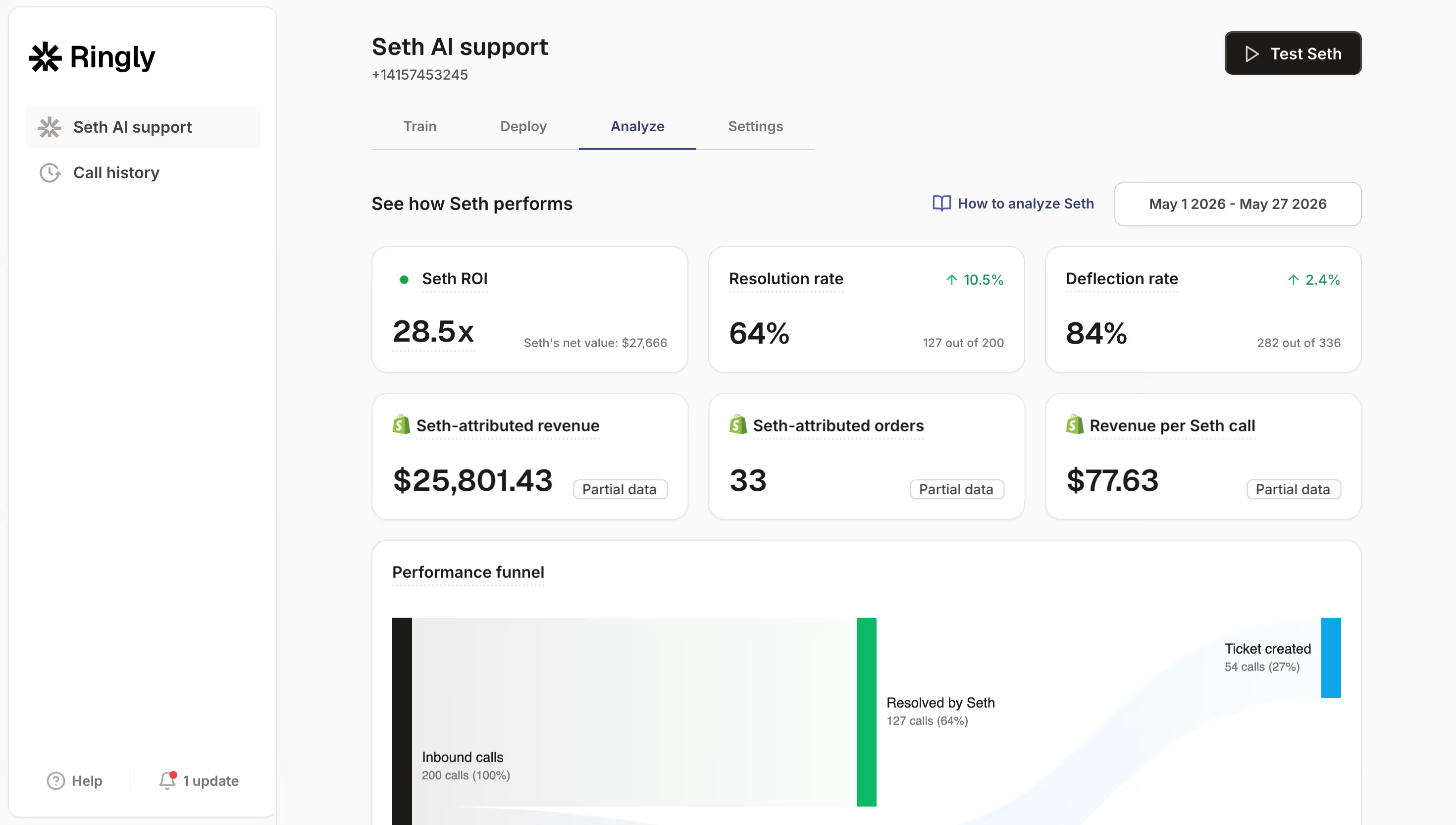
The AI answers inbound calls 24/7. It finds orders in your Shopify store, processes returns and exchanges, answers product questions from your knowledge base, and rescues abandoned carts via outbound follow-up. Across 50+ brands, the AI resolves 73% of calls autonomously at roughly $0.42 per resolved call. And here's the part that closes the loop on everything above: calls that need a human escalate cleanly to Gorgias, and the call outcome is written back into the helpdesk as a ticket through the API, so your CS team and your call reporting finally see phone alongside email and chat.
WashCo, a Shopify brand we launched, recovered $22,664 in its first 7 days on the phone. That revenue used to roll to voicemail and disappear. Now it's a line item in the helpdesk.
"My customers also feel like it's a normal person. They feel like they can communicate if they have questions."
Claudia Droge, TechCraft Studio
You keep your current phone number, your Gorgias instance, and your workflows. The AI sits in front, handles the routine call, and uses the same API you'd otherwise pay a developer to wire up. If you're already weighing Gorgias against other helpdesks or comparing Gorgias and Richpanel, the phone layer is the same regardless of which one you land on. It also pairs with your existing Shopify support setup, your order-status workflows, and the custom actions the API makes possible.
It's the same idea as a Shopify phone support agent that lives on top of your stack rather than replacing it.
Plans: Grow $349/mo (1,000 minutes), Pro $799/mo (2,500 minutes), Enterprise custom, with the full breakdown on the pricing page. Live in under an hour. 65% resolution guarantee: if the AI resolves under 65% of your calls in 90 days, we refund the last 3 months.
Frequently asked questions
What is the Gorgias API used for? It lets external systems read and write your helpdesk data: tickets, customers, messages, and events. Brands use it to sync data to a warehouse or CRM, auto-create tickets from outside events, and show third-party data in the agent sidebar.
How do I get a Gorgias API key? Open Settings in the bottom-left, go to Account, then select REST API. You'll find the base URL, your account email, and a generated API key there. Those three pieces are all you need for HTTP Basic auth.
What are the Gorgias API rate limits? The API uses a leaky bucket. API key integrations get 40 requests per 20-second window, OAuth2 apps get 80. Plan tiers add per-second limits, roughly 2 per second on Starter and Basic and 10 on Pro and Advanced. Going over returns a 429, so build in backoff.
Is the Gorgias API the same as webhooks? No. Webhooks push events to you in real time (ticket created, message received). The REST API is how you pull data on demand or write data back in. Most real integrations use both together.
Do I need a developer to use the Gorgias API? For raw API work, yes. Building and maintaining a custom integration is engineering work. If you don't have spare developer time, a middleware connector or a tool that handles the integration for you is usually cheaper than building from scratch.
Can the Gorgias API log phone calls as tickets? Yes, if something calls POST /api/tickets with the call details. Phone calls don't enter Gorgias on their own. An AI phone agent like Ringly writes the call outcome back into the helpdesk through the API, so phone shows up next to email and chat.
Does Ringly work with Gorgias? Yes. Ringly handles the inbound phone calls and escalates the ones that need a human cleanly into Gorgias, Richpanel, or Reamaze. You keep your current helpdesk and control what escalates.
Talk to us

If you run a $10M-$100M Shopify brand and your phone calls never make it into Gorgias, a 30-min call is the fastest way to close that gap. We'll show you what the phone channel is leaving out of your helpdesk and your reporting.
The 3-layer guarantee.
- Live in 14 days or it's free until launched.
- 65% resolution in 90 days or we refund the last 3 months of subscription fees.
- We keep working free until we hit it.
Ruben (Ringly co-founder) takes these calls personally.