

This post in 30 seconds.
- What it is: a contact center is the place a company handles customer questions across more than one channel (phone, email, chat, SMS, social), where a call center only handles the phone.
- What changed: in 2026 the front line went AI-first. Gartner expects conversational AI to cut contact center labor costs by $80 billion this year.
- What you actually need: if you run a $10M-$100M Shopify brand with a phone number on your site, you already operate a small contact center. The lever isn't buying a seven-channel suite. It's getting the routine phone calls answered.
If you run a Shopify brand with a phone number on your site, you already operate a small contact center. You might not call it that. You have a phone line, a helpdesk like Gorgias or Zendesk, a few reps, and a queue that fills up every Monday. That's a contact center.
So the real question for most operators isn't "what is a contact center." It's "do I actually need the enterprise version everyone keeps trying to sell me." I've spent two years reading the call logs of 50+ Shopify brands. The answer, almost every time, is no. You need the routine calls handled, not another login. If you want to skip ahead, book a 30-min call and we'll talk through your specific case.
This guide covers the plain definition, how a contact center actually works, what the call-center-vs-contact-center fuss is really about, and the honest version of what a growing Shopify brand should spend on.
Most $10M-$100M Shopify brands I talk to are running a 3-to-12 person CS team and a phone line nobody picks up after 6pm. The same WISMO questions land over and over, the after-hours calls roll to voicemail, and "hire rep #5" never quite pencils out. That's the problem this whole category is supposed to solve. Book a 30-min call and we'll look at what your store is leaving on the table after hours.
What a contact center actually is
A contact center is a team (and the software behind it) that handles customer interactions across multiple channels. Phone, email, live chat, SMS, social media, sometimes video and self-service help articles. One place, many doors in.
A contact center is just a call center that grew more than one channel, plus the software to route everything to the right person. That's the whole idea. Salesforce, Zendesk and Cisco all define it roughly the same way: a central hub for customer service, sales help, and technical support, usually wired into a CRM so the agent can see who's calling and why.
The word "center" makes it sound like a building full of headsets. It can be. But most modern contact centers are virtual, run in the cloud, with reps working from wherever. For a DTC brand, your contact center might be four people in a Slack channel and a Gorgias inbox. Size doesn't change the definition.
What every contact center has in common:
- More than one channel. If it's only phone, it's a call center. Add email or chat and it's a contact center.
- Routing. Calls and messages get sent to the right rep, or held in a queue, or sent to an automated answer.
- A shared record. Reps can see the customer's history so nobody asks "what's your order number" three times.
- Reporting. Someone, eventually, wants to know the resolution rate and how many calls got dropped.
The point of bundling all of that together is consistency. A customer who emails on Monday and calls on Wednesday should hit a team that already knows the context, instead of starting over. That's the promise. Whether you get it depends far less on how many channels you switch on and far more on how well you handle the busy one. For most Shopify brands, that's the phone, and it's usually the channel with the thinnest coverage. The ecommerce phone support side is where the routine volume and the missed-call leak both live.
Contact center vs call center: the difference in one table
This is the question nearly everyone is actually asking. A call center handles the phone. A contact center handles the phone plus every other way a customer might reach you. That's the difference in one sentence.
| Dimension | Call center | Contact center |
|---|---|---|
| Channels | Phone only | Phone, email, chat, SMS, social, self-service |
| Software | Phone system + basic IVR | Omnichannel routing + CRM + analytics |
| Agent skills | Voice only | Voice plus written channels |
| Customer record | Often siloed per call | Shared across channels |
| Typical buyer | Pure inbound/outbound voice ops | Most customer-facing businesses in 2026 |
Here's the part the software vendors gloss over. Adding channels is not automatically the win, especially for a phone-heavy brand. The phone is still where your highest-intent and oldest customers land. One coffee brand owner told us a majority of his calls were people who wanted to place an order by voice because they didn't trust the website. That call is worth more than a chat ticket, and it's the one most teams under-staff after hours.
So if you're picking between "answer the phone well" and "add four more channels," answer the phone well first. More on that below. If you want a deeper read on the voice side, we wrote about 24/7 ecommerce phone support and the broader shift in how AI is changing call centers.
How a contact center actually works
Strip away the acronyms and a contact center is four moving parts.
The whole machine exists to get the right question to the right place, fast, without the customer repeating themselves. Here's what's under the hood, in plain English.
- Routing (the ACD). The "automatic call distributor" decides who picks up. Round-robin, by skill, by language, or straight to a queue. On the digital side, the same logic routes chats and emails.
- The menu (IVR). "Press 1 for orders." That's interactive voice response. Modern setups replace the rigid menu tree with an AI that just asks what you need and acts on it.
- The customer record (CRM or helpdesk). This is where Gorgias, Intercom, Gladly or Re:amaze live. The rep (or the AI) sees the order, the past tickets, the subscription.
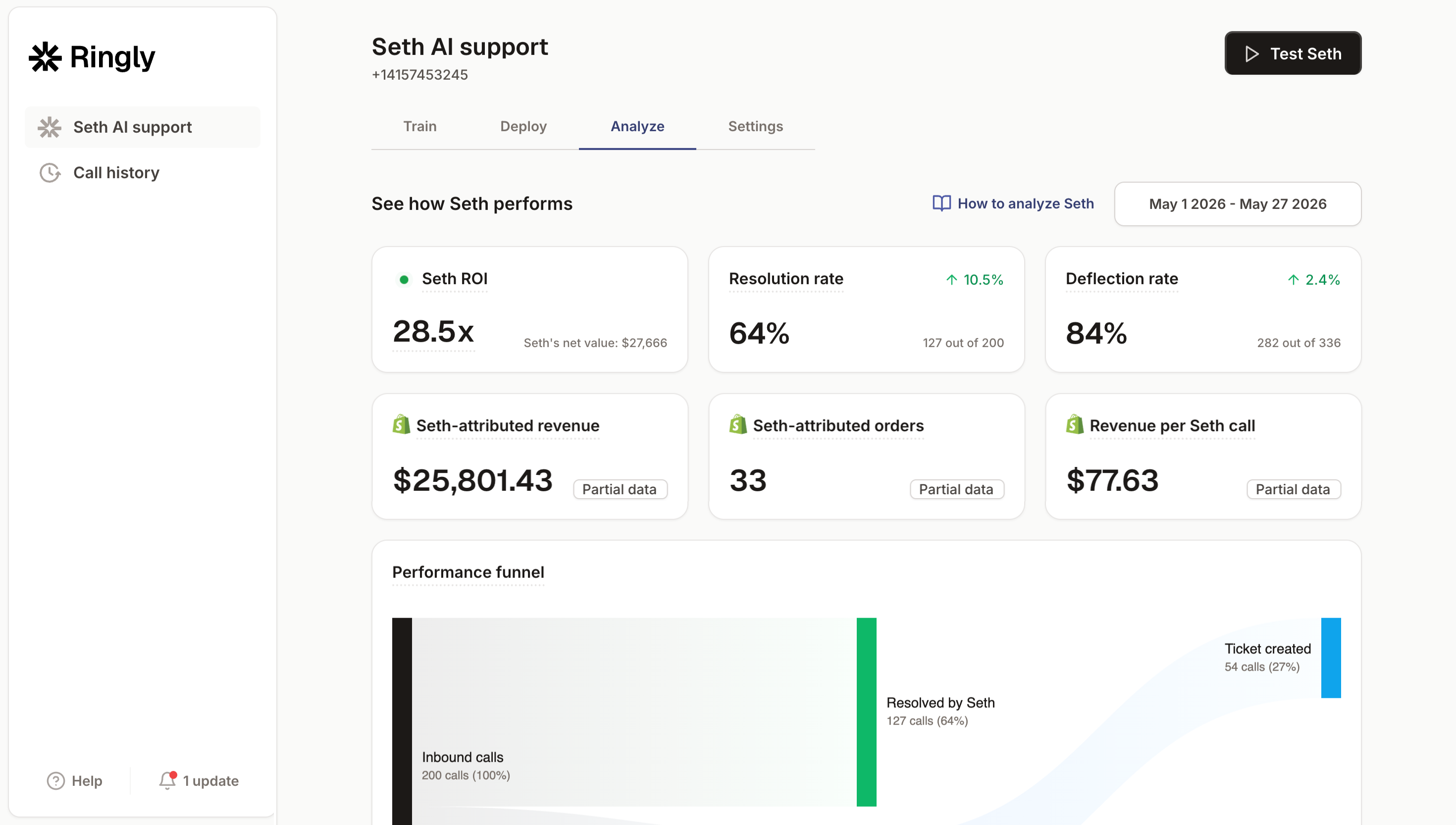
- Reporting. Resolution rate, average handle time, how many calls got dropped, how many rolled to voicemail and never came back.
Contact centers also come in a few flavors, which is where the jargon piles up:
- Inbound vs outbound vs blended. Inbound takes calls (support, WISMO, returns). Outbound makes them (sales, win-back, abandoned cart). Blended does both.
- On-premises vs cloud vs CCaaS. On-prem means servers in your building (rare now). Cloud means it runs over the internet. CCaaS, "contact center as a service," means you rent the whole stack from a provider and never touch hardware. CCaaS is where the market is moving: the CCaaS market is projected to grow from roughly $8.33 billion in 2026 to over $30 billion by 2034, a 17.4% annual clip (Fortune Business Insights).
For a Shopify brand, you don't need to memorize any of this. You need to know that the routine inbound calls are the expensive part, and they're the part that's now automatable. We break the software options down further in our guides to cloud contact center software and AI call center software.
What changed in 2026: the AI-first front line
The contact center didn't disappear. The front line got automated.
In 2026 the first voice a customer hears is usually an AI, and on routine questions it resolves the call without ever touching a human. This isn't a forecast anymore, it's the operating model. Gartner expects conversational AI to cut contact center labor costs by $80 billion this year. Around 80% of routine interactions (order tracking, common questions, basic troubleshooting) are now handled by AI. And 91% of customer service leaders told Gartner they're under pressure to put AI in front of their support, in a survey run in late 2025.
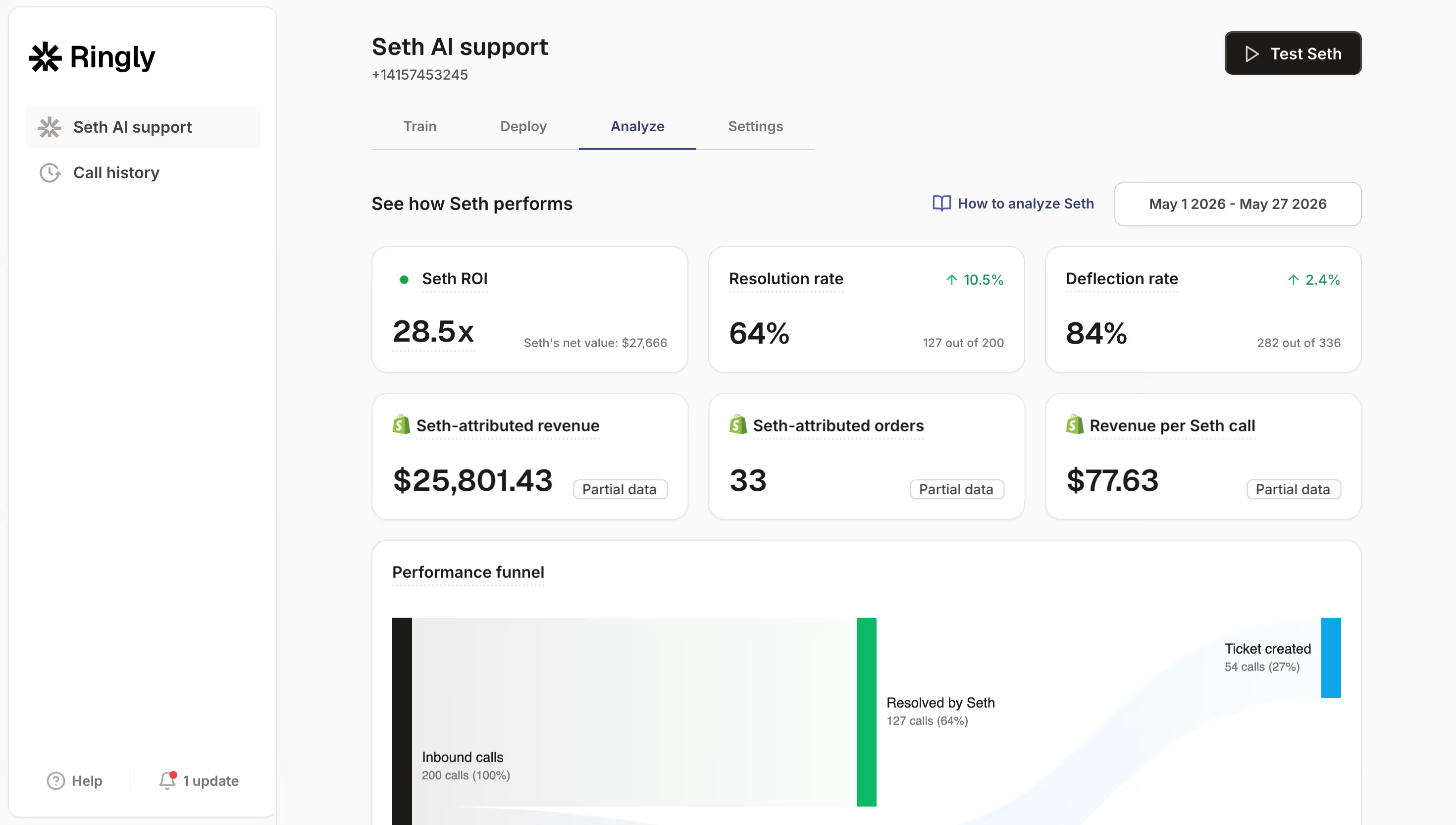
The reason is simple math. The same questions come in over and over. Across the 50+ Shopify brands I've watched, 70-80% of inbound calls are the routine stuff: where's my order, can I return this, is this back in stock. That work doesn't need a person. On those brands the AI resolves 73% of calls on its own, at about $0.42 per resolved call, against the $7-$16 a human-handled call costs at a typical BPO.
WashCo, a Shopify brand we launched, recovered $22,664 in its first 7 days on the phone.
"My customers also feel like it's a normal person. They feel like they can communicate if they have questions."
Claudia Droge, TechCraft Studio
That last point matters more than the cost. The most repeated thing customers say after talking to the AI is that it doesn't sound like AI. The fear that automating the phone means annoying your best customers is the right fear to have, and it's the one good voice quality answers. We dug into the voice side in our piece on AI receptionists for ecommerce.
What hasn't changed is the shape of the work. The split most leaders are settling into is simple: AI takes the routine, repeatable volume, and humans take the complex, emotional, or high-stakes calls. The after-hours "where's my order" goes to the AI. The angry customer who needs a judgment call goes to your team, who now actually have the time. That's not a smaller support operation. It's the same one, with the WISMO calls peeled off the people who were never hired to answer the same question fifty times a day.
What a Shopify brand actually needs (the honest version)
Here's the honest version, the one the enterprise vendors won't lead with.
For a $10M-$100M Shopify brand with 3-12 reps, a full omnichannel contact center suite is usually overkill. The lever is getting your routine inbound phone calls answered, then keeping your team for the hard ones.
Think about where the money actually goes. A US support rep runs about $4,000 a month loaded (salary, benefits, training, the churn when they quit at month nine). You staff them for the daytime, and the after-hours calls roll to voicemail anyway. You're paying full price for partial coverage, and every missed call is a customer who might just buy from someone who picked up.
Now compare the routine call. At roughly $0.42 per resolved call versus $7-$16 for a human-handled one, the math on the repeatable 70-80% isn't close. You don't fire anyone. You stop hiring rep #5 to answer the same WISMO question for the thousandth time, and you give your existing team the after-hours coverage they could never staff. That's the move, whether you call it a contact center or not. If you've been weighing whether to scale customer service without hiring or outsource it, this is the third option.
This is where Ringly.io fits. Ringly is AI phone support for Shopify brands. Instead of hiring and training a phone team, the AI handles inbound calls 24/7: order status, returns, product questions, abandoned cart rescue. It finds orders in your Shopify store, answers from your knowledge base, and escalates the genuinely hard calls to whatever helpdesk you already run. Across 50+ brands the AI resolves 73% of calls autonomously at roughly $0.42 per resolved call. Plans start at $349/mo with a 65% resolution guarantee, and you can be live in under an hour. You can see the full AI call center setup or check pricing directly.
It doesn't replace your helpdesk. It sits in front of the phone, which is the channel most teams are weakest on. If you want help mapping which of your calls are routine and which need a human, book a 30-min call and we'll do it with you.
Frequently asked questions
Is a contact center the same as a call center? No. A call center handles the phone only. A contact center handles the phone plus other channels like email, chat, SMS, and social. In practice most businesses now run contact centers, even small ones, because customers reach out in more than one way.
Do I need a contact center if I'm a small Shopify brand? You already have one in spirit: a phone line plus a helpdesk is a small contact center. What you usually don't need is a large enterprise suite with every channel turned on. Start by getting the routine phone calls handled, since that's the channel most DTC teams under-staff.
How much does a contact center cost? It depends on whether you build it with people or software. Outsourced human agents run roughly $1,200-$4,000 per agent per month, or about $1-$5 per interaction. AI phone support handles the routine calls at closer to $0.42 per resolved call, which is why most brands automate the repeatable volume first.
What's the difference between contact center software and a regular phone line? A phone line just connects a call. Contact center software adds routing, a shared customer record, automation, and reporting so you can see resolution rates and dropped calls. It's the difference between answering and actually managing your support.
What is CCaaS? CCaaS stands for "contact center as a service." It means you rent the entire contact center stack from a cloud provider instead of buying and running hardware. It's the dominant model now, with the CCaaS market projected to pass $30 billion by 2034.
Can AI run a contact center? AI can run the front line of one. In 2026 around 80% of routine customer interactions are handled by AI, and on phone-heavy Shopify brands the AI resolves about 73% of calls on its own. The complex, emotional, or high-stakes calls still escalate to your human team.
Does Ringly replace my contact center or my helpdesk? Neither. Ringly is AI phone support that sits in front of your phone line and resolves the routine inbound calls, then escalates the rest to the helpdesk you already use, like Gorgias or Zendesk. You keep your stack and your team, and the phone stops rolling to voicemail.
Talk to us

If you run a $10M-$100M Shopify brand and your phone rolls to voicemail after 6pm, that's the leak worth fixing first. A 30-min call is the fastest way to see what those missed calls are actually costing you.
The 3-layer guarantee.
- Live in 14 days or it's free until launched.
- 65% resolution in 90 days or we refund the last 3 months of subscription fees.
- We keep working free until we hit 65%.
Ruben (Ringly co-founder) takes these calls personally.