

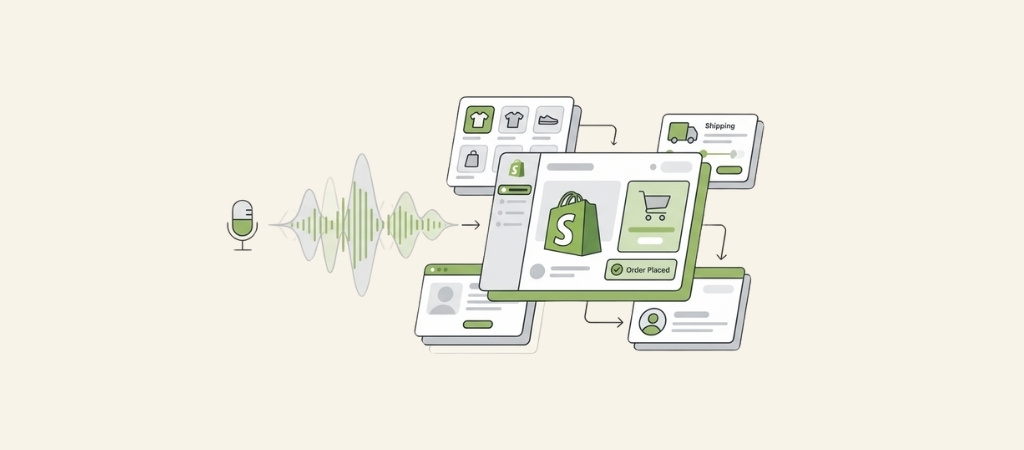
Manual processes cost the average e-commerce brand between 20% and 30% of their annual revenue.
You are likely losing thousands of dollars every month to a workflow that forces your team to choose between scaling sales and managing a mountain of support calls.
But there is a fix.
This will go over how you can recapture that lost revenue by using voice commerce for Shopify.
First, we’ll go over what voice commerce actually is.
Then, we’ll show you the exact steps to automate your phone support so you can scale without adding more headcount.
Editor’s note: Want to hear some sample support calls made for your Shopify store?
- Just paste your store URL
- Get sample calls in under 20 seconds (no email required)
- Listen to demo calls for my store
What is voice commerce for Shopify?
Voice commerce is just using your voice to find and buy products online through assistants like Siri, Alexa, and Google Assistant.
When you ask your smart speaker to add something to your shopping list or buy a movie ticket, you're using voice commerce.
The tech behind it uses voice recognition to hear what you say and natural language processing (NLP) to understand what you mean.
From there, it connects to e-commerce platforms to get the job done.
It’s also helpful to know the voice search vs. voice commerce. Voice search is for finding information, like asking, "What are the best running shoes?" Voice commerce takes it a step further by handling the actual purchase.
A customer might start with that search, then say, "Okay, buy the blue ones in size 10," completing the transaction without ever touching a screen.

The benefits and challenges of voice commerce
Adopting a new technology comes with both perks and a few things to figure out.
While voice commerce offers some new opportunities, it's good to be aware of the advantages and the current limitations.
Benefits of a voice-first approach
- It's fast and convenient: Speaking is just quicker than typing. For customers making simple or repeat purchases, voice commands make for a much smoother shopping experience. It removes the hassle of navigating a website for a product they already know they want.
- A better customer experience: Voice offers a hands-free way to shop that fits right into a customer's daily life. They can order things while doing chores or add to their cart while getting ready for bed. It meets them where they are.
- Improved accessibility: This is a big one. Voice commerce makes online shopping much easier for customers with visual impairments or physical disabilities. It opens up your store to a broader audience who might find traditional websites tricky to use.
Challenges to be aware of
- No visual confirmation: This is probably the biggest hurdle right now. Customers can't see what they're buying, which is a problem for products like clothing or furniture. This is why voice commerce currently works best for reordering everyday items.
- Technology isn't perfect: Voice assistants have come a long way, but they can still misunderstand accents, get thrown off by background noise, or misinterpret a command. This can lead to a frustrating experience or a wrong order.
- Security and privacy concerns: A lot of people are still a bit wary of saying their credit card information out loud. Building trust is a big part of getting customers comfortable with making payments through voice commands.
These challenges are real, but they can be managed. For example, AI phone agents like the AI agent from Ringly.io are designed to handle tricky situations by passing a call to a human agent if a question gets too complicated or a customer is frustrated.
This provides a safety net, making sure the customer always gets the help they need.
How to prepare your store for voice commerce
Getting your Shopify store ready for voice commerce isn't about a massive technical project. It really starts with strengthening your e-commerce basics, which will improve your store's performance everywhere.

Optimize for voice search
- Use a conversational tone: Voice searches are often phrased as questions. Instead of just targeting a keyword like "waterproof boots," write your product descriptions to answer questions like, "What are the best waterproof hiking boots for women?"
- Focus on long-tail keywords: People tend to be more specific when they speak. A typed search might be "running shoes," but a voice search is more likely to be "best lightweight running shoes for marathon training." Targeting these longer phrases will help you show up in those searches.
- Target local searches: According to Shopify, voice searches are three times more likely to be about something local. If you have a physical store, make sure your address, hours, and phone number are correct in directories like Google Business Profile.
A good example of a conversational product description would be something like: "Made from 100% organic cotton, this t-shirt is great for sensitive skin and everyday wear. It's pre-shrunk, so you won't have to worry about it changing size in the wash."
Structure your product data
- Keep product data clean: Make sure your product titles, descriptions, and other details are clear and consistent. An AI can get confused by messy data, which can lead to errors when a customer tries to order with their voice.
- Use structured data (schema markup): This sounds technical, but it’s just a way of labeling your content so search engines can understand it better. The good news is that most modern Shopify themes automatically include the right schema markup for products. This helps voice assistants pull the right information.
Streamline your checkout
- Enable saved customer details: The secret to a good voice purchase is a smooth checkout. Encourage your customers to create accounts where they can save their payment and shipping info. This makes reordering as simple as saying, "Buy it again."
While optimizing your site is a great first step, other tools offer a more direct way to engage with customers through voice.
For instance, an AI phone agent with a deep Shopify integration can pull order information directly from your store, providing instant support over the phone without relying on your site's SEO.
Exploring voice commerce solutions
As a Shopify store owner, you have a few different ways to approach voice commerce. Each option serves a different purpose, from helping customers browse your site to offering support after they've made a purchase.
On-site apps
This approach involves adding a voice-powered tool directly to your storefront.
These apps are usually found in the Shopify App Store and are designed to help customers who are already on your website.
- Example: Nowutalk AI Voice Sales Agent
- What it does: According to its Shopify App Store listing, this app adds a voice agent to your site that can help customers find products, almost like a virtual salesperson.
- Pricing: The app is listed as free to install. As of early 2026, the app's listing shows it has not yet received user reviews.
- Limitations: This type of tool is designed for visitors who are actively browsing the website. It does not address customer interactions that happen over other channels, such as phone calls.
Dedicated AI phone agents
This solution focuses on automating the oldest voice channel around: the telephone.
An AI phone agent can answer your support calls 24/7, handling common questions and freeing up your team for more complex issues.
- Example: the AI by Ringly.io
- What it does: the AI is an AI phone representative made specifically for Shopify stores. It connects to your store's data to look up order statuses, process returns, and answer common questions. On average, The AI handles about 73% of calls without any human help.
- Advantage: This targets a different part of the customer journey. A customer who calls your store is usually looking for immediate help. the AI provides that instant support around the clock in over 30 languages, which builds trust. Best of all, it only takes a few minutes to set up.
| Feature | Nowutalk AI Voice Agent | Seth by Ringly.io |
|---|---|---|
| Primary Channel | On-site voice assistant (Web-based) | Phone call support (Inbound/Outbound) |
| Primary Goal | Sales Conversion: Guides shoppers and overcomes objections. | Support Automation: Resolves support tickets and WISMO. |
| Shopify Integration | Reads product catalog for recommendations. | Full Write-Access: Processes returns, refunds, and order edits. |
| Key Function | Acts as a "Digital Stylist" or salesperson on the site. | Automates ~73% of support calls without human staff. |
| Pricing Model | Free (currently listed as Free on App Store) | Guaranteed: $0 until 65% resolution met, then $349/mo. |
| Availability | Active only while the user is browsing the store. | 24/7 via a dedicated business phone number. |
Ringly.io offers a unique guarantee where you don't pay anything until the AI successfully resolves at least 65% of 100 eligible calls.
This makes it a risk-free way to see if AI phone support is a good fit for your store.
Your next steps in voice commerce
Voice commerce is more than just a passing trend; it reflects customers' desire for quick, easy, and convenient interactions with brands.
While we're still in the early stages, the move toward conversational shopping is clear.
For any Shopify store, optimizing for voice search and structuring your product data are solid first steps. These are just good practices that will help your store no matter how technology changes.
From there, you can look into more direct voice solutions.
On-site apps can improve the browsing experience, while AI phone agents can turn your customer support into a 24/7 asset. A complete voice strategy thinks about all the ways customers might want to talk to you, including just picking up the phone.
Advancing your voice commerce strategy
Optimizing your site for voice search is a great start, but many of your most urgent customer questions still come in over the phone.
An AI phone agent can turn that traditional support channel into an efficient, always-on resource.
Ringly.io provides the AI, an AI agent that integrates with your Shopify store to handle customer calls instantly. It can look up orders, process returns, and answer common questions, freeing up your team to focus on growing your business.
Ready to see how an AI phone agent can improve your customer support? Start your free trial of Ringly.io today.
Frequently Asked Questions
How does voice commerce for Shopify actually work?
It works by using voice assistants like Alexa or Google Assistant to understand a customer's spoken commands. This technology connects to your Shopify store's backend to find products, add them to a cart, and complete a purchase, all without the customer needing to type or tap.
What are the biggest challenges of implementing voice commerce for Shopify?
The main challenge is the lack of visuals. Customers can't see the product, which makes it best for simple, repeat purchases of items they already know. Other hurdles include potential voice recognition errors and customer concerns about payment security.
Is voice commerce for Shopify only for large stores?
Not at all. While larger stores can benefit, any Shopify store can get started. The first steps, like optimizing for voice search with conversational language and structured data, are good practices that help stores of all sizes improve their overall SEO and user experience.
How can I optimize my product pages for voice commerce for Shopify?
Use a conversational tone in your descriptions, answering questions a customer might ask. Focus on long-tail keywords (e.g., "best waterproof hiking boots for women") and ensure your product data is clean and clearly labeled. Most modern Shopify themes handle the technical side (schema markup) for you.
What's the difference between on-site search and a phone agent for voice commerce for Shopify?
On-site search helps customers who are already on your website find products using their voice. A phone agent, like the AI agent from Ringly.io, handles a different part of the journey. It answers incoming calls to help with order status, returns, and other support questions, providing a complete voice experience.
How secure is voice commerce for Shopify for my customers?
Security is a valid concern. Most voice commerce transactions rely on pre-saved payment information from a customer's account, so they aren't speaking their credit card details out loud. Building trust by having secure account and checkout options is key.
What is the first step I should take to get started with voice commerce for Shopify?
A great first step is to focus on voice search optimization. Start writing your product descriptions and blog content in a more conversational, question-and-answer format. This helps voice assistants find your products more easily and improves your store's overall SEO.