
The short version.
- Voice AI that works means three things: it resolves the call (not just deflects it), it can see the customer's Shopify order in real time, and it doesn't sound like a bot.
- Most of the AI voicebots that burned people failed for five specific reasons. Each one has a fix, and you can test for all five before you sign anything.
- WashCo, a Shopify brand we launched, recovered $22,664 in its first 7 days on the phone.
- Written for founders, COOs, and Heads of CX at $10M-$100M Shopify brands running a paid helpdesk and a visible phone line.
If you tried an AI phone agent a couple of years ago and it read your customer a menu, then dumped them into a voicemail box nobody checks, you are right to be skeptical. That version did not work. It made you look worse than no phone line at all, and 78% of buyers abandon a brand after one unanswered call (PCN missed-call study).
So this is not a pitch that the technology is magic now. It's a straight answer to the question in the keyword: what separates voice AI that actually works for a Shopify store from the stuff that embarrassed you, and how do you tell the difference before you spend a dollar. I'll show you the five reasons the old tools failed, the one thing Shopify-specific that almost everyone gets wrong, and how I tested which tools resolve a call versus stall on one.
We build AI phone support for Shopify brands, so I look at this as the person who has to make it work, not as a critic. If you're a founder or Head of CX at a $10M-$100M Shopify brand and your phone backlog is real, you can book a 30-min call and we'll listen to your missed calls together and tell you, honestly, whether voice AI would resolve them.
In this post:
What "actually works" even means
Start with the word "works," because the whole category hides behind a softer one: deflection. Deflection means the call left the queue. It says nothing about whether the customer's problem got solved. A bot that answers, fails, and dumps the caller to voicemail "deflected" the call. It also lost you the customer.
Voice AI works when it resolves the call end to end: the order gets found, the return gets processed, the question gets answered, and the customer hangs up done. That's resolution, and it's a completely different number from deflection. Industry benchmarks put automated resolution at roughly 45-60% of Tier-1-eligible calls, climbing to 70-85% on clean workflows like order tracking and dropping to 10-25% on complex complaints (IrisAgent 2026 benchmarks). Across the brands we run, the AI resolves up to 90% of inbound calls without a human.
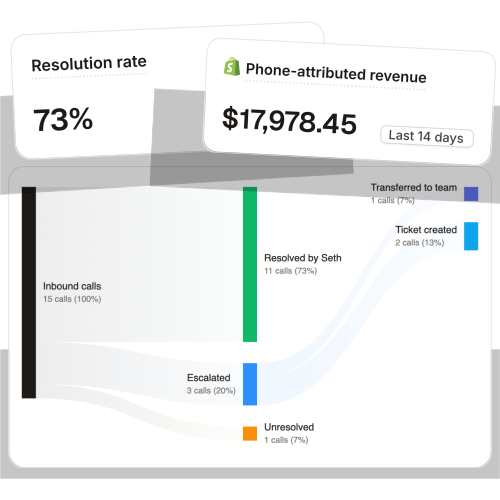
Here's the practical test. When a vendor quotes you a number, ask which one it is. If they say "we handle 80% of calls," ask what "handle" means. Handled and resolved are not the same word, and the gap between them is exactly the gap that makes you look bad on Trustpilot. The honest vendors talk about resolution and report it back to you per call. The rest talk about volume.
For a deeper read on the metric that actually matters, our piece on first-call resolution for ecommerce breaks down how to measure it without gaming it.
Why the voice AI you tried didn't work
The thing that burned you wasn't bad luck. AI customer service fails at nearly four times the rate of other AI applications (Channel.tel), and the failures cluster into five patterns. Almost every "it didn't work" story traces back to one of these five, and each has a concrete fix you can verify.
Here's the rundown.
- It sounded robotic because of latency. In a normal conversation, the gap between one person stopping and the next starting is about 200 milliseconds. Past one second, the caller assumes something is wrong. Past two, they repeat themselves or hang up, and abandonment jumps roughly 40% (AssemblyAI). Old voicebots sat at two or three seconds. The fix is sub-second response plus barge-in, so the caller can interrupt and the agent yields like a person would.
- It misheard, so it mis-acted. Speech recognition is the ceiling for everything downstream. If the transcription is wrong, the intent is wrong, the action is wrong, and the customer is furious, no matter how smart the language model is. Tools tuned on clean studio audio fall apart on a real caller with an accent on a noisy street.
- It guessed instead of looking. A bot working off a stale nightly export gives high-confidence wrong answers, which are worse than no answer. If it can't see the live order at the moment of the call, it can only guess.
- It transferred the caller cold. When the AI gave up, it handed the customer to a human with zero context. The customer re-explained the whole thing from scratch, and CSAT collapsed at the exact moment you needed it to hold. The fix is an escalation that carries the transcript and the order with it.
- It deflected instead of resolved. This is the Klarna story. Klarna replaced 700 support staff with AI, claimed the system handled two-thirds of chats, then reversed course in 2026 and started rehiring after customers complained about robotic, inflexible answers and the loop of repeating themselves to a human (Entrepreneur). High volume hid low quality until the reviews caught up.
WashCo, a Shopify brand we launched, recovered $22,664 in its first 7 days on the phone, which is the opposite outcome: calls that used to roll to voicemail turned into resolved orders.
None of these five are about the AI being "not smart enough." They're engineering and integration choices. That matters, because it means you can test for every one of them.
The Shopify part most voice AI gets wrong
Here's the piece the generic voice-AI tools skip. A voice agent that can talk beautifully but can't see your Shopify store will always feel like a menu, because it can't actually do the thing the customer called about.
Think about what your phone calls actually are. WISMO ("where's my order") is 30-40% of support tickets in normal periods and over 50% at peak (Salesforce). For the AI to resolve a WISMO call, it has to pull that specific order, in real time, mid-call, and read back the tracking. A bot that can only recite your shipping policy did not resolve anything. It deflected.
Voice AI works for Shopify specifically when it reads and writes to your store live: it finds the order, checks the subscription, processes the return, and answers from your real knowledge base, all during the call. That's the difference between a voicebot and a phone agent that belongs on a Shopify brand. Most Shopify-native helpdesks, by their own admission, don't have real voice at all, so the integration depth is where the field separates fast.
If WISMO is the bulk of your volume, our guides on WISMO calls and WISMO automation on Shopify go deeper on how to route those without a night shift. The mechanics of the live lookup are in our check order status feature page.
How I tested which voice AI actually works
I'm Ruben, co-founder of Ringly. To write this without hand-waving, I did the one test every buyer can do for free: over the last few weeks I called the published phone line of every voice-AI tool I could find and noted which ones resolved my question and which ones read me a menu.
Five things I listened for on each call:
- The order-aware test. I asked a "where's my order" question with a real order number and listened for whether the agent pulled the actual order or stalled with a policy answer. This is the one most tools fail.
- The latency-and-interruption test. I counted the pause before each response, then interrupted mid-sentence to see if it stopped like a person or steamrolled me. Anything past a second felt like a bad international call.
- The does-it-sound-like-AI test. I noted the moment I could tell it wasn't human. The good ones, I forgot. The bad ones told on themselves in the first sentence.
- The escalation test. I forced a question it couldn't answer and watched whether it transferred me with context or dumped me cold into a queue.
- The after-hours test. I called the lines again at 11 p.m. on a weeknight, because after-hours is exactly when your real customers call and exactly when a voicemail box loses you the sale.
The tools that passed all five had one thing in common: they were built around the live data and the conversation, not bolted onto a chatbot. The ones that failed usually failed on the first and third tests, which are the two your customers will notice first. I don't take affiliate money on any tool. I sell Ringly, and it gets judged on the same five tests below.
What working voice AI looks like in practice
Ringly.io: AI phone support for Shopify brands
Best for: $10M-$100M Shopify brands that want phone support resolved, not deflected, without hiring a night shift.
Ringly is AI phone support for Shopify brands. Your team wasn't hired to answer the same WISMO call fifty times a day, so the AI takes the routine inbound calls and your reps get the hard ones back. It was built around the two things the failed tools skipped: live Shopify data and a conversation that doesn't sound like a bot.
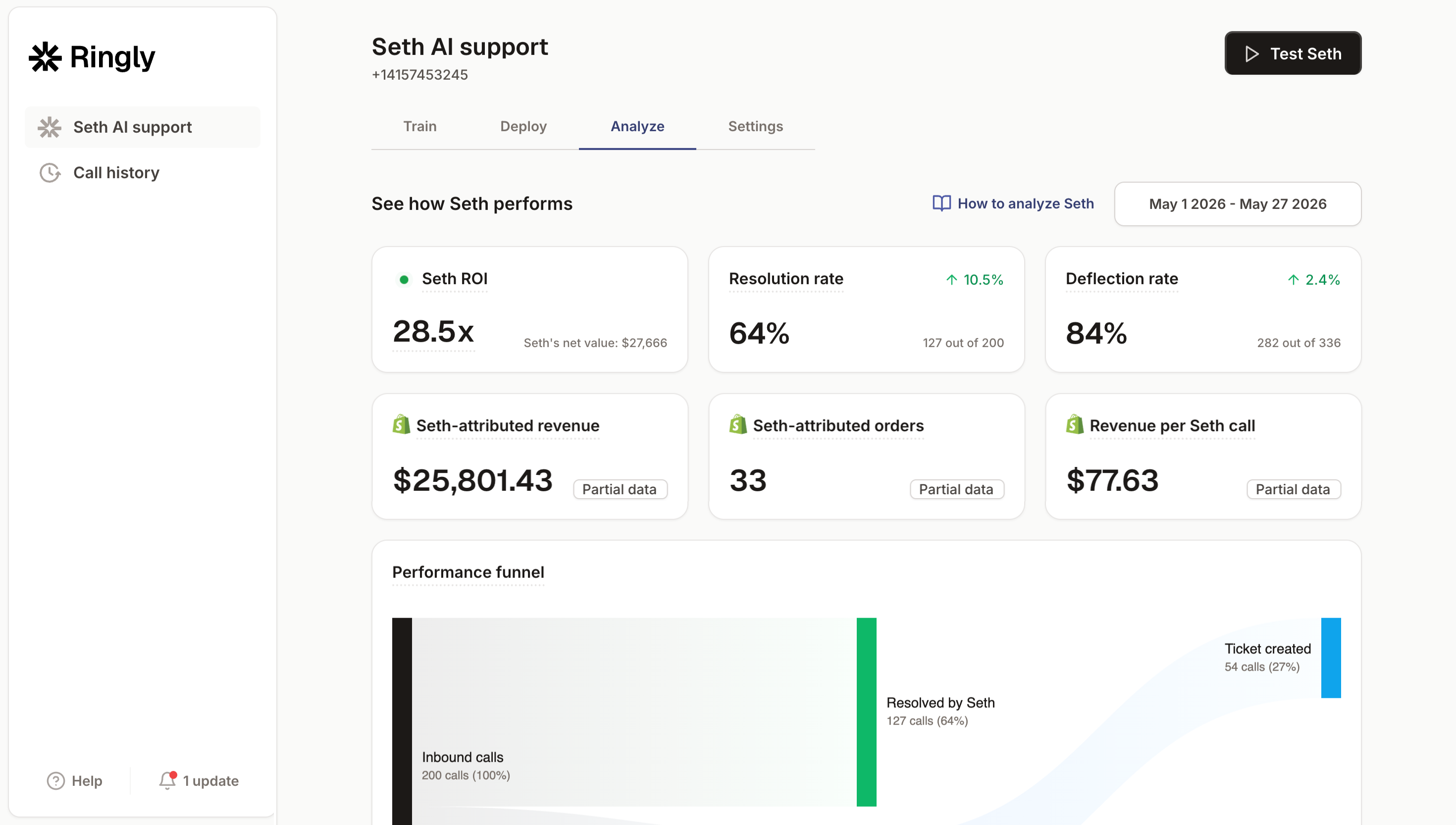
The AI answers inbound calls 24/7 in 40 languages. It finds orders in your Shopify store, processes returns and exchanges, answers product questions from your knowledge base, and cancels orders when a caller asks. It resolves up to 90% of calls autonomously for $1.99 a call after the first 50, versus $7-$16 per call for a human BPO. Calls that need a person escalate cleanly, with context, to Gorgias, Richpanel, Re:amaze, or whatever helpdesk you already run, so the smart call transfer never starts the customer from zero.
On the question every skeptic asks first, here's a customer in their own words.
"My customers also feel like it's a normal person. They feel like they can communicate if they have questions."
Claudia Droge, TechCraft Studio
What works
- Native Shopify lookup, live: finds the actual order, subscription, and return during the call, so it resolves WISMO instead of reciting your policy.
- Doesn't sound like a bot: sub-second response and natural turn-taking. The most repeated thing customers say is "you don't sound like AI."
- Resolution, reported: you see the real resolution rate per call in the dashboard, not a vanity deflection number.
- Keeps your stack: sits in front of your helpdesk, escalates with context. You don't rip anything out.
- Done-for-you build: an engineer reviews real calls weekly, so it gets better instead of drifting.
What doesn't (yet)
- Subscription cancels run as a custom action, not out of the box, so flag it on the call if cancel-by-phone is core to your flow.
- Phone orders go through an SMS payment link rather than the AI taking a card over the phone.
- Inventory refreshes daily, not to the second, so it's not the tool for live stock counts on a flash sale.
Why it works
It passes the five tests above because it was designed around them. Plans: $99 a month for the first 50 conversations, then $1.99 each. Live in under 1 hour. 65% resolution guarantee: if Seth resolves under 65% of your calls in a month, that month comes back as credit (after 90 days on Pay per call).
If you've been burned by a tool that promised the world and delivered a menu, the honest comparisons in our Consio vs Ringly breakdown and our AI voice agents for ecommerce guide give you more to compare against.
What this costs vs what your team costs today
The math is rarely about the price of the tool. It's about the spread between what you pay now and what you'd pay instead.
Take a typical Shopify brand running a 6-rep CS team.
| Line item | Today | With Ringly |
|---|---|---|
| 6 reps × $4K loaded per rep | $24,000/mo | n/a |
| Ringly Enterprise (~$5K/mo) | n/a | $5,000/mo |
| Net monthly CS spend | $24,000/mo | $5,000/mo |
| Monthly savings | n/a | $19,000/mo |
| Annual savings | n/a | $228,000/yr |
That's the routine 70% (order status, returns, the same five questions over and over) routed to the AI. The genuinely complex 30% still goes to your team, who now have time to actually solve those. The shape scales with team size, roughly the price landing near 20% of your current spend.
| Team size | CS spend today | Illustrative quote | Net monthly savings |
|---|---|---|---|
| 4 reps | $16,000/mo | ~$3,000/mo | ~$13,000/mo |
| 6 reps | $24,000/mo | ~$5,000/mo | ~$19,000/mo |
| 12 reps | $48,000/mo | ~$8,000/mo | ~$40,000/mo |
Exact Enterprise pricing is set on a call. These are the savings shapes we see across 200,000+ calls. If you want it run against your real call volume, book a 30-min call and we'll do the math live.
How to evaluate voice AI before you buy it
You don't need to take anyone's word, including mine. Run the same five tests I did, then check the contract for the things that separate a tool that works from one that demos well and collapses in production.
Choose a tool if it can do all of this:
- It looks up your live Shopify order on the call. Ask for a demo with a real order number. If it can't pull the order, it can't resolve WISMO, which is most of your volume.
- It answers in under a second and lets you interrupt. Call the demo line yourself. Count the pause. Cut it off mid-sentence and see if it yields.
- It reports resolution, not deflection. Ask how it measures success and whether you see it per call. "Handled" is not "resolved."
- It escalates with context. Force a question it can't answer and confirm the human gets the transcript and the order, not a cold transfer.
- It carries a real guarantee. A vendor confident the thing works will tie their fee to a resolution number. We guarantee 65% resolution: if Seth resolves under 65% of your calls in a month, that month comes back as credit (after 90 days on Pay per call).
Walk away if a vendor leads with "AI handles 90% of calls" but can't tell you the resolution rate, won't let you call the line, or hands you the software and disappears. That last one is how the tools that burned you got built.
For a wider field to compare against, our roundups of Gorgias alternatives, Intercom alternatives, and our overview of Shopify voice AI are good next reads. For the always-on angle, 24/7 ecommerce phone support covers the after-hours case.
Frequently asked questions
Does voice AI actually work for Shopify customer support? Yes, when it resolves calls instead of just deflecting them and can read your live Shopify data on the call. Seth resolves up to 90% of inbound calls autonomously. The tools that fail usually can't see the order in real time or sound robotic, which are both testable before you buy.
What's the difference between resolution and deflection? Deflection means the call left the queue. Resolution means the customer's problem actually got solved on the call. A bot that answers, fails, and routes to voicemail counts as a deflection but lost you the customer, so always ask a vendor which number they're quoting.
Will customers know they're talking to AI? Does it sound robotic? The robotic feel almost always comes from latency. Sub-second response plus the ability to be interrupted is what makes it feel like a person. The single most repeated thing our customers report hearing is "you don't sound like AI."
How is voice AI for Shopify different from a generic voicebot? A generic voicebot can talk but can't touch your store, so it recites policies instead of resolving anything. Voice AI built for Shopify finds the actual order, processes the return, and answers from your real knowledge base live on the call. That integration depth is the whole difference.
What happens on calls the AI can't handle? It escalates to a human with full context, passing the transcript and the order so the customer never repeats themselves. You decide what escalates. Emotional or genuinely complex calls are meant to reach your team, not get forced through the AI.
How much does voice AI for Shopify cost? Ringly is $99 a month for the first 50 conversations, then $1.99 each. For context, the AI costs $1.99 a call after the first 50 versus $7-$16 per call for a human BPO. Most brands compare it to their current CS payroll, not to a per-minute rate.
How fast can I get it live? Self-serve plans go live in under an hour: add your site, docs, and knowledge base and the AI is ready. We can also build and tune it for you, and setup is free.
Talk to us

If you run a $10M-$100M Shopify brand and your phone still rolls to voicemail after 6 p.m., a 30-min call is the fastest way to hear what working voice AI actually sounds like. We'll pull a few of your real missed calls and tell you, plainly, whether the AI would have resolved them.
Our 3 promises.
- Live in under 1 hour. Setup and test calls are free.
- 30-day money back on the $99 plan fee.
- 65% resolution guarantee: if Seth resolves under 65% of your support calls in a month, that month comes back as credit (after 90 days on Pay per call).
Ruben (Ringly co-founder) takes these calls personally.