

This post in 30 seconds.
- Coffee customers call more than most ecommerce shoppers, and the same five conversations repeat all day: where's my order, will it be fresh, change my gift's delivery, pause my subscription, what grind do I need.
- Voice AI for customer service is the difference between a phone tree that says "press 1" and an agent that actually pulls up the order and answers the question. We'll walk through what it can take off your team and what it can't.
- Written for $10M-$100M Shopify coffee roasters running a paid helpdesk with a visible phone number on the site.
A customer calls on a Tuesday afternoon. She wants to pause "the dark roast" she gets every month, and while she's on the line, she remembers she also sent a bag to her dad and wants it to arrive before Saturday instead. Two requests, one call, neither of them in a SKU she could ever recite. Your rep handles it fine. The problem is the other forty people who called the same hour.
I spent a week reading call transcripts from coffee brands running on our platform, and the thing that jumps out isn't the volume. It's how repeatable the conversations are. The same handful of questions, phrased a hundred slightly different ways, all day, every day.
If you run customer experience at a Shopify coffee brand doing $10M-$100M, you already know the shape of this. The phone backlog gets worse every gifting season, and most of those calls are the same stuff your team could answer in their sleep. We've built voice AI phone agents for 50+ Shopify brands with exactly this pattern. Book a 30-min call and we'll listen to a few of your real calls together and map which ones the AI can take.
The five conversations a coffee brand's phone actually has
Coffee is one of the few ecommerce categories where the phone never went away. Part of it is the buyer. A real chunk of specialty coffee revenue comes from older customers who don't feel comfortable placing an order on the website, so they call. Part of it is the product. Coffee is perishable and time-sensitive in a way a t-shirt isn't.
Read enough transcripts and the calls collapse into five conversations, and four of them never need a human. Here's what they look like.
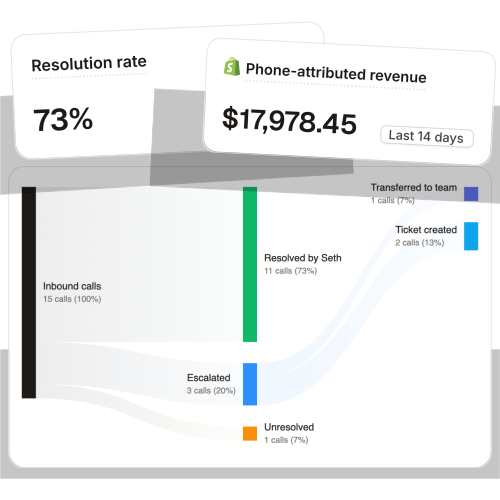
1. Where's my order, plus the freshness worry underneath it. This is the big one. "Where's my order" runs 30-40% of all support tickets and climbs past 50% at peak, per Salesforce. For coffee it comes with a tail: "will it still be fresh when it gets here?" The caller doesn't just want a tracking number, they want reassurance about roast date and transit time.
2. Gift timing, and the change-of-plan mid-call. A lot of coffee is bought as a gift, and the ETA matters more than the price. Callers ask when it ships, whether it arrives by a date, and often want to change the delivery address or bump shipping speed right there on the phone. December is when this conversation triples.
3. Subscription pause, skip, or swap, by product name. Coffee subscriptions have grown into a real channel, which means pause-and-skip calls now show up year-round. The catch is that customers say "the dark roast," not "item 1247." A scripted phone menu can't map that. Something that can see your store can.
4. Roast date, grind, and brew-method questions. "Is this ground for espresso or pour-over?" "When was this roasted?" "What's the difference between your two medium roasts?" These are knowledge-base questions, and a good agent answers them straight from your existing docs.
5. The one that should go to a human. Spoiled-on-arrival, a wrong-grind shipment for the third time, a refund argument. Trade Coffee customers have publicly described getting the wrong grind because the website had two different grind-preference fields, the kind of mess that needs a person. This call gets escalated, not answered.
Four of those five are routine. That's the phone support load eating your team's day, and it's the part voice AI was built to take.
What "handling the conversation" actually means
There's a difference between a phone system and a voice agent, and it's worth being precise about because the old phone tree is what most people picture when they hear "automated."
A phone tree routes. It says press 1 for orders, press 2 for returns, then dumps the caller into a queue or a voicemail. A voice AI customer service agent has the conversation. It hears "I want to pause the dark roast and also where's the bag I sent my dad," holds both threads, looks up the subscription and the gift order in your Shopify store, and handles them.
The thing that makes or breaks it is whether the caller forgets they're talking to software. Two things drive that. The first is latency. Callers read silence longer than about 1.5 seconds as a failure, and hang-up rates climb sharply past two seconds of dead air, so the agent has to respond at conversation speed, not chatbot speed. The second is voice quality. The most repeated thing customers say after a call on our platform is some version of "you don't sound like AI," and in coffee, with an older and more skeptical caller base, that bar is higher than anywhere else.
"My customers also feel like it's a normal person. They feel like they can communicate if they have questions."
— Claudia Droge, TechCraft Studio
The other half of "handling it" is doing something, not just talking. The agent needs to see the order, modify the subscription, send a tracking link by text, and when the call is genuinely complex, hand it to your team cleanly with the context already attached. A voice agent that can talk but can't touch the order is just a more expensive answering machine.
The voice AI options for a coffee brand
Here's how I'd look at the field if I ran a roaster doing $20M on Shopify. I'm Ruben, co-founder of Ringly, so treat my read on our own tool with the appropriate skepticism. The criteria I weigh: can it see and act on the Shopify order, does it sound human enough for an older caller, who builds and maintains it, and does the price stay sane as call volume climbs in December.
Across the five conversations above, the question isn't "which tool has the most features." It's which one actually resolves a coffee call end to end without a developer babysitting it.
| Tool | Best for | Shopify-native | Who builds it | Verdict |
|---|---|---|---|---|
| Ringly.io | Coffee/DTC phone support | Yes | Done for you | Resolves the routine call, escalates the rest |
| Gorgias AI Agent | Brands already deep in Gorgias chat | Partial | You configure | Strong on chat, weaker on phone |
| Fin (Intercom) Voice | Intercom shops | Generic | You configure | KB-grounded, not coffee-tuned |
| Sierra / Decagon | Enterprise contact centers | No | Their engineers | Overkill and overpriced for $10-100M |
| Vapi / Retell | Teams with developers | Build it | You build + maintain | Powerful, but it's a project |
1. Ringly.io: voice AI phone support for Shopify brands
Best for: coffee and DTC brands that want the routine calls handled without hiring a phone team. Ringly is AI phone support for Shopify brands. Hiring a phone team scales linearly with call volume. The AI doesn't.
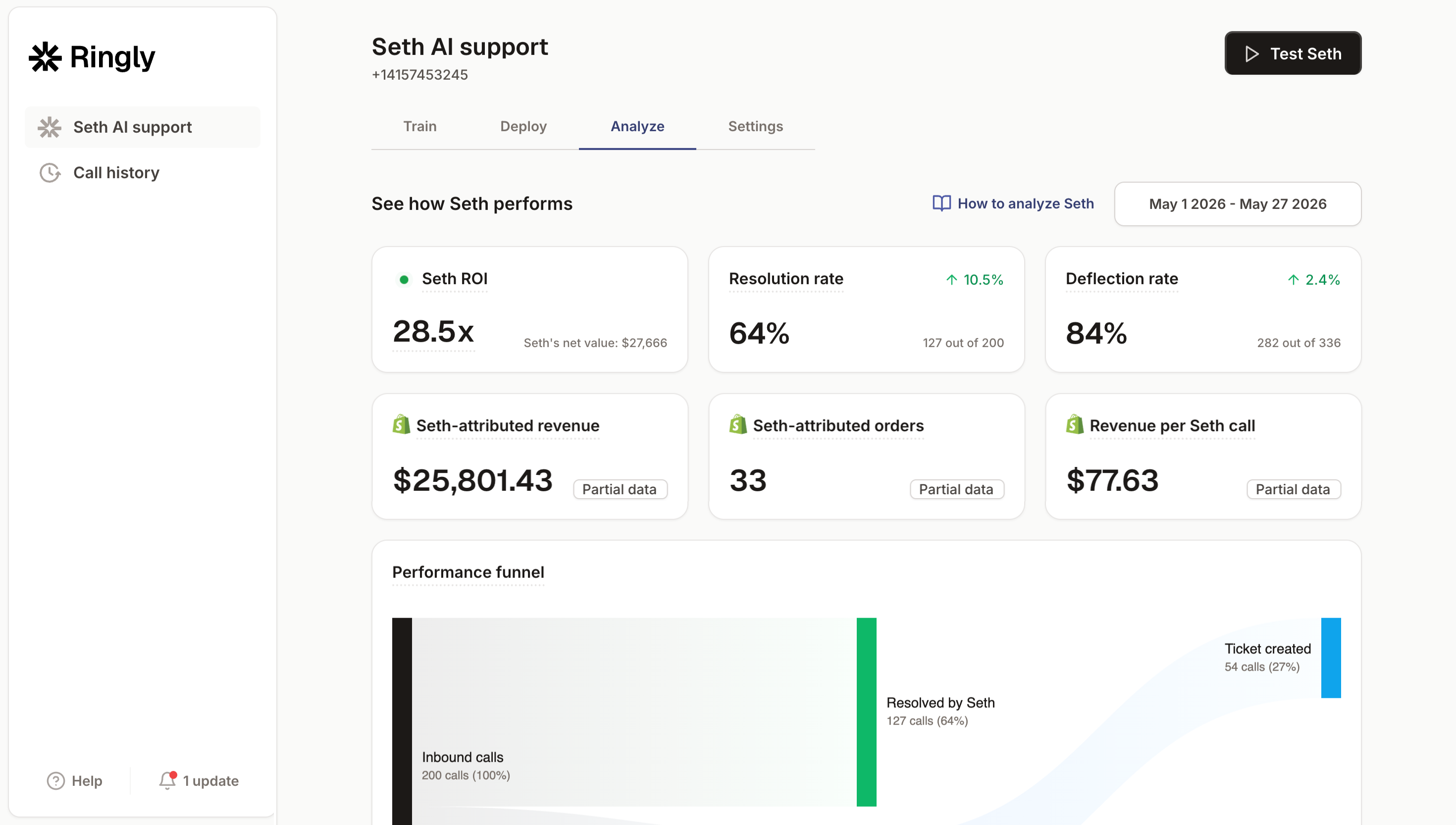
The AI answers inbound calls 24/7. It finds orders in your Shopify store, processes returns and exchanges, answers product questions from your knowledge base, and rescues abandoned carts with an outbound follow-up. Calls that need a person escalate cleanly to Gorgias, Richpanel, Reamaze, or whatever helpdesk you already run.
Pricing
| Plan | Price | Minutes |
|---|---|---|
| Grow | $349/mo | 1,000 (~500 calls) |
| Pro | $799/mo | 2,500 (~1,250 calls) |
| Enterprise | By call | Custom |
What works
- Sees the actual order. It can check order status and modify the right subscription even when the caller only says "the dark roast."
- Built, not handed to you. Our team builds and tunes it, and an engineer reviews real calls every week. You're not the implementation team.
- Sounds human. The compliment we hear most is "you don't sound like AI," which matters more with a 60-plus coffee buyer than anywhere else.
- Keeps your stack. Same phone number, same helpdesk, same workflows.
What doesn't
- It doesn't take net-new card orders by phone. For a customer who wants to order coffee on the call with a card, the agent sends a payment link by text or transfers to a human. More on that gap below.
- It's not a fit under $2.4M/yr. Below that, the self-serve plans make more sense than a done-for-you build.
Why it ranks first
For a Shopify coffee brand, it's the one option here that resolves the routine call end to end, sounds right to an older caller, and comes with a 65% resolution guarantee.
2. Gorgias AI Agent
Best for: brands already running most of their support through Gorgias chat and email. Gorgias added a stronger AI Agent in 2026 that handles pre- and post-purchase WISMO and returns, with cases showing roughly a 60% cut in human-handled tickets on the full deployment.
The trouble is phone. Gorgias is chat-and-email-first, and voice is the weaker leg. The per-ticket billing also climbs as automation volume goes up, which has surprised more than one operator at renewal. If you're weighing it, our take on the Gorgias Sidekick alternatives and the broader Gorgias alternatives goes deeper.
3. Fin (Intercom) Voice
Best for: brands already standardized on Intercom. Fin answers calls, holds a natural conversation, and pulls answers from your knowledge base 24/7.
It's solid as a generic voice agent, but it isn't tuned for the Shopify order graph or for coffee specifics like roast date and subscription swaps, and it leans on you to configure it. If Intercom is your hub, look at the Intercom Fin Voice alternatives before committing.
4. Sierra and Decagon
Best for: large contact centers with a dedicated ops team and a six-figure budget. Both are genuinely capable enterprise voice platforms.
They're also priced and scoped for companies far bigger than a $10-100M roaster. Year-one cost runs well into six figures, implementation needs their engineers, and the setup is weeks of work. For a coffee brand this size, it's a lot of machine for five recurring conversations.
5. Vapi and Retell
Best for: teams with developers who want to build a custom voice stack. Both give you the building blocks to craft exactly the agent you want.
The flip side is that you're building and maintaining a support product on top of running a coffee company. If you have the engineering bandwidth, the Vapi alternatives and Retell alternatives roundups are worth a read. If you don't, this path turns into a roadmap you didn't want.
What this costs vs your current CS team
The math is where this gets real. A typical $20M specialty food or coffee brand runs a small team year-round and a much bigger one for the Nov-Dec gifting rush:
- 4 reps × $4K loaded year-round = $16,000/mo ($192K/yr)
- 4 extra seasonal reps × $4K × 3 months = $48,000/yr peak
- True annual CS spend: roughly $240K/yr
Voice AI at the Enterprise level (set on a call, never list-priced) handles the roast-date, gift-ETA, WISMO, and subscription calls year-round and absorbs the gifting spike without the seasonal hiring. The savings shape we see lands around $140K-$180K/yr depending on volume. These are the patterns we see across 50+ Shopify brands, not a quote.
The unit economics back it up. Ecommerce voice support runs $9 to $16 per resolved contact with a human team, while AI-assisted voice resolves at roughly $2 to $3, and our verified per-call cost is even lower.
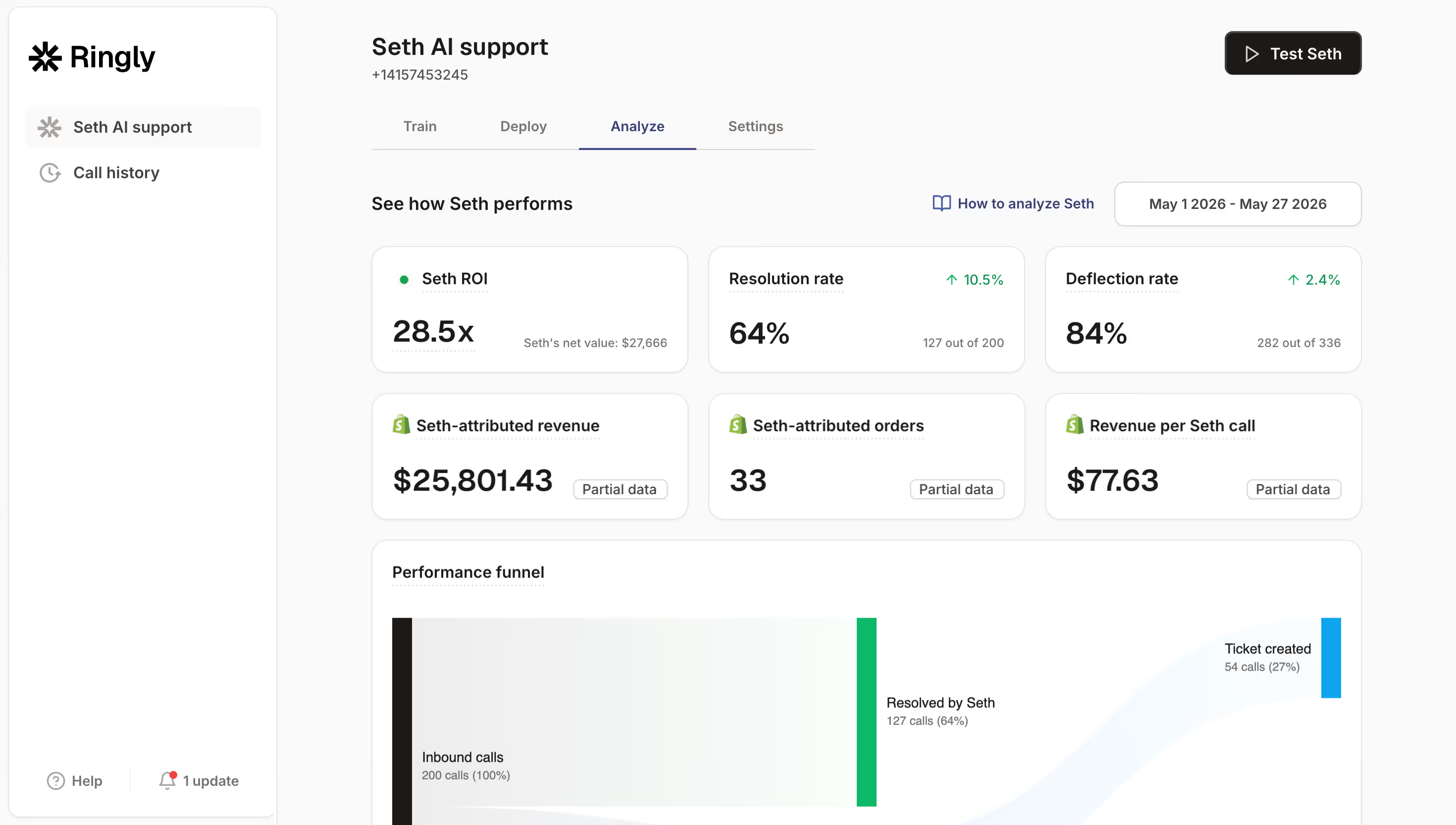
Real numbers from WashCo, a Shopify brand we launched recently:
- $22,664 in attributed revenue, first 7 days post-launch
- 271 calls handled
- 85% deflection rate
- 66% resolution rate
- $0.91 per call vs $2.70 per human-handled call
Source: Ringly dashboard, verified live data.
What happens on the call.
- We pull a few of your recent calls live, on the call. No homework for you.
- We show you what the AI would have resolved on its own and what it would have escalated.
- You decide if it's worth a deeper conversation. No deck, no follow-up sequence.
The call makes sense if:
- You're a Shopify (or Shopify Plus) coffee brand doing $10M-$100M
- You run a paid helpdesk like Gorgias, Zendesk, Gladly, Re:amaze, or Intercom
- You have a visible phone number on your store
- Your CS team is 3-12 people
If that's you, the math usually works. Book a 30-min call and we'll run it live against your real call volume.
Where voice AI still hands the call to your team
Being honest about the edges is the whole point, because the worst outcome is an agent that overreaches on a call it should have passed off.
The clearest gap for coffee is the phone order. A chunk of your callers, especially the older ones, want to place a brand-new order with a card right on the phone. We don't take card payments by voice. The agent's move there is to text a secure payment link or transfer to a human, which keeps the sale but isn't the "just charge my card" experience some callers expect. If more than half your revenue comes in as phone orders, you're not our fit yet, and we'll tell you that on the call.
The rule we hard-code is simple: anything emotional or genuinely broken goes to a person. A spoiled shipment, a gift that arrived late and ruined a birthday, a refund argument, a customer who's already angry. Those calls escalate with the order context attached so your rep isn't starting cold. The AI takes the routine so your team has the time and patience left for the calls that actually need them.
That's also why the after-hours story matters. Businesses answer only 37.8% of inbound calls, and 85% of callers who can't reach anyone never call back. The routine calls voice AI picks up at 9 p.m. are calls that were going to voicemail and then to a competitor.
Frequently asked questions
Can voice AI actually handle a coffee subscription pause if the customer only knows the product by name? Yes, as long as the agent is connected to your store. It maps "the dark roast" to the right line item on the subscription and pauses or skips it. A generic phone menu that only takes order numbers can't do this.
Will older coffee customers accept talking to an AI? This is the real test in coffee, and it comes down to voice quality and latency. The most common feedback we get is "you don't sound like AI," and the best way to judge it is to call the agent yourself before you decide.
Does voice AI replace my customer service team? No. It takes the four routine conversations (WISMO, gift timing, subscriptions, product questions) so your reps handle the complex and emotional calls. Most brands keep their team and stop adding seasonal headcount.
What about the December gifting spike? That's the case voice AI is best at. It absorbs the volume surge without you hiring and training seasonal reps who walk out in January, and it answers the ship-by and ETA questions that flood in around the holidays.
Can it take a new order over the phone? Not with a card directly. It sends a payment link by text or transfers to a human for the order, then handles everything else. If most of your revenue is phone orders, that gap matters and you should raise it on a call.
How long does it take to get live? On the self-serve plans you can be live in under an hour. For a done-for-you Enterprise build, the standard is a 14-day Launch Sprint, and it's free until it's launched.
Talk to us

If you run a $10M-$100M Shopify coffee brand and your phone backlog gets worse every gifting season, a 30-min call is the fastest way to see which of your calls the AI can take and what that's worth.
The 3-layer guarantee.
- Live in 14 days or it's free until launched.
- 65% resolution in 90 days or we refund the last 3 months of subscription fees.
- We keep working free until we hit 65%.
Ruben (Ringly co-founder) takes these calls personally.