

WISMO calls are the silent profit killer in e-commerce.
These "Where Is My Order?" inquiries eat up 25-50% of customer service volume, cost $5-6 each to resolve, and frustrate both your team and your customers.
The good news? Most WISMO calls are preventable.
Let's break down 10 strategies that actually work, backed by real merchant results.
Editor’s note: Want to hear some sample AI support calls made for your Shopify store?
- Just paste your store URL
- Get sample calls in under 20 seconds (no email required)
- Listen to demo calls for my store
Set accurate delivery expectations upfront
The best way to reduce WISMO calls is to prevent them from ever happening. That starts before the customer checks out.
Use your historical shipping data combined with real-time carrier performance to set realistic delivery windows.
If a carrier averages five days during holiday rushes, don't promise three.
Be transparent about delivery times and you'll build trust while reducing calls.
Display delivery estimates prominently before checkout, not buried in confirmation emails.
Customers need to know what to expect while they're still deciding whether to buy.
When delays happen (and they will), update expectations immediately.
Research from project44 found that 69.7% of shoppers are less likely to shop with a retailer again if a package is delayed without notification.
PittaRosso, a footwear retailer, saw drastic WISMO reductions simply by making shipping information crystal clear from the start.
Clear expectations upfront meant fewer confused customers reaching out later.
Build a branded tracking experience
Customers want to check their order status without talking to anyone.
A branded tracking page gives them that self-service option while keeping them on your site instead of a carrier's.
The results speak for themselves. Sweetie Shoppie, a UK confectionery retailer, implemented a branded tracking page and cut WISMO queries by 50%.
Customers could easily check their order status without contacting support.
Your tracking page should include:
- Real-time order status
- Carrier information and tracking number
- Expected delivery window
- Links to shipping FAQs
- Contact options for issues
Mobile optimization is essential. Most customers check tracking on their phones.
If your tracking page doesn't work smoothly on mobile, you're pushing people toward calling instead.
Automate proactive notifications
Don't wait for customers to ask where their order is. Tell them before they wonder.
A multi-channel notification strategy keeps customers informed across email, SMS, WhatsApp, and push notifications.
Different customers prefer different channels, so offer options.
The key touchpoints for notifications are:
- Order confirmation
- Shipping/label created
- Handed to carrier
- Out for delivery
- Delivered
- Exceptions or delays
When exceptions occur, speed matters.
Sendcloud's research shows proactive communication about delivery issues can reduce support tickets by up to 75%.
Travelbags, a luggage retailer, reduced WISMO requests by 39.2% through real-time monitoring and proactive alerts about shipment exceptions.
They spotted problems before customers noticed and reached out first.
Deploy AI for instant WISMO resolution
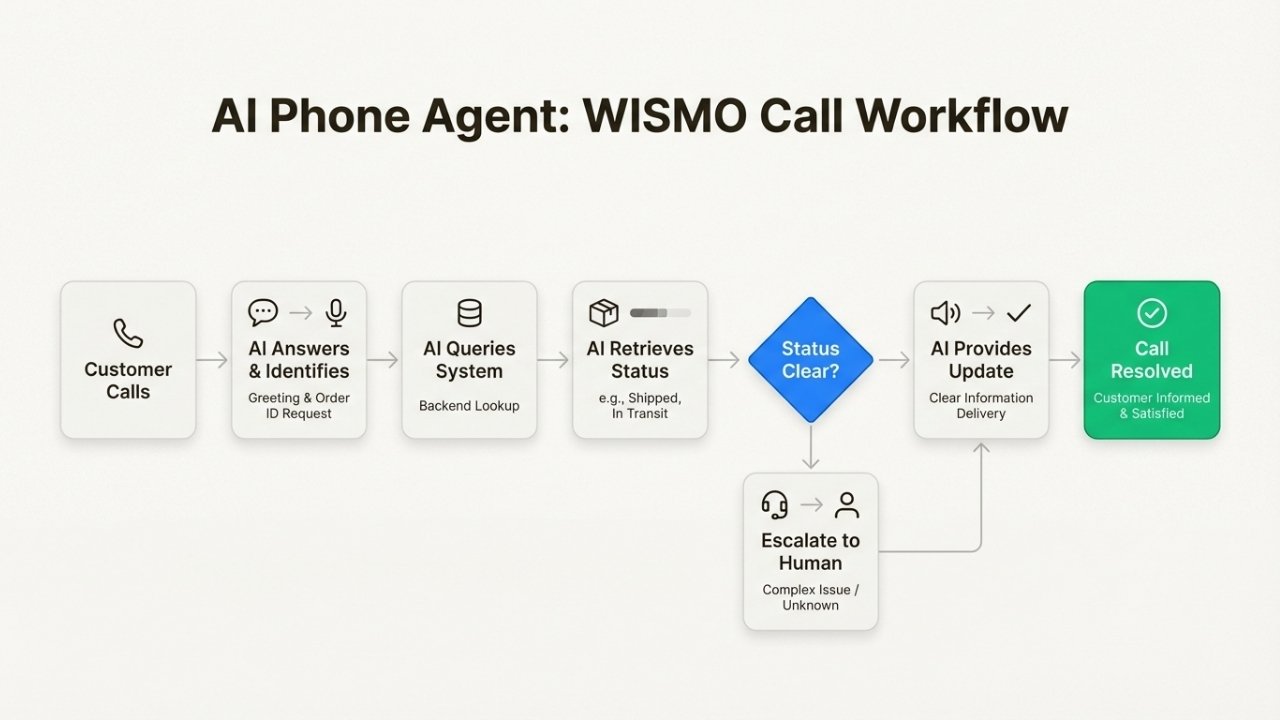
Even with perfect proactive communication, some customers will still call. AI phone agents can handle these routine inquiries without human intervention.
Here's how it works. When a customer calls asking about their order, the AI agent uses speech-to-text to understand the request, pulls order data from your e-commerce platform, and responds with accurate information in natural language. No waiting on hold. No "let me check that for you."
Ringly.io offers the AI, an AI phone support representative that resolves around 73% of calls without human help.
It handles order lookups, delivery status questions, and returns inquiries 24/7. When a call needs human expertise, it escalates smoothly.
The cost difference is significant. A human agent might handle 10-15 WISMO calls per hour at $15-25 per hour fully loaded.
An AI agent handles unlimited simultaneous calls for a fraction of that cost.
For Shopify stores specifically, AI phone agents integrate directly with order data. the AI pulls real-time order status, shipping information, and customer history instantly.
Multilingual support across 30 languages means global customers get help in their preferred language.
The setup is fast too. Most merchants deploy AI phone support in under 10 minutes without technical work.
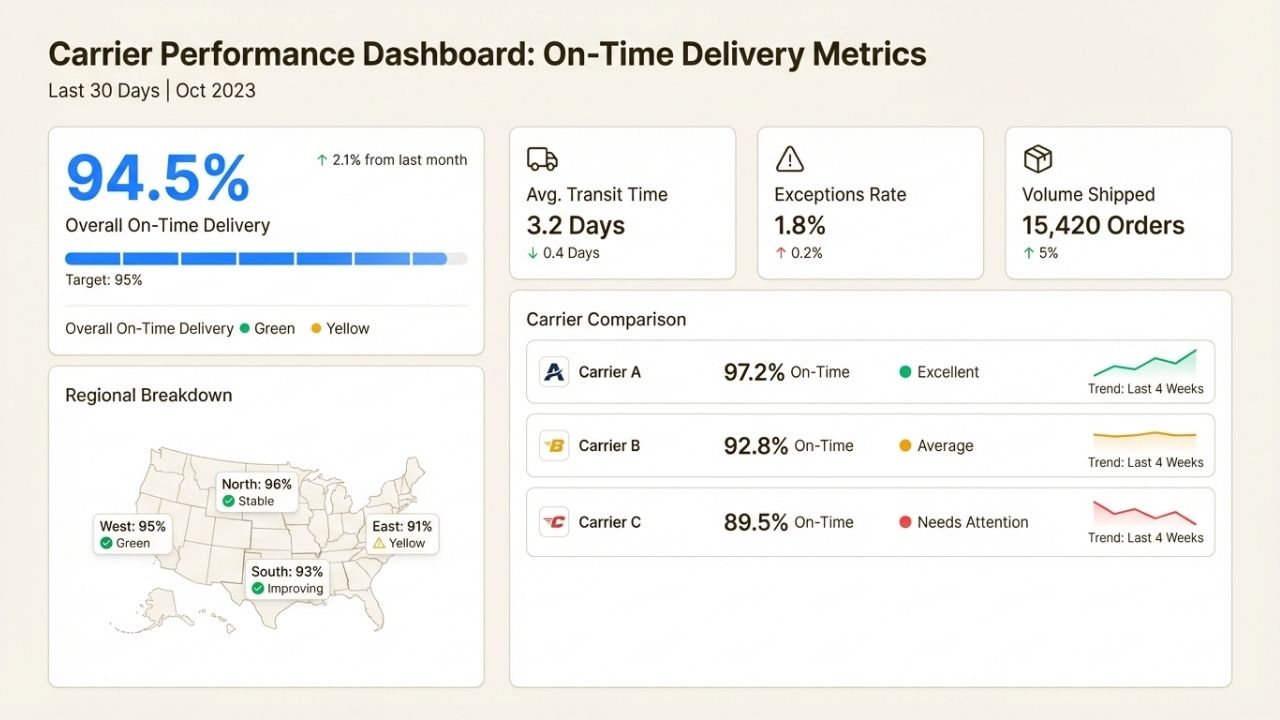
Monitor and optimize carrier performance
Your carriers directly impact WISMO volume. When packages arrive late or tracking stops updating, customers call you, not the carrier.
Track on-time delivery rates by carrier and shipping lane. Identify patterns.
If Carrier A consistently delays shipments from your West Coast warehouse, that's data you can act on.
Use this data to negotiate better terms.
Alex Formicola, Customer Support Lead at Rosefield, shared with Sendcloud that having access to detailed courier performance insights helped their team "gain better control over deliveries and negotiate more favorable terms with the couriers."
Continuous monitoring lets you route orders through the most reliable carriers for each destination.
Better carrier selection prevents delays before they generate WISMO calls.
Streamline returns communication (WISMR)
WISMR ("Where Is My Return?") follows the same principles as WISMO.
Customers who return items want visibility into refund status. Without it, they call.
The solution is identical: proactive notifications at each step of the returns process.
Confirm when the return is dropped off. Notify when it reaches your warehouse. Update when the refund processes.
New Look, a British fashion retailer, achieved a 20% decrease in WISMR calls by implementing step-by-step return notifications.
Their Senior Product Manager Rachel Troke explained: "Before, customers had no updates until the refund was processed.
Now, we confirm the drop-off and notify when it reaches the distribution centre."
Consider offering instant refund options like store credit or gift cards.
ZigZag's research found 57% of customers would accept a gift card refund instead of waiting for bank processing. That means quicker resolution for customers and retained revenue for you.
Empower customers with self-service
Most WISMO callers would prefer to find answers themselves if the information were easy to access. Build comprehensive self-service options.
Start with a detailed FAQ covering shipping timelines, carrier information, international delivery, and return policies.
Put this where customers naturally look: your website header, checkout page, and order confirmation emails.
Chatbots integrated with order data can handle routine questions instantly.
Vanessa Wu, a women's accessories brand, significantly reduced WISMO queries by implementing automated responses for common shipping questions.
Their chatbot pulls tracking data via API and provides real-time order status without human intervention.
Make sure your self-service works across all channels. Customers should find consistent information whether they check your website, open your app, or read your emails.
Measuring WISMO success
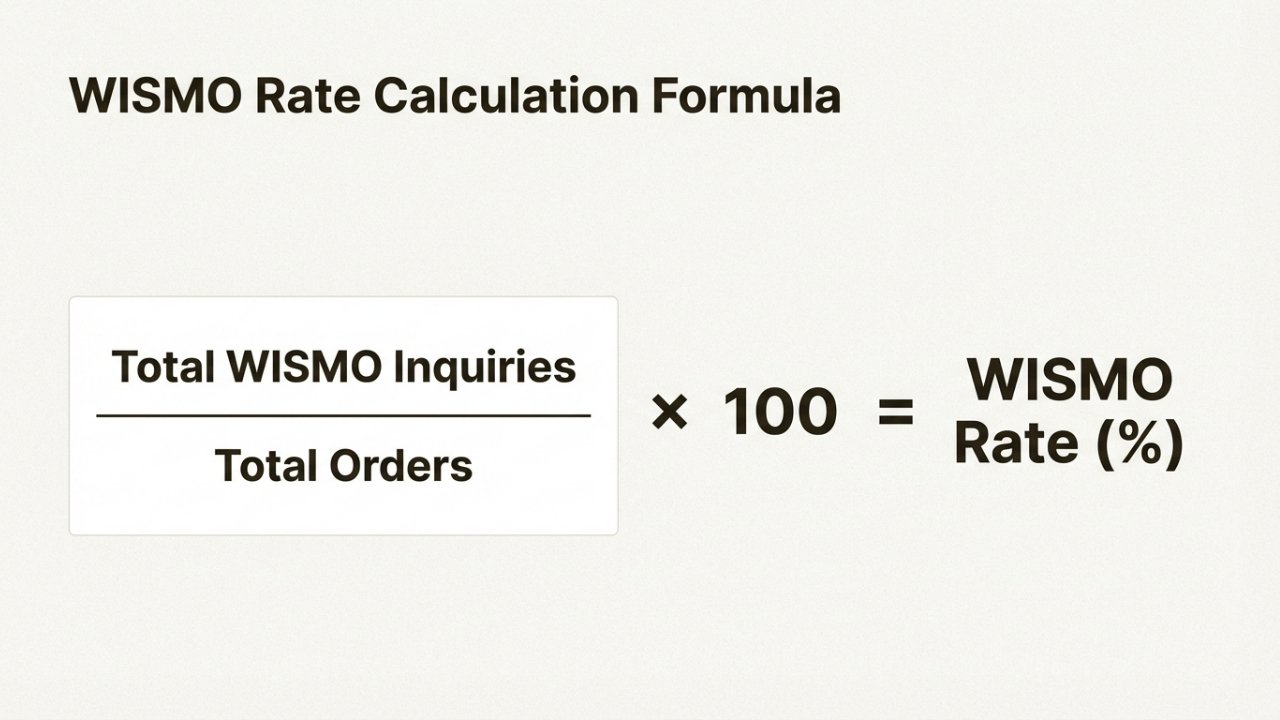
You can't improve what you don't measure. Track your WISMO rate to gauge progress and identify problem areas.
The formula is simple:
WISMO rate = (Number of WISMO inquiries ÷ Total orders) × 100
If you process 10,000 orders monthly and receive 300 WISMO calls, your rate is 3%.
Industry benchmarks suggest aiming for under 2-3% as a healthy target.
Track this metric over time and break it down by:
- Carrier
- Shipping destination
- Product category
- Time of year
This analysis reveals patterns. Maybe WISMO spikes with a specific carrier.
Perhaps international orders generate more calls. Data guides your improvement efforts.
Also track the cost side. Multiply your WISMO volume by $5-6 per call to understand the financial impact.
Then measure reduction as you implement these strategies.
Implementing your WISMO reduction strategy
You don't need to tackle everything at once. Prioritize based on impact and effort.
Quick wins (implement this week):
- Add a branded tracking page
- Set up automated email notifications at key milestones
- Review and clarify your shipping policy language
Medium-term improvements (implement this month):
- Start tracking carrier performance by lane
- Implement SMS notifications for critical updates
- Optimize your returns communication flow
Long-term investments (implement this quarter):
- Deploy AI phone agents for 24/7 WISMO handling
- Build predictive analytics to catch exceptions early
- Integrate all channels into a unified customer view
The compounding effect matters. Each strategy reduces WISMO volume, which frees your team to focus on higher-value work, which improves customer satisfaction even further.
Want to see how AI phone support could impact your WISMO volume?
Try Ringly.io free for 14 days. You get your last 3 months refunded if the AI resolves under 65% of calls in 90 days. Most Shopify stores see 70-73% resolution rates within the first month.
Frequently Asked Questions
What are the best strategies to reduce WISMO calls for small e-commerce businesses?
Start with the quick wins: set up a branded tracking page, automate email notifications at order confirmation and shipping, and clarify your delivery estimates. These three changes alone can cut WISMO volume by 30-50% with minimal investment.
How much do strategies to reduce WISMO calls typically cost to implement?
Costs vary by approach. Branded tracking pages and email notifications are often included in shipping platforms you already use. AI phone agents like Ringly.io start at $349/month. Most businesses see positive ROI within the first month because each prevented WISMO call saves $5-6.
Which strategies to reduce WISMO calls work best during peak season?
Proactive communication becomes critical during peak season when WISMO volume can double. Focus on exception management (alerting customers about delays before they notice), expanding notification channels (adding SMS), and ensuring your tracking infrastructure can handle traffic spikes.
How long does it take to see results from strategies to reduce WISMO calls?
Quick wins like clearer delivery estimates and automated notifications show results within days. Branded tracking pages typically reduce WISMO within 2-4 weeks. AI phone agents show resolution rates immediately, with optimization happening over the first month.
Can strategies to reduce WISMO calls improve customer satisfaction too?
Absolutely. The same proactive communication that prevents WISMO calls also improves customer experience. Customers appreciate transparency and self-service options. Many merchants see CSAT scores improve alongside WISMO reduction.
What's the difference between WISMO and WISMR, and do the same strategies apply?
WISMO is 'Where Is My Order?' while WISMR is 'Where Is My Return/Refund?' The same principles apply: proactive communication, clear timelines, and self-service tracking. Returns-specific strategies include step-by-step refund notifications and instant refund options like store credit.
How do I calculate the ROI of implementing strategies to reduce WISMO calls?
Calculate your current monthly WISMO volume, multiply by $5-6 cost per call for total current cost. Estimate reduction percentage from each strategy (20-50% is typical). Compare implementation costs against savings. Most strategies pay for themselves within 1-3 months.