


The human vs AI debate in ecommerce support is framed wrong.
The real question is not which one to choose, but which tasks belong to each.
Online vendor blogs selling hybrid solutions dominate search results for this topic.
Most promise vague "cost savings" without explaining what actually works. This post cuts through that noise with data on costs, customer preferences, and practical implementation tactics.
Here's what the research shows: 49% of customers still prefer human agents, yet AI can resolve 70-80% of routine inquiries without any human involvement.
The challenge is getting implementation right, not debating philosophy.
Editor’s note: Want to hear some sample support calls made for your Shopify store?
- Just paste your store URL
- Get sample calls in under 20 seconds (no email required)
- Listen to demo calls for my store

The real cost difference between AI and human phone support
Most vendor content glosses over the financial details with vague promises. Let's look at actual numbers instead.
Human support costs between $6-12 per contact depending on complexity, location, and channel.
AI phone agents operate at a significantly lower per-interaction cost, especially as volume increases.
But the hidden costs matter more than the sticker price.
Hidden costs of human teams:
- Training new hires (call centers average 30-45% annual turnover)
- Management overhead and scheduling
- After-hours coverage and overtime
- Quality assurance and monitoring
Hidden costs of AI:
- Implementation and integration
- Customer churn from poor experiences
- Brand damage from failures
Research from Forbes shows a 12.9% reduction in staffing needs after AI adoption.
Dialzara data suggests cost reductions up to 60% on support operations are possible.
But here's the catch. A Facebook study cited by ScienceDirect found that over 70% of customers perceive chatbot interactions as failures when implemented poorly. Cost savings mean nothing if customers leave.
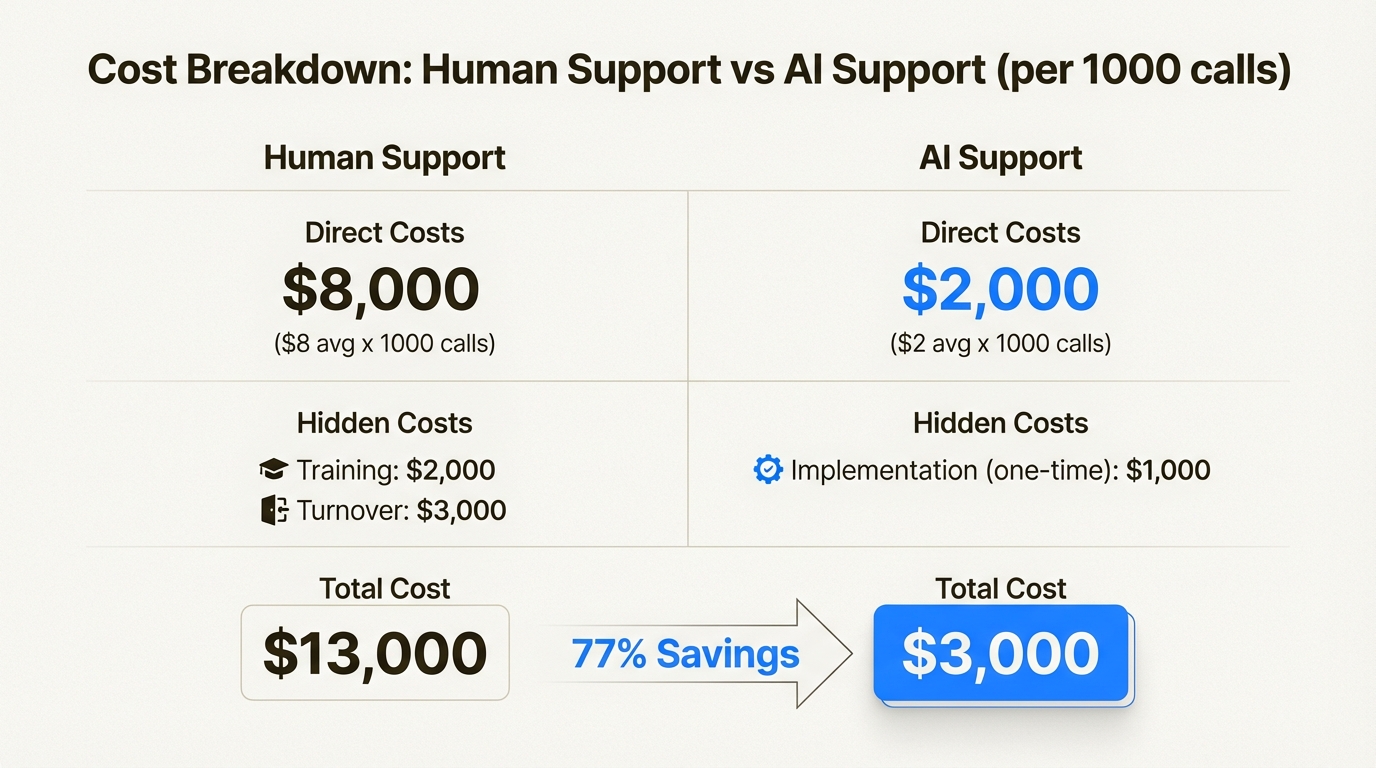
Human support costs 3-4x more at scale but AI failures carry hidden retention costs
What AI phone support handles well (and where it fails)
Knowing which tasks to route to AI is the difference between cost savings and customer frustration. Here's the tactical breakdown.
Where AI wins
Order status and tracking inquiries are the most common call type for ecommerce stores.
AI handles these perfectly because they require simple data lookups, not judgment.
Return policy lookups and simple return initiations work well too.
The rules are clear, the process is repeatable.
Customers get instant answers.
FAQ responses covering store hours, shipping times, and basic product questions require no creativity.
AI delivers consistent, accurate answers every time.
The 24/7 availability advantage is substantial. Customers calling at 2 AM get the same quality response as those calling at 2 PM.
No overtime, no scheduling headaches.
Volume spikes during Black Friday or flash sales would crush a human team. AI handles 10x normal volume without degradation.
Where AI struggles
Emotionally charged complaints requiring de-escalation are where AI falls flat. Angry customers need empathy, not scripts.
Complex multi-variable issues trip up AI systems. When a customer has a damaged item, a missing refund, and a billing error all at once, the situation requires human judgment.
According to a Kinsta study cited by Kustomer, 71% of users encountered situations where AI struggled with sarcasm, idioms, or cultural nuance.
Judgment calls requiring flexibility are beyond AI capability.
Extending a discount for a loyal customer who had a bad experience needs discretion, not rules.
Building long-term customer relationships happens through genuine human connection.
AI can handle transactions, but trust builds through conversations.
The key insight from SuperAGI research: 80% report positive AI experiences when responses are fast, accurate, and context-aware. The problem is implementation, not the technology itself.
What customers actually prefer (the data might surprise you)
Vendor blogs spin customer preference data to fit their narrative. Here's what the Katana survey of 250 US and Canada respondents actually found in January 2025.
| Preference | Percentage | |
|---|---|---|
| Prefer human agents | 49% | Valued for complex problem solving and empathy |
| Prefer AI | 12% | Chosen for speed and 24/7 instant availability |
| Depends on the situation | 25% | Usually prefer AI for tracking, Human for complaints |
| No preference | 14% | Interested only in the fastest resolution possible |
That 25% who said "it depends" tells the real story. Customers don't categorically reject AI.
They want the right tool for the right task.
Breakdown by demographic
Age matters, but not how you might expect. Millennials and Gen Z still prefer humans (40% vs 13% for AI), though they're more open to AI than older generations.
Gen X and Boomers show 61% preference for human agents, with only 9% preferring AI.
Income level affects preferences too. High-income shoppers show more openness to AI (15% prefer) compared to low-income shoppers (8% prefer).
But even high earners still prefer humans overall at 38%.
Gender shows slight differences. Women prefer human agents at 51% and show more caution about data sharing.
Men prefer humans at 45% but feel more comfortable sharing personal data with AI.
The critical insight is that preference shifts based on task complexity. Simple order tracking? AI is acceptable.
Billing dispute? Customers want a human.
Additional Kustomer research shows 88.8% of customers believe companies should always offer a human option. The path to a human cannot be hidden.
Building a hybrid ecommerce human vs AI call center model that actually works
Moving from philosophy to implementation requires clear frameworks. Here's what separates good hybrid models from frustrating ones.
The task-routing framework
Effective routing rules consider four factors.
Complexity determines the first branch. Simple queries like order status go to AI.
Multi-step issues with multiple variables go to humans immediately.
Emotion detection prevents escalation disasters. When AI detects frustration, anger, or repeated questions, it transfers instantly.
No customer should have to ask twice for a human.
Value-based routing prioritizes high-LTV customers. Your best customers deserve immediate human attention when they call.
History tracking catches repeat issues. When someone calls about the same problem twice, automatic escalation kicks in.
Escalation without friction
The biggest complaint about AI support is the gatekeeper problem. Customers get trapped in bot loops with no exit.
Best practices that actually work:
- Always provide a clear, obvious path to human support
- Transfer full context when escalating (no repetition required)
- Set maximum AI interaction attempts before auto-escalation
- Let customers opt out of AI at any point in the call
The fashion retailer Everlane achieved 4x increase in inquiries resolved without human agents using Kustomer.
But their success came because escalation worked seamlessly when customers needed it.

Most calls never need to reach a human when routing rules are properly configured
How Ringly.io handles the hybrid balance for ecommerce stores
Ringly.io offers a practical implementation of the hybrid model through the AI, their AI phone agent built specifically for Shopify stores.
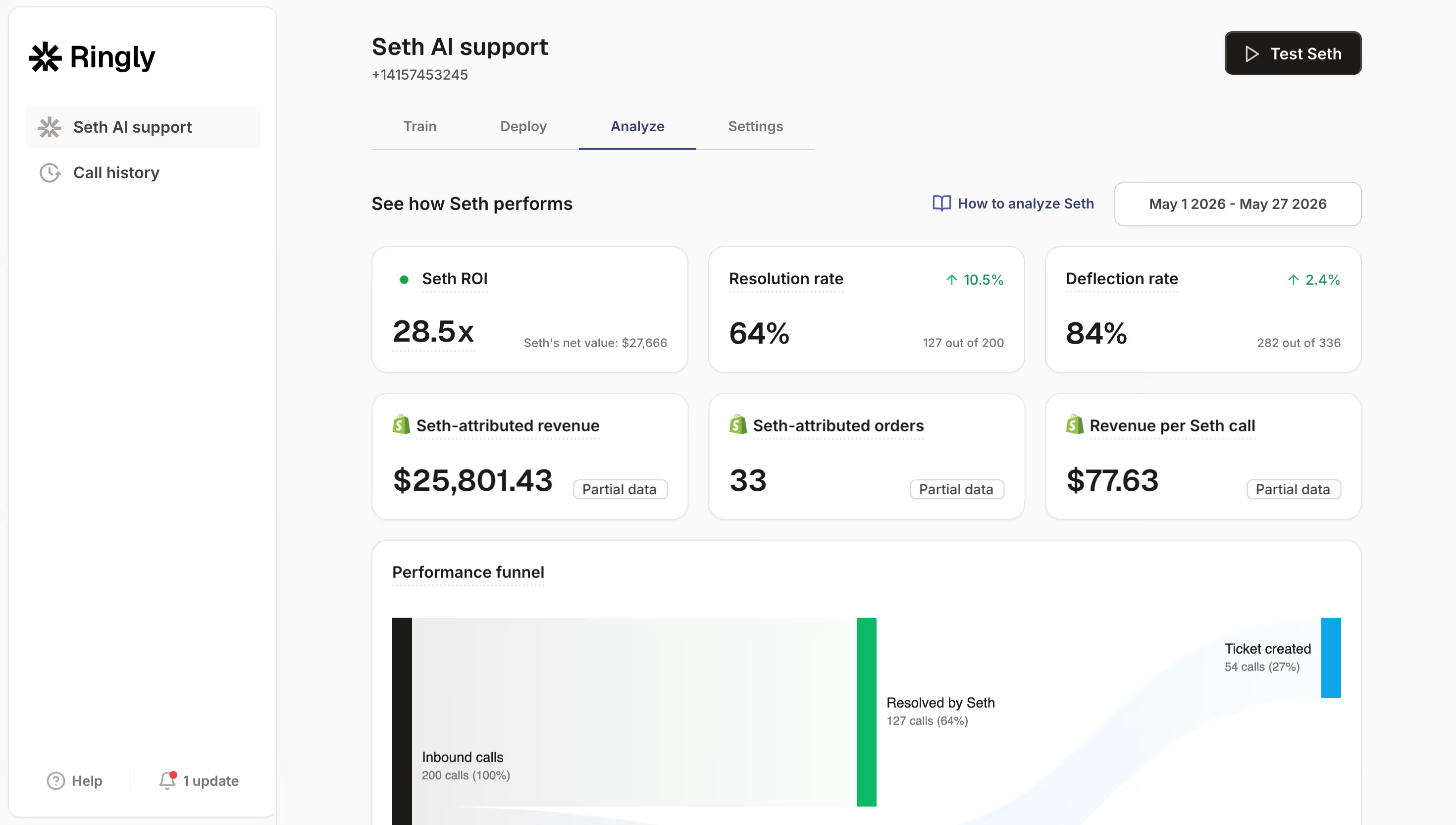
The AI resolves approximately 73% of calls without human intervention across 2,179+ Shopify stores.
This aligns with the hybrid sweet spot where AI handles routine tasks and humans focus on complex issues.
The deep Shopify integration matters. the AI pulls real order data, customer history, and product information directly from your store.
Callers don't need to provide order numbers if their phone is in your customer database.
Automatic escalation kicks in when the AI detects it cannot help. Anger detection, confusion signals, and repeated questions trigger immediate transfer to human agents.
Full transcripts and recordings pass along during handoff, so customers never repeat themselves.
For stores with global customers, the AI supports 40+ languages and operates 24/7 across all time zones.
| Plan | Monthly Cost | Minutes Included | Best For |
|---|---|---|---|
| Grow | $349 | 1,000 minutes | Growing stores with steady volume |
| Enterprise | Custom | 5,000+ minutes | High-volume operations |
Overage minutes cost $0.19 per minute on all plans.
The trial structure reduces adoption risk. Billing only begins after the AI demonstrates a 65% resolution rate on 100 calls over 21 days.
If it doesn't hit that threshold, you pay nothing.
The AI handles the 70% of calls that are routine so human agents can focus on complex issues where they add real value. That's the hybrid model in practice.
Choosing the right ecommerce human vs AI call center approach for your store
Your store characteristics determine which approach makes sense. Here's the decision framework.
Consider AI-first (with human backup) if:
- High call volume with repetitive inquiries (order tracking, returns)
- Limited budget for full-time support staff
- Global customer base needing 24/7 coverage
- Clear, documented policies that AI can follow consistently
Consider human-first (with AI assist) if:
- High-touch products requiring expertise (luxury goods, technical products)
- Customer relationships drive significant lifetime value
- Complex return or exchange policies with many exceptions
- Brand voice that requires nuance to replicate
The hybrid sweet spot: Most ecommerce stores benefit from AI handling 60-80% of initial contacts, with seamless escalation to humans for the rest.
The goal is not eliminating human support. It's making human support more valuable by freeing agents from "where's my order" calls so they can handle the conversations that actually build loyalty.
Start a free trial with Ringly.io to see how The AI handles your store's most common calls. You'll only pay if it works.
Frequently Asked Questions
What is the main difference between an ecommerce human vs AI call center?
Human call centers use trained agents for all inquiries, while AI call centers use automated systems for routine tasks. The key difference is cost (AI costs less per interaction) and availability (AI runs 24/7). Most successful ecommerce operations use a hybrid of both.
How much does an ecommerce human vs AI call center cost to operate?
Human support costs $6-12 per contact. AI support costs significantly less, especially at scale. However, total cost depends on implementation quality, call volume, and escalation rates. Factor in hidden costs like training and turnover for humans, or integration failures for AI.
Which is better for customer satisfaction in an ecommerce human vs AI call center?
Neither is universally better. According to Katana survey data, 49% prefer humans, but 25% say it depends on the situation. Simple tasks like order tracking work fine with AI. Complex issues and emotional situations require human agents for better satisfaction.
How do I implement a hybrid ecommerce human vs AI call center model?
Start by identifying your most common call types. Route simple, rule-based inquiries to AI and complex or emotional issues to humans. Always provide a clear path to human support, transfer full context during escalation, and let customers opt out of AI at any point.
What percentage of calls can AI handle in an ecommerce human vs AI call center?
Well-implemented AI systems handle 60-80% of routine inquiries without human involvement. Ringly.io's the AI achieves 73% resolution across Shopify stores. The remaining 20-40% should escalate smoothly to human agents with full context.
Do customers prefer human or AI support in an ecommerce human vs AI call center?
Most still prefer humans. The Katana survey shows 49% prefer human agents, while only 12% prefer AI. However, 25% say it depends on the task. Younger and higher-income demographics show more openness to AI, but all groups prefer having a human option available.
What tasks should AI handle in an ecommerce human vs AI call center?
AI excels at order status tracking, return policy lookups, FAQ responses, and simple return initiations. These tasks are repetitive, rule-based, and don't require empathy or judgment. Reserve human agents for complaints, multi-variable problems, and relationship-building conversations.