

This post in 30 seconds.
- Chargeback risk runs both ways. Ship a fraudulent order and you eat the product plus the dispute. Cancel a flagged-but-real order and you lose the sale, the repeat customer, and a chunk of goodwill.
- The signals Shopify flags are easy to read. The hard part is the verification step that tells a real customer apart from a thief, and that step is a phone call almost nobody staffs.
- Built for founders, COOs, and Heads of CX at $10M-$100M Shopify brands running a paid helpdesk and a visible phone number.
There's a small warning symbol that shows up next to an order number in your Shopify admin. High risk of chargeback. And every time it appears, somebody on your team has to make a call that has real money on both sides: ship it and maybe eat a chargeback, or cancel it and maybe torch a customer who was going to spend with you for years.
If you run a $10M-$100M Shopify brand with a real support team and a phone line on your site, you already know this isn't a once-a-week thing. It's a daily queue. And the orders that get flagged are not the obvious ones. They're the big first-time purchases, the gift orders shipping to a different address, the customer using a new email. Real revenue, sitting in limbo, waiting for someone to decide.
Most brands at your stage want to fix the fraud side and quietly accept the false-positive side as the cost of doing business. That's the expensive half. If you're losing good orders to over-blocking and you'd like to see what that's actually costing you, book a 30-min call and we'll do the math on your numbers.
We build AI phone support for 50+ Shopify brands, and the pattern we keep seeing is that the verification call, the one step that actually resolves a flagged order, is the step nobody has the headcount to run. If your store flags orders faster than your team can clear them, book a 30-min call and we'll show you what handling that queue at volume looks like.
What chargeback risk actually means on Shopify
Chargeback risk is the odds that a given order ends in a forced reversal. A customer disputes the charge with their bank, the bank pulls the money back, and you're often out the product too. Shopify's fraud analysis gives every order a low, medium, or high recommendation based on signals like Address Verification System (AVS) results, the card's CVV match, the buyer's IP address, and unusual purchase patterns, per Shopify's own documentation. Flagged orders get that warning symbol, and if you ship enough of them and they go bad, you can lose Shopify Payments entirely.
Here's the part that the standard guides skip. Chargeback risk is symmetric, and the false-positive side is the one that quietly bleeds you. Shipping a bad order costs you. Cancelling a good one costs you the sale, the lifetime value, and a customer who tells their friends you accused them of fraud.
The math says prevention matters more than fighting. Chargeback volume is projected to hit roughly 281 million in 2026, and US merchants only win around 17% of fraud-coded disputes they contest, according to chargeback.io's 2026 data. Once a fraudulent order ships, your odds of clawing the money back are slim. The room to win is all upstream, in the decision you make before the box leaves the warehouse.
So the goal isn't a perfect fraud score. It's a fast, cheap way to tell a real customer apart from a thief on the orders where the signals are mixed. That's where most of the lost money lives, and it's a problem you solve with a process, not a better algorithm. The same logic shows up in WISMO calls and return requests: the routine touch you can't staff is the one that protects the most revenue.
The high-risk order signals worth scoring
Before you can lower your chargeback risk, you need a consistent way to read it. Shopify scores most of this automatically, but knowing what's driving the flag tells you whether to ship, hold, or verify.
| Signal | Why it raises risk | Weight |
|---|---|---|
| Billing address does not match shipping | Classic stolen-card pattern | High |
| Multiple failed payment attempts on one order | Card testing | High |
| Brand-new email plus a large first order | No history to lean on, big exposure | High |
| IP location far from shipping location | Buyer may not be who they claim | Medium |
| Several cards tried in a short window | Card cycling | High |
| Order value far above your normal AOV | Outside the customer's typical behavior | Medium |
| Express or overnight shipping on a risky order | Rushing fulfillment before a dispute lands | Medium |
| Prior chargeback history on the card | Repeat exposure | High |
None of these is a verdict on its own. Plenty of real customers ship gifts to a different address or place a big first order during a sale. One signal is noise, three stacked signals is a pattern, and a pattern is your cue to verify before you ship, not to auto-cancel. That distinction is the whole game.
The workflow that holds up: let Shopify flag, layer your own rules on top so the score reflects your store's normal behavior, and route anything in the gray zone to a verification step instead of a binary ship-or-kill. The brands that get this wrong treat every medium-risk flag as fraud and cancel it, which is how you lose real orders all day without ever seeing the bill. If you want to tighten the scoring layer first, our guide to Shopify chargeback prevention and the breakdown of where chargeback percentages tip into danger are the place to start.
Fraud versus friendly fraud, the risk you can't score away
There are two very different things hiding inside that one warning symbol, and they need different defenses.
Third-party fraud is the stolen card. Someone who is not the cardholder placed the order, and AVS, CVV, and IP checks are built to catch it. Friendly fraud is the harder one. The order is real, the card is the customer's own, and they dispute the charge anyway, usually weeks later, because they forgot, regretted it, or learned that filing a dispute is easier than asking for a refund.
Friendly fraud is now the bigger problem for most brands your size. Roughly 6 in 10 merchants report rising first-party misuse, per chargeback.io, and buyer's remorse drives a large share of those disputes. In the Merchant Risk Council's 2026 fraud report, 57% of merchants said refund or policy abuse was rising and 47% named it their top attack type. No address-verification check catches a real customer who simply changes their mind.
A fraud score can flag a stolen card, but only a human-feeling conversation can defuse the customer who's about to dispute their own order. That's not a scoring problem. It's a relationship problem, and relationships happen on the phone.
"My customers also feel like it's a normal person. They feel like they can communicate if they have questions."
Claudia Droge, TechCraft Studio
When a customer feels heard at the moment of doubt, a confirming call before you ship, a quick note that the order is on its way, they're far less likely to reach for the dispute button later. The brands that lose the least to friendly fraud aren't the ones with the strictest filters. They're the ones whose customers feel like there's a real person on the other end.
The verification call that de-risks a flagged order
When you strip away the apps and the dashboards, one manual step resolves a flagged order better than anything else: you call the number on the order and ask the buyer to confirm a couple of details. What did they order, where's it going, does the story hold together. Fraud guides have recommended this for years because it works. A legitimate customer answers and confirms in under a minute. A thief using someone else's card doesn't pick up, or fumbles the basics.
I tried this myself on a batch of flagged orders. The real customers answered, confirmed, and were genuinely glad we checked. The fraudulent ones went straight to a dead line. The verification call is the cheapest de-risking step in ecommerce, and it's the one almost nobody staffs.
That last part is the catch. The verification call works perfectly and scales terribly when a human has to make it. At 20 to 50 flags a day, you'd need someone dialing for hours, most of those calls going to voicemail, the rest interrupting a CS rep who was hired to do something more valuable than confirm shipping addresses. So the call that would save you the most chargebacks is the call your team never has time to make, and the orders sit, and you default to either shipping blind or cancelling good revenue.
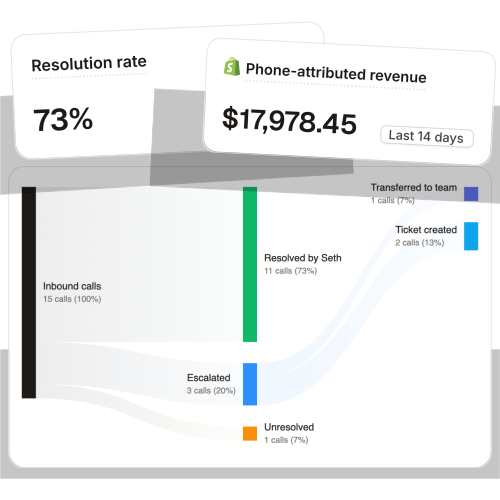
This is the part Ringly is built for. Ringly is AI phone support for Shopify brands, and the same engine that runs abandoned-cart follow-up calls can place the outbound verification call on a flagged order, confirm the buyer, and write the result back so your team ships or cancels with confidence. It also picks up the inbound side, the "why is my order on hold" calls that pile up when you start holding orders for review, the same after-hours volume that makes 24/7 phone support hard to staff. It runs on Shopify-native custom actions and order-status lookups, so the call has the order in front of it. Across 50+ brands, the AI resolves about 73% of calls on its own at roughly $0.42 per resolved call, so verification stops being a staffing decision. Gear Rider handled 1,595 calls in 90 days without a phone rep, which is the kind of volume a verification queue actually generates.
To be straight about scope: Ringly isn't the fraud-scoring engine. Shopify's fraud analysis, chargeback management tools, and dedicated fraud apps score the order. Ringly runs the call, the one step that turns a guess into a decision. If your flagged-order queue is growing faster than your team can clear it, book a 30-min call and we'll walk through how the verification calls get handled.
What over-blocking actually costs you
Run the numbers on both sides and the false-positive cost usually wins.
Ship a fraudulent $100 order and lose the dispute, and a Stripe merchant can be out around $181 once you count the product, the chargeback fee, and the lost revenue, per chargeback.io. On a $250 AOV brand that number is bigger. That's the cost everyone's afraid of, and it's real.
Now the side nobody prices. Auto-cancel a flagged order from a real customer with a $250 cart, and you lose the sale, the repeat purchases that customer would have made over the next two years, and you hand them a reason to shop elsewhere and warn their friends. Cancel a handful of those a day and the annual leak dwarfs the occasional chargeback you avoided.
Here's the third option priced against staffing it with people:
| Line item | Cost |
|---|---|
| One missed-fraud chargeback ($100 order, lost dispute) | ~$181 |
| One auto-cancelled good order ($250 AOV plus lost LTV) | $250+ and a lost customer |
| One human CS rep dialing verification calls (loaded) | ~$4,000/mo, idle between flags |
| One AI verification call on Ringly | ~$0.42 to $0.91 per call, 24/7 |
The verification call costs less than a dollar and saves you from both expensive mistakes, which is why it's worth automating before you spend another rep's time on it. WashCo, a Shopify brand we launched, runs its phone support at about $0.91 per call against $2.70 for a human-handled one. At that price the question stops being "can we afford to verify every flagged order" and becomes "why are we still cancelling good revenue to avoid a call."
Frequently asked questions
What does "high risk of chargeback" mean on a Shopify order? It's Shopify's fraud analysis telling you the order has signals associated with disputes, things like a billing-shipping mismatch, a new account, or an IP that doesn't match the shipping location. It's a recommendation, not a verdict. Plenty of high-risk flags are real customers.
Should I cancel a high-risk Shopify order or ship it? Neither by default. Verify first. Call the number on the order and confirm the details before you decide. Cancelling unverified means you'll lose real sales, and shipping unverified means you'll eat real chargebacks.
Can Shopify's fraud analysis be wrong? Often. Gift orders, big first-time purchases, travelers buying from a new location, and customers with new emails all trip the same signals fraudsters do. That's the false-positive problem, and it's why a verification step matters more than a stricter filter.
Does calling the customer actually lower chargeback risk? Yes, on both fronts. A confirming call exposes stolen-card fraud because the thief won't pick up, and it builds enough of a relationship that real customers are less likely to dispute later. The hard part is making those calls at volume, which is the staffing problem most brands never solve.
What's the difference between fraud and friendly fraud? Third-party fraud is someone using a stolen card. Friendly fraud is a real customer disputing their own legitimate order, usually from regret or because filing a dispute is easier than requesting a refund. AVS and CVV checks catch the first, not the second.
Can too many chargebacks get me removed from Shopify Payments? Yes. A chargeback rate that runs too high can get your store flagged and ultimately removed from Shopify Payments, which is why keeping the rate down is an account-survival issue, not just a margin one.
Talk to us

If your store flags 20-plus orders a day and nobody has time to verify them, you're paying for chargeback risk on both sides of the decision. The orders you ship blind cost you in disputes, and the ones you cancel cost you in lost customers. A 30-min call is the fastest way to see what closing that verification gap is worth on your numbers.
The 3-layer guarantee.
- Live in 14 days or it's free until launched.
- 65% resolution in 90 days or we refund the last 3 months of subscription fees.
- We keep working free until we hit it.
Ruben (Ringly co-founder) takes these calls personally.