
This post in 30 seconds.
- A Shopify chargeback guarantee means one of two things: Shopify Protect (free, narrow) or a third-party service like Signifyd or Riskified (paid, liability-shift). Both cover true card fraud.
- Neither covers friendly fraud, which is roughly 80% of chargeback losses. That's the bucket bleeding most Shopify brands.
- Built for founders, COOs, and Heads of CX at $10M-$100M Shopify brands with a visible phone line. The cheapest dispute prevention you own is a support line a customer can actually reach before they call their bank.
A chargeback guarantee sounds like it hands the problem to someone else. Sign up, pay a small percentage, and chargebacks become the vendor's headache instead of yours. That's the pitch.
Here's what the pitch leaves out. A guarantee covers the chargeback type you can least control (a stranger using a stolen card) and leaves the type that actually drains a $30M Shopify brand: the customer who got their order, then disputed the charge anyway, or the one who couldn't reach anyone so the bank became their support desk. That second bucket is around 80% of chargeback losses, and no guarantee on the market reimburses it.
Most founders, COOs, and Heads of CX at $10M-$100M Shopify brands watch their dispute rate creep up in the same months their after-hours voicemails pile up. The two are connected. Book a 30-min call and we'll look at how many of your disputes started as a missed call.
What a Shopify chargeback guarantee actually means
The phrase covers two completely different things, and merchants mix them up constantly.
The first is Shopify Protect, the native feature built into Shopify Payments. The second is a third-party chargeback guarantee service like Signifyd, Riskified, ClearSale, or NoFraud. One is free and narrow. The others are paid and broader, but they all share the same blind spot.
Every "guarantee" on the market reimburses true third-party fraud and almost nothing else. Here's the at-a-glance version before we go deeper.
| Option | What it covers | Cost | Catch |
|---|---|---|---|
| Shopify Protect | Fraudulent + unrecognized chargebacks | Free | Shop Pay + US only, fraud only |
| Signifyd / Riskified | Approved orders that turn into fraud chargebacks | % of approved orders | Friendly fraud excluded |
| ClearSale / NoFraud | Approved orders, fraud liability shift | % of approved orders | Friendly fraud excluded |
| A reachable support line | The dispute that never gets filed | Cost of staffing | You have to actually pick up |
A useful way to think about it: a guarantee is insurance on the orders a robot already flagged as risky. The reachable support line is prevention on the orders that look perfectly fine until the customer gets frustrated. You want both, but most brands buy the first and skip the second.
Shopify Protect: free, but narrow
Shopify Protect is the closest thing to a built-in Shopify chargeback guarantee, and it's genuinely useful. When an eligible order is marked "Protected," Shopify manages the dispute and reimburses the disputed amount plus the chargeback fee. You don't file anything. You don't pay extra.
The coverage is real, but the eligibility fence is high. Protect only applies to orders placed through Shop Pay, only for US merchants on Shopify Payments, and only when you fulfill with a tracking number through an approved carrier within seven days of the order. Miss the tracking window and the order falls out of coverage.
It also covers exactly two reason types: fraudulent (a stolen card) and unrecognized (the customer doesn't recognize your billing descriptor). According to Shopify's own help documentation, item-not-as-described disputes, where the customer says the product was defective or different from the listing, are not covered. Neither is the customer who simply changed their mind and went to the bank.
If you want the mechanics of how a dispute moves through Shopify, our guide to ecommerce chargebacks walks the full timeline. The short version: Protect handles the fraud you couldn't have stopped, and leaves you holding everything else.
Third-party chargeback guarantee services
When Shopify Protect isn't enough, brands move to a paid guarantee service. The model is a liability shift. The provider screens every order, approves the ones it believes are legitimate, and guarantees those approvals. If an approved order later turns into a fraud chargeback, the provider reimburses you 100% and eats the loss.
You pay a percentage of approved-order value, and you only pay on orders the provider approves. Riskified has been making guarantee decisions for nearly a decade and reimburses any chargeback on an order it greenlit. ClearSale runs more than 2,000 human analysts to review borderline orders instead of auto-declining them, then backs the call with a 100% chargeback guarantee. Signifyd does the same with automated screening plus manual review.
These services are good at what they do. They shift fraud risk off your P&L and let you auto-fulfill orders you'd otherwise hold. If you're comparing them, we keep a running list of Riskified alternatives with the trade-offs.
But read the fine print on any of them and you'll find the same line: the guarantee covers true third-party fraud only. Friendly fraud, where a real customer disputes a charge they actually made, is not covered by any guarantee or insurance product. And friendly fraud is where the money goes.
The 80% no guarantee covers: friendly fraud
Here's the number that reframes the whole category. Friendly fraud, also called first-party misuse, accounts for roughly 80% of chargeback losses for merchants, according to chargebacks911. It's not slowing down either. A 2026 MRC survey found 64% of merchants reporting a meaningful rise in first-party misuse, and first-party fraud now makes up 36% of all reported fraud globally.
A chargeback guarantee is built to ignore the exact disputes that cost you the most. The provider has no liability for the customer who received the package and disputed anyway, or the one who didn't recognize "B&B LLC" on their statement, or the one who emailed about a damaged item, heard nothing back, and called the bank instead.
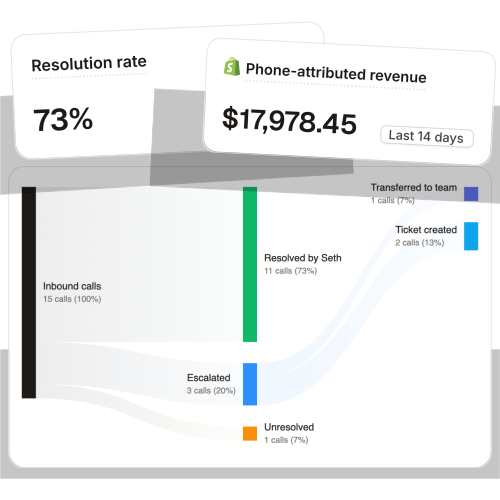
That last one matters more than most operators realize. Many disputes start because the customer couldn't reach you. If someone has a problem and can't get a human within about a day, the dispute becomes their next move. A reachable support line intercepts that customer before the bank does. On Ringly, Seth resolves up to 90% of inbound calls autonomously, which means the customer who was halfway to filing a dispute gets an answer from us first. WashCo, a Shopify brand we launched, recovered $22,664 on the phone in its first 7 days.
"My customers also feel like it's a normal person. They feel like they can communicate if they have questions."
Claudia Droge, TechCraft Studio
And fighting friendly fraud after the fact is a losing game. Even with strong evidence, the representment win rate sits around 40-60%, and net of every chargeback issued against you, the average merchant recovers about 1 in 8. The cleaner play is to stop the dispute from being filed. Our breakdown of ecommerce fraud statistics has the full picture if you want the deeper data.
Why reachability is the cheapest chargeback prevention
Every chargeback prevention guide eventually lands on the same advice: respond fast, make your contact info easy to find, resolve issues before they escalate. The reason that advice keeps showing up is that it works, and it's cheaper than any guarantee fee.
A phone call to you costs a fraction of a chargeback to your acquirer. A US Shopify Payments chargeback fee is $15 before you've lost the merchandise, the shipping, or the staff time. The average first-party misuse dispute costs around $82 to resolve, per the 2026 MRC report. A call on Ringly costs $1.99 after the first 50. The math isn't close.
The catch is coverage. A customer with a 9 p.m. problem won't wait for your team to clock in at 9 a.m. If your line goes to voicemail after hours, those are the calls that turn into disputes. This is the same after-hours gap that shows up in WISMO calls and unanswered weekend tickets, and it's why 24/7 phone coverage is a dispute lever, not just a service nicety.
Ringly.io is AI phone support for Shopify brands. The AI answers inbound calls around the clock, finds the order in your Shopify store, explains where it is, processes the return or exchange, and answers the product question, all before the customer reaches for their card statement. Calls that need a human escalate cleanly to whatever helpdesk you already run. The numbers above come from real Ringly billing across Shopify brands plus the cited third-party fraud research, not list-price math.
When the answer comes from your brand instead of the bank, the dispute never gets a reason code. That's the whole point of building customer service for Shopify that's actually reachable.
What this costs you today vs what it costs with Ringly
Take a typical $50M Shopify brand running a 6-rep CS team:
| Line item | Today | With Ringly |
|---|---|---|
| 6 reps x $4K loaded per rep | $24,000/mo | n/a |
| Ringly Enterprise (~$5K/mo) | n/a | $5,000/mo |
| Net monthly CS spend | $24,000/mo | $5,000/mo |
| Monthly savings | n/a | $19,000/mo |
| Annual savings | n/a | $228,000/yr |
That's roughly 70% of repeatable calls (order status, returns, the same five questions over and over) routed to the AI. The other 30%, the genuinely complex calls, still go to your CS team, who now have time to actually solve them.
Now layer the dispute math on top. Every one of those after-hours order-status calls that used to hit voicemail is a friendly-fraud chargeback you didn't have to fight, a $15 fee you didn't pay, and an order you didn't refund. The CS savings are the headline. The avoided chargebacks are the quiet line item your finance team will notice next quarter.
If you want to see this against your own numbers, book a 30-min call and we'll do the math live.
The layered chargeback prevention stack
No single tool covers all three chargeback reason buckets. The brands that keep their dispute rate low stack the right lever against each type instead of buying one guarantee and hoping.
| Reason bucket | Share of losses | The lever that prevents it |
|---|---|---|
| True third-party fraud | Smaller slice | Fraud screening + a guarantee (Protect or Signifyd/Riskified) |
| Merchant error / not received | Middle slice | Clear policies, tracking, matching billing descriptor |
| Friendly fraud / first-party misuse | ~80% | A reachable support line that answers before the bank does |
The guarantee handles the slice a robot can flag; reachability handles the slice a human has to talk down. Get the order-status and returns calls answered fast and you starve friendly fraud of its most common excuse, "I couldn't reach anyone."
Keeping the rate low isn't optional at scale. Visa's monitoring programs flag merchants that cross dispute thresholds, and those thresholds keep tightening. The VAMP "excessive" line sat at 2.2% in mid-2025 and drops to 1.5% for North America and the EU in April 2026, per Ravelin's analysis. Cross it and you're looking at per-dispute fees, forced remediation, and eventually losing the ability to take Visa. Our deeper dive on chargeback prevention and where your Shopify chargeback percentage should sit covers the thresholds in detail, and the chargeback management tools roundup covers the alerting side.
A clear, generous return policy helps too. Customers who know they can easily get a refund rarely file a chargeback as a shortcut. The same logic runs through ecommerce customer retention: the customer you keep talking to is the customer who doesn't dispute.
Frequently asked questions
Does Shopify offer a chargeback guarantee? Sort of. Shopify Protect reimburses fraudulent and unrecognized chargebacks on eligible Shop Pay orders for US merchants on Shopify Payments, at no extra cost. It does not cover item-not-as-described disputes or friendly fraud.
Does Shopify Protect cover all chargebacks? No. It only covers two reason types (fraudulent and unrecognized) and only on Shop Pay orders fulfilled with tracking within seven days. Everything else, including the bulk of friendly fraud, is on you.
What chargebacks does a guarantee not cover? Every guarantee, native or third-party, excludes friendly fraud, which is roughly 80% of chargeback losses. Guarantees only reimburse true third-party fraud, where a stranger used stolen card details.
Can you actually stop friendly fraud? You can prevent a large share of it. Most first-party disputes start when a customer can't reach you or doesn't recognize the charge, so a clear billing descriptor and a support line that answers fast intercept the dispute before it's filed.
Is a chargeback guarantee service worth the fee? For brands with real fraud exposure, yes, because it shifts liability and lets you auto-fulfill. Just don't expect it to move your friendly-fraud rate, which is the bigger number. Pair it with reachable support.
How does customer service reduce chargebacks? A fast answer gives the customer a reason not to call their bank. When the AI resolves the order-status or return question in minutes, the dispute loses its excuse. That's why AI phone agents for Shopify sit upstream of any guarantee.
What is an acceptable chargeback rate? Card networks tighten the line every year. Visa's VAMP "excessive" threshold drops to 1.5% for North America and the EU in April 2026, and crossing it brings fees and remediation, so most brands aim well under 1%.
Talk to us

If you run a $10M-$100M Shopify brand and disputes are creeping toward your acquirer's threshold, the fastest fix isn't another guarantee. It's making sure the customer with a problem reaches you before they reach their bank. A 30-min call is the quickest way to see how many of your chargebacks started as a missed call.
Our 3 promises.
- Live in under 1 hour. Setup and test calls are free.
- 30-day money back on the $99 plan fee.
- 65% resolution guarantee: if Seth resolves under 65% of your support calls in a month, that month comes back as credit (after 90 days on Pay per call).
Ruben (Ringly co-founder) takes these calls personally.