

Running an online store means juggling inventory across multiple channels, processing orders quickly, and keeping customers happy.
Without the right systems in place, things fall apart fast. An order management system (OMS) is the backbone that keeps everything moving smoothly.
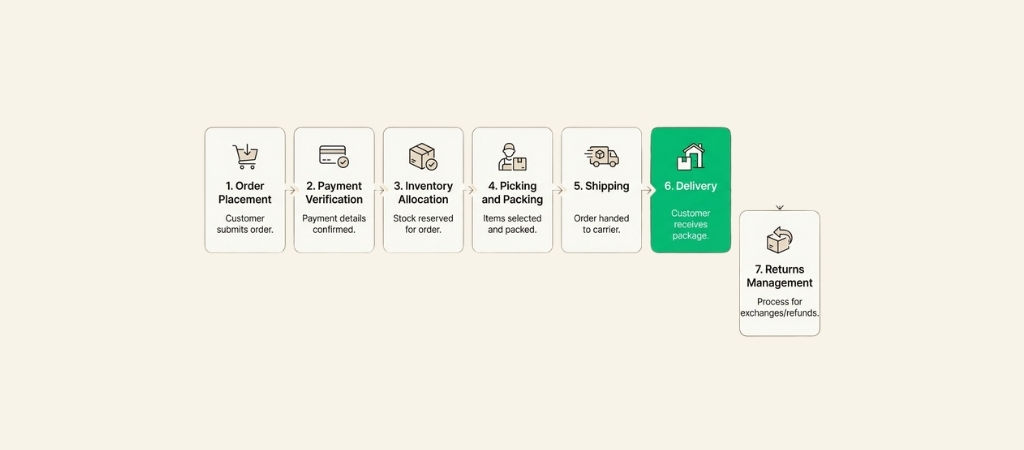
Here's the short version: an OMS tracks every order from the moment a customer clicks "buy" until the package arrives at their door.
It connects your sales channels, warehouses, and shipping providers into one coordinated workflow.
For growing ecommerce businesses, it's the difference between scaling smoothly and drowning in operational chaos.
Editor’s note: Want to hear some sample AI support calls made for your Shopify store?
- Just paste your store URL
- Get sample calls in under 20 seconds (no email required)
- Listen to demo calls for my store
What is an order management system?
An order management system is software that handles the entire lifecycle of customer orders.
It sits at the center of your ecommerce operations, connecting sales channels, inventory, fulfillment, and customer data.
Let's break it down. When a customer places an order on your website, the OMS immediately checks inventory across all your locations.
It confirms the payment, routes the order to the best fulfillment center, and tracks the shipment until delivery.
If the customer needs to return something, the OMS handles that too.
Traditional inventory software only tracks stock levels. Basic shipping tools just print labels. A
n OMS does both and everything in between. It orchestrates the entire order-to-cash process so nothing falls through the cracks.
The best systems also integrate with your customer support channels.
When a shopper calls asking "where's my order?" your support team can instantly pull up real-time status without switching between systems.
This is where modern solutions like Ringly.io add value by connecting order data directly to AI phone support, letting customers get instant answers about their purchases.
Why your ecommerce business needs an order management system
Selling through multiple channels sounds great until you're manually updating inventory in five different systems. The problems stack up quickly.
Without an OMS, you risk overselling the same item across platforms.
A customer buys your last unit on Amazon while someone else checks out on your website with the same product.
Now you're scrambling to cancel an order and apologize. These inventory discrepancies hurt your seller ratings and customer trust.
Manual order processing doesn't scale. When you're processing ten orders a day, spreadsheets work fine.
At a hundred orders, you're hiring staff just to copy data between systems. At a thousand, the errors and delays become business-critical.
Customer expectations have shifted dramatically. Shoppers want same-day or next-day delivery, real-time tracking, and hassle-free returns.
Meeting these expectations requires automation that only an OMS can provide.
The data tells a clear story. Ecommerce now represents 50% of B2B purchases, up 22% from just two years ago.
Global ecommerce sales are projected to hit $7.4 trillion by 2025. Businesses that can't fulfill orders efficiently will lose ground to competitors who can.
Core features to look for in an order management system
Not all OMS platforms are built the same. Here are the capabilities that matter most for ecommerce operations.
Real-time inventory visibility
Your OMS should show accurate stock levels across every channel and location instantly.
When an order comes in, inventory deducts immediately across your website, Amazon, eBay, and any other marketplaces.
This prevents the overselling nightmare that damages customer relationships.
Look for systems that support multiple warehouse locations and provide a centralized view.
You should see what's available to promise, what's allocated to existing orders, and what's in transit from suppliers.
Multichannel order routing
Smart routing sends each order to the optimal fulfillment location based on inventory availability, proximity to the customer, and shipping costs.
Some systems can even split shipments automatically when items are in different warehouses.
Advanced platforms use AI to optimize routing decisions.
Salesforce Order Management offers agentic order routing that learns from past fulfillment patterns to make smarter decisions over time.
Integration ecosystem
Your OMS needs to talk to everything else in your tech stack. Essential integrations include:
- Ecommerce platforms like Shopify, WooCommerce, and BigCommerce
- Marketplaces including Amazon, eBay, Walmart, and Etsy
- Shipping carriers (UPS, FedEx, USPS) for rate shopping and label generation
- 3PL providers if you use third-party fulfillment
- Accounting software for financial reconciliation
- Customer support systems for order lookups
The more native integrations available, the less custom development you'll need.
Automation and workflows
Modern OMS platforms automate repetitive tasks that used to require manual intervention.
This includes order confirmation emails, inventory updates, low-stock alerts, and reorder point notifications.
Returns management is another area where automation shines.
A good system generates return labels, updates inventory when items come back, and processes refunds or exchanges without manual data entry.
Analytics and reporting
You can't improve what you don't measure. Your OMS should provide insights into order trends, fulfillment speed, shipping costs, and channel performance.
Look for dashboards that show average order value, fulfillment time by location, and return rates.
Some platforms offer demand forecasting based on historical data.
This helps you position inventory strategically before demand spikes.
Top order management systems compared
The market offers solutions for every business size and complexity level. Here's how the leading platforms stack up.
| Platform | Starting Price | Best For | Key Differentiator |
|---|---|---|---|
| Salesforce Order Management | Custom pricing | Enterprise brands | AI-powered routing and Customer 360 integration |
| Brightpearl | From $375/mo | High-growth retailers | End-to-end retail operations with strong inventory focus |
| Flowspace | Custom pricing | Scaling DTC brands | Fulfillment network + OMS in one platform |
| Skubana (Extensiv) | From $999/mo | Multi-channel sellers | Deep marketplace integrations |
| Cin7 | From $349/mo | Wholesale/B2B | Built-in EDI and warehouse management |
| Linnworks | From $269/mo | Marketplace sellers | Strong inventory sync across channels |

Salesforce Order Management targets large enterprises with complex fulfillment needs.
It offers agentic AI features for automated decision-making and deep integration with Salesforce's CRM and service clouds.
The trade-off is implementation complexity and cost.
Brightpearl positions itself as a digital operations platform rather than just an OMS.
It combines order management with inventory, accounting, and CRM functionality. This all-in-one approach works well for retailers who want fewer systems to manage.
Flowspace differentiates through its fulfillment network. You get OMS capabilities plus access to their warehouse network for distributed inventory.
This is ideal for brands looking to offer fast shipping without building their own warehouse footprint.
Skubana (now part of Extensiv) excels at marketplace selling. If Amazon, Walmart, and eBay represent significant portions of your revenue, the platform's channel-specific features justify the investment.
How to choose the right order management system for your business
Selecting an OMS is a major decision that affects every part of your operation. Here's a framework for evaluating your options.
Assess your current pain points
Start by documenting what's broken in your current process. Are you overselling inventory? Struggling with manual data entry?
Unable to offer accurate delivery estimates? Different OMS platforms solve different problems, so clarity on your priorities matters.
Consider your order volume and growth trajectory. A system that works at 100 orders per month might choke at 1,000.
Look for platforms that can scale with your business without requiring a complete rebuild.
Evaluate integration requirements
Map out your current tech stack and future needs. Which ecommerce platform do you use? Which marketplaces matter most?
Do you have existing ERP or accounting systems that need to sync?
The best OMS for your situation is the one that connects to your critical systems with minimal custom development.
Check whether integrations are native (built by the OMS vendor) or third-party (built by middleware platforms).
Consider total cost of ownership
Subscription pricing is just the beginning. Factor in implementation costs, training time, integration development, and ongoing maintenance.
Some platforms charge per order or per user, which can surprise you as you scale.
Cloud-based SaaS solutions typically have lower upfront costs but ongoing monthly fees.
On-premise systems require significant initial investment but may cost less long-term for high-volume operations.
Implementation best practices
Rolling out a new OMS affects your entire team. Here's how to do it right.
Clean your data first. Importing messy product data, duplicate customer records, and inaccurate inventory counts will poison your new system.
Spend time auditing and cleaning before migration.
Test integrations thoroughly. Don't assume that because an integration exists, it works exactly how you need.
Run test orders through every channel and fulfillment path before going live.
Train your team early. The best technology fails if people don't use it properly.
Involve warehouse staff, customer service reps, and finance team members in training sessions relevant to their workflows.
Plan for a soft launch. Start with a subset of products or a single sales channel. Work out the kinks before migrating everything at once.
Connect support channels. Once orders flow through your OMS, make sure customer support can access that data.
Modern AI phone agents like those from Ringly.io can integrate directly with your OMS to handle "where's my order" calls automatically, freeing your team for complex issues.
Streamline your ecommerce operations beyond order management
An order management system transforms how you handle inventory, fulfillment, and multichannel selling.
The right platform eliminates manual work, prevents costly errors, and lets you scale without adding headcount.
But order management is just one piece of the customer experience puzzle.
When shoppers have questions about their orders, they expect immediate answers.
This is where AI-powered support makes a difference.
Ringly.io offers an AI phone agent that integrates with your order data to handle common support calls automatically.
It can look up order status, process returns, and answer product questions 24/7.
When issues require human attention, it escalates seamlessly to your team.
The combination of a solid OMS and intelligent support automation creates the foundation for sustainable ecommerce growth.
Your operations scale smoothly, your customers get faster service, and your team focuses on strategic work instead of repetitive tasks.
Start your free trial with Ringly.io today and see how AI phone support can complement your order management investment.
Frequently Asked Questions
What is an order management system ecommerce businesses use?
An order management system (OMS) for ecommerce is software that tracks and manages orders from purchase through delivery. It connects sales channels, inventory, warehouses, and shipping providers to automate the entire fulfillment process.
How does an order management system ecommerce integration work?
An OMS integrates with your ecommerce platform through APIs or native connectors. When a customer places an order, the OMS automatically receives the details, checks inventory, routes the order to fulfillment, and updates tracking information back to your store.
What features should I look for in an order management system ecommerce solution?
Look for real-time inventory visibility, multichannel integration, automated order routing, shipping carrier connections, returns management, and analytics reporting. The best systems also integrate with your customer support tools.
How much does an order management system ecommerce platform cost?
Pricing varies widely based on features and order volume. Entry-level solutions start around $269/month, while enterprise platforms like Salesforce require custom pricing. Most charge either a flat monthly fee or per-order fees.
Can small businesses benefit from an order management system ecommerce setup?
Absolutely. Even small ecommerce businesses selling on multiple channels benefit from inventory synchronization and automated order processing. Many platforms offer tiered pricing that scales with your business size.
What's the difference between an OMS and basic inventory management software?
Inventory software tracks stock levels. An OMS handles the entire order lifecycle including payment processing, fulfillment routing, shipping coordination, and returns management. It orchestrates multiple systems rather than just tracking one data point.
How long does it take to implement an order management system ecommerce platform?
Implementation timelines range from a few weeks for simple cloud solutions to several months for complex enterprise deployments. Factors include data migration complexity, integration requirements, and team training needs.