
This post in 30 seconds.
- Cross-border returns are harder than domestic ones on three axes at once: customs and duties, return-shipping economics, and regional policy. Each one lands as a phone call or an email.
- Cross-border return rates run around 25% (apparel and footwear higher), and most brands never reclaim the import duties they're owed. Only about 18% recover them.
- Built for founders, COOs, and Heads of CX at $10M-$100M Shopify brands selling across borders with a visible phone line.
If you sell into other countries, you already know a return that crosses a border isn't the same animal as a return from two states over. The freight costs more, the customs paperwork comes back to haunt you, and your policy has to bend to whatever the customer's country says it should be.
What nobody puts in the same sentence is the support load. Every one of those complications shows up as a question: where do I ship this, will I get my duties back, why is my refund taking a month, what's your policy in my country. I went through the returns-related calls across the 50+ Shopify brands we run phone support for, and most of the cross-border ones are the same five questions, just asked at 2 a.m. in a different language.
Most $10M-$100M Shopify brands selling abroad handle this with a CS team that's stretched across timezones and a phone line nobody picks up after 6 p.m. We've built AI phone agents for 50+ brands trying to fix exactly that. Book a 30-min call and we'll map where your international returns are leaking time and money.
Why international returns are harder than domestic ones
A domestic return is a label and a refund. A cross-border return is a label, a refund, a customs declaration, a duty question, and a policy that changes depending on which country the box is sitting in.
The volume is real. A 2025 IMRG study put cross-border return rates around 25% across categories, with apparel and footwear running well above that. The whole reverse-logistics market is now estimated at around $872 billion and climbing. So this isn't an edge case you can wave off. If a quarter of your international orders come back, the way you handle them is a line item, not a footnote.
The three things that make a cross-border return expensive are customs, shipping, and policy, and all three of them end up as work for your support team. A customer who can't figure out where to send a return doesn't quietly sort it out. They call. A customer who paid import duties and wants them back doesn't read your help center. They email. The complexity doesn't stay in the warehouse. It rolls downhill to the people answering your phone.
Let's take the three axes one at a time.
Customs, duties, and the money you leave at the border
Here's the part that quietly costs brands the most. When a customer in another country buys from you, somebody pays import duties and taxes to get that package across the border. When the product comes back, those duties don't automatically come back with it.
There's a mechanism to recover them. It's called duty drawback, and under US customs rules it can refund up to 99% of the import duties, taxes, and fees on goods that are re-exported or destroyed under customs supervision. The catch is that almost nobody files. One estimate found more than 85% of eligible businesses never file a single drawback claim, leaving over $2 billion a year on the table according to US customs data.
It gets worse when you narrow it to returns specifically. A dataset of 502 cross-border sellers found only about 18% consistently recover duties and taxes on returns. The other 82% just eat the cost. Part of the reason is structural: low-value direct-to-consumer shipments often clear customs on a broker's business number, not your own importer account, so you may not even have standing to file the claim.
| What happens to import duties | On a domestic return | On a cross-border return |
|---|---|---|
| Auto-refunded with the product | Not applicable | No |
| Recoverable at all | Not applicable | Yes, via duty drawback |
| Up to how much | Not applicable | 99% of duties paid |
| Time to recover | Not applicable | 3 to 12 months (90 days with accelerated payment) |
| Brands that actually recover | Not applicable | ~18% |
The timeline matters too. Drawback claims typically take 3 to 12 months to process, though an accelerated-payment privilege can pull that down to around 90 days. None of this is fast, and all of it generates customer questions you have to answer in the meantime, because the customer wants their refund now, not in a quarter.
If you want to go deeper on the policy side of this, our guide on ecommerce returns management walks through how the operational and financial pieces connect.
Return shipping costs and local return hubs
The second axis is freight, and the math is brutal on low-value items. Shipping a single return back across an ocean can cost more than the product is worth. On a $40 order, a $35 international return label means you've lost money before the item even reaches your warehouse.
The fix that's become standard is the local return hub. Instead of asking a customer in the UK to ship back to your warehouse in Texas, you give them an address in their own country. A local facility receives the return, inspects it, issues the refund right away, and then batches up returns onto a single freight pallet that ships back to your main warehouse once a month.
A regional return hub cuts per-item return shipping by up to 40% and compresses the refund cycle from 30-plus days down to 5 to 7. That's the difference between a customer who's annoyed and a customer who buys again. It also lines up with what shoppers actually want: 67% prefer dropping returns at a parcel locker or shop, and in Europe that number jumps to 79%.
On who pays for return shipping: charging the international customer is normal and accepted, as long as you state it clearly before they buy. The problem isn't the charge. The problem is the surprise. A customer who finds out about a return fee at the moment they want to return something calls your support line angry. A customer who saw it at checkout doesn't. If you're rethinking how you frame this, our ecommerce return policy guide and the broader DTC returns best practices playbook are good starting points.
Regional policy differences you can't ignore
This is where a lot of brands get caught. A return policy that's perfectly fine in the US can be illegal in the EU, and you don't get to pick.
In the US, there's no federal law forcing you to accept a return for buyer's remorse. Returns are largely at the merchant's discretion, and most states only require that you honor whatever policy you've posted. You set the rules.
The EU is the opposite. The Consumer Rights Directive gives shoppers a 14-day right of withdrawal on distance sales. The customer can return almost anything within 14 days of delivery, no reason required, and you have to refund them within 14 days of getting the cancellation. It's not a courtesy. It's the law, and it applies to you the moment you sell to someone in the EU.
| Returns rule | United States | European Union |
|---|---|---|
| Returns required by law | No (merchant discretion) | Yes, 14-day withdrawal |
| Reason required from customer | Whatever you set | None |
| Refund deadline | Per your policy | Within 14 days of cancellation |
| Who pays return shipping | Per your policy | Customer, unless you didn't disclose |
The trap is assuming your home-country policy travels with you. A US brand selling into Germany still has to honor the EU 14-day rule, no matter what the policy page says. So if you sell across borders, you don't have one return policy. You have a few, and your customers will ask which one applies to them. That question, "what's your return policy in my country," is one your team answers over and over.
The hidden cost: international returns are a phone and email problem
Now stack it all up. Customs questions, hub addresses that change by region, refund timelines that run long, and a policy that's different in every market. Where does all of that land?
On your support team. Specifically on the people answering calls and emails, often after hours, because your customer is in a timezone where it's the middle of your night.
The brutal part is how repeatable it is: the same five questions, all day, in five languages, most of them outside your business hours. Where do I send my return. Will I get my duties refunded. Why hasn't my refund cleared. What's your policy here. Can I exchange instead. None of these are hard. They're just constant, and they pile up into a phone backlog and a wall of voicemails you never get back to. This is the same pattern we see with WISMO calls, where the where's-my-order question eats a huge share of the queue, and it's why ecommerce order tracking and returns end up on the same support line.
So what does this actually cost? Take a typical $50M Shopify brand running a 6-rep CS team, with at least one or two of those reps staffed just to cover the second timezone returns come in on.
| Line item | Today | With Ringly |
|---|---|---|
| 6 reps x $4K loaded per rep | $24,000/mo | n/a |
| Ringly Enterprise (~$5K/mo) | n/a | $5,000/mo |
| Net monthly CS spend | $24,000/mo | $5,000/mo |
| Monthly savings | n/a | $19,000/mo |
| Annual savings | n/a | $228,000/yr |
That's roughly 70% of the repeatable returns calls (where do I ship, refund status, policy questions, exchanges) handled automatically. The genuinely complex ones, like a customs dispute or a damaged high-value item, still route to your team, who now have time to actually solve them.
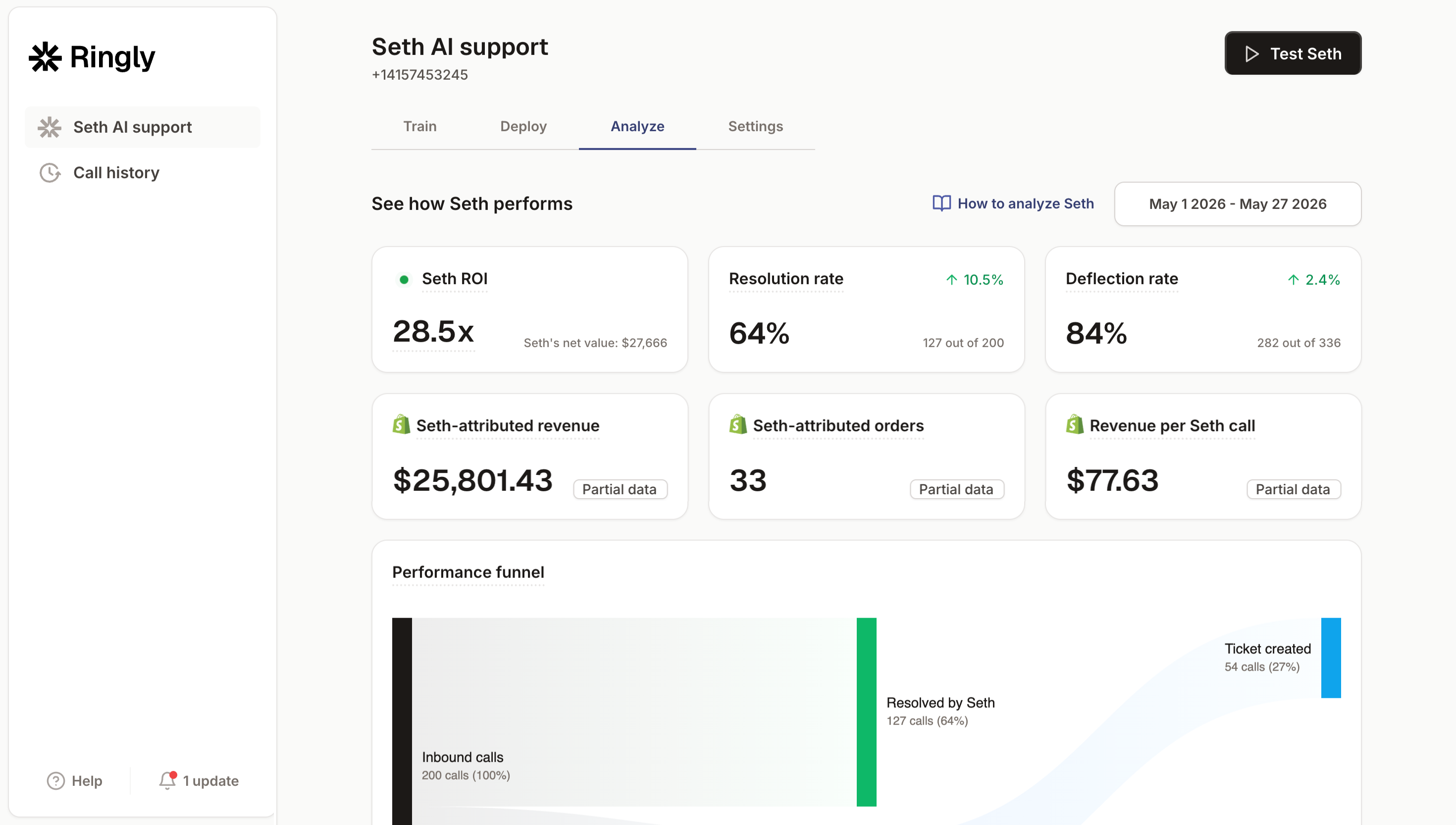
This is the gap Ringly was built for. The AI phone agent answers your inbound calls 24/7 in 40 languages, finds the order in Shopify, explains your region-specific return policy, kicks off the return, and tells the customer exactly where their refund stands. When a call needs a human, it transfers cleanly to your team with the context attached. WashCo, a Shopify brand we launched, handled its calls at $0.91 each against $2.70 for a human-handled call.
"My customers also feel like it's a normal person. They feel like they can communicate if they have questions."
Claudia Droge, TechCraft Studio
If you want to compare this against your current setup, book a 30-min call and we'll do the math on your real returns volume.
A practical playbook for handling international returns
Here's how the brands that handle this well actually do it. Six steps, in order.
- Publish a region-specific return policy. Don't run one global policy. Spell out the rules for each major market you sell in, including the EU 14-day right, and put the return-shipping terms in front of the customer at checkout, not after the sale.
- Set up local return hubs in your biggest markets. Partner with a 3PL that runs in-country facilities so customers return locally, get refunded in days, and you consolidate freight monthly.
- Pick a duty strategy and own it. Decide whether you're filing for duty drawback or absorbing the cost, and make sure your customs setup gives you the standing to file if you want it.
- Automate the repeatable questions. The where-do-I-ship, refund-status, and policy questions are the same every time. Put a knowledge base behind an agent that can answer them 24/7 across timezones and languages.
- Escalate the genuinely hard ones. Customs disputes, damaged high-value items, and anything emotional should hit a human fast, with the full context already attached.
- Measure what it's costing you. Track return rate by market, refund cycle time, and how much of your support queue is returns. If you don't measure it, you can't shrink it. Our returns management service breakdown covers what to watch.
One more thing worth saying: the cheapest international return is the one that doesn't happen. Clearer sizing, better product pages, and honest photos all cut your rate before any of this logistics machinery kicks in. We wrote a whole guide on how to reduce product returns if that's where you want to start. And if your team is buried, the question of whether to staff up or route it differently is covered in our in-house vs outsource support comparison.
Frequently asked questions
Can I get import duties back when an international order is returned? Sometimes, through a process called duty drawback, which can refund up to 99% of the duties and taxes you paid. But it's slow (3 to 12 months) and most brands never file. Only about 18% of cross-border sellers consistently recover duties on returns.
Who should pay for international return shipping? Charging the customer is standard and accepted, as long as you state it clearly before they buy. The mistake is surprising them with a return fee after the sale, which turns a routine return into an angry support call.
Do I have to accept returns from EU customers? Yes. The EU's Consumer Rights Directive gives shoppers a mandatory 14-day right of withdrawal on distance sales, with no reason required, regardless of where your business is based. Your US-style "all sales final" policy doesn't override it.
What's a local return hub and do I need one? It's an in-country facility where international customers send returns instead of shipping back to your main warehouse. It can cut per-item return shipping by up to 40% and shrink the refund cycle from 30-plus days to under a week. If you're doing real volume in a market, it pays for itself.
How much of an international returns workload is actually repeatable? In our experience across 50+ Shopify brands, roughly 70% of returns-related calls are the same handful of questions: where to ship, refund status, policy, and exchanges. Those are the ones an AI phone agent can resolve without a human.
Can an AI phone agent handle returns calls in other languages? Yes. Ringly's agent answers in 40 languages, which matters when your returns come in from customers across multiple countries and timezones. It finds the order in Shopify, explains the right regional policy, and starts the return.
Will automating returns calls hurt my customer experience? It tends to help, because the alternative is a voicemail nobody returns. The agent resolves the routine questions instantly, 24/7, and routes anything complex or emotional to your team with context attached, so your reps spend their time on the calls that actually need them.
Talk to us

If you run a $10M-$100M Shopify brand selling across borders and your returns are piling up as after-hours calls and voicemails, a 30-min call is the fastest way to see what it's costing you and what you'd get back.
The 3-layer guarantee.
- Live in 14 days or it's free until launched.
- 65% resolution in 90 days or we refund the last 3 months of subscription fees.
- We keep working free until we hit 65%.
Ruben (Ringly co-founder) takes these calls personally.