
This post in 30 seconds.
- A return is the reverse leg of your fulfilment operation. It starts a 10-14 day processing clock and a stream of phone calls, and most brands plan for the first and ignore the second.
- We'll walk the full reverse-logistics workflow (intake, inspection, disposition, restocking, inventory sync), the in-house vs 3PL decision, and the call load the whole thing generates.
- Built for founders, COOs, and Heads of CX at $10M-$100M Shopify brands running a returns-heavy operation with a visible phone number.
A return doesn't end when the customer drops the box at the carrier. It starts two clocks: a 10-14 day reverse-logistics process, and a stream of phone calls about it.
Most operators scope the first clock and forget the second. You build the returns portal, sign the 3PL, set the restocking SLA, and the back end of the operation runs. Then the phone rings, because the customer who shipped a return last Tuesday wants to know where their refund is, and the unit is still sitting in an inspection queue 1,400 miles away. I read through 50+ real returns-status call transcripts across the Shopify brands we run, and the share that were pure status questions (where's my refund, did you get my return, when does my exchange ship) was higher than anything I expected.
This is for the founder, COO, or Head of CX at a $10M-$100M Shopify brand where returns are a real line item, not a rounding error. Apparel, footwear, home, anything with a 20%-plus return rate. You already run a paid helpdesk and you already have a phone number on the site, which means the returns operation isn't just a warehouse problem for you. It's a phone problem too. If you want to see what the returns-status calls are costing you specifically, book a 30-min call and we'll pull the numbers together.
In this post:
What "returns and fulfilment" actually means
Fulfilment is the forward leg: pick, pack, ship, deliver. Returns are the reverse leg of the exact same operation, running the product back from the customer's door to your shelf (or to a liquidator, or to the bin). When people say "returns and fulfilment" they're describing one system with two directions, and the reverse direction is the harder, messier, more expensive one.
The reverse leg is where the margin quietly disappears, because every step costs money and most of them happen out of your sight. A return that comes back, gets inspected, gets graded, and goes back on the shelf still cost you the inbound shipping, the labor to process it, and the days it sat unsellable.
The scale is bigger than most founders carry in their head. Shopify's enterprise team put 2025 returns at 19.3% of items sold, worth around $849.9 billion in merchandise flowing backward through the system, per their reverse-logistics guide. The National Retail Federation pegged 2023 at 17.6%, or $247 billion. For a returns-heavy category, a fifth of everything you ship is coming back, and each unit needs the same operational attention on the way in as it got on the way out.
So the right mental model isn't "fulfilment, plus a returns policy bolted on." It's one operation that runs in two directions, and the reverse direction is the one bleeding cash if you're not watching it.
The reverse-logistics workflow, step by step
When a return comes back, it moves through a fixed sequence. The brands that keep returns from eating their margin are the ones who instrument every step instead of treating the whole thing as a black box.
Here's the workflow, in order:
- Intake / RMA. The customer requests the return, you issue a return authorization, and the box re-enters your network. This is where your returns app (or returns management process) generates the label and sets expectations.
- Inspection. Warehouse staff open the box and assess condition. Is it new, lightly used, damaged, or not the item that was supposed to come back?
- Grading. The unit gets a condition grade that drives the next decision. Grading is where fraud and shrinkage get caught (or missed).
- Disposition. The big fork. Resellable items get repackaged for stock, repairable items get refurbished or sold open-box, and non-recoverable items go to liquidation, recycling, or disposal.
- Restocking. Resellable units physically return to the pick face and get logged back into inventory.
- Inventory sync. The system updates available-to-sell so the unit can actually be ordered again.
Each of those steps has a cost. The industry range for processing a single return runs $10 to $15 once you add up return shipping, inspection, repackaging, and restocking labor, and reverse logistics runs 2-3x more expensive per parcel than outbound shipping. The longer a unit sits between intake and inventory sync, the more of its resale value evaporates, because a returned jacket that takes three weeks to get back on the shelf is a jacket you couldn't sell for three weeks.
The disposition step is the one that decides whether returns are a managed cost or a slow bleed. Get the grading right and a resellable unit goes straight back to full-price stock. Get it wrong, either by restocking a damaged item that gets returned again or by liquidating a perfect one, and you've turned a recoverable order into a write-off. This is also where return fraud gets caught, and the numbers are not small: the industry loses roughly $100 billion a year to return fraud, so your grading rules are also your fraud screen.
Two things make the workflow run well. The first is documentation, so every person touching a return follows the same disposition logic instead of guessing. The second is speed, because the whole sequence is a race against value decay. A unit that moves from dock to shelf in 48 hours is worth far more than the same unit that takes two weeks, and the difference is pure margin.
The end-to-end clock matters more than any single step, because the gap between intake and refund is the exact window your customers spend calling you. We'll come back to that. First, the question every operator at your stage hits: do you run this yourself or hand it to a 3PL?
In-house vs 3PL: who handles the reverse leg
At $10M you can probably still process returns in your own warehouse. At $50M, with returns spiking 200-400% every Q4, most brands have moved at least the reverse leg to a third-party logistics provider. About 40% of retailers now use a 3PL to handle returns, and the pitch is real: 9-15% logistics savings, 30-50% labor cuts, and faster processing through automation.
Here's the honest tradeoff:
| Approach | What it costs | Speed | The catch |
|---|---|---|---|
| In-house | Warehouse labor + space + software | You control it | Doesn't flex for Q4 spikes; ties up your team |
| 3PL | Per-return fee + storage + dispute overhead | 10-14 days typical | You lose visibility after the dock; shrinkage and billing disputes |
| Returns app only | Monthly SaaS | Instant portal | Automates the label, not the warehouse or the phone |
The 3PL route solves the warehouse problem and creates a visibility problem. Once the box hits their dock, you're trusting their disposition logic, their grading, and their inventory feed. When disposition rules and SLAs are loose, the hidden costs show up as 2-5% shrinkage on returned goods, delayed restocking that creates phantom stockouts, and billing disputes that run into the thousands monthly.
The seasonal math is where a lot of brands get caught. Many 3PL contracts quietly extend their processing SLA during Q4, so the 5-day promise you signed becomes 10-15 days exactly when return volume is at its highest. If your peak return wave lands in the same weeks your SLA stretches, the gap between a customer shipping their return and seeing their refund can run three weeks or more. That gap doesn't stay in the warehouse. It shows up on your phone line as a wave of where's-my-refund calls, and your CS team eats it whether you outsourced the warehouse or not.
So the in-house vs 3PL decision is really two decisions. One is who physically processes the returns, where the 3PL usually wins above $30M. The other is who handles the customer asking about the return while it's in process, and that one nobody outsources to the 3PL, because the 3PL doesn't pick up your phone.
Whichever route you pick, the reverse leg has a long tail, and that tail is the thing nobody prices in. Processing averages 10 to 14 days end-to-end, longer in peak. For two weeks, the customer has shipped their item, has no refund, and has a phone number sitting in your site footer.
Restocking and inventory sync: where the money leaks
Restocking sounds like the easy part. Unit comes back in good shape, goes on the shelf, done. In practice it's where two specific leaks live.
The first leak is timing. A returned unit in resellable condition is only worth full price if it gets back on the shelf fast. Every day it sits in an inspection queue, you're holding inventory you can't sell, and Shopify's data puts US inventory carry at around $1.40 held per $1 in sales. Slow restocking turns recoverable revenue into dead stock.
The second leak is inventory sync. The unit is physically back, but your available-to-sell number hasn't updated, so the storefront still shows it as out of stock. That's a phantom stockout, and it costs you twice: you lose the reorder, and you generate a call.
A returns operation with a slow inventory feed creates a second, sneakier call type: the customer who wants to reorder the thing you actually have in stock but can't see. "Is the medium back in stock yet? I returned mine for a size and I want to rebuy." Multiply that across a returns-heavy catalog and you've got a steady drip of calls your storefront is causing.
Tightening this up is mostly disposition logic and a clean inventory integration. The faster and more accurately a returned unit moves from dock to available-to-sell, the less revenue you leave on the floor and the fewer calls the gap generates. For the deeper version of this, our returns best practices guide goes further than we can here.
The call your returns operation generates
Here's the part the 3PL pitch decks skip. Your returns operation, no matter how clean, generates inbound phone calls. The 10-14 day processing window is exactly when customers call to ask where their refund is, whether you received their return, and when their exchange ships.
It's the reverse-logistics twin of WISMO. Everyone knows "where's my order" calls are a flood. Order and return-status inquiries together run 40-60% of all inbound customer service contacts, and each one takes 4-6 minutes of hold, verification, and lookup. The where's-my-refund version is the same shape, just on the reverse leg, and it scales with your return rate. If a fifth of your orders come back, a meaningful chunk of your phone volume is people asking about returns you're already processing correctly.
These are the lowest-value calls your team handles. The information the customer wants already exists in your system. The unit's been received, the refund is queued, the exchange ships Thursday. Your rep just has to look it up and read it back. Do that 80 times a day during a post-holiday returns wave and you understand why your CS team is burnt out on the same questions over and over.
WashCo, a Shopify brand we launched, recovered $22,664 in attributed revenue in its first 7 days on the phone, much of it from calls a voicemail box would have dropped. The returns-status call isn't just a cost. Handled live, it's a retention and reorder moment.
"My customers also feel like it's a normal person. They feel like they can communicate if they have questions."
Claudia Droge, TechCraft Studio
This is the gap the order-tracking and WISMO call conversations usually miss: the return creates the call, and the call is repeatable enough to hand off.
How I mapped the returns-call load
I'm Ruben, co-founder of Ringly. The claims above come from one source: the real returns-status calls across the 50+ Shopify brands running on Ringly right now.
Over the last few weeks I went through the call data the way an operator would, not the way a marketer would:
- I read 50+ real returns-status transcripts. Not summaries, the actual back-and-forth, to see what customers say when they call about a return.
- I tagged each call by type. Where's-my-refund, did-you-get-my-return, when-does-my-exchange-ship, is-it-restocked, and the truly complex ones (wrong refund amount, damaged-in-transit, policy disputes).
- I counted the repeatable share. The status-and-lookup calls (the ones where the answer already lives in the system) were the clear majority on the reverse leg.
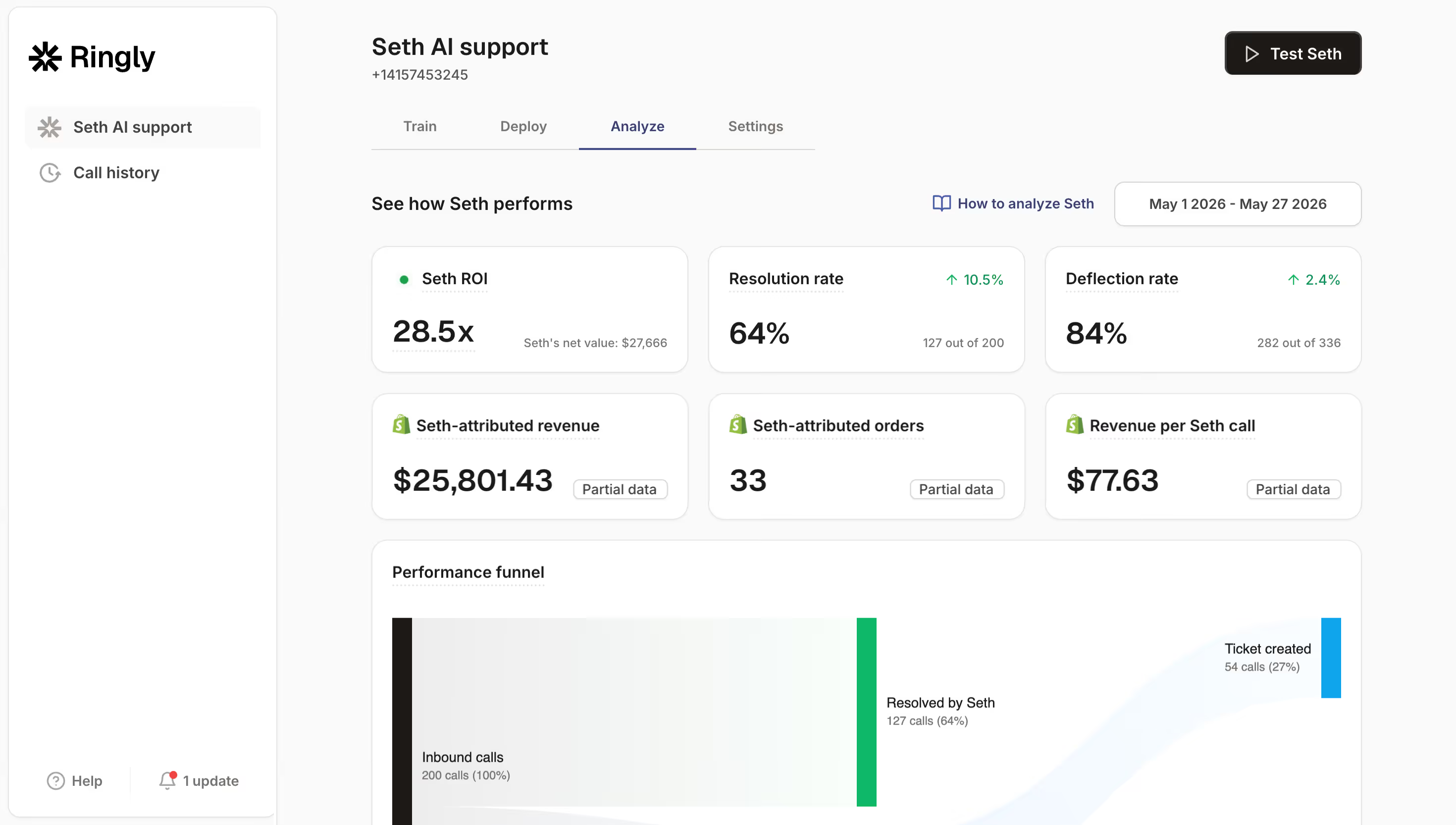
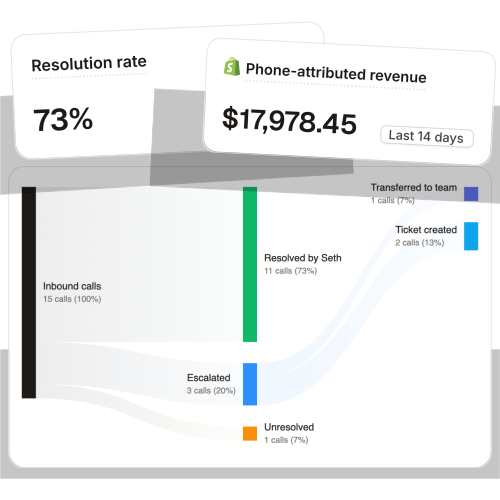
- I checked them against resolution data. Across those brands the AI resolves 73% of inbound calls on its own, and the returns-status calls sit at the high end because they're so structured.
- I separated cost from value. The same call is a payroll cost when it sits in a queue and a reorder opportunity when it's answered live.
I'm not claiming every returns call is automatable. The angry, the damaged, the wrong-refund-amount calls need a human, and they should escalate to one. The point is narrower and more useful: the bulk of the reverse-logistics call load is status lookups, and status lookups are exactly what a phone agent handles without breaking a sweat.
What this costs your CS team
Put real numbers on it. Take a typical $50M Shopify brand running a 6-rep CS team:
| Line item | Today | With Ringly |
|---|---|---|
| 6 reps x $4K loaded per rep | $24,000/mo | n/a |
| Ringly Enterprise (~$5K/mo) | n/a | $5,000/mo |
| Net monthly CS spend | $24,000/mo | $5,000/mo |
| Monthly savings | n/a | $19,000/mo |
| Annual savings | n/a | $228,000/yr |
That's roughly 70% of repeatable calls (order status, return status, the same five things over and over) routed to the AI. The complex 30%, including the hard returns calls, still go to your CS team, who now have time to actually solve them instead of reading tracking numbers off a screen all day.
The math gets sharper in a returns-heavy category, because your repeatable-call share is higher. A brand where a fifth of orders come back has more status calls per rep than a brand with a 5% return rate, which means more of the load is automatable. At roughly $0.42 per resolved call versus $7-$16 per call for human BPO, the cost gap on that repeatable volume is not close.
If you want this run against your actual call data instead of a model, book a 30-min call and we'll do the math live.
The returns-and-fulfilment playbook
Pulling it together, here's the operator sequence for running returns as a real part of your fulfilment operation instead of a cost you tolerate.
- Map the reverse flow. Document every step from RMA to inventory sync, the same way you'd map forward fulfilment. You can't fix what you can't see.
- Set disposition logic and SLAs. Define what gets restocked, refurbished, or liquidated, and hold your 3PL to a processing SLA in writing. Loose rules are where shrinkage and disputes live.
- Fix inventory sync. Get returned units from dock to available-to-sell as fast and accurately as possible. This recovers resale revenue and kills the phantom-stockout calls.
- Instrument the call load. Pull your last 30 days of calls and tag the returns-status ones. You'll likely find a bigger repeatable share than you expected.
- Automate the status calls. Hand the where's-my-refund, did-you-get-my-return, and is-it-restocked calls to a phone agent that reads the answer straight out of your system, and escalate the hard ones to your team.
- Measure both sides. Track processing time AND call deflection together. The returns operation and the phone load are one system.
Where does Ringly fit? Not as a returns app. Ringly is AI phone support for Shopify brands, and on a returns-heavy operation it's the layer that absorbs the call the reverse logistics generates. The AI answers inbound calls 24/7, finds the order in your Shopify store, reports the return and refund status, handles exchanges and refund questions from your knowledge base, and escalates the complex calls cleanly to whatever helpdesk you already run. Across 50+ brands it resolves 73% of calls on its own at roughly $0.42 per resolved call. Live in under an hour, with a 65% resolution guarantee.
Gear Rider, a Ringly customer, closed 1,595 calls in 90 days without a phone rep. For a returns-heavy brand, a big slice of volume like that is reverse-logistics status, and it's the cheapest slice to hand off. If you run an ecommerce call center or you're outsourcing this load today, the check order status feature and the Shopify phone agent are the two pages worth reading next. Returns done right also lifts customer retention, since the post-return call is where you save the relationship or lose it.
Frequently asked questions
What's the difference between returns and reverse logistics? Returns is the customer-facing event: someone sends an item back. Reverse logistics is the operational process that moves, inspects, grades, and disposes of that item once it re-enters your network. Reverse logistics is the back end of returns.
How much does it cost to process an ecommerce return? The industry range is $10 to $15 per return once you add return shipping, inspection, repackaging, and restocking labor. Reverse logistics runs 2-3x more expensive per parcel than outbound shipping, and a return can consume a large share of the item's original margin.
Should I handle returns in-house or use a 3PL? In-house gives you control but doesn't flex for Q4 spikes, which can run 200-400% above baseline. A 3PL gives you speed and labor savings but costs you visibility after the dock, so set tight disposition rules and SLAs in writing if you go that route. Around 40% of retailers now use a 3PL for returns.
Why is my available-to-sell wrong after a return? The unit is physically back but your inventory feed hasn't synced, so the storefront still shows it out of stock. That phantom stockout costs you the reorder and generates a "is it back in stock yet" call. The fix is tighter disposition logic and a cleaner inventory integration.
How long does returns processing take? End-to-end processing averages 10 to 14 days, stretching to 20-plus during peak season. That gap between intake and refund is the window when customers call to ask where their refund is.
What share of customer calls are about returns and refunds? Order and return-status inquiries together run 40-60% of all inbound customer service contacts, and they spike after a returns-heavy period like post-holiday. These are high-volume, low-complexity calls where the answer already lives in your system.
Can AI handle return-status phone calls? Yes, because they're structured lookups. The AI finds the order in Shopify, reports the return and refund status, and answers exchange questions from your knowledge base, escalating the genuinely complex calls to your team. Across 50+ Shopify brands on Ringly the AI resolves 73% of inbound calls on its own.
Talk to us

If your returns operation runs clean but your phone still lights up with refund-status questions, that gap is the cheapest revenue you can recover this quarter. A 30-min call is the fastest way to see what those calls are costing you and how much of the load is automatable.
The 3-layer guarantee.
- Live in 14 days or it's free until launched.
- 65% resolution in 90 days or we refund the last 3 months of subscription fees.
- We keep working free until we hit 65%.
Ruben (Ringly co-founder) takes these calls personally.