
This guide in 30 seconds.
- The customer service experience your customers actually remember is built on the channels you measure least, and for most DTC brands that's the phone line.
- A 9-step operator playbook, ordered so each move is measurable: answer rate, time-to-answer, hold abandonment, after-hours coverage, the repeatable 70%, and feedback as a weekly ritual.
- Written for founders, COOs, and Heads of CX at $10M-$100M Shopify brands running a paid helpdesk and a visible phone number.
Most guides on improving the customer service experience tell you to be more empathetic, gather feedback, and add a loyalty program. Fine advice. None of it touches the place where the experience quietly breaks for a Shopify brand: the phone line nobody picks up after 6 p.m.
If you run support at a $10M-$100M DTC brand, you already track email first-reply time and CSAT. You probably can't tell me your phone answer rate off the top of your head. That blind spot is expensive. Across the businesses studied by PCN, 62% of callers who can't reach a person switch to a competitor, and they don't tell you they left.
We've launched AI phone support for 50+ Shopify brands, which means we read a lot of call logs. The brands with the best customer service experience aren't the ones with the most reps. They're the ones who measure the right things and fix the channel where customers were silently leaving. If your phone goes to voicemail after hours or you're drowning in the same questions over and over, book a 30-min call and we'll show you what your store is leaving on the table.
In this guide:
Start where the experience actually breaks
Email and chat get all the attention because they're easy to measure. Tickets in, tickets out, a tidy CSAT score at the end. The phone is messier, so most teams look away from it. That's exactly why it's where the experience leaks.
Here's the uncomfortable number. According to AmbsCallCenter, the average business answers only 37.8% of inbound calls, and another 37.8% roll straight to voicemail. And Eden found that 80% of voicemail-routed callers hang up without leaving a message. So for every ten people who call your brand, you're hearing from fewer than four, and the rest form an opinion of your customer service experience based on a phone that rang out.
The customer service experience is decided on the channels your dashboard ignores, and the phone is the loudest one. Your resolution dashboard tells you what happened on the calls you answered. It says nothing about the ones you missed.
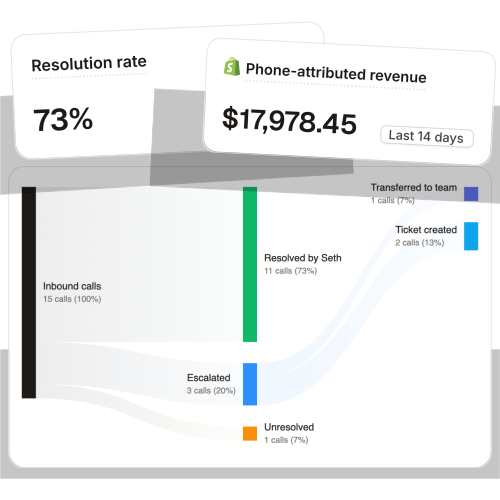
When we set up a new brand, the first thing we do is time their own after-hours queue and read a week of call transcripts. The pattern is the same almost every time. A wall of WISMO ("where's my order"), a stack of return questions, the same five product questions on repeat, and a long tail of after-hours calls that nobody ever returned. The work itself is mostly routine. The damage is that no human was there to do it.
So before you reach for empathy training or a new feedback survey, fix the channel that's leaking. Everything below is ordered around that idea. You can read more on the phone-side of ecommerce customer service if you want the broader picture first.
How I built this playbook
I'm Ruben, co-founder of Ringly. I've spent the last two years running phone support for Shopify brands, and the steps below come from real implementation work, not from rewriting other people's CX checklists.
For this guide, I pulled from the work itself:
- I read the call logs. Across 50+ Shopify brands on Ringly, I went through real call transcripts and counted what customers actually call about. Roughly 70% is repeatable: order status, returns, product questions.
- I timed the after-hours queue. I clocked how long calls sat unanswered after the team logged off, and how many rolled to a voicemail box that nobody checked until Monday.
- I tracked answer rate, not just CSAT. I looked at the percentage of calls a brand actually picked up before and after, because that's the number that moves the experience the most.
- I measured resolution, then revenue. For each brand I tracked how many calls got fully handled and what that recovered in sales, so the experience improvement ties to a dollar figure, not a vibe.
- I stress-tested the hard calls. I listened to the genuinely complex calls (angry customer, edge-case refund) to confirm those still reach a human cleanly, because automating those would wreck the experience, not improve it.
The steps are ordered the way I'd actually run them with a brand. Measure first, fix the biggest leak second, automate the routine third. Skip the order and you optimize things customers never noticed while the phone keeps ringing out.
9 steps that change the experience
This is the playbook. Each step is a measurable change, not a feeling. Run them in order.
1. Measure the metrics customers actually feel
Most teams measure CSAT and email first-reply time, then wonder why the experience isn't moving. Customers don't feel your CSAT score. They feel whether the phone got answered and how long they waited.
Start tracking three numbers you probably aren't: phone answer rate (what share of calls you pick up), time-to-answer, and hold abandonment. Brightmetrics found 34% of callers hang up after two minutes on hold, and abandonment spikes hard between three and five minutes. If you don't measure those, you're flying blind on the part of the experience customers remember most.
Here's why CSAT alone fools you. CSAT only surveys the people you actually served, so it's a satisfaction score for the calls that went well, by definition. The customer who hit voicemail at 9 p.m. and bought from someone else never fills out your survey. Your score can climb while your experience gets worse, because the unhappy customers are leaving instead of rating you. Our breakdown of customer service KPIs for ecommerce covers the full set and how they fit together.
2. Set a response-time standard per channel
A good experience is mostly speed plus competence. About 80% of consumers say speed, convenience, knowledgeable help, and friendly service are what make an interaction feel good, so set a real target on each channel instead of a vague "respond quickly."
- Phone: answer 80% of calls within 20 seconds. That's the long-standing contact-center benchmark, and it's still the bar customers judge you against.
- Chat: under a minute, or it's not really chat.
- Email: under 24 hours, ideally same business day. HubSpot data shows roughly 90% of customers expect an immediate reply when they reach out.
Write the standards down, then measure against them weekly. A standard nobody checks is a wish. See our response-time benchmarks for targets by channel and category, and our SLA guide if you want to formalize them.
3. Close the after-hours gap
Your team logs off at 6 p.m. Your customers don't stop having problems. Evening reorders, weekend WISMO, the older customer who only feels comfortable placing an order by phone. All of it hits a voicemail box, and as we saw, most of those callers never leave a message and never call back.
The single biggest experience improvement most DTC brands can make is answering the calls that currently roll to voicemail. This is where 62% of callers quietly switch to a competitor, per PCN. You don't fix it by hiring a night shift you can't afford. You fix it by having something pick up. An after-hours answering setup or 24/7 phone coverage closes the gap without the payroll.
4. Automate the repeatable 70%
When we read the call logs, the same thing shows up everywhere: most of the volume is the same questions over and over. Salesforce pegs WISMO alone at 30-40% of tickets in normal periods and over 50% at peak, and each one costs $5 to $22 to handle manually.
Routing that routine work away from your reps does two things for the experience. Callers get an instant answer instead of a hold, and your team gets time back to actually solve the hard 30%. WashCo, a Shopify brand we launched, recovered $22,664 in its first 7 days once the phone was answered around the clock. The point isn't the tool you pick. It's that the repeatable calls should never sit in a queue. Our guide to WISMO calls goes deeper on the biggest category.
5. Make the knowledge base the single source of truth
A great experience falls apart when a customer gets two different answers from two reps. That happens when the answers live in people's heads instead of one place.
79% of consumers expect self-service options, and self-service only works if the underlying knowledge base is right. Put your shipping rules, return policy, sizing, and product facts in one source. Update it the moment a policy changes. Then both your humans and any automation pull from the same truth, which is the only way the experience stays consistent across channels. A self-service support setup sits on top of that source.
6. Build clean escalation and routing
Automating the routine 70% only improves the experience if the other 30% reaches a human without friction. The angry customer, the lost package with a custom claim, the refund edge case. Those calls need a person, fast.
Set hard rules for what escalates. Define business-hours behavior versus after-hours. Make sure context travels with the call so the customer never repeats themselves, which is the fastest way to torch goodwill. Brands that get first-call resolution right are usually the ones with the cleanest routing rules.
7. Personalize with order context, not scripts
Personalization isn't using the customer's first name in a templated reply. It's the rep (or the system) already knowing the order, the shipping status, and the history before the customer explains it.
When the person answering can see the order in your Shopify store and reference it directly, the call gets shorter and the customer feels known. That's the version of personalization that actually moves the experience, and it has nothing to do with a clever script.
The practical version: whoever picks up should already have the caller's last order, tracking status, and recent ticket history on screen before they say hello. For older or high-touch customers, who make up a real share of phone volume at a lot of DTC brands, that context is the difference between a 90-second call and a five-minute one where they re-explain everything. Make "the customer never repeats themselves" the rule, and most of your personalization work is done.
8. Close the loop with proactive follow-up
The best experiences answer the question before it's asked. If a shipment is delayed, a proactive text beats a frustrated inbound call every time.
Proactive follow-up also turns a resolved issue into loyalty. A quick check-in after a return, a heads-up on a backordered item, an outbound nudge on an abandoned cart. Each one cuts future inbound volume and tells the customer you were paying attention. Done well, it's also a retention lever, not just a support one.
The cheapest place to start is the delay text. The moment a shipment slips its promised date, a single proactive SMS kills the WISMO call before it happens. One outbound message is far cheaper than the inbound call it prevents, and the customer reads it as care rather than an interruption. Stack a few of these (delay alerts, post-return check-ins, backorder updates) and you'll watch your inbound volume drop while satisfaction climbs.
9. Make feedback a weekly operating ritual
Most brands collect feedback and let it rot in a spreadsheet. The improvement comes from acting on it on a fixed cadence.
Pick a weekly slot. Read the lowest CSAT calls, the longest holds, the calls that escalated. Find the one recurring pattern and fix it that week. Then repeat. The experience doesn't improve in one big project. It improves a little every week because someone is paying attention to the right signals.
If you want to compare your current setup to a brand that's already run this playbook, book a 30-min call and we'll walk your numbers live.
Handle the phone channel without a night shift
Steps 3 and 4 keep coming back to the same problem: the phone has to be answered, and you can't staff it the way the experience demands. Your team wasn't hired to answer the same call 50 times a day, and they definitely weren't hired to do it at midnight.
Ringly.io is AI phone support for Shopify brands. Instead of growing your support headcount every time call volume goes up, the AI takes the routine inbound calls so your team can focus on the work that actually moves revenue.
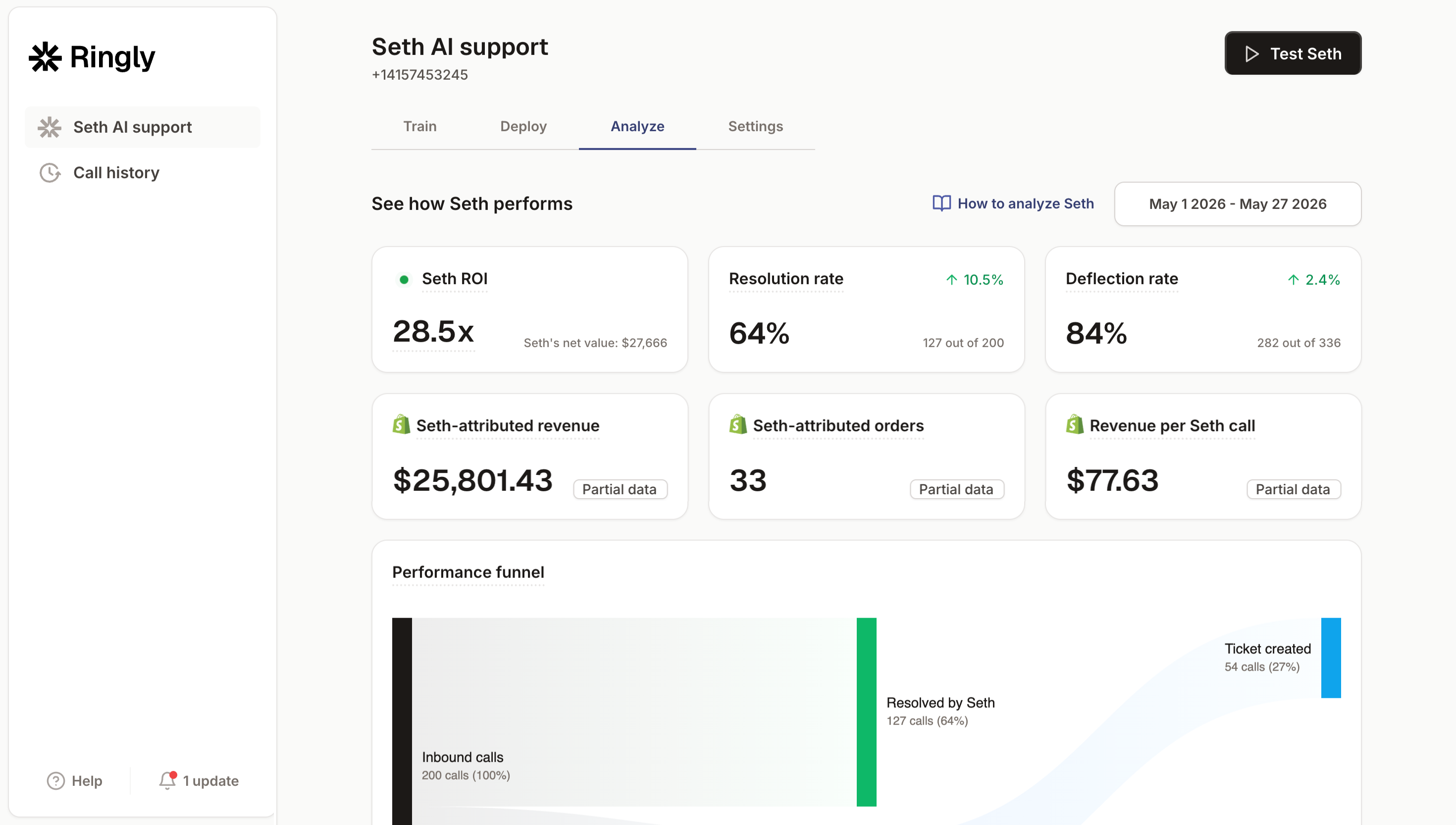
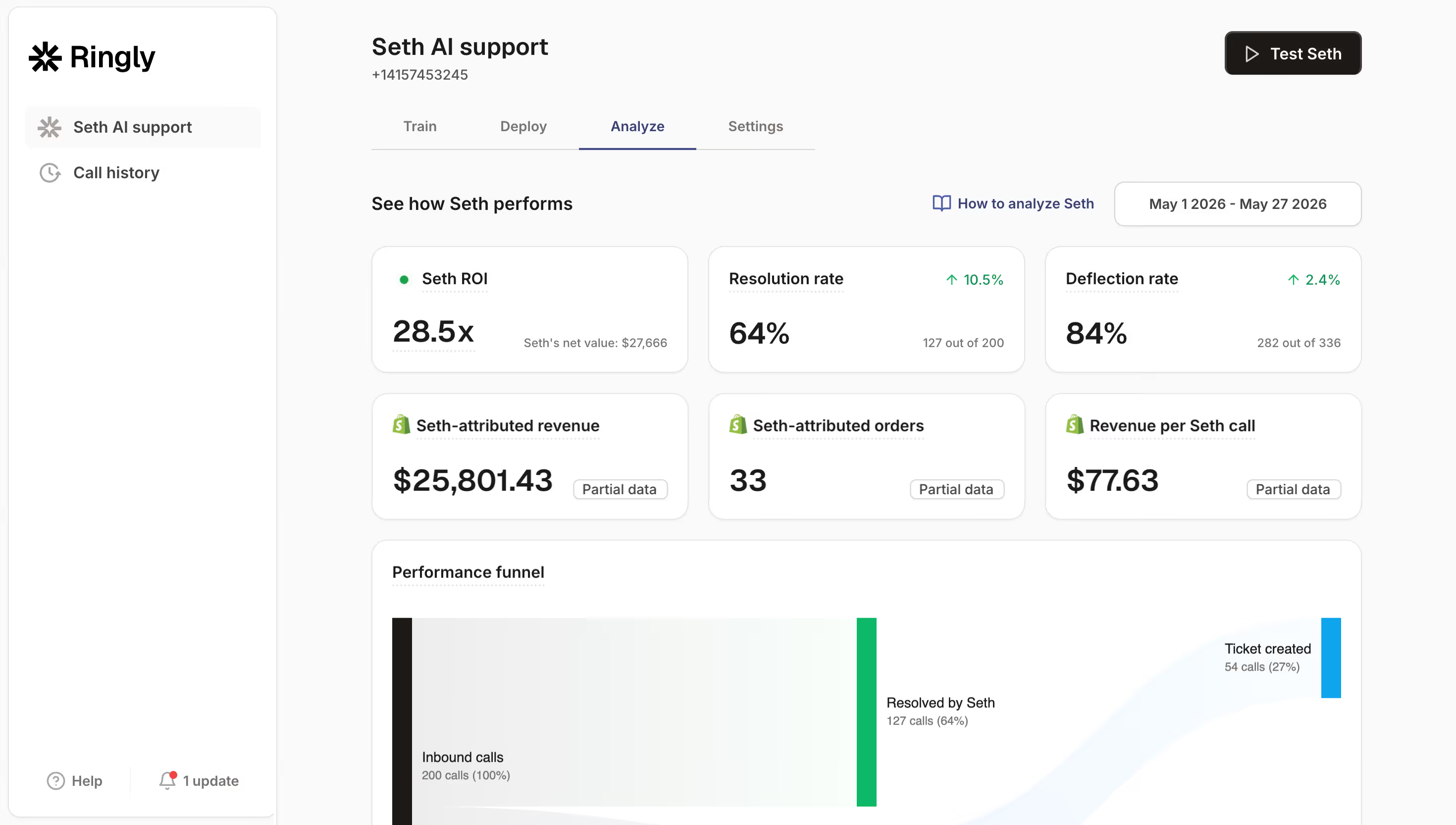
The AI answers inbound calls 24/7 in 40 languages. It finds orders in your Shopify store, processes returns and exchanges, answers product questions from your knowledge base, and rescues abandoned carts via outbound follow-up. Across 50+ brands, it resolves 73% of calls autonomously at roughly $0.42 per resolved call. Calls that need a human escalate cleanly to Gorgias, Richpanel, Reamaze, or whatever helpdesk you already run. You keep your number, your stack, and your control.
The objection we hear most is whether customers will hate talking to AI. The answer is in what they say after the call.
"My customers also feel like it's a normal person. They feel like they can communicate if they have questions."
Claudia Droge, TechCraft Studio
The most repeated thing customers say after a call is "you don't sound like AI." That's the bar. If the experience on the phone is good enough that callers don't clock it, the channel stops being a liability and starts being a quiet strength. If you want the phone-specific deep dive, see AI phone agents for Shopify and customer service for Shopify.
What a bad customer service experience actually costs
It's easy to treat the experience as a soft metric. It isn't. A bad one has a P&L line, and it's bigger than most founders think.
Take a typical $50M Shopify brand running a 6-rep CS team:
| Line item | Today | With Ringly |
|---|---|---|
| 6 reps x $4K loaded per rep | $24,000/mo | n/a |
| Ringly (illustrative) | n/a | $5,000/mo |
| Net monthly CS spend | $24,000/mo | $5,000/mo |
| Monthly savings | n/a | $19,000/mo |
| Annual savings | n/a | $228,000/yr |
That's roughly 70% of the repeatable calls (order status, returns, the same five things) routed to the AI. The other 30%, the calls that actually need judgment, still go to your team, who now have time to solve them properly.
Then there's the cost of the experience you're already losing, which never shows up on the CS line of the P&L. Run the missed-call math for yourself. If you take 1,000 calls a month and answer 60% of them, that's 400 missed calls. If even a third of those callers were ready to buy or reorder and 62% of them switch to a competitor, you're handing away dozens of orders a month to a phone that rang out. At a $120 average order value, that's real revenue leaking from a number nobody on your team is watching.
The team side costs too. 78% of buyers abandon a brand after one unanswered call, and replacing a single burnt-out CS rep runs about $14,113 per Gartner via Insignia, against industry turnover north of 31%. The missed calls and the rep churn are the same problem wearing two costumes: a phone experience that depends entirely on humans being available, and they can't always be. For a fuller view, our Shopify Plus customer service guide breaks down the volume math at scale.
The metrics that prove the experience improved
You can't claim the experience got better without a number that moved. Here's the scoreboard we actually watch, and what each one tells you about the experience.
| Metric | What it measures | Target | Why it maps to experience |
|---|---|---|---|
| Phone answer rate | Share of calls picked up | 90%+ | The calls you miss are the experience you never see |
| Time-to-answer (ASA) | Seconds to pick up | Under 28s | Customers feel the wait before they feel anything else |
| Hold abandonment | Share who hang up waiting | Under 8% | Every abandon is a lost issue and a worse impression |
| First-call resolution | Issues solved in one contact | 70-80% | Repeats are the clearest sign the experience failed |
| Resolution rate | Calls fully handled | 65%+ | The core measure of whether support actually works |
| CSAT | Stated satisfaction | 90%+ | The lagging check, useful but never the only one |
The mistake is leading with CSAT because it's the comfortable number. Lead with answer rate and hold abandonment. Those are the leading indicators of the experience, and they move first when you fix the phone.
Common mistakes that quietly wreck the experience
These are the patterns we see kill the experience even at brands that think they're doing everything right.
- Over-indexing on CSAT. A 92% CSAT on the calls you answered means nothing if you only answered 38% of them. Measure the misses first.
- Ignoring the phone channel. Pouring effort into chat and email while the phone rings out is optimizing the part customers tolerate and neglecting the part they remember.
- Adding channels you can't staff. A new SMS or social channel you can't cover on time makes the experience worse, not better. Cover what you have before you add more.
- Scripting empathy. Customers can tell a templated apology from a real one. Personalize with order context, not canned warmth.
- Having no after-hours plan. "We're closed" is a fine sign on a door and a terrible policy for a phone line that customers expect to work.
Frequently asked questions
What's the difference between customer service and customer experience? Customer service is the help you give when someone has a problem. Customer experience is the whole impression across every touchpoint, including the calls you never answered. Service is a part of the experience, and the phone is where the two overlap most for a DTC brand.
What's the single most important way to improve the customer service experience? Answer more of your phone calls. For most $10M-$100M Shopify brands, the largest hidden gap is the after-hours and peak-time calls that roll to voicemail. Close that gap and the experience improves more than any survey or loyalty program will move it.
How fast should you answer customer phone calls? The long-standing benchmark is answering 80% of calls within 20 seconds, with an average speed of answer under 28 seconds. Past two minutes on hold, about a third of callers hang up, so speed-to-answer is one of the most important experience metrics to track.
How do you improve the customer service experience without hiring more reps? Automate the repeatable 70% of calls (order status, returns, product questions) so the routine never sits in a queue, and route the complex 30% to your existing team. That gives customers instant answers and gives your reps time to handle the hard cases well, without growing headcount.
What metrics measure the customer service experience? Phone answer rate, time-to-answer, hold abandonment, first-call resolution, resolution rate, and CSAT. Lead with answer rate and hold abandonment because they're leading indicators. CSAT is a lagging check, useful but never the whole story.
How do you handle after-hours customer service calls? You need something that picks up when the team is off, because most voicemail-routed callers never leave a message. An AI phone agent or after-hours answering setup covers the gap without the cost of a night shift, and routes anything complex to a ticket for the morning.
Does AI hurt the customer service experience? It does when it's a chatbot pretending to be a phone agent. Done well, it helps: across 50+ Shopify brands on Ringly the most repeated thing callers say is "you don't sound like AI," and routine calls get answered instantly instead of sitting on hold.
How long does it take to see the experience improve? The phone metrics move fast, often within the first week of closing the after-hours gap, because you immediately answer calls you were missing. The softer metrics like CSAT and repeat-purchase rate follow over the next few months as the consistency compounds.
Talk to us

If you run a $10M-$100M Shopify brand and the customer service experience is leaking on the phone, after hours or during the seasonal spike, a 30-min call is the fastest way to see what you're leaving on the table. We'll read your missed calls with you and do the math live.
The 3-layer guarantee.
- Live in 14 days or it's free until launched.
- 65% resolution in 90 days or we refund the last 3 months of subscription fees.
- We keep working free until we hit it.
Ruben (Ringly co-founder) takes these calls personally.