
This post in 30 seconds.
- Seven strategies that move repeat-purchase rate, ranked by what actually works for a Shopify brand already past product-market fit.
- The one most retention guides skip: answering the phone. A missed call is a silent churn event nobody logs.
- Built for founders, COOs, and Heads of CX at $10M-$100M Shopify brands running a real support team and a visible phone line.
Most retention advice you'll read is a list of marketing tactics. Loyalty points, email flows, a subscription toggle. All useful. But when we pulled call data across 50+ Shopify brands on Ringly, the most common silent-churn moment wasn't a bad product or a missed email. It was an after-hours call that rolled to voicemail and never got returned. The customer didn't complain. They just bought from someone else next time.
So this guide covers the marketing levers everyone names, plus the support lever almost nobody does. If you run customer experience at a $20M-$100M Shopify brand and your repeat-purchase rate has gone flat, the cheapest growth you have isn't a new ad set. It's the customers you already paid to acquire. Book a 30-min call and we'll look at where your phone line is quietly losing them.
Why retention beats acquisition (and the numbers behind it)
Here's the part the CFO already knows. Acquiring a new customer costs somewhere between 5 and 25 times more than keeping one you already have, and in ecommerce that gap has gotten worse as ad costs climbed (customer retention statistics, 2026). The probability of selling to an existing customer sits around 60-70%. For a brand-new prospect it's 5-20%.
The profit math is the headline. A 5% lift in retention can raise profits by 25% to 95%, a finding from Bain and Harvard Business Review that has held up for two decades. Returning customers are usually a small slice of your traffic, often under 10%, but they drive a large share of revenue because they spend roughly 67% more than first-timers.
There's a reason this is the lever most brands underuse anyway. Acquisition is visible. You can see the ad spend, the new orders, the dashboard going up. Retention is invisible until it isn't, and by the time a flat repeat-purchase rate shows up in the numbers, the customers who left did so quietly months ago. Only about 18% of companies focus more on retention than acquisition, even though retention is the cheaper line on the P&L. The brands that flip that ratio are the ones still growing when ad costs make acquisition unprofitable.
Retention is the only growth lever that gets cheaper as you scale, while acquisition gets more expensive. That's why the brands quietly winning right now are reallocating budget away from the top of the funnel and toward the customers already in the door.
None of this is new. What's new is how much of the retention battle now happens at the support layer instead of the marketing layer. 86% of consumers say they'll pay more for a better experience (PwC Consumer Intelligence Series), and 81% say they're likely to buy again after a single good service interaction (Zendesk CX research). The flip side is brutal: 73% will walk after one bad one.
The 7 strategies that actually move repeat-purchase rate
You don't need all seven running at once. Pick the two with the biggest gap between where you are and where you should be, ship those, then come back for the rest. For a deeper menu, our ecommerce customer retention guide and customer retention best practices go further on each.
1. Make the first 30 days flawless
Churn is decided early. The window between the first order and the second is where most customers silently decide whether you get a third. A clean unboxing, a shipping update that arrives before they think to ask, and a product that does what the page promised. Those three things carry more weight than any points balance.
The first 30 days are also where the most expensive support moments happen, because a first-time buyer has no patience yet. They don't know your brand is good for it. A delayed package, a confusing return policy, or a phone call that goes nowhere lands harder on someone who hasn't built trust with you. Get those interactions right while the relationship is new and you've bought yourself slack later.
- Set delivery expectations you can beat. A package that arrives a day early beats one that arrives "on time" after a vague promise.
- Make the first reorder one click. Save the cart, pre-fill the address, remove every reason to think twice.
- Reach out before they reach out. A proactive "your order shipped" note kills the most common first-month support call before it happens.
The second purchase is the hardest one to earn and the one that predicts lifetime value best. Track your first-to-second-order conversion rate as its own metric. If it's under 30%, fix onboarding before you touch loyalty.
2. Build a loyalty program that rewards behavior, not just discounts
Discount-only loyalty trains customers to wait for the next coupon, which erodes margin and does nothing for the customers who'd have paid full price. The programs that work reward behavior you actually want: reviews, referrals, subscription sign-ups, a second purchase inside 60 days.
A well-built ecommerce loyalty program gives customers a reason to come back that isn't purely price. Tier it so your best customers feel it. The 8% of shoppers who already repeat-buy are the ones you most want to lock in, and a tiered program makes that small group feel like insiders rather than just discount hunters.
The other half of loyalty is making the points worth chasing. A program nobody can remember the rules to is a program nobody uses. Keep the earn-and-burn simple, surface the balance everywhere the customer touches you, and tie the top tier to something that costs you little but feels premium: early access, free expedited shipping, a real human on the phone when they call. That last perk costs almost nothing once routine calls are handled for you, and it's the one customers remember.
3. Run a post-purchase email and SMS sequence
Email and SMS are still the cheapest retention channel you own, and they work best together. The job of the post-purchase sequence isn't to sell. It's to keep your brand top of mind between orders and to catch the moment a customer is ready to reorder.
- Replenishment timing. For consumables, fire a reorder nudge a few days before the average run-out date, not after.
- Education over promotion. A how-to-use email earns more goodwill than a fourth discount code.
- Win-back before they're gone. Customers slipping past their normal reorder window get a different message than active ones.
Pair this with a tight abandoned cart email strategy so you're recovering near-misses, not just nurturing past buyers.
4. Personalize from first-party data
You already have the data that makes retention work: what they bought, when, how often, and what they returned. With third-party cookies gone, first-party data is the asset. Use it to recommend the next logical product, time messages to the customer's actual rhythm, and stop sending winter-coat emails to someone who bought sandals.
Customers now expect personalization by default, and 76% get frustrated when a brand doesn't deliver it. Our guide to ecommerce personalization breaks down where to start without a data-science team.
Personalization shouldn't stop at the inbox. The same first-party data that powers your email recommendations should reach your support layer, so that when a customer calls, whoever picks up already knows their order history and what they last bought. A caller who has to re-explain who they are every time feels like a stranger to a brand they've spent hundreds with. When your phone agent can pull the Shopify order on the spot and pick up where the relationship left off, the call itself becomes a retention moment instead of a friction point.
5. Turn subscriptions into the default
If any part of your catalog is consumable, a subscription is the strongest retention mechanism you can offer because it removes the decision to reorder entirely. Three-quarters of ecommerce businesses now run some subscription option for exactly this reason: predictable revenue and a customer who has to actively choose to leave.
Two things separate subscriptions that stick from ones that churn. First, flexibility. The fastest way to lose a subscriber is to make pausing or skipping feel like a fight, so let them skip a shipment in one tap instead of forcing a cancel. Second, the save moment. A subscriber calling to cancel is one good conversation away from staying, and most brands lose that conversation because nobody picks up or the rep can't make a save offer on the spot.
The catch is that cancel call. Subscription churn happens on the phone and in the help desk, which is exactly why the next strategy matters more than most operators think.
6. Answer the phone (the retention lever almost nobody lists)
Here's where the data surprised us. Across the 50+ Shopify brands we run phone support for, the calls that predicted churn weren't the angry ones. They were the unanswered ones. A customer dials with a simple question, hits voicemail after 6 p.m. or during a launch-day spike, and quietly never calls back. Roughly 62% of business calls go unanswered, and 85% of people who can't reach you won't try again (call abandonment data).
That's the silent leak. No ticket, no NPS ding, just a customer who routes their next order to a competitor who picked up. Most of those calls are routine: "where's my order," a return question, a quick "does this fit my setup." The same questions over and over. They don't need a human. They need an answer, fast, at the hour the customer actually called.
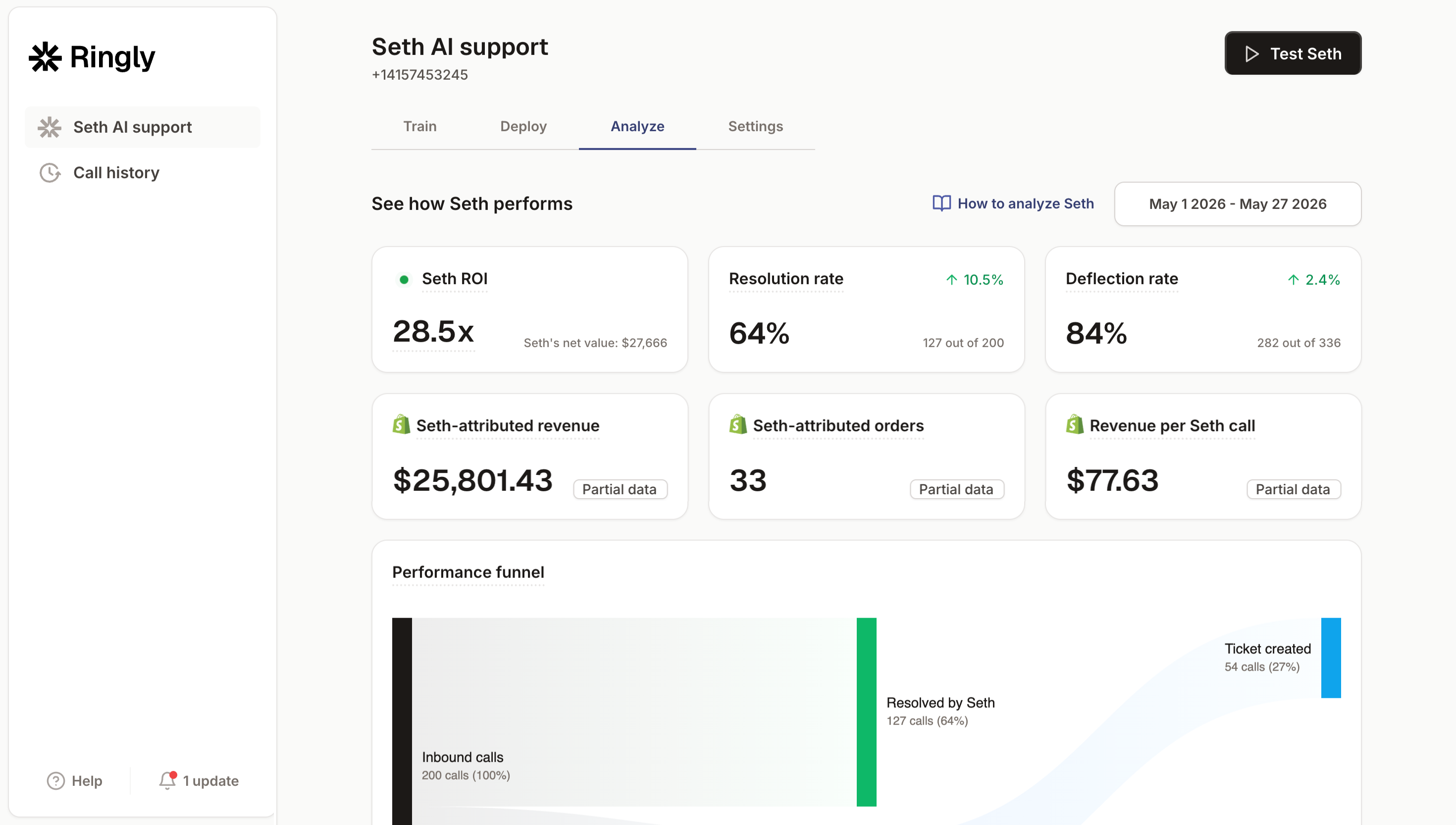
This is what Ringly.io does. It's AI phone support for Shopify brands. The AI answers inbound calls 24/7, finds orders in your Shopify store, handles returns and product questions, and escalates cleanly to whatever help desk you already run, whether that's Gorgias or one of the Gorgias alternatives. Across 50+ brands the AI resolves 73% of calls on its own at about $0.42 per resolved call. WashCo, a Shopify brand we launched, recovered $22,664 in attributed revenue in its first 7 days on the phone, much of it from calls that used to roll to voicemail.
If your phone goes quiet after 6 p.m., that's not a coverage problem. It's a retention problem wearing a coverage problem's clothes. See how 24/7 ecommerce phone support and WISMO calls connect to repeat-purchase rate.
7. Close the loop on every complaint, fast
A complaint is a retention opportunity most brands fumble by being slow. Customers don't expect perfection. They expect a fast, human resolution when something goes wrong, and they remember the recovery more than the problem. The data backs this up: a well-handled complaint can leave a customer more loyal than if nothing had gone wrong at all.
Speed is the variable. Response-time expectations have collapsed, and a 24-hour email reply now feels like a week. Three things move the needle here:
- Cut time-to-first-response. The clock starts the second they contact you, on any channel, not when a rep finally opens the ticket.
- Empower the front line to fix it. A rep who has to escalate a $40 refund makes the customer wait twice. Give them a resolution budget.
- Free up bandwidth for the hard calls. Route the routine "where's my order" volume away from your team so the human time goes to the genuinely upset customer who needs it.
That last point is where automation earns its keep. When the AI handles the 70% of calls that are routine, your reps aren't burnt out by repetition and have the headspace to turn an angry caller back into a repeat buyer. Our notes on ecommerce customer service and customer service training get into the specifics.
What better support costs vs what it saves
Retention strategies are easy to nod along to and hard to fund, so here's the math on the one most people underweight. Take a typical $50M Shopify brand running a 6-rep CS team:
| Line item | Today | With Ringly |
|---|---|---|
| 6 reps × $4K loaded per rep | $24,000/mo | n/a |
| Ringly (around $5K/mo) | n/a | $5,000/mo |
| Net monthly CS spend | $24,000/mo | $5,000/mo |
| Monthly savings | n/a | $19,000/mo |
| Annual savings | n/a | $228,000/yr |
That's roughly 70% of repeatable calls, the order-status, returns, and product questions you hear over and over, routed to the AI. The other 30%, the genuinely complex ones, still go to your team, who now have time to actually solve them and save the customer. The savings are real, but the retention upside is the bigger number: every after-hours call you stop dropping is a customer you keep.
If you're weighing this against hiring or against your current help desk, book a 30-min call and we'll do the math on your real call volume live. You can also scope the no-hire path in how to scale customer service without hiring.
"My customers also feel like it's a normal person. They feel like they can communicate if they have questions."
Claudia Droge, TechCraft Studio
How to know whether retention is actually improving
You can't improve what you don't measure, and retention is easy to fool yourself about. Track three numbers monthly, not vanity metrics.
- Repeat purchase rate. The share of customers who buy a second time. The single best early signal that retention work is landing.
- Customer retention rate. Of the customers you had at the start of a period, how many are still buying at the end. Run the math with our retention rate calculator. A 70% retention rate is excellent in ecommerce.
- Customer lifetime value. What an average customer is worth over the whole relationship. When CLV rises faster than CAC, your retention strategy is paying for your acquisition.
Watch the channel-level data too: a falling call answer rate or a rising voicemail count is a retention problem six weeks before it shows up in your repeat-purchase number. For more on the metrics that matter, see customer retention tips.
One more thing on measurement. Don't average these numbers across your whole customer base, because the average hides the story. Cohort them by acquisition month and watch each group's repeat-purchase curve over time. A healthy brand sees later cohorts retain better than earlier ones as the product and support improve. If newer cohorts retain worse, something you changed recently is leaking customers, and the channel data usually points at where. The brands that catch this early are the ones reading their call logs, not just their dashboards.
Frequently asked questions
What is a good customer retention rate for ecommerce? A 70% retention rate is considered excellent in ecommerce, meaning you keep more than two-thirds of your customers. Most brands sit lower, so anything above 40% is a workable base to build from. The number that matters more is the trend: up and to the right beats a high static figure.
Is it really cheaper to retain customers than acquire them? Yes. Acquiring a new customer costs 5 to 25 times more than retaining an existing one, and the probability of selling to an existing customer is 60-70% versus 5-20% for a new prospect. The gap has widened as ad costs rose, which is why retention is the cheaper growth lever in 2026.
What's the difference between customer retention and loyalty? Retention is the outcome: customers keep buying. Loyalty is one of the inputs, usually a structured program of rewards. You can have strong retention with no loyalty program if your product and support are excellent, but a loyalty program with weak support rarely holds customers.
How does customer service affect retention? Directly and heavily. 81% of customers say they're likely to buy again after a positive service interaction, and 73% will abandon a brand after a single bad one. Service is one of the few retention levers that can both win a customer back and lose one in a single interaction.
Can phone support actually improve retention? For brands with a visible phone line, yes, often faster than email-based tactics. Unanswered and abandoned calls are a direct churn trigger, and around 85% of callers who can't reach you won't try again. Answering those calls, even with AI for the routine ones, recovers customers who would otherwise quietly leave.
How long does it take to see retention improve? A post-purchase email sequence and a loyalty program typically move repeat-purchase rate 15-30% within 90 days. Support fixes can show up faster because they stop active churn immediately, but the cleanest read comes from watching repeat-purchase rate and retention rate over a full quarter.
Talk to us

If you run a $10M-$100M Shopify brand and your repeat-purchase rate has gone flat, the fastest place to find recovered revenue is usually the calls you're already missing. A 30-min call is the quickest way to see what your phone line is costing you in customers.
The 3-layer guarantee.
- Live in 14 days or it's free until launched.
- 65% resolution in 90 days or we refund the last 3 months of subscription fees.
- We keep working free until we hit 65%.
Ruben (Ringly co-founder) takes these calls personally.