
The short version.
- Eight real help desk software examples, sorted by the job each one does in a Shopify stack, not a generic best-of ranking.
- Across 200,000+ calls handled, up to 90% of the routine phone calls your helpdesk never logs get resolved without a human.
- Built for $10M-$100M Shopify brands running a paid helpdesk plus a visible phone line.
If you run support at a Shopify brand doing $10M-$100M a year, you already have a help desk. So you're not shopping for one, you're trying to work out which example does which job and which one is worth keeping. Most lists answer that with "best for small teams" or "best for enterprise." That's not how the decision goes when you're staring at a 200-ticket Monday queue and a phone line that's been ringing out since Friday.
So this is the catalog version. Eight examples, each tagged to the specific job it does well, plus the one channel almost every one of them quietly ignores.
Most operators reading this run Gorgias, Zendesk, Gladly, Re:amaze, or Intercom, with a visible phone number and 3 to 12 reps drowning in the same questions over and over. If that's you, book a 30-min call and we'll compare what you're running now to where the calls are actually leaking.
At a glance
| Example | Best for | Pricing model | Phone channel | Verdict |
|---|---|---|---|---|
| Ringly.io | The phone layer in front of your helpdesk | Per call (from $99 a month) | Built for it (the whole point) | The piece your stack is missing |
| Gorgias | The ecommerce-native inbox | Per ticket | Basic add-on, rarely enabled | Best Shopify inbox |
| Zendesk | The enterprise ticketing platform | Per agent ($55+) | Bolt-on (Talk) | Scale + routing |
| Help Scout | The lightweight email desk | Per agent ($20+) | Not really a channel | Simplest shared inbox |
| Zoho Desk | The budget all-rounder | Per agent ($0-$40) | Generic telephony add-on | Cheapest omnichannel |
| Gladly | The people-centric platform | Per agent ($180+) | Unified, human-staffed | Premium high-touch CX |
| Re:amaze | The SMB ecommerce inbox | Per agent ($29+) | Not a real channel | Affordable starter |
| Intercom | The chat-first platform | Per seat + Fin per resolution | Weak | Best live chat |
What counts as help desk software (and what it leaves out)
Help desk software is the tool that catches every customer question, turns it into a ticket, and routes it to someone who can resolve it. Email, chat, social, sometimes phone, all funneled into one queue so your team isn't checking six inboxes. That's the job.
Almost none of these tools say the quiet part out loud, though: the category was built for typing, not talking. Email and chat are the channels they obsess over. Phone is the channel every help desk treats as a checkbox, which is exactly why it's the one leaking revenue at a Shopify brand with an older-leaning customer base.
And the volume is real. "Where's my order" alone runs 20-40% of support tickets in a normal month and tips past 50% during a launch or the holiday spike, according to Salesforce. A chunk of that arrives by phone, from the customer who didn't feel like typing. When the line rings out, nothing gets logged, so the call never shows up in your helpdesk reporting at all.
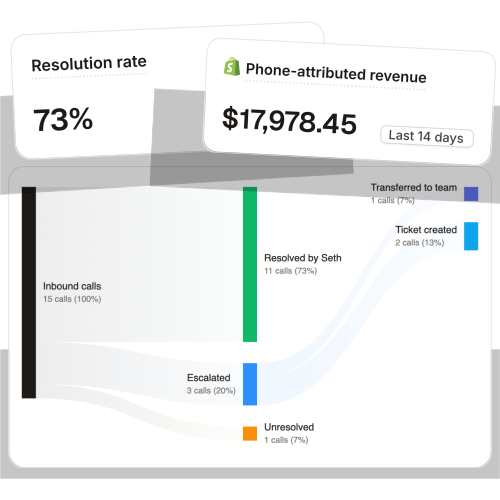
That's the lens for this whole list. Every example below is good at something. The interesting part is what each one leaves uncovered.
How I picked these 8 examples
I'm Ruben, co-founder of Ringly. We run AI phone support for Shopify brands, so I evaluate help desk tools constantly, and I do it as a buyer rather than a reviewer. For this list I scored every example against five things I actually care about when a brand asks me what to run.
- Shopify integration depth. I checked whether each tool can see the order, edit it, process a refund, and write back, without a developer.
- Pricing predictability. I modeled a 5-rep team at ~1,000 tickets a month and looked for where the bill jumps or the overages hide.
- Channel coverage. Email, chat, social, phone, self-service. What's native versus what's a paid bolt-on.
- Phone reality. I called the published support line of each vendor and noted what actually happened. This is the criterion nobody else tests, and it's the one that tells you whether "voice support" is real or a logo on a feature page.
- Escalation fit. When the routine question gets handled upstream, does the hard one land cleanly in the helpdesk with full context.
Then I pulled the resolution data from 200,000+ real calls across our brands to ground the phone numbers in something other than a marketing page. Nothing below is affiliate-driven. I only sell Ringly, and it shows up here against the same five criteria as everyone else.
The 8 help desk software examples
1. Ringly.io: the phone layer
Best for: the phone calls your helpdesk was never built to handle. Ringly.io is AI phone support for Shopify brands, and it's the one example here that sits in front of your stack instead of replacing it.
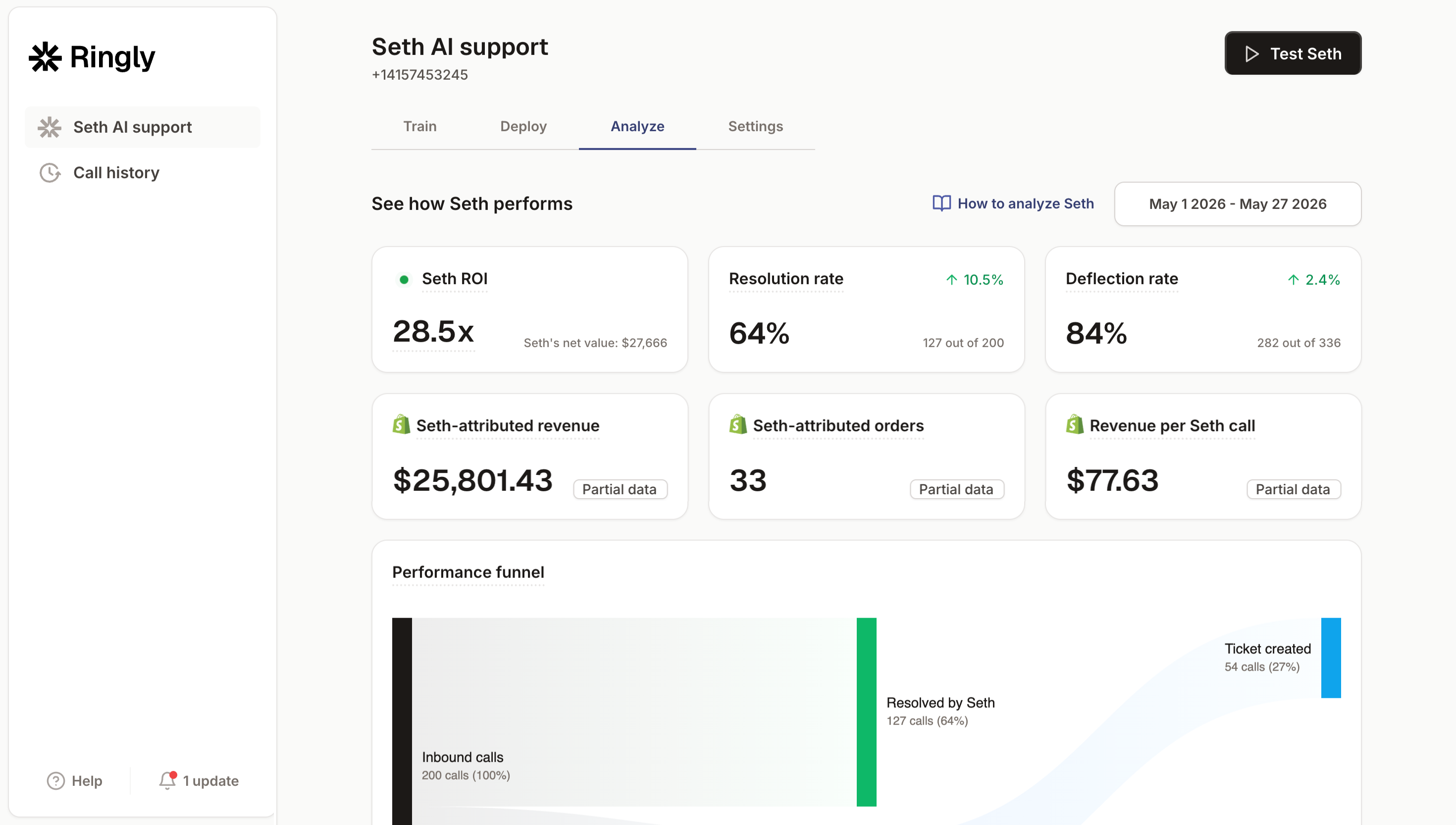
Your team wasn't hired to answer the same WISMO call 50 times a day. The AI answers inbound calls 24/7 in 40 languages, finds the order in Shopify, processes returns and exchanges, answers product questions from your knowledge base, and cancels orders when a caller asks. The calls that need a human escalate cleanly to Gorgias, Re:amaze, or whatever you already run, with the context attached. WashCo, a Shopify brand we launched, recovered $22,664 in its first 7 days on the phone.
Pricing: $99 a month for the first 50 conversations, then $1.99 each. Free to try. Live in under an hour.
What works
- Phone is the product, not a checkbox. Seth resolves up to 90% of calls autonomously for $1.99 a call after the first 50, versus $7-$16 per call at a human BPO.
- Real Shopify actions. It looks up orders, processes returns, and answers FAQs, then hands the rest to your team.
- Sits in front of your helpdesk. You keep your number, your helpdesk, and your workflows. The AI just takes the routine calls.
- You stay in control. You decide what escalates and what the AI handles.
What doesn't
- It's not an email/chat ticketing inbox. By design. It's the phone layer, so you still run a helpdesk alongside it.
- No order-taking or payment by phone (it sends an SMS payment link instead).
- Subscription cancels are a custom action, and inventory refreshes daily rather than in real time.
Why it ranks first: it's the only example here built for the channel the other seven treat as an afterthought, and it's backed by a 65% resolution guarantee.
2. Gorgias: the ecommerce-native inbox
Best for: Shopify and BigCommerce brands that want order edits, refunds, and subscription changes done inside the ticket. Gorgias is the most-installed ecommerce help desk for a reason.
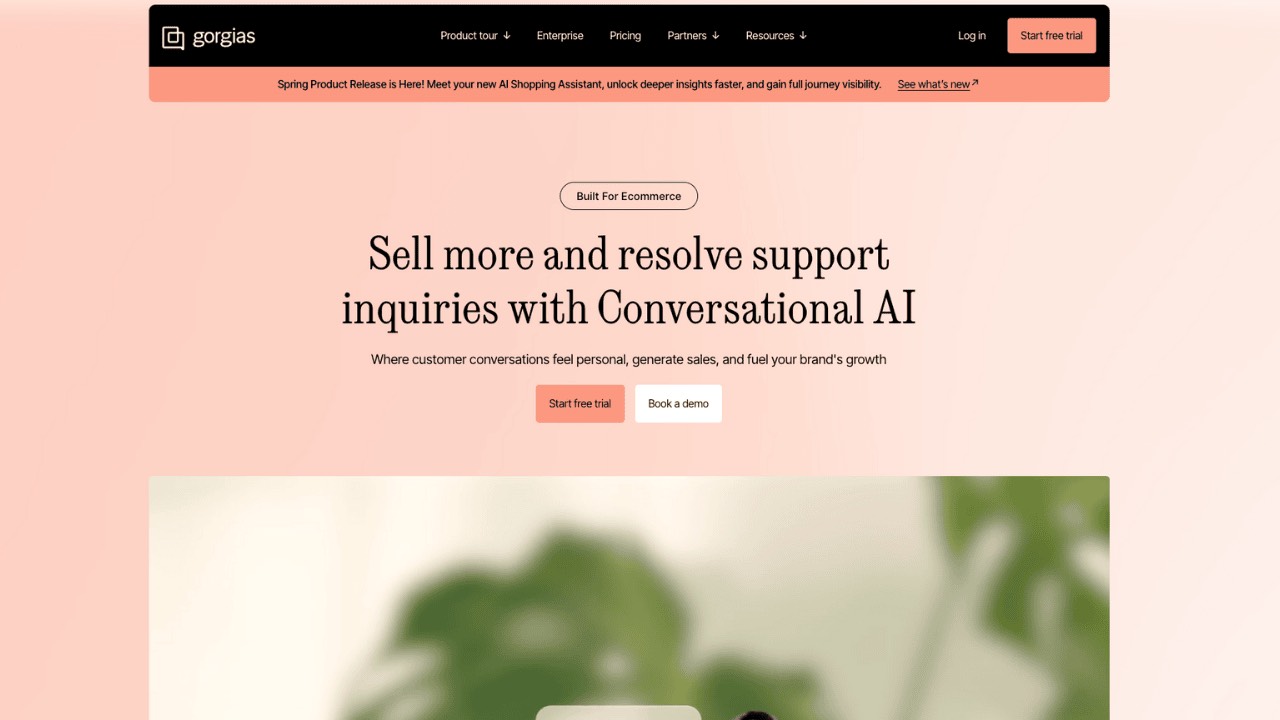
The pitch is tight. A rep can pull up the order, issue a refund, and duplicate a subscription without leaving the ticket view, and the inbox unifies email, chat, and social. For a high-volume DTC brand, that native Shopify depth is genuinely better than the general-purpose tools.
Pricing: ticket-based, roughly $10/mo Starter up to ~$900/mo Advanced, plus custom Enterprise, with unlimited agents. AI is billed separately at around $0.90-$1.00 per AI interaction.
What works
- Native Shopify actions from inside the ticket, no dev required.
- Unified inbox across email, chat, and social comments.
- Strong automation rules for the repetitive stuff.
What doesn't
- The ticket bands trap you. The jump from Basic to Pro (roughly $60 for 300 tickets to $360 for 2,000) is the most common complaint operators raise, you either eat overages or over-buy headroom.
- AI is metered on top of the plan, per interaction.
- Phone is a basic add-on most brands never turn on. It logs calls. It's not a real phone system.
Why it ranks second: for a Shopify inbox, it's the best on this list. If Gorgias isn't the right fit, the Gorgias alternatives worth a look are mostly other ecommerce-native inboxes, not the phone gap it leaves open.
3. Zendesk: the enterprise ticketing platform
Best for: larger support orgs that need real routing, SLAs, and multi-department workflows. Zendesk is the veteran, built to handle complexity at scale.
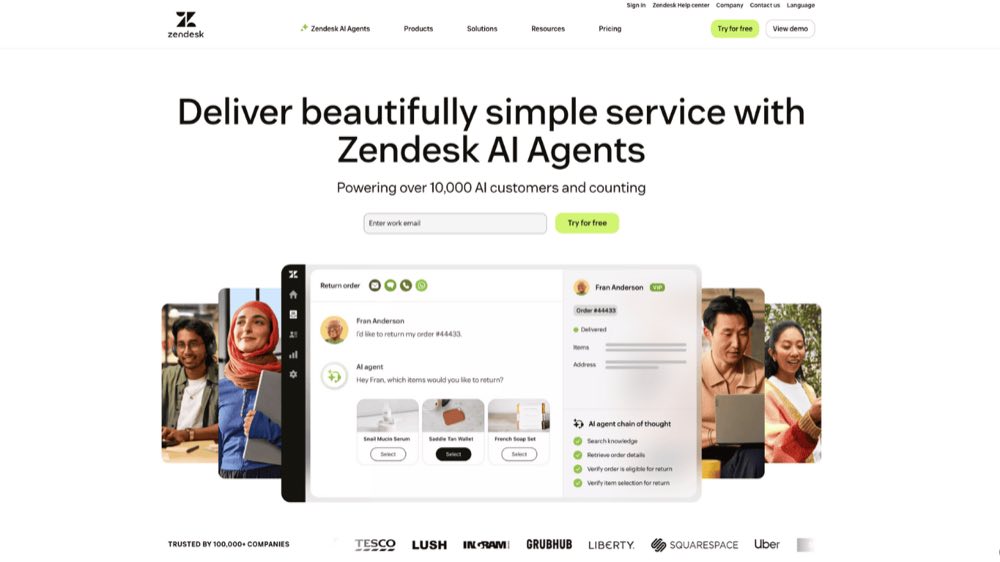
If a single issue routinely touches three teams and a long timeline, Zendesk's case management and reporting earn their keep. The app marketplace is huge. The trade-off is that ecommerce actions that are one click in Gorgias often need workarounds here.
Pricing: roughly $55-$169 per agent per month. AI resolutions run $1.50 committed or $2.00 pay-as-you-go.
What works
- Mature routing, SLAs, and reporting for complex operations.
- Scales to large agent counts and ticket volume.
- Enormous integration marketplace.
What doesn't
- Ecommerce depth lags Gorgias for Shopify-native order actions.
- Per-agent cost climbs fast as the team grows.
- Zendesk Talk is a bolt-on most DTC brands never run as a real phone line.
Why it ranks third: the right call for scale and complexity, overkill for a lean DTC team. If it's more than you need, the Zendesk alternatives lean lighter and more ecommerce-focused.
4. Help Scout: the lightweight email desk
Best for: small-to-mid teams that want a clean shared inbox without the learning curve. Help Scout deliberately doesn't feel like a ticketing system.
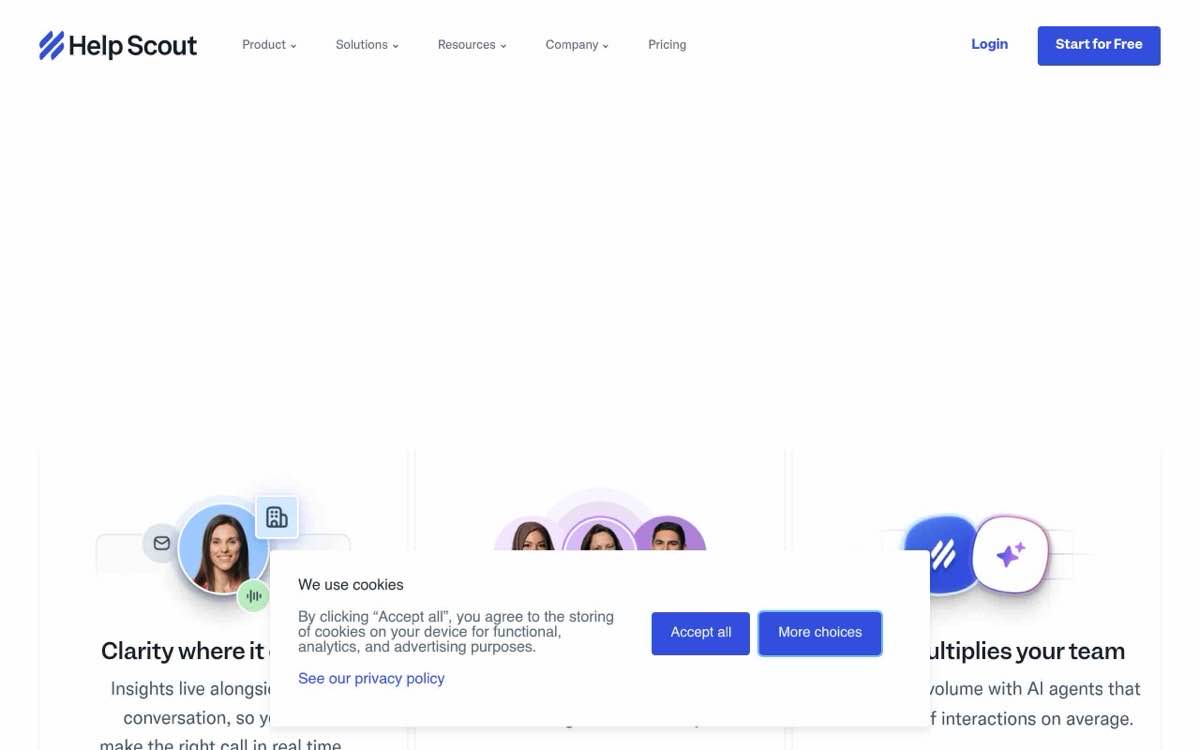
It's email-first, fast to onboard, and pairs the inbox with a knowledge base and basic chat. Customers never see a ticket number, which a lot of brand-led teams prefer. The flip side is that it's thinner on the ecommerce and high-volume routing side.
Pricing: Standard ~$20/agent/mo, Plus ~$40/agent/mo, Pro custom.
What works
- Genuinely simple shared inbox, minimal training.
- Solid email plus knowledge base in one place.
- No "tickety" feel for the customer.
What doesn't
- Lighter Shopify depth than the ecommerce-native tools.
- Not built for heavy routing or high ticket volume.
- Phone isn't a real channel.
Why it ranks fourth: the simplest desk here, best when email is most of your volume. For more horsepower, the Help Scout alternatives add automation and ecommerce depth.
5. Zoho Desk: the budget all-rounder
Best for: teams already in the Zoho ecosystem, or anyone who wants omnichannel coverage cheaply. Zoho Desk is the value play.

You get email, chat, social, a portal, and a telephony add-on, plus 200+ integrations and the Zia AI assistant, starting at free for three agents. The catch is the setup curve and an ecommerce experience that doesn't match a purpose-built tool.
Pricing: Free (3 agents), Express $7, Standard $14, Professional $23, Enterprise $40 per user per month.
What works
- Cheapest omnichannel on this list, free tier included.
- 200+ integrations and a CRM that's already familiar to Zoho users.
- Zia AI baked in across plans.
What doesn't
- UI and setup get fiddly at higher tiers.
- Ecommerce depth is weaker than Gorgias or Re:amaze.
- Phone is generic telephony, not built for DTC call patterns.
Why it ranks fifth: unbeatable on price, average on ecommerce. If the value is appealing but the fit isn't, the Zoho Desk alternatives trade cost for ecommerce polish.
"My customers also feel like it's a normal person. They feel like they can communicate if they have questions."
Claudia Droge, TechCraft Studio
6. Gladly: the people-centric platform
Best for: premium brands that want one lifelong customer conversation instead of a stack of tickets. Gladly throws out the ticket model entirely.
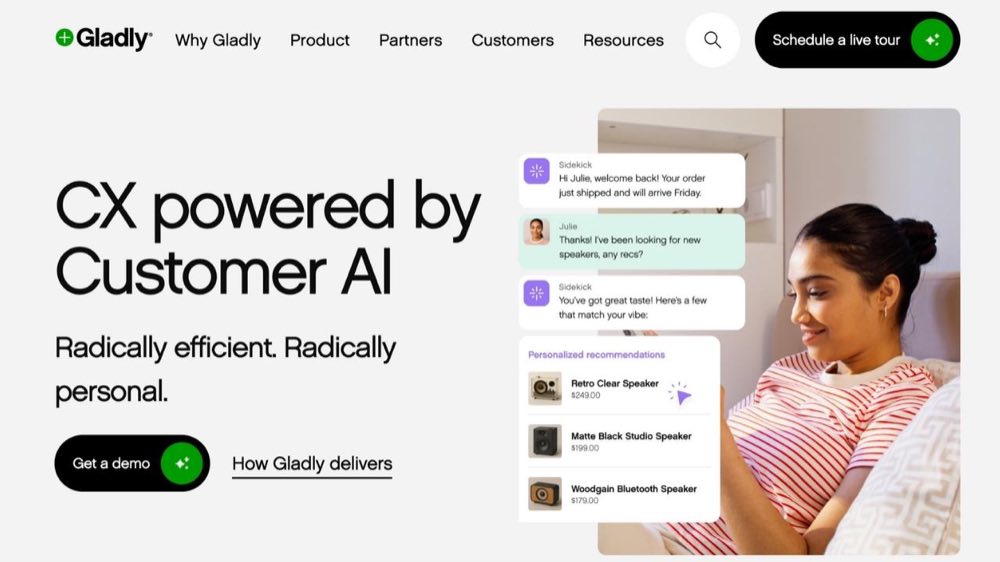
Everything centers on the customer, not the case, and voice plus messaging live in one thread. For a high-touch brand where CX is the differentiator, that's a real edge. It's also the most expensive option here, and it's still a human-staffed model, so the phone still needs people answering it.
Pricing: roughly $180-$210 per agent per month, billed annually.
What works
- Customer-centric, not ticket-centric conversations.
- Voice and messaging unified in one timeline.
- Loved by reviewers: 100% of G2 reviewers rated it 4 or 5 stars and 94% would recommend it (G2 Winter 2024).
What doesn't
- Expensive per agent, hard to justify for small teams.
- Overkill for a brand that mostly needs WISMO handled.
- Still human-staffed phone. It organizes the channel, it doesn't reduce the headcount answering it.
Why it ranks sixth: premium CX done right, for the brands that can fund it. The Gladly alternatives cover the cheaper conversation-led options.
7. Re:amaze: the SMB ecommerce inbox
Best for: smaller and growing ecommerce brands that want a shared inbox plus chat without paying Gorgias money.
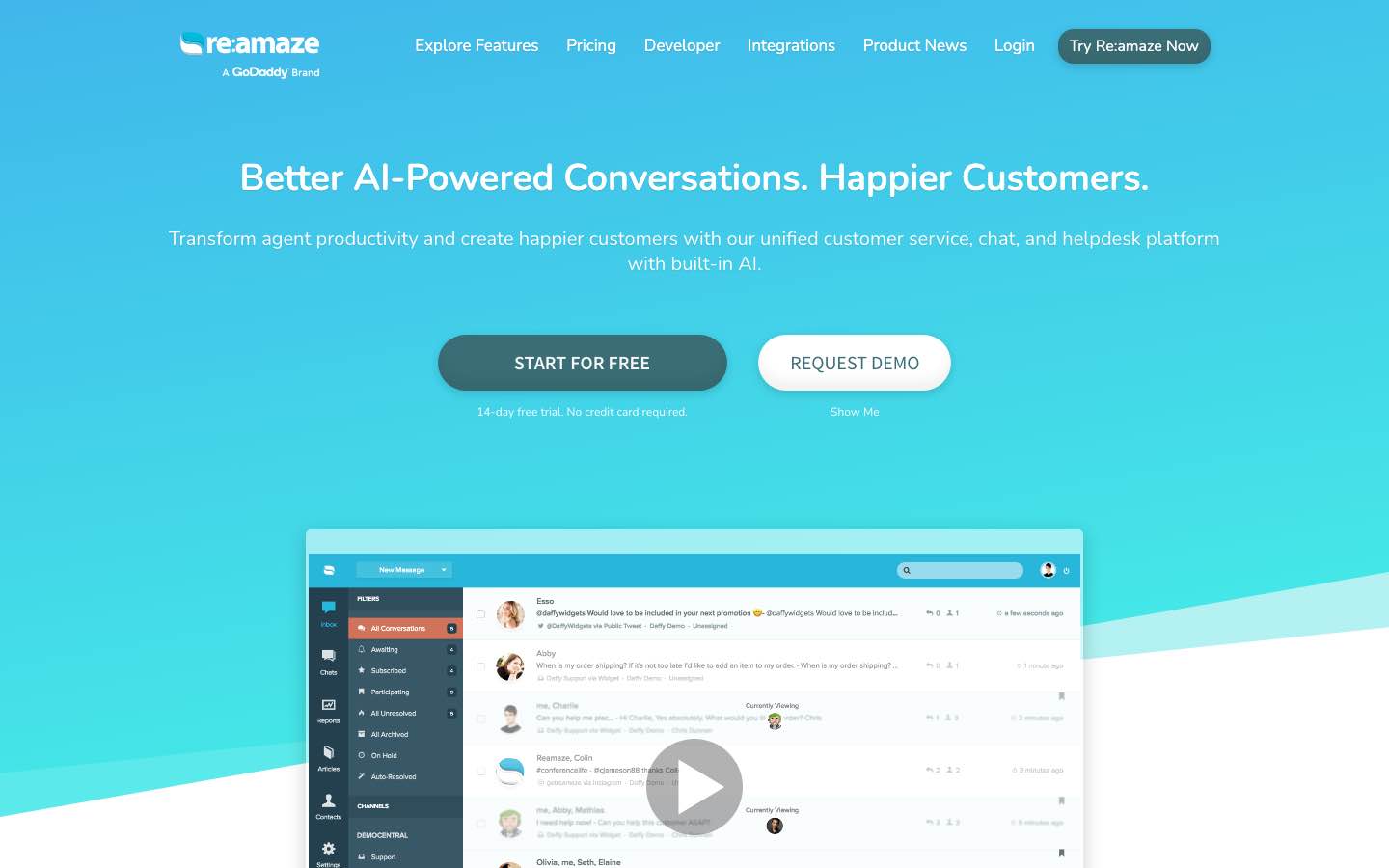
Re:amaze is ecommerce-friendly out of the box, with a shared inbox, live chat, FAQ pages, and Shopify integration at a low entry price. It's a sensible first real help desk. Automation and reporting are lighter than the bigger tools, and like the rest, phone isn't a real channel.
Pricing: Basic $29/user, Pro $49/user, plus a flat $59 Starter with unlimited agents for low-volume brands.
What works
- Affordable ecommerce shared inbox with chat and FAQ.
- Shopify integration for order context.
- Flat Starter tier is friendly for early-stage brands.
What doesn't
- Lighter automation and reporting than Gorgias or Zendesk.
- Scales less gracefully at high volume.
- No real phone channel.
Why it ranks seventh: a great starter desk that brands outgrow. When you do, our ecommerce helpdesk software guide maps the upgrade paths.
8. Intercom: the chat-first platform with Fin AI
Best for: brands that lead with live chat and in-app messaging, and want AI to resolve chats. Intercom is the chat benchmark, and Fin is a strong AI resolver.
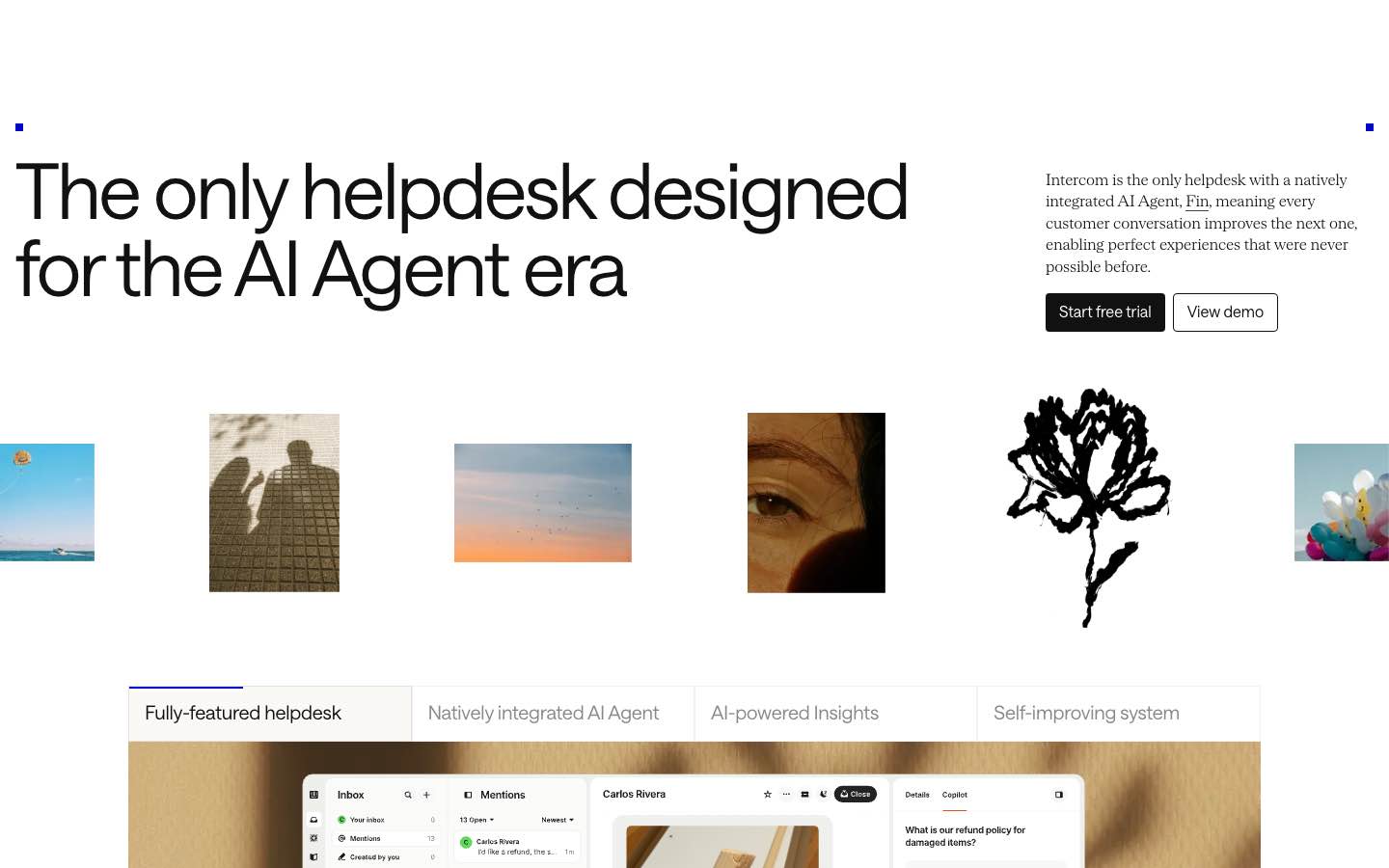
If most of your volume comes through the chat widget, Intercom's messaging UX and Fin's deflection are hard to beat. The catch is that it's chat-first by design, so phone is an afterthought, and the per-resolution AI pricing adds up as you scale.
Pricing: roughly $29/seat/mo, with Fin AI billed at $0.99 per resolution.
What works
- Standout live chat and in-app messaging.
- Fin AI resolves a real share of chat volume.
- Strong self-service and help center.
What doesn't
- Chat-first, phone-weak.
- Per-resolution AI fees stack up at volume.
- Pricier as seats and resolutions grow.
Why it ranks eighth: the chat winner, not a phone answer. The Intercom alternatives cover the cheaper chat-led tools.
The phone gap every example on this list leaves open
Notice the pattern. Eight examples, eight strong email-and-chat tools, and the same one-line "what doesn't" on almost every card: phone isn't really a channel. The voice modules exist, but they log calls. They don't answer them at 11pm when a customer is trying to fix an order before they give up and buy from someone else.
That matters because the phone is where the impatient customer goes. When email replies run past an hour, roughly 89% of customers feel ignored and about a quarter of them pick up the phone. Your helpdesk is built to win the inbox, which means the calls are exactly the volume nobody on your team is staffed to catch.
So the honest version of "help desk software examples" includes the layer that handles the channel the rest skip.
What this gap costs you today
Take a typical $50M Shopify brand running a 6-rep CS team:
| Line item | Today | With Ringly |
|---|---|---|
| 6 reps × $4K loaded per rep | $24,000/mo | n/a |
| Ringly (~$5K/mo) | n/a | $5,000/mo |
| Net monthly CS spend | $24,000/mo | $5,000/mo |
| Monthly savings | n/a | $19,000/mo |
| Annual savings | n/a | $228,000/yr |
That's roughly 70% of the repeatable calls (order status, returns, product questions, the same five things over and over) handled by the AI. The genuinely complex calls still go to your reps, who now have time to actually solve them.
Want to see the version of this math for your store and your actual call volume? Book a 30-min call and we'll run it live off your missed-call data.
How to choose for a DTC stack
You don't pick one tool. You pick the helpdesk that fits your inbox, then add the layer that covers your phone. Here's the quick map.
- Choose Gorgias if you're a Shopify brand and you want order actions inside the ticket. It's the default ecommerce inbox for a reason.
- Choose Zendesk if you're at scale with complex, multi-team routing and SLAs.
- Choose Help Scout if email is most of your volume and you want the simplest possible shared inbox.
- Choose Zoho Desk if budget is the constraint or you already live in Zoho.
- Choose Gladly if you're a premium brand and high-touch conversation is your differentiator.
- Choose Re:amaze if you're smaller and want an affordable ecommerce inbox to start with.
- Choose Intercom if live chat is your primary channel.
- Add Ringly if you have a visible phone line and nobody's reliably answering it, especially after-hours.
The first seven decide where your typed tickets live. The eighth decides whether the phone is a leak or a channel. For the deeper helpdesk-by-helpdesk breakdown, our Shopify helpdesk app guide and the customer service for Shopify overview both go further, and you can always check WISMO calls to size the order-status problem first.
Frequently asked questions
What is the best example of help desk software for a Shopify brand? For the inbox, Gorgias is the default because it does Shopify order actions natively. But the best stack pairs an ecommerce inbox with a phone layer, since none of the inbox tools actually answer calls well. Decide your inbox first, then cover the phone.
Is phone support part of help desk software? Technically yes, practically no. Most help desks (Gorgias voice, Zendesk Talk, Zoho telephony) offer a phone add-on, but they log calls rather than resolve them, and most brands never enable it. That's why a dedicated phone layer like order status handling exists.
How much does help desk software cost? It ranges widely. Per-agent tools run from ~$20/agent/mo (Help Scout) to ~$180+/agent/mo (Gladly), while Gorgias uses ticket-based bands from ~$10 to ~$900/mo. AI features are usually billed separately, per resolution or per interaction.
What's the difference between Gorgias and Zendesk? Gorgias is purpose-built for ecommerce and does Shopify order actions inside the ticket. Zendesk is built for complex, multi-department support at scale, with stronger routing and SLAs but weaker native ecommerce depth. Smaller DTC brands usually pick Gorgias; large complex orgs lean Zendesk.
Do I need a separate tool for phone support? If you have a visible phone number and you care about after-hours coverage, usually yes. The helpdesk voice add-ons aren't built to autonomously answer and resolve calls, so brands add a phone layer that handles the routine calls and escalates the rest. You can keep your existing helpdesk either way.
Can help desk software handle WISMO calls automatically? The email and chat side can deflect a lot of "where's my order" with tracking automations. The phone side is the gap, because the calls ring out to voicemail. An AI phone agent can look up the order live in Shopify and answer the WISMO call without a rep, which is where most of the recovered time comes from. See our guide to 24/7 ecommerce phone support for how that works.
Talk to us

If you run a $10M-$100M Shopify brand and the phone is the channel nobody's managing, a 30-minute call is the fastest way to see what it's quietly costing you. We'll look at your last week of missed calls and do the math live, no deck.
Our 3 promises.
- Live in under 1 hour. Setup and test calls are free.
- 30-day money back on the $99 plan fee.
- 65% resolution guarantee: if Seth resolves under 65% of your support calls in a month, that month comes back as credit (after 90 days on Pay per call).
Ruben (Ringly co-founder) takes these calls personally.