
The short version.
- Gorgias is the Shopify-native helpdesk: order data next to every ticket, social channels, per-ticket billing. HappyFox is the multi-department help desk: support plus IT plus HR, per-agent pricing, unlimited tickets, predictable cost.
- The billing models decide most of it. Per-ticket punishes a busy month. Per-agent punishes a big team. Pick the one whose math your store can live with.
- Built for founders and CX leads at $10M-$100M Shopify brands with a visible phone number. One thing neither tool does: answer that phone.
Most teams pick a helpdesk by the demo. Then six months in, the invoice or the queue tells you whether you picked right.
If you run customer experience at a $10M-$100M Shopify brand, your shortlist is probably down to these two, and they barely overlap. Gorgias is built around your store. HappyFox is built around your whole operation. They solve different shapes of the same problem, which is exactly why "which is better" has no clean answer until you say which problem you have.
I run AI phone support for 50+ Shopify brands, so I look at helpdesk tools constantly, as a buyer, not a critic. I'll give you the honest both-sides read on HappyFox and Gorgias: pricing, Shopify depth, automation, channels, and who each one actually fits. Then I'll name the gap both of them share, the one no comparison page seems to write down.
Most $10M-$100M Shopify brands run a helpdesk plus a phone line that goes quiet after 6 p.m. We've launched AI phone agents for 50+ brands trying to close that gap. Book a 30-min call and we'll show you what your store leaves on the table after-hours.
HappyFox vs Gorgias at a glance
Here's the decision in one table before we go deep. The clean split: Gorgias is the ecommerce specialist, HappyFox is the generalist that happens to do support well.
| Gorgias | HappyFox | |
|---|---|---|
| Pricing model | Per-ticket (conversations), unlimited seats | Per-agent, unlimited tickets |
| Starting price | $10/mo (Starter, 50 tickets) | $24/agent/mo (Basic) |
| Best for | Shopify / ecommerce DTC teams | Multi-department teams (support, IT, HR) |
| Shopify depth | Native, order data in the ticket | Integration, order data via connector |
| Channels | Email, chat, SMS, FB, IG, X, WhatsApp | Email, chat, social, multi-brand |
| AI automation | AI Agent, $0.90-$1.00 per resolution | Add-on chatbot, per-agent tiers |
| Phone / voice AI | n/a | n/a |
| Rating | 4.6/5 Capterra (≈133 reviews) | 9.2/10 ease of use, G2 |
The phone row is the one to sit with. We'll come back to it.
How I compared HappyFox and Gorgias
I'm Ruben, co-founder of Ringly. We run AI phone support for 50+ Shopify brands, which means I evaluate helpdesk tools the way our customers do: as a buyer deciding where their CS budget goes, not as a reviewer scoring features.
Over the past few weeks I set up and poked at both, and ran the same five questions through each one:
- Shopify depth. I checked whether order and customer data lives inside the ticket, or whether it's a side panel you have to wire up. Native context is the difference between a 90-second reply and a five-tab scavenger hunt.
- Pricing at real volume. I modeled what each costs at the volume a $10M-$100M brand actually runs, not the headline starting price. The starting price is marketing. The price at 5,000 tickets is the truth.
- Automation reality. I separated what the AI is marketed to do from what published case studies show it actually does. There's a real gap.
- Channel coverage. I mapped which channels each tool answers, and which it leaves on the floor.
- The failure mode. I asked the question the spec sheets skip: when a customer picks up the phone at 8 p.m. on a Sunday, what happens? On both tools, the honest answer is the same, and it's the most expensive answer in this whole comparison.
I don't take affiliate money on either tool. I sell Ringly, which is AI phone support, not a helpdesk, so it doesn't compete with HappyFox or Gorgias on the thing they're good at. It competes with the voicemail box.
Gorgias: the Shopify-native helpdesk
1. Gorgias
Best for: Shopify and ecommerce DTC teams that want order context, social channels, and store-aware automation in one inbox.
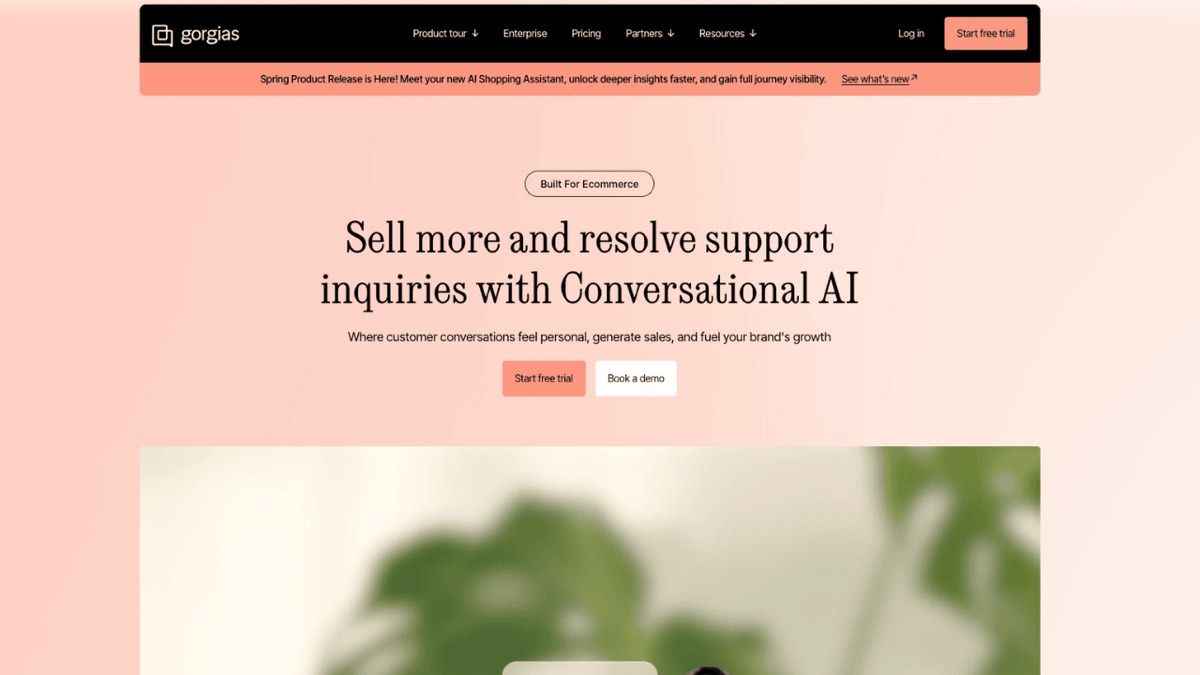
Gorgias was built for ecommerce from day one, and you feel it the moment you open a ticket. The customer's Shopify order history, subscription status, and past conversations sit right next to the message, so a rep answers "where's my order" without leaving the screen. It's the most Shopify-native helpdesk of the two by a wide margin.
That focus shows up in the automation too. Gorgias AI Agent handles chat and email, runs Flows for multi-step questions, and offers self-serve order status. It's good at the routine ecommerce ticket. It's less good than the marketing suggests, which we'll get to.
Pricing
| Plan | Monthly | Annual | Tickets/mo | Overage |
|---|---|---|---|---|
| Starter | $10 | n/a | 50 | $0.40/ticket |
| Basic | $60 | $50 | 300 | $40/100 tickets |
| Pro | $360 | $300 | 2,000 | $36/100 tickets |
| Advanced | $900 | $750 | 5,000 | $36/100 tickets |
| Enterprise | Custom | Custom | 5,000+ | $32/100 tickets |
Gorgias bills on conversations, not agents, so you get unlimited seats (up to 500). AI Agent costs $1.00 per resolved conversation monthly, $0.90 annual. The catch worth circling: an AI resolution counts toward both your AI usage and your ticket limit, so the same conversation can bill twice (myAskAI's 2026 breakdown documents this clearly).
What works
- Native Shopify context. Order, customer, and subscription data live in the ticket. No tab-switching, no connector to babysit.
- Unlimited seats. Add reps without adding to the bill. Pricing scales with conversations, which suits a lean team handling heavy volume.
- Strong social and chat. Email, chat, SMS, Facebook, Instagram, X, and WhatsApp in one inbox.
- Ecommerce-tuned macros. Refund, reorder, and WISMO templates that actually know your store.
What doesn't
- Per-ticket billing climbs with volume. A launch, a viral moment, or a returns spike pushes you into overage fast. Growth costs you on the line item that should reward it.
- AI underdelivers vs marketing. Gorgias markets "up to 60%" automation; published case studies show 26%, 30%, and 56% in real deployments, with one documented customer at 26% (myAskAI). The AI also only reads your last 10 customer orders.
- No phone. Gorgias answers text. It does not pick up the phone with AI.
Why it fits ecommerce
If you're a Shopify DTC brand living in email, chat, and social, Gorgias is the stronger native fit and it isn't close. It earns its 4.6/5 on Capterra across roughly 133 reviews. Just go in clear-eyed on the per-ticket math and the AI's real automation rate. If Gorgias isn't quite right, our Gorgias vs Richpanel and Intercom vs Gorgias breakdowns go deeper.
HappyFox: the multi-department help desk
2. HappyFox
Best for: mid-market teams running support across more than one department who want predictable per-agent cost, strong SLAs, and a clean UI.
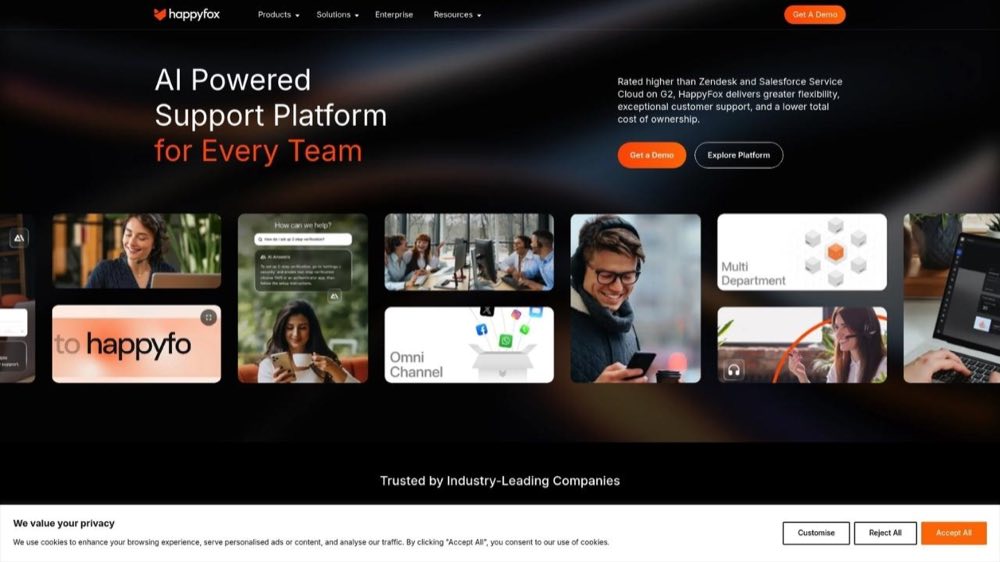
HappyFox isn't an ecommerce tool, and it doesn't pretend to be. It's a general-purpose help desk that handles customer support, IT, HR, and facilities under one roof, which is exactly why some teams pick it. If your support team and your IT team and your ops team all need tickets, one HappyFox setup covers all three.
The thing people consistently praise is how little training it takes. Reviewers rate it 9.2/10 for ease of use on G2, with support quality close behind. Onboarding is quick, the SLA management is solid, and the inbox is clean. It connects to Shopify, WooCommerce, and BigCommerce so reps can see an order and create a ticket without tab-hopping. But Shopify is a connector here, not the center of gravity, and there's no built-in CRM.
Pricing
| Plan | Price | Notes |
|---|---|---|
| Basic | $24/agent/mo | unlimited tickets, SLA, KB, SSO |
| Team | $49/agent/mo | + multi-brand, custom roles, 24/5 support |
| Pro | $99/agent/mo | + task and asset management, 24/7 support |
| Enterprise Pro | Contact sales | + agent scripting, 2TB storage |
| Growth (unlimited agents) | $1,999/mo | 150,000 tickets/yr |
| Scale (unlimited agents) | $3,999/mo | 200,000 tickets/yr |
HappyFox bills per agent with unlimited tickets, so a busy month never triggers overage. For big teams it also offers unlimited-agent tiers from $1,999 to $5,999/mo (desk365's 2026 pricing breakdown lays out all of them). There's no free plan, just a 14-day trial, and the unlimited-agent tiers usually want an annual commitment.
What works
- Predictable per-agent cost. Unlimited tickets means no bill shock when volume spikes. You know the number.
- Multi-department. One platform for support, IT, HR, and facilities. Useful if CS isn't your only ticket queue.
- Easy to learn. The 9.2/10 ease-of-use score is real. New reps get productive fast.
- Strong SLA and reporting. Built for teams that manage to service levels, not just inbox zero.
What doesn't
- Not ecommerce-native. Shopify is an integration, not the design. No built-in CRM means you lean on other tools for full customer history.
- Unlimited-agent tiers get pricey. Crossing into $1,999-$5,999/mo plus an annual commitment is a real jump, and the best features sit on the upper per-agent tiers.
- No phone. Same gap as Gorgias. HappyFox routes text, not AI phone calls.
Why it fits broad teams
HappyFox wins when support is one of several queues you run and predictable cost matters more than ecommerce-native depth. For a pure Shopify DTC brand, it's the more generic of the two. For a brand running CS, IT, and HR off one platform, it's the more sensible one.
Pricing: per-ticket vs per-agent, and what it costs at volume
The pricing models aren't a footnote. They're the decision. Gorgias bills you for conversations; HappyFox bills you for people. The right answer depends entirely on whether your volume or your headcount grows faster.
Run the same scenario through both and the gap is obvious. At 5,000 tickets a month with 5 agents, Gorgias lands around $1,500/mo while HappyFox on the Pro plan runs about $495/mo (eesel's comparison does this math). Stretch it to 10 users for a year and the spread widens: roughly $44,376 on Gorgias against $28,560 on HappyFox (crisp's breakdown).
So HappyFox is cheaper at volume? Not always. The model cuts both ways:
- Per-ticket (Gorgias) wins when you have a small team handling moderate volume. Unlimited seats, pay for conversations. A 3-rep team on Pro is efficient.
- Per-agent (HappyFox) wins when you have steady volume and want the number locked. A busy launch month doesn't move your bill at all.
- Per-ticket hurts when volume is spiky and growing. Every viral moment and every returns wave is an overage line.
- Per-agent hurts when you keep adding reps to keep up. Each hire is another full seat, every month.
Here's the part both models share, and it's the expensive part. Neither price tag includes the phone.
The channel both miss: your phone
Every comparison of these two argues about email, chat, and social. None of them mention the channel that's quietly costing you the most. Whichever helpdesk you pick, your phone still rings, and after 6 p.m. it still goes to voicemail.
For a $10M-$100M Shopify brand, that's not a small leak. WISMO ("where's my order") is 30-40% of support tickets and over 50% at peak (Salesforce), and a real share of those customers would rather call than type. Higher-AOV stores feel it hardest: at a $250 average order value, 12-18% of orders generate a phone call, versus about 3% at a $40 AOV. Those calls come in after hours, on weekends, during the launch you weren't staffed for. They hit voicemail, and a chunk of those callers just buy somewhere else.
HappyFox and Gorgias don't solve this because they weren't built to. They're text tools. The phone is a separate problem, and most brands "solve" it by hiring, which is the most expensive way to answer a routine question.
Run the math on the hire-your-way-out approach:
| Line item | Today | With an AI phone layer |
|---|---|---|
| 6 reps × $4K loaded per rep | $24,000/mo | n/a |
| AI phone support (~$5K/mo) | n/a | $5,000/mo |
| Net monthly phone-CS spend | $24,000/mo | $5,000/mo |
| Monthly savings | n/a | $19,000/mo |
| Annual savings | n/a | $228,000/yr |
That's roughly 70% of repeatable calls (order status, returns, the same five questions over and over) handled without a human. The genuinely hard calls still go to your team, who now have time to actually solve them.
Ringly.io: the AI phone layer on top of your helpdesk
Ringly.io is AI phone support for Shopify brands. It isn't a third helpdesk to evaluate. It's the layer that handles the calls HappyFox and Gorgias were never built to answer, and it sits in front of whichever one you pick.
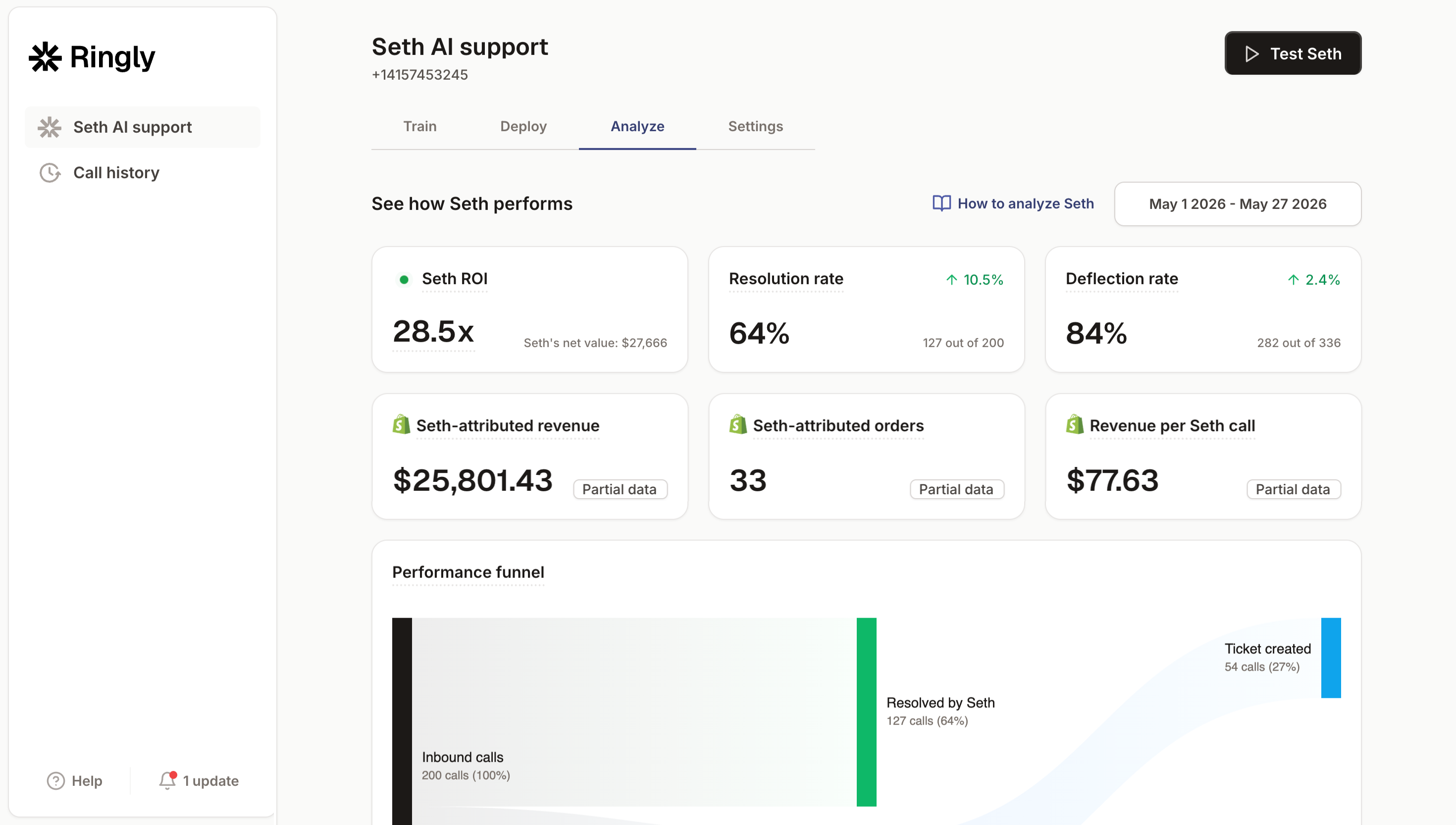
The AI answers inbound calls 24/7. It checks order status in your Shopify store, processes returns and exchanges, and answers product questions from your knowledge base. Across 50+ brands it resolves 73% of calls on its own at roughly $0.42 per resolved call. Calls that need a person escalate cleanly to Gorgias, Richpanel, Reamaze, or whatever helpdesk you already run, so you keep your stack and just stop losing the phone.
WashCo, a Shopify brand we launched, recovered $22,664 in its first 7 days on the phone. And the most repeated thing customers say after a call is the one that matters most for a brand that cares about voice.
"My customers also feel like it's a normal person. They feel like they can communicate if they have questions."
Claudia Droge, TechCraft Studio
If you're picking between HappyFox and Gorgias, book a 30-min call and we'll review your missed calls live, then map how the phone layer sits on top of whichever helpdesk you choose.
How to choose between HappyFox and Gorgias
The decision comes down to what kind of team you are, not which tool is "better." Pick by shape: ecommerce specialist or multi-department generalist.
Choose Gorgias if:
- You're a Shopify DTC brand and live in email, chat, and social
- You want order and customer context inside every ticket
- You have a lean team and moderate volume that suits per-ticket billing
- Ecommerce-native automation matters more than multi-department breadth
Choose HappyFox if:
- You run support across more than one department (CS plus IT plus HR)
- You want predictable per-agent cost with no overage surprises
- SLA management and a clean, low-training UI are priorities
- You'd rather not bet on per-ticket pricing during growth
And whichever you pick, add the phone layer. Your helpdesk handles the typing. Something has to handle the ringing, or you keep paying for it in missed calls and WISMO you never see. For more on running customer service for Shopify across channels, we've broken down the full picture, including how an ecommerce call center fits a DTC stack and what to look for in a Shopify helpdesk app.
Frequently asked questions
Is Gorgias or HappyFox better for a Shopify store? Gorgias, in most cases. It's built for ecommerce, with Shopify order data inside every ticket and automation tuned for store workflows. HappyFox is the better pick only if you run support across multiple departments and want predictable per-agent pricing.
Why is Gorgias more expensive than HappyFox at high volume? Gorgias bills per ticket (conversation), so cost climbs as volume grows, and overage kicks in past your plan limit. HappyFox bills per agent with unlimited tickets, so a busy month doesn't change the price. At 5,000 tickets with 5 agents, Gorgias runs around $1,500/mo versus roughly $495 on HappyFox Pro.
Does HappyFox integrate with Shopify? Yes, through a connector that pulls order data and lets reps create tickets from Shopify. But it's an integration, not native design, and HappyFox has no built-in CRM. Gorgias keeps that context inside the ticket by default.
How good is Gorgias AI automation really? Gorgias markets "up to 60%" automation, but published case studies show 26% to 56% in real deployments, with one documented customer at 26%. Its AI also only reads your last 10 customer orders, which limits how much context it can use.
Can HappyFox or Gorgias answer phone calls? Neither answers phone calls with AI. Both are text-first tools built for email, chat, and social. Inbound phone, especially after-hours, is a gap you'd cover separately with an AI phone agent like Ringly.
Do I have to replace my helpdesk to add AI phone support? No. Ringly sits in front of your existing helpdesk and handles inbound calls, then escalates anything complex to Gorgias, HappyFox, Richpanel, or whatever you run. You keep your stack and add the channel neither helpdesk covers.
Which has better reviews, HappyFox or Gorgias? Both review well in their lanes. Gorgias holds 4.6/5 on Capterra across about 133 reviews, strong for an ecommerce helpdesk. HappyFox scores 9.2/10 for ease of use on G2, reflecting its reputation as the easier tool to learn.
Talk to us

If you run a $10M-$100M Shopify brand and you're choosing a helpdesk, the helpdesk is only half the decision. The phone is the other half, and it's the half that's quietly leaking revenue after-hours. A 30-min call is the fastest way to see what your store is losing on the line, and how the phone layer sits on top of HappyFox or Gorgias.
The 3-layer guarantee.
- Live in 14 days or it's free until launched.
- 65% resolution in 90 days or we refund the last 3 months of subscription fees.
- We keep working free until we hit 65%.
Ruben (Ringly co-founder) takes these calls personally.