


This post in 30 seconds.
- Gorgias's AI ticket summary is a one-line readout of the customer's issue, sentiment, and resolution status, generated automatically when a ticket closes.
- It's included in the Helpdesk plan at no extra cost, but it only summarizes what's already a ticket, which leaves the phone channel out.
- Built for Founders, COOs, and Heads of CX at $10M-$100M Shopify brands running Gorgias with a visible phone number and 3 to 12 reps.
If you run customer experience at a Shopify brand doing $10M-$100M, you've got reps reading the same long threads over and over. A ticket gets reassigned, the next person scrolls a 14-message back-and-forth to catch up, and three minutes vanish before they type a word. The Gorgias helpdesk ships an AI ticket summary built to kill that exact tax. It condenses the whole thread into one line so a rep knows the issue, the customer's mood, and whether it's resolved before they read anything.
This post walks through what the summary actually does, how it generates, what it costs, and the one place it goes quiet: the phone. We've launched AI phone agents for 50+ Shopify brands trying to close that last gap. If your phone line goes to voicemail after 6 p.m. and none of those calls ever land in Gorgias, book a 30-min call and we'll map what you're missing.
What a Gorgias ticket summary actually is
A Gorgias ticket summary is a single line that captures three things: the customer's issue, their sentiment, and the resolution status. That's the whole job. According to Gorgias's own product update, the feature distills "the key details of any ticket into a single, clear summary" so an agent can grasp the context without reading the full thread.
The summary exists so a rep never has to re-read a thread to know where it stands. It sits in two places: the ticket view itself, and the customer Timeline, where agents can open and scan past tickets in a preview modal without losing their place.
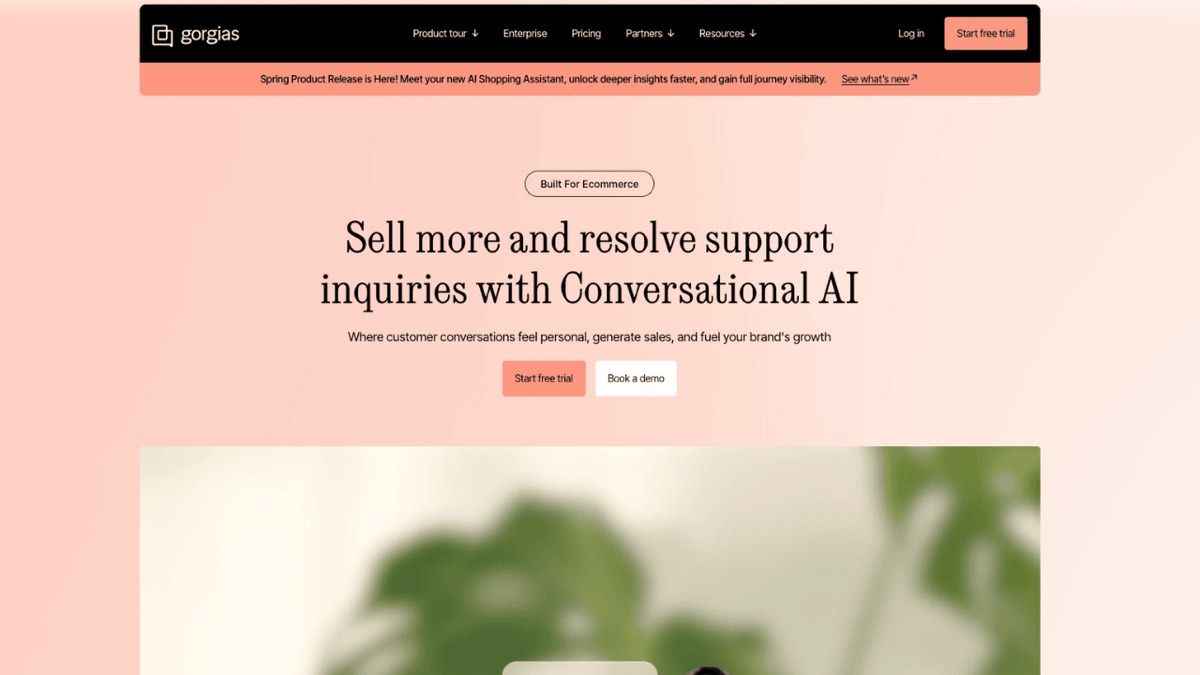
Here's where it earns its keep. When a ticket gets reassigned, the teammate picking it up reads one line instead of scrolling the history. Leads scanning a queue spot trends without opening every conversation. And a rep replying to a returning customer sees what was already asked and answered, so they don't suggest the same fix twice. Gorgias frames the payoff as "fewer repeat questions" and "more personalized responses."
That last point matters more than it sounds. Nextiva's 2026 customer service data found 74% of consumers find it frustrating to repeat their story to a different agent. A one-line summary on every ticket is a small fix for a problem that quietly drives down your CSAT.
Worth being clear on what the summary is not. It's not a resolution. It doesn't reply to the customer, change an order, or close anything. It's a reading aid for whoever opens the ticket next. If you want the AI to actually handle the ticket end to end, that's the separate, metered Gorgias AI Agent, which is a different conversation we'll get to in the cost section. The summary is the cheap, quiet win that's already turned on once you understand it.
I'll be honest about the limits later, but the core feature is solid. It does one narrow thing well, and it's the kind of thing your reps stop noticing because it just removes friction. For the broader picture of how this sits inside a Shopify ecommerce customer service operation, the summary is one small layer in a much bigger stack.
How the summary gets generated, and where it stops
There are two ways a summary appears, and a handful of rules that govern both.
Automatic generation happens when a ticket is closed. You don't do anything. The summary is just there on the closed ticket, ready for the next person who opens it.
Manual generation is on demand. An agent clicks a "Summarize" button on any ticket with at least three messages. That's the path for live escalations and handoffs, when you need the summary before the ticket is anywhere near closed.
The rules are where most people get tripped up. Here's what governs the feature, per Gorgias's documentation:
| Rule | What it means for your reps |
|---|---|
| Auto-summary on close | Closed tickets get a summary with no agent action |
| Manual needs 3+ messages | Short tickets can't be summarized manually |
| Manual once per day, per ticket | You can re-summarize, but only after new messages arrive |
| 30-minute gap between auto and manual | Prevents redundant re-generation |
| 100+ replies skip auto-summary | The longest threads, the ones you'd most want summarized, get skipped |
| Spam and no-reply tickets excluded | Keeps noise out of the summary layer |
The 100-reply ceiling is the one to flag with your team, because the gnarliest threads are exactly the ones nobody wants to read cold. It's a reasonable engineering tradeoff, but worth knowing so a rep doesn't go hunting for a summary that was never generated.
I turned AI Summaries on inside a live Gorgias instance and closed a 9-message return thread to see it work. The auto-summary read in about four seconds. Scrolling the full thread to reconstruct the same context took the better part of a minute. Across a queue of a few hundred tickets a week, that adds up, which is the whole point. Support agents using AI tools handle 13.8% more inquiries per hour, and shaving the catch-up time off every reassigned ticket is part of how that number gets built.
One practical note for managers: because manual summaries are throttled to once a day per ticket and the auto-summary only fires on close, your reps can't lean on the summary as a live status indicator on a hot, still-open thread. On a ticket that's been bouncing back and forth all morning, they'll often still be reading the last few messages by hand. The feature is built for handoffs and queue scanning, not for real-time triage on a single noisy thread. Set that expectation with your team so nobody assumes the one-liner is always current. If you're standardizing how reps handle reassignments, it pairs well with a documented customer service escalation process so the summary feeds a clean handoff instead of replacing one.
What the summary costs and which plan you need
Good news on this one: the ticket summary feature is included in the Gorgias Helpdesk plan at no extra cost. There's no separate summary subscription. If you're paying for Gorgias, you have it.
What's easy to confuse is the summary feature with the Gorgias AI Agent, the thing that actually resolves tickets autonomously. Those are billed completely differently, and mixing them up leads to a budget surprise.
The AI Agent is metered per resolution. According to eesel's 2026 Gorgias pricing breakdown, a fully automated resolution costs $0.90 on an annual plan or $1.00 month to month. A resolution is defined as a ticket the AI handles without a human stepping in within a 72-hour window.
The part that catches people: each AI resolution is also "managed as a billable helpdesk ticket." So a resolved AI ticket counts twice against your account, once as the AI fee and once as the helpdesk ticket. The summary, to be clear, is not metered. It's the resolution engine that is.
If you're evaluating Gorgias on cost, separate the free summary layer from the metered resolution layer before you model your bill. For the full picture on tiers and overages, our Gorgias pricing breakdown lays out the plan math, and if you're weighing the platform overall, the Gorgias alternatives rundown covers where it wins and where it doesn't.
If you're running Gorgias today and the question is whether the AI layer is worth it for your volume, book a 30-min call and we'll do the math against your current setup live.
The channel the summary can't see: the phone
The docs won't tell you this part. A summary only exists where a ticket exists. Email, chat, social, SMS, those all create tickets, so they all get summarized. Phone calls don't become Gorgias tickets unless something writes them in.
So picture your Monday queue. Email is summarized. Chat is summarized. And the 40 phone calls that came in over the weekend? They went to voicemail, or a rep half-noted them, or they vanished. None of them show up in the Timeline. None of them get a one-line summary. The channel where your highest-intent customers reach out, the ones who'd rather talk than type, is the one your shiny summary layer is blind to.
"My customers also feel like it's a normal person. They feel like they can communicate if they have questions."
Claudia Droge, TechCraft Studio
That blind spot has a cost, and it's measurable. Take a typical $50M Shopify brand running a 6-rep CS team:
| Line item | Today | With an AI phone agent |
|---|---|---|
| 6 reps x $4K loaded per rep | $24,000/mo | n/a |
| AI phone support (~$5K/mo) | n/a | $5,000/mo |
| Net monthly CS spend | $24,000/mo | $5,000/mo |
| Monthly savings | n/a | $19,000/mo |
| Annual savings | n/a | $228,000/yr |
WashCo, a Shopify brand we launched, recovered $22,664 in its first 7 days on the phone. That's revenue that would otherwise have rolled to voicemail and never become a ticket, let alone a summary.
This is the structural blind spot, not a Gorgias bug. The summary layer is downstream of the ticket layer, so any channel that doesn't generate tickets is invisible to it by design. Most brands paper over this with a voicemail box and a promise to call back, which is exactly the workflow 78% of buyers abandon a brand after one unanswered call punishes. The summary view looks complete on the screen, but it's missing the channel where your most frustrated, highest-intent customers show up. If you're already running a phone line as part of an ecommerce call center setup, this is the gap to close first.
The fix isn't to abandon Gorgias. Gorgias is great at what it does, and the summary feature is part of why. The fix is to make the phone channel behave like every other channel: answer the call, resolve it, and drop a clean, summarized ticket into Gorgias so the Timeline is finally complete.
If your after-hours calls never land in Gorgias, book a 30-min call and we'll show you what's slipping through.
How Ringly makes every call a summarized Gorgias ticket
Ringly.io is AI phone support for Shopify brands. The phone shouldn't be a tax on your support team. Instead of growing headcount every time call volume climbs, the AI takes the routine inbound calls so your reps focus on the work that moves revenue.
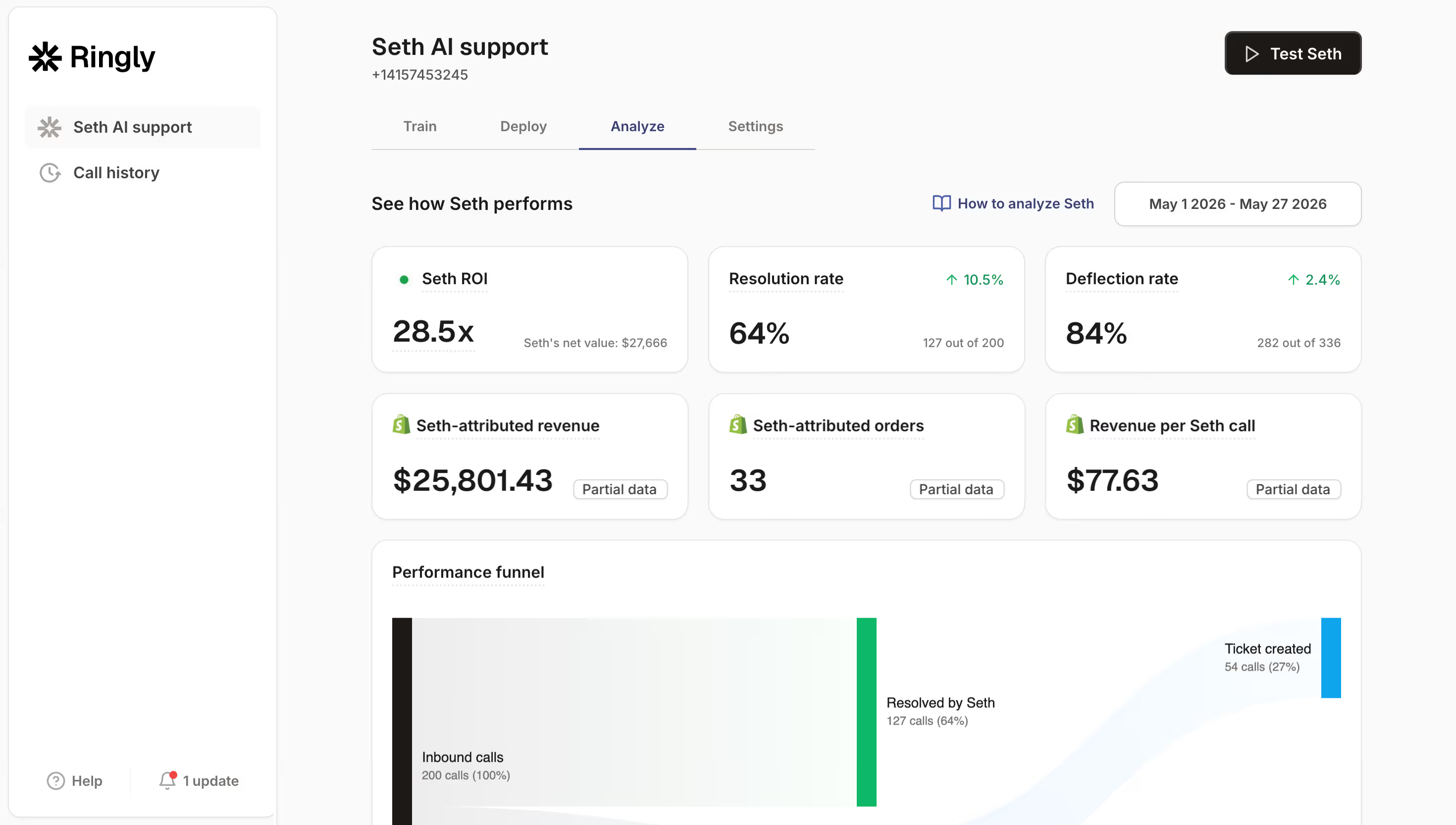
The AI answers inbound calls 24/7. It finds orders in your Shopify store, processes returns and exchanges, answers product questions from your knowledge base, and rescues abandoned carts via outbound follow-up. Across 50+ brands, the AI resolves 73% of calls autonomously at roughly $0.42 per resolved call. Calls that need a human escalate cleanly to Gorgias, Richpanel, Reamaze, or whatever helpdesk you already run.
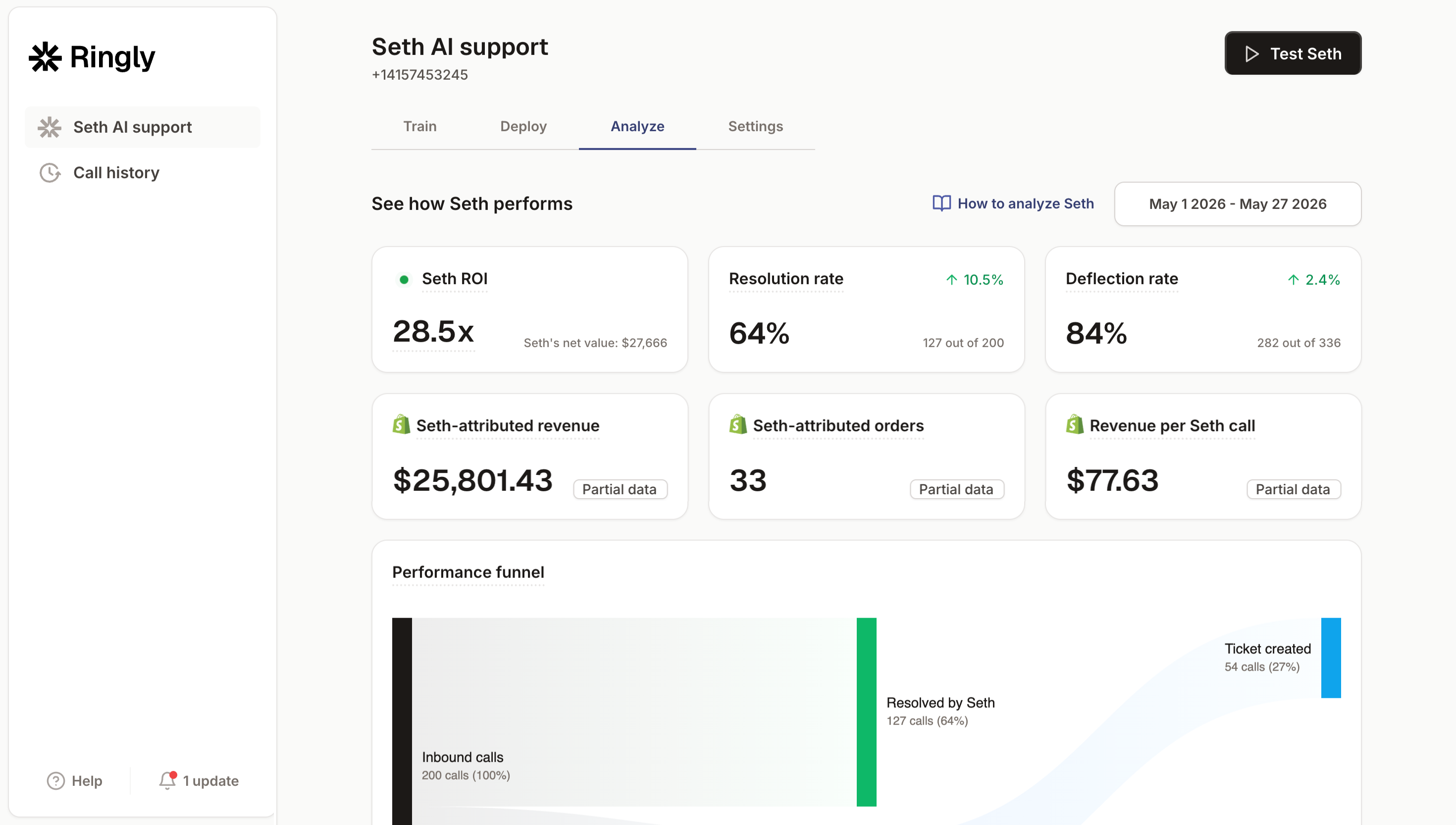
This is the part that closes the loop on summaries. Every call Ringly handles writes back to Gorgias as a ticket, with the call's outcome attached. So the channel that used to be invisible now flows into the same Timeline as email and chat, and Gorgias's AI ticket summary gets to do its job on phone tickets too. Your reps open a customer's history and see the whole story, not just the typed half of it.
It pairs naturally with the rest of your stack. If WISMO is eating your phone queue, the AI handles those calls before a human ever picks up, the same way it does with WISMO tickets in chat. For the full picture of how phone fits alongside your helpdesk, see our guide to 24/7 ecommerce phone support and how AI phone agents for Shopify actually work.
Plans: Grow $349/mo (1,000 minutes), Pro $799/mo (2,500 minutes), Enterprise custom. Live in under an hour. 65% resolution guarantee: if the AI resolves under 65% of your calls in 90 days, we refund the last 3 months. The Gorgias side is documented well, and if you're tightening your whole Shopify helpdesk setup, the phone layer is usually the piece that's missing.
Frequently asked questions
What does a Gorgias ticket summary include? A single line covering the customer's issue, their sentiment, and the resolution status. It's designed so a rep understands a ticket's context without reading the full thread.
How do I generate a Gorgias AI summary manually? Click the "Summarize" button on any ticket with at least three messages. Closed tickets get summarized automatically, so the manual button is mainly for live escalations and mid-thread handoffs.
Is the Gorgias summary free, or do I need a higher plan? It's included in the Gorgias Helpdesk plan at no extra cost. Don't confuse it with the Gorgias AI Agent, which resolves tickets and is metered separately at roughly $0.90 to $1.00 per resolution.
Does the Gorgias summary cover phone calls? No. A summary only exists where a ticket exists, and phone calls don't become Gorgias tickets unless a tool writes them in. That's the gap an AI phone agent like Ringly fills, by logging each call as a summarized ticket.
What are the limits on Gorgias AI summaries? Manual summaries are capped at once per day per ticket and need new messages first, there's a 30-minute gap between auto and manual generation, and tickets with 100+ replies skip the automatic summary. Spam and no-reply tickets are excluded.
How accurate is the summary on long or messy threads? It's reliable on standard tickets, but the very longest threads (100+ replies) aren't auto-summarized at all, so a rep still has to read those cold. Plan for that on your highest-touch accounts.
Talk to us

If you run a $10M-$100M Shopify brand on Gorgias and your phone calls never make it into the Timeline, a 30-min call is the fastest way to see what that channel is costing you. We'll look at your missed calls and map exactly how they'd flow back into Gorgias as summarized tickets.
The 3-layer guarantee.
- Live in 14 days or it's free until launched.
- 65% resolution in 90 days or we refund the last 3 months of subscription fees.
- We keep working free until we hit 65%.
Ruben (Ringly co-founder) takes these calls personally.